
Lucy Freeman Sandler • New York University
Recommended citation: Lucy Freeman Sandler, “The Candlemas Procession in the Bedford Hours and Processions in Medieval Paris,” Different Visions: New Perspectives on Medieval Art 13 (2026). https://doi.org/10.61302/IMWD9562.
In memory of Elizabeth A. R. Brown
Introduction
The phrase “social sculpture” in the title of this volume of Different Visions is associated with the theories of the post-World War II German artist Joseph Beuys concerning the form, facture, purposes, and effects of art. To Beuys, and numerous artists since, art is not limited in media to conventional forms—sculpture, painting, architecture––but is understood as social action, a social action that changes, or sculpts society, eliciting responses that are beyond the conventional aesthetic, emotional, or intellectual. In studying a period of the past, the Middle Ages, for example, one way this concept may be used is to analyze how works of medieval art depicted acts of social sculpture—rituals, performances, processions, for example—and the way such representations impacted, changed, in other words, produced social actions on the part of the viewers. Since the study of the past is never disengaged from viewpoints of the present, the concept of social sculpture might also be used to consider the impact of works of medieval art on present-day viewers, including the present scholar. The essay that follows, which concerns medieval manuscript representations of processions—a form of social action, or social sculpture—is the result of this effort.
Medieval Processions and their Textual and Visual Documentation
Processions were an integral part of medieval life experience.[1] Rulers led processions as they entered cities or celebrated victories; funerals were occasions of processions; the bodies or relics of saints were carried in public processions; processions were held to beg for relief from plague or drought, or in thanksgiving for relief therefrom; and processions within and around churches or from one church to another took place on important feast days and at every Sunday mass. Active participants in processions came from all stations of society, lay and clerical, as did the spectators.
Documentation of medieval processions comes from historical accounts, from contemporary records, from manuals containing instructions for conduct of religious ceremonies, and from liturgical texts themselves. But the available documentation is also visual, since representations of processions are abundant in medieval art. Such representations depict not only contemporary ceremonies but also those of the past—biblical, ancient pagan, and Christian. It must be stressed however that processions depicted in medieval art are idealized images whose components and compositions respond to demands of function, purpose, patronage, context, and traditions of representation. Taking into account then the complex relationship between any medieval visual representation of social practice and “real life,” what is the truth value of images of processions? The purpose of this essay is to consider this question by focusing on the early fifteenth-century representation of a Candlemas procession in the celebrated Parisian manuscript known as the Bedford Hours (Fig. 1).
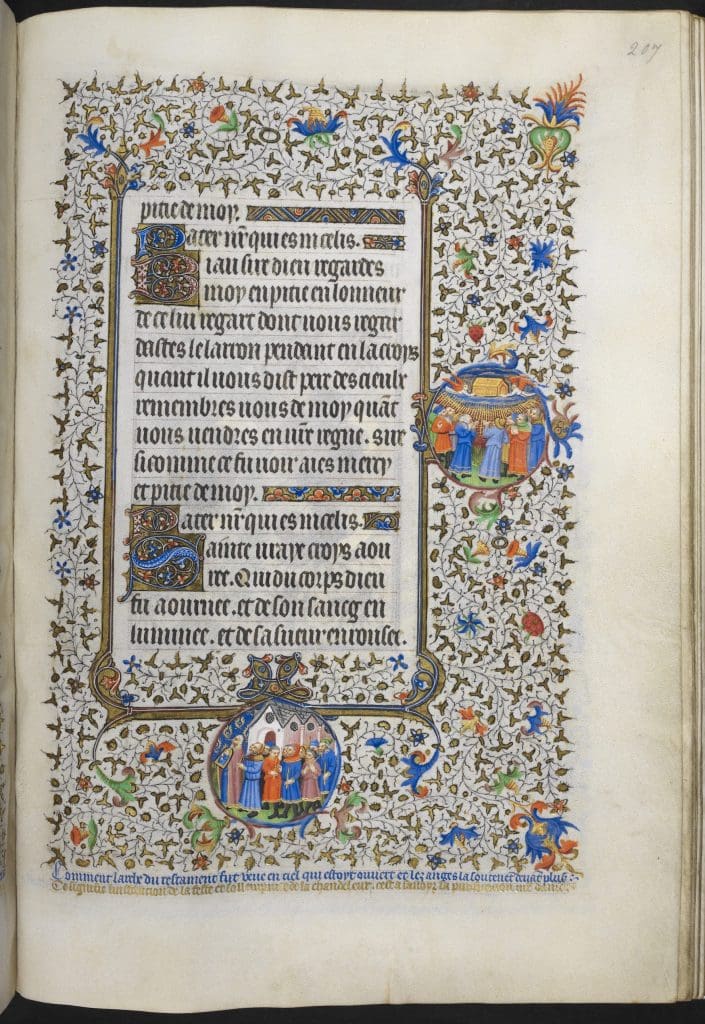
Fig. 1. Bedford Hours, Paris. ca. 1415-30. London, British Library Add. MS 18850, fol. 207.
The Bedford Hours and Its Image of a Candlemas Procession
The Bedford Hours was produced in Paris between ca. 1410 and 1430, and owned, if not begun for John Duke of Bedford, regent of France (d. 1435), and his wife Anne of Burgundy (d. 1432). On Christmas Eve 1430, with the permission of her husband, Anne presented the book to the young English king Henry VI, who was awaiting his coronation as King of France in the city of Rouen.[2] The manuscript includes calendar illustrations, large miniatures at each of the main divisions of the text, and a number of additional full-page miniatures, among them the portraits of Anne and John, almost all further enriched with figural medallions in the decorative borders. In addition, there are more than 1,200 small figural medallions in the decorated borders of the text pages, arranged for the most part in pairs. The subjects are organized in multiple series, the longest of which is an unparalleled cycle correlating some 450 events of the New Testament with an equal number of typological subjects based on the Old Testament (Gospels, Acts and Epistles) and interpretative moralizations (Apocalypse).[3] Gold and blue captions in French identifying the pictorial subjects were introduced on each page.[4]
The illustration of a Candlemas procession in the manuscript (Fig. 2) is paired with a pictorial subject based on Apocalypse 11.19: “And the temple of God was opened in heaven: and the ark of the testament [covenant]was seen in his temple.” (Fig. 3).[5] The Apocalypse image is described in the caption: “Comment larche du testament fut veue en ciel qui estoyt ouvert et lez anges la soutene[n]t deva[n]t plus[ieurs]” (How the ark of the testament was seen in [the temple in] heaven, which was opened, and the angels support it in the sight of many people).[6] The composition shows a group of people looking up toward two angels in heaven who support a gold reliquary-shaped ark from which golden rays descend. The caption of the paired Candlemas scene interprets the Apocalypse subject historically: “Ce signifie linstitution de la feste et sollempnite de la chandeleur. cest a savoyr la purification n[ost]re dame” (This signifies the institution of the feast and solemn celebration of Candlemas, that is to say the Purification of Our Lady). The medallion (Fig. 2) depicts the “solemn celebration” as a procession of laymen in contemporary dress holding lit candles as they move from right to left in front of a building with a round arched entrance doorway, multiple gables, circular windows and exterior colonettes. The procession is led by a priestly figure wearing a mantle, his head veiled. He carries a round-topped painted panel showing the half-length Virgin Mary with hands raised in intercession.
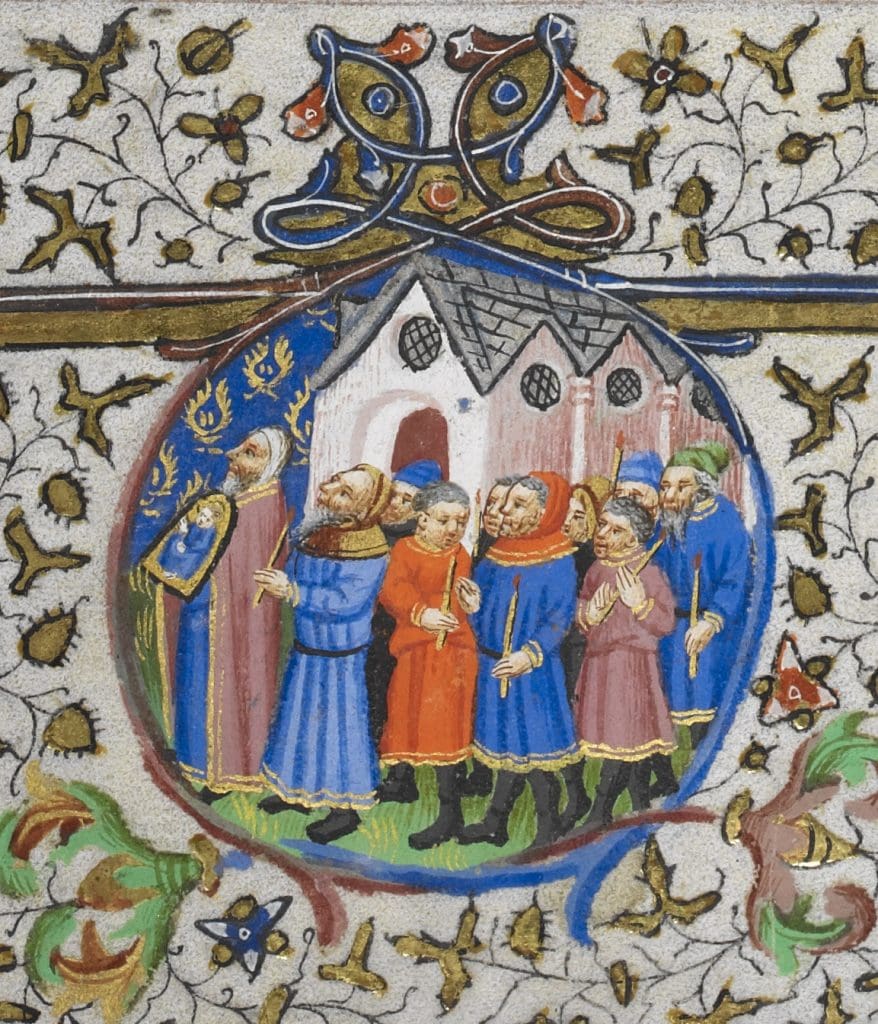
Fig. 2. Candlemas procession. Bedford Hours, Paris, ca. 1415-30. London, British Library Add.MS 18850, fol. 207, detail.
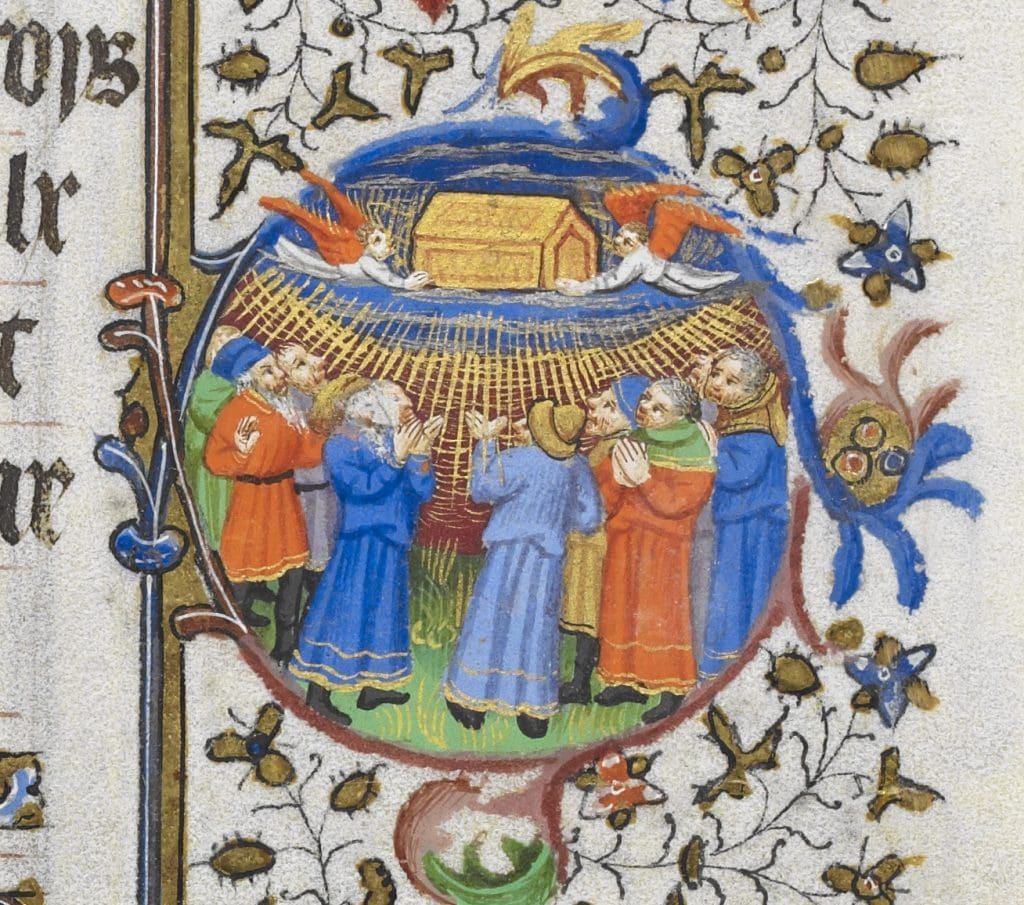
Fig. 3. Temple opened in heaven with ark of the covenant. Bedford Hours, Paris, ca. 1415-30. London, British Library Add. MS 18850, fol. 207, detail.
The Candlemas procession image offers challenges worthy of further investigation: What were the sources—pictorial, textual, and societal—of the artist’s pictorial imagery? How does the image compare in concept, function and composition with other known depictions of Candlemas processions? How is it related to actual Candlemas processions of the period? To the degree that the Candlemas procession in the Bedford Hours both reflects social performance and creates social responses, ethical, moral and spiritual, if not outright political, it may be understood as an exemplar of the concept of “medieval social sculpture.”
Candlemas, the Feast of the Purification of the Virgin/Presentation of Christ in the Temple
February 2, “Candlemas,” was one of the major feast-days of the Church, marking the celebration of the Purification of the Virgin/Presentation of Christ in the Temple.[7] In the course of the Middle Ages multiple names were given to the feast—Hypapante (Simeon’s meeting with the Lord), Presentation of Christ in the Temple, Purification of the Virgin, and in English, Candlemas, French, Chandeleur, or German, Lichtmess. An essential element of the liturgical celebration was a procession before mass, either into or within the church, or from one church to another, in which the participants carried candles.[8] While not mentioned specifically in the Gospels, candles were understood to refer symbolically to Christ as the “light of the world.”[9] They were to be carried in honor of the purity of the Virgin, as wise virgins carried them to bridegroom in the parable of Matthew 25:1-13.[10]
Although candlelit processions on February 2 were common in religious practice, they were very rarely depicted in medieval representations of the Purification/Presentation. Texts such as Durandus’ Rationale divinorum officiorum describing religious ceremonies, including the celebration of the Purification/Presentation, while sometimes illustrated, did not include pictures of the Candlemas procession,[11] and representations of Candlemas processions are almost unknown in other types of manuscripts, or indeed, other forms of pictorial or sculptural imagery, even though images of processions for other feast days or other ceremonial occasions, such as saintly translations, funerals, imperial triumphs, or royal entries are common enough.[12] The illustration of a Candlemas procession in the Bedford Hours is a rarity.
Instead of representing Candlemas processions, medieval images referring to the feast of the Purification of the Virgin ordinarily showed the Presentation of Christ in the Temple. The scriptural basis was the passage in the Gospel of Luke (2:22-39) describing how the Virgin Mary and her spouse Joseph brought Jesus to the temple in Jerusalem “to present him to the Lord” according to the Mosaic law requiring the purification of women forty days after childbirth; there, Mary and Joseph offered a sacrifice of two turtledoves; the infant was received into the arms of the just and devout Simeon; and the prophetess Anna bore witness to the oblation. In medieval devotional and liturgical manuscripts, representations of the Presentation appeared either in prefatory cycles or as an illustration for the Hours of the Virgin, or the breviary office, or the mass of the Purification/Presentation. Often the compositional format is formal and centralized, focused on the infant Christ held like a sacrificial offering over the altar, either still in the arms of the Virgin, or received into the hands of the priest Simeon. Generally attendants are present on either side, in particular Joseph and Anna, one of whom offers sacrificial doves. One or more of the attendant figures also hold lit candles, visually evoking the words of Simeon after he has received Christ, “Because my eyes have seen thy salvation, Which thou hast prepared before the face of all peoples: A light to the revelation of the Gentiles, and the glory of thy people Israel” (Luke 2:30-32).[13] The Presentation of Christ in the Bedford Hours, a miniature at the beginning of None of the Hours of the Virgin, follows this general pattern (Fig. 4).
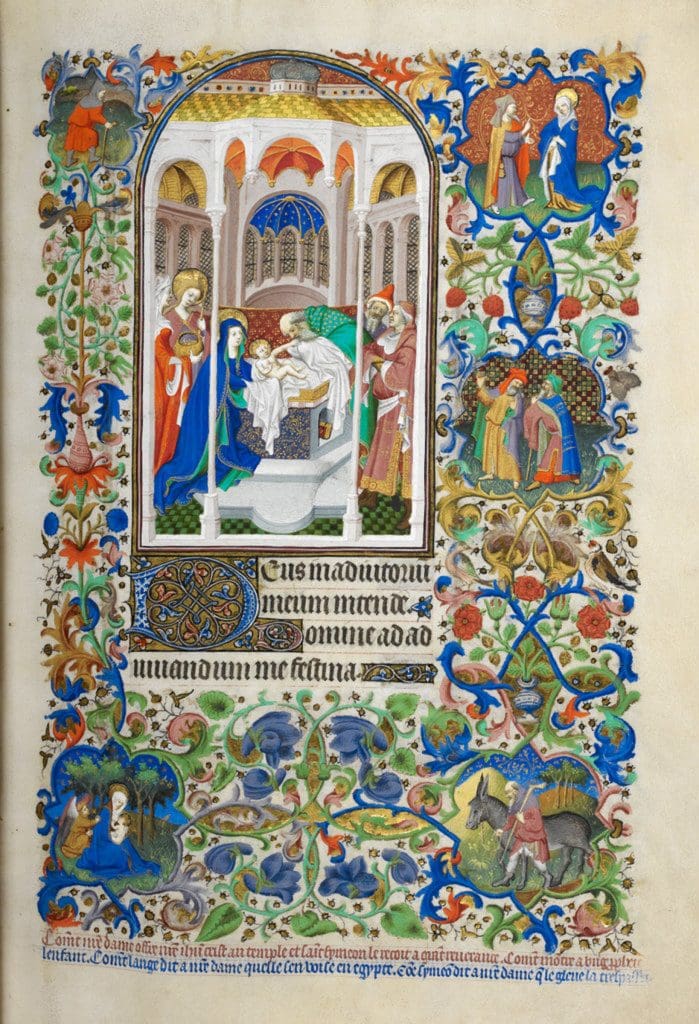
Fig. 4. Presentation of Christ in the Temple. Bedford Hours, Paris, ca. 1415. London, British Library Add. MS 18850, fol. 79.
The Textual and Pictorial Sources of the Bedford Hours Candlemas Procession
The descriptive and interpretative captions on the Bedford Hours page with the paired images of the Apocalyptic vision of the temple opened in heaven and the Candlemas procession offer no clue to the reason for the juxtaposition of the two scenes (Fig. 1). I believe however that the inspiration was an Apocalypse commentary based at least in part on Nicholas of Lyra’s widely circulated literal-historical Postilla literalis super totam Bibliam (1331) and his allegorical Postillla moralis (1339), or on a French translation of these works that does not survive.[14] In one section of his long exposition of the Apocalypse passage about the temple opened in heaven Nicholas wrote: “At that time [the rule of the Arian Goths in the sixth century] a great plague affected Constantinople, for which the feast of the purification of the Blessed Mary was instituted to be solemnly celebrated on February 2, when the Blessed Virgin presented her son in the temple, which is called the ‘ark of the covenant’ . . . . The plague ceased, and this is what is said, Then God’s temple in heaven was opened, That is, Christ, whose offering and presentation in the temple through St. Simeon and Anna the prophetess was memorialized in the Feast of Purification, which spread from Constantinople to other parts of the world.”[15] Nicholas was referring to a plague that devastated Constantinople in 541 during the reign of Justinian (527-565) and the subsequent imperial order for the celebration of the feast in gratitude to the Virgin for the end of the outbreak.[16]
Nicholas of Lyra’s attribution of a Byzantine origin to the rite of the Purification of the Virgin was generally accurate, although the feast is known to have been celebrated in Jerusalem as early as the end of the fourth century, coming to Constantinople only a century later, and reaching the West toward the end of the seventh century.[17] Justinian’s connection with the institution of the feast was twofold: during his rule the date of the celebration was changed from February 14, forty days after Epiphany (January 6), to February 2, forty days after the birth of Christ on December 25; and, more important, the feast was re-focused from Jesus to his mother, increasing the number of feasts already celebrated in Constantinople in honor of the Virgin Mary—the Annunciation, her birth, and her own presentation in the Temple.[18]
In treating the reign of Justinian Byzantine authors such as Theophanes (d. 818) noted the onset of the plague “and in the same year” the institution of the Purification on February 2.[19] In western Europe Justinian’s name was connected with the celebration by the early twelfth century, as for example in the universal chronicle of Hugh of Fleury (d. 1110).[20] Hugh’s account however differed in one significant respect from those of Byzantine authors. He said that because of the plague the feast of the Purification was instituted on February 2.[21] This causal link between the onset of the plague and the institution of the feast was preserved in chronicles widely circulated at the time of the production of the Bedford Hours, in particular, the Chronicon pontificum et imperatorum of Martinus Polonus (d. 1278), who wrote succinctly “Hic Iustinianus abbreviavit leges Romanorum. Huius temporibus facta est mortalitas apud Constantinopolim. Qua de causa instituta est sollempnitas purificacionis beate Marie que dicitur ypapanti Domino” (The said Justinian summarized the Roman laws. In his times there came a mortal illness [i.e., the plague] in Constantinople, on account of which the solemn celebration of the Purification of the blessed Mary, which is called the Meeting with the Lord, was instituted).[22] However, like Nicholas of Lyra, who was the ultimate source of the Bedford Hours caption, neither Martinus Polonus, nor Hugh of Fleury, nor later French chroniclers provided details about the actual liturgical ceremonies that were associated with the institution of the feast, in which a candlelit procession—as depicted in the Bedford image itself—was prominent.[23]
The Bedford designer’s idea of visualizing the “solemn celebration” of the feast of the Purification of the Virgin with the image of a procession had its textual roots, not in chronicles, but in the account of a miracle of the Virgin that was included in European collections that proliferated during the twelfth century, among them William of Malmesbury’s Miracula sanctae Mariae Virginis of 1136-39 and Adgar’s (William Trouvère’s) French verse Gracial of the second half of the century.[24] According to these miracle stories, the plague of 541 was provoked by Justinian’s fall into heresy, but when an image of the Virgin was carried in procession in Constantinople, wherever it went the plague subsided. In gratitude the repentant Justinian and the patriarch of Constantinople established the feast of the Purification, which had never been celebrated previously.[25] These accounts are much longer than those in the chronicles; they are graphic in their description of the plague; and they say specifically, in the words of William of Malmesbury, that “a remedy was thought up for these ills, a procession in the city accompanied by the image. It took place, and wherever the image went all illness fled away.”[26] The procession was important, but even more so was the image of the Virgin that was carried by the participants. It was the image that saved the city.
By the beginning of the fourteenth century the account of the procession of thanksgiving for the Marian miracle was incorporated into at least one vernacular universal chronicle, a richly illustrated work produced in the northern French diocese of Thérouanne (Fig. 5), now in the Pierpont Morgan Library and Museum.[27] Under the heading “Justinian the great” the entry records the same story as William of Malmesbury had, almost translating William’s words directly: “. . . sages gens penserent remede. Il furent procession od lymage nostre dame par la cite. Et par la ou lymage passa fui toute lenfermete.” (wise people thought of the remedy. They led a procession through the city with the image of Our Lady. And there where the image passed all illness fled). The illustration accompanying the chronicle entry on Justinian shows a procession of tonsured clerics in white vestments carrying a statue of the Virgin and Child on poles that rest on their shoulders. The color of the vestments accords with the regulations of Pope Innocent III (d. 1216) on the use of white in the liturgical observance of the Purification of the Virgin.[28] The artist visualized the word “ymage” as a three-dimensional sculpture, reflecting a common usage of the term in the Middle Ages. Although the text concerns a Marian procession in sixth-century Constantinople—the Byzantine East—the pictorial representation is entirely contemporary and “Western,” familiar from other manuscript images that include clerics and cult statues and from numerous surviving sculptural works themselves. And while the picture of the procession in the chronicle differs considerably in detail from that in the Bedford Hours, it provides some evidence that the idea of visualizing Justinian’s institution of the feast of the Purification/Presentation as a procession, and especially one that included an image of the Virgin, was not completely unprecedented.
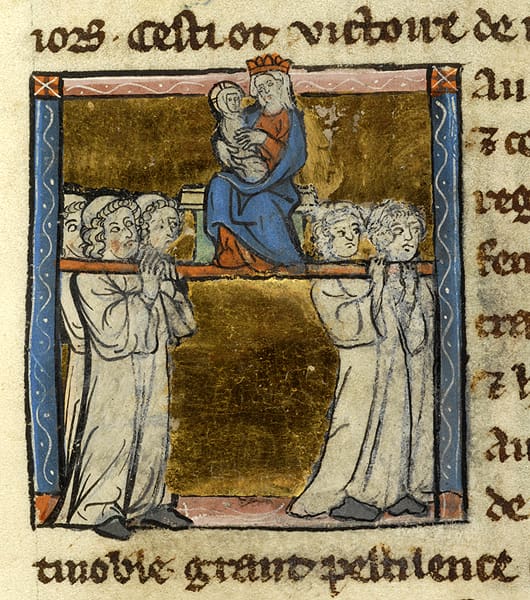
Fig. 5. Procession of clerics carrying image of Virgin and Child. Chronicle of universal history, northern France, ca. 1300. New York, Pierpont Morgan Library and Museum MS M.751, fol. 63, detail.
The Bedford Hours Candlemas Procession and Byzantium
Unlike the early fourteenth-century illuminator of the Morgan Library chronicle, the designer/artist of the Bedford Hours pictured the Purification procession with striking details that allude to the origin of the feast in Byzantium. Even the overall format of the composition, a candle-bearing file of figures parallel to the picture plane, is reminiscent of traditional Byzantine manuscript images of processions, such as those in the early eleventh-century Menologion of Basil II.[29] While the Bedford artist depicted the lay participants in the procession in contemporary clothing, he represented the leader of the procession as non-Western, clothed in garments that differ from those usual in representations of European priests, as they were shown for instance in the Morgan Library chronicle. Comparable images of head-covered priests of the Old Testament appeared in some Byzantine Octateuchs, in illustrations of the book of Leviticus (1:2-5) that show Aaron and his sons making a burnt offering. In one example Aaron is bearded, his head-covering is white, and his vestment is red, details paralleling those in the Bedford Hours.[30] But the priests in Byzantine representations of post-biblical Christian religious ceremonies wear a variety of head-coverings; their most characteristic physiognomic feature is a beard. It is probable then that the Bedford artist/designer’s intention was to give the Candlemas procession a distinctive look that was ancient and non-Western, belonging to a distant world of the “other”— “byzantinizing,” to use the neologism—without replicating a particular Byzantine model. As if underscoring this point, the artist differentiated the vestments of the Candlemas priest from those of other priests represented in the manuscript: Old Testament priests, or Jewish priests who played a role in the narratives of the New Testament wear tall conical headdresses, and post-biblical Christian priests are tonsured and wear contemporary ecclesiastical vestments appropriate to their priestly function. For example, a processional scene of the ninth-century translation of the body of St. Maur to the Parisian abbey of Saint-Maur des Fossés shows tonsured black-garbed clerics carrying the shrine containing his body on their shoulders, depicting the event as contemporary and showing the priests in vestments of a color prescribed for funerary rites (Fig. 6).[31]
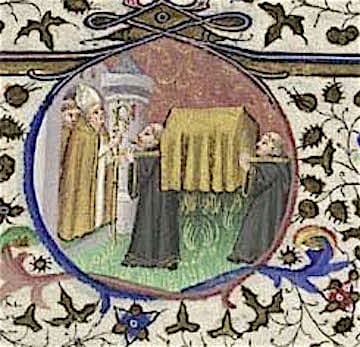
Fig. 6. Procession of clerics carrying relics of St. Maur. Bedford Hours, Paris, ca. 1415-30. London, British Library Add. MS 18850, fol. 272v, detail.
More recognizably Byzantine in character is the Marian image carried by the priest at the head of the Bedford Candlemas procession (Fig. 2). The figure of the Virgin is half-length, shown alone, without the Christ Child, her arms raised to one side, bent at the elbow with hands open. Her hair is golden, her garment blue. The background is metallic gold. The image is represented as portable, and its simple shape is round-topped. In short, the artist represented an icon of the Virgin, of the Byzantine type known as Hagiosoritissa, the Virgin of intercession.[32] In Constantinople icons of the Virgin, evidently including this type, were frequently carried in Marian processions described in textual sources.[33] However, in the few surviving images of such processions in Byzantine manuscripts and wall paintings, which date from the eleventh century and after, the icon, usually of the Hodegetria type (the Virgin ceremonially gesturing toward the Christ Child), is represented as rectangular, and oriented frontally, often centered in the composition, interrupting the movement of the participants.[34] It does not appear then that a Byzantine illustration of a Marian procession could have served in entirety as a model for the designer/artist of the Bedford Hours image. However, the designer could well have been familiar with icons of the Hagiosoritissa type themselves, because multiple examples of eastern Mediterranean origin circulated in western Europe.[35] In fact, on his way to visit Paris in 1402 the Byzantine emperor Manuel II Palaeologus presented a thirteenth-century Hagiosoritissa to Duke Giangaleazzo Visconti in Milan, an icon known as the “hope of the hopeless” which survives in the cathedral treasury of Freising.[36] Such images of the Virgin as intercessor were replicated by European artists, who sometimes replaced their rectangular shape with one with a rounded top (Fig. 7 ).[37]
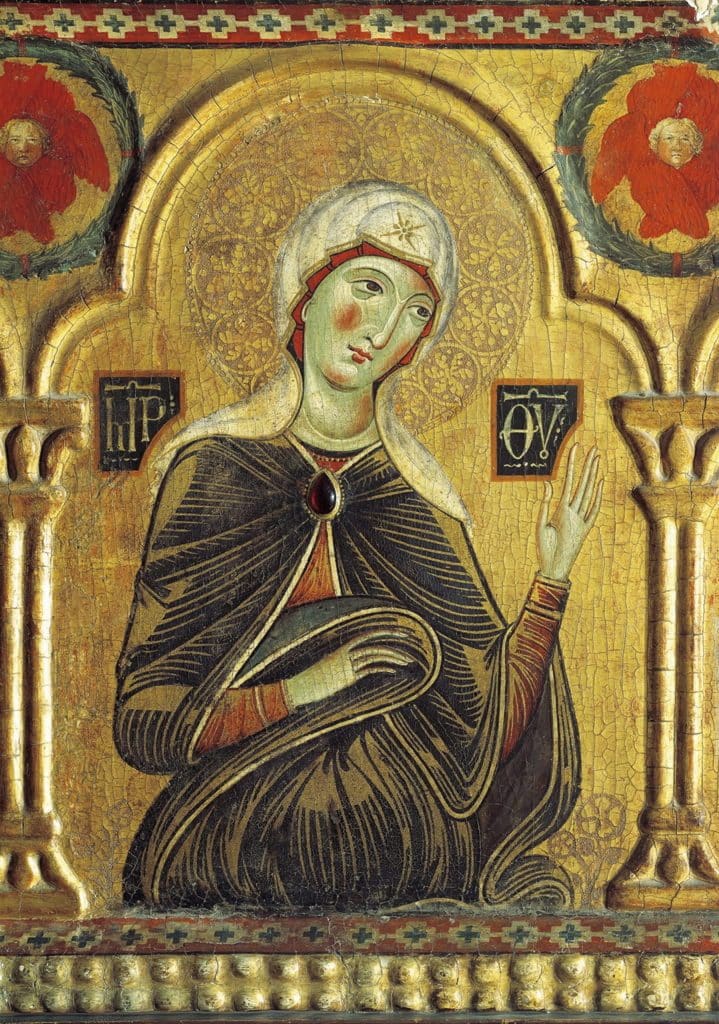
Fig. 7. Virgin Mary Hagiosoritissa. Meliore di Jacopo, altarpiece, Florence, 1271. Florence, Uffizi Gallery inv. No. 1890.9153, detail.
The Processional Medallion in the Bedford Hours Calendar
The byzantinizing character of the Bedford Candlemas procession can be judged by comparison with a second processional image in the manuscript, this one of the illustrations in the calendar for the month of February (Fig. 8). As on the text pages of the hours, the margins of the calendar are filled with a pictorial cycle of medallions set in the decorated borders.[38] Each month is allotted the recto and the verso of a folio. The recto, with the calendrical entries for the first half of the month, is illustrated with rectangular miniatures of the signs of the zodiac and labors of the months, and a single medallion in the right-hand border. The verso, with the second half of the month, has two medallions, one in the left-hand side of the border and the other at the bottom. So far as known the series is unique. The subjects are apparently based on Antique treatises on the names and festivals of the months of the year that were transmitted to the Middle Ages along with their commentaries, among them possibly Ovid’s Fasti, as well as medieval translations of these works into the vernacular.[39] From the wording of the Bedford captions, which includes phrases such as “selon les poetes” (according to the poets), “Comment les payens” (How the pagans), “selon les mescreans” (according to the infidels), and “Comment seneque” (How Seneca), it is evident that the textual source was not separate works of individual ancient authors themselves but a compilation or florilegium which viewed the past from a historical distance, thus a medieval work.[40] The source of the captions was French in all likelihood, since, as Paul Durrieu noted more than a century ago, the text for the month of June puns on the pronunciation of the French name of the month, Juin, and the term joins (joined), referring to events of that month which joined together Hercules and Hebe and Romulus and Tatius. Had the source been Latin this pun would not have been possible.[41]
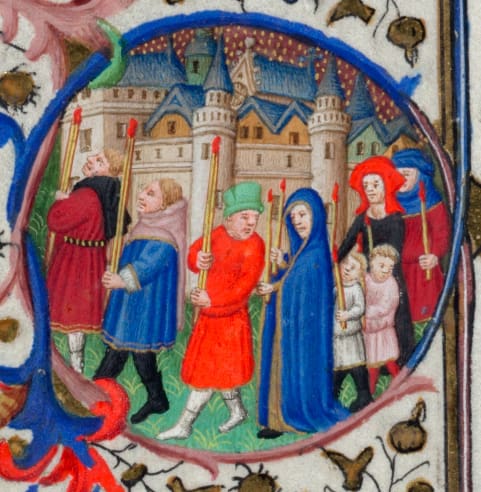
Fig. 8. Procession of lustration. Bedford Hours, Paris, ca. 1415-30. London, British Library Add. MS 18850, fol. 2v, detail.
Durrieu made a particular point of the representations of ancient gods, goddesses and rulers in the Bedford calendar medallions as contemporary men and women, alluding to a phenomenon now so widely accepted as generally characteristic of Gothic art that the mode of clothing in pictorial images of such figures almost never seems to require mention. Yet the depiction of the procession in the February medallion makes a useful comparison with the depiction of the Candlemas procession precisely on account of the representation of the one as entirely contemporary and familiar and the other as a mix of present and past, or “other.” The February medallion shows six men and women clothed in a variety of contemporary Western garments, perhaps representing different social classes, and two children, all carrying lit candles as they process single-file in front of the walls of a city. At the bottom of the page the caption explains: “Comment on faisoyt procession generale entour la cite pour reverance [de februa]” (How a general procession was held around the city to honor Februa [the caption is water-damaged at the end, but close study supports the reading “Februa”]).[42] Februa, or februata, was an epithet of Juno—“Juno the purified”—who is depicted in the medallion on the recto of the February page in the Bedford calendar as a young woman smelling a flower (Fig. 9).[43] As a deity Februa was connected with the Roman festival of purification, Lupercalia, celebrated on February 15, which is often considered to have been supplanted by the Christian feast of the Purification of the Virgin.[44] Indeed, Durrieu identified the Bedford procession as a representation of this festival.[45] The rituals of Lupercalia involved a race of so-called luperci, young men who ran naked around the streets of Rome in the midst of throngs of spectators while carrying the strips of animal skin that could be used for purification of women by flagellation.[46] Clearly, despite Durrieu’s identification of the subject, the procession of the Bedford calendar medallion does not show the celebration of Lupercalia. Instead, it can be connected with the lustratio urbis, or Amburbale, a Roman rite of urban purification that also took place in mid-February, as described ca. 400 by Macrobius in the Saturnalia.[47] From the time of the Venerable Bede in the eighth century, this pagan purification ritual had been connected with the celebration of the Purification of the Virgin.[48] Among the later sources that would have been familiar in fifteenth- century Paris was the account of the Purification of the Virgin in Durandus’ Rationale divinorum officiorum.[49] Using phrasing echoed in the French caption of the Bedford medallion, Durandus noted that “Fiat autem hac die processio generalis . . . . Romani namque de quinto in quintum anno in kalendis februarii ad honorem Februe matris Martis, qui, ut putabant, erat deus belli, lustravant Urbem tota nocte cum cereis ac facibus accensis ut filius eius eis victoriam de hostibus concederet cuius matrem tam sollempniter honorabant, quod festum ab urbale [Amburbale] dicebatur” (Let there be a general procession on this day . . . . Indeed, in the fifth year of every five, on the calends of February, in honor of Februa the mother of Mars, whom they considered the god of war, the Romans illuminated the city all through the night with candles and torches so that the son of the mother honored with such solemn ceremony would be allowed victory over enemies, which festival was called a burbale [Amburbale]).[50]
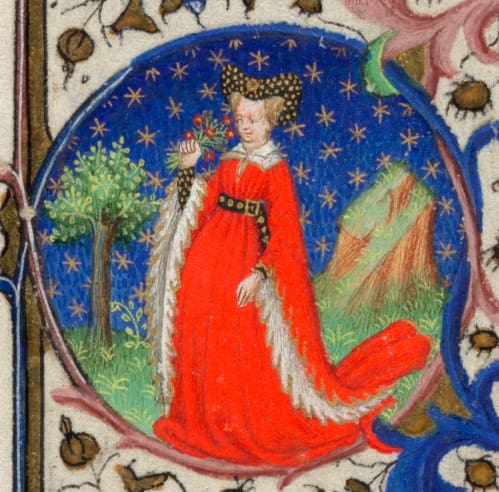
Fig. 9. February. Bedford Hours, Paris, ca. 1415-30. London, British Library Add. MS 18850, fol. 2, detail.
A similar account of the Roman festival, “en lonneur de februe mere de martis” had been incorporated in the 1260s into Jacobus de Voragine’s Legenda aurea entry on the Purification of the Virgin.[51] The Latin text, which has survived in more than a thousand manuscript copies, was translated by Jean de Vignay for Queen Jeanne de Bourgogne between 1333 and 1348 and provided with a rich pictorial program.[52] This work was certainly known to the creators of the Bedford Hours.[53] The French Légende dorée recounts that “iadis es kalendes de fevrier, toute la cite de rome estoit de .v. ans en .v. ans avironnee de gens et aloient entour a cierges & a brandons en lonneur de februe mere de martis qui estoit dieu de bataille. pour ce que son filz leur donast victoire de leur anemis du quil il aouroient la mere. Et cele espace de temps estoit dit lustre. Cest a dire resplendent de lumiere “(formerly on the calends of February every fifth year in five the city of Rome was circumambulated by the populace and they went around with candles and torches in honor of Februa mother of Mars, who was god of war, so that her son, whose mother was worshipped, would be granted victory over enemies. And this period of time was called lustration. That is to say, resplendent with light).[54] The details of the Bedford image correspond to these descriptions, in particular, the “Romans” in their contemporary Parisian clothing, the lit candles, and the conventional pictorial shorthand representation of a city.
Processions in Medieval Paris and Processions in Parisian Art
Can the representation of a Candlemas procession in the Bedford Hours be connected with contemporary social practice? We know something about Candlemas rituals in Paris from liturgical texts for use at Notre Dame, in particular two thirteenth-century processionals, and the rites described in these manuscripts evidently continued into at least the seventeenth century.[55] However, the focus in these works is on the roles played by the clergy, in particular in the blessing of candles and their distribution, first to various clerical officers, and only then to members of the laity, “post omnes de Clero” (after all those of the clergy).[56] As far as the Candlemas procession itself is concerned, it is characterized as conducted “more solito” (in the customary manner), and the route followed is not described as extending beyond the baptistry, the choir, and the cathedral precincts.[57] Such a primarily clerical procession is depicted in one of the miniatures in the earliest copy of the well-known allegorical treatise on the virtues, the Sainte Abbaye, illustrated in Paris or northeastern France ca. 1294 (Fig. 10).[58] The picture, set in a complex ecclesiastical structure, incorporates numerous details that are mentioned separately in written descriptions of the Candlemas rituals, with nuns rather than male clerics playing important roles. In the lower section, moving from left to right, the procession is led by a cross-bearer, followed by nuns carrying lit candles, next a deacon carrying the gospel book for the mass, then the priestly celebrant in mass vestments, then a group of nuns two of whom hold open books inscribed with the text and music of the introit of the Candlemas mass, and finally, the abbess herself with her crozier. In the upper part of the image the mass is about to begin.[59] Although the details of the image correspond with actual liturgical practice, the reasons for the particular choice of the procession at the mass of the Purification of the Virgin are not certain; however, the need for spiritual purification is a central theme of the text of the Sainte Abbaye.[60]
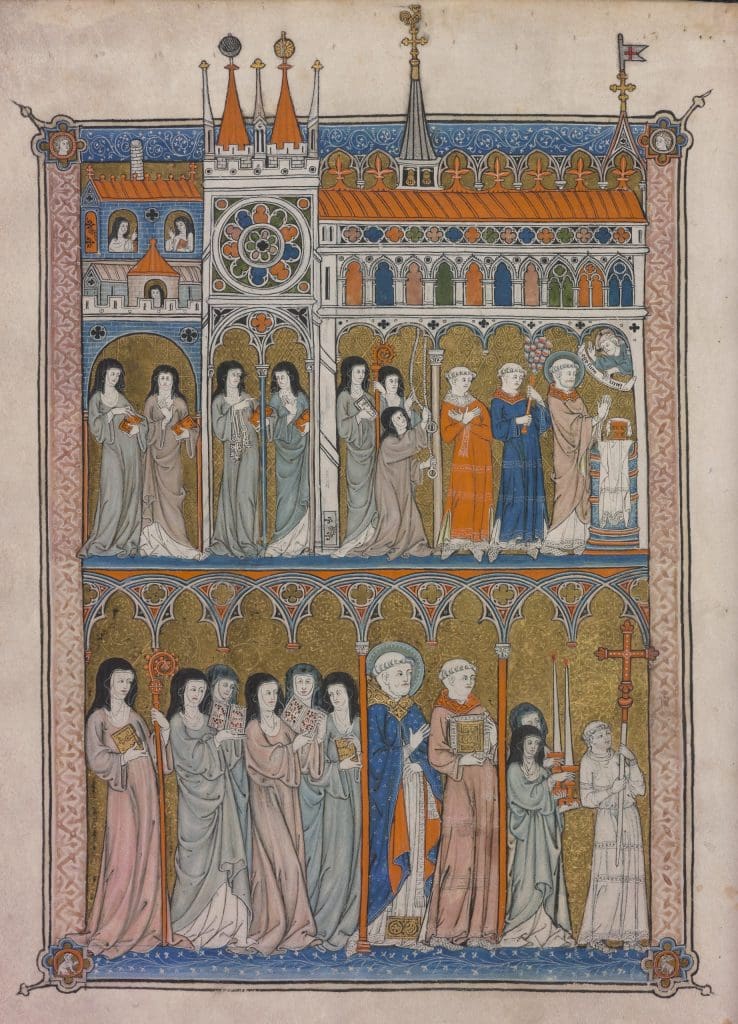
Fig. 10. Procession of nuns before mass of the Purification. Sainte Abbaye, northeastern France, end of thirteenth century. London, British Library MS Yates Thompson 11, fol. 6v.
Liturgical texts do not offer a clear picture of lay participation in Candlemas processions, nor do they serve as a background to the decision-making process by which the image of the procession in the Bedford Hours came into existence. The multiple fifteenth-century chronicles are more promising sources, among them, the Journal d’un bourgeois de Paris (for 1405-1449), Enguerran de Monstrelet’s Chronique (for the years 1400-1444), and Jean Jouvenal des Ursins’ Histoire de Charles VI, Roy de France (mid-fifteenth century).[61] All these provide detailed accounts of processions in Paris which included the laity. They were held on occasions of civic or national importance, either times of danger, triumph, or death. For instance, for the year 1412 the author of the Bourgeois de Paris recounted that in support of Charles VI’s campaign against the Armagnacs in Bourges, “les plus piteuses processions qui onques eusssent esté veues de aage de homme” (the most moving processions that had ever been seen in human history) took place).[62] These processions were held on a daily basis in May, June, and July and included every order and rank of clergy from the entire Parisian area, and “tant de peuple que sans nombre” (countless people)—“tres anxiens hommes, femmes grosses et petiz enfens, chascun cierge ou chandelle en sa main” (very old men, pregnant women, and little children, each one with a taper or candle in hand), all “piez nudz” (barefoot).[63] These details, at least many of them, parallel the pictorial details included by the Bedford artists in both the medallions of the Candlemas procession and the purification procession on the February calendar page.
Sacred relics were carried in the Parisian processions of 1412. On May 30 for example Dominicans, Carmelites and Cistercians, followed, according to the chronicle, by some 30,000 lay people, carried the relic of the True Cross from the Sainte-Chapelle to Saint-Martin des Champs by way of the rue Saint-Denis, before returning the precious fragment to the royal chapel by way of the rue Saint-Martin.[64] On June 3 an even larger procession, including 40,000 lay people, came from every Parisian parish church and religious establishment bearing precious relics and more than 4,000 torches to the church of Saint-Jean en Greve, where the Host-relic known as the Miracle des Billettes was collected by four bishops before the entire throng continued on to the church of Sainte-Geneviève to hear mass.[65] Again these descriptions offer analogies to the image of the Marian icon carried by the priest in the Bedford Candlemas medallion.
Enguerran de Monstrelet’s description of the procession held for the funeral of Charles VI in 1422 is as vivid as that of the author of the Bourgeois de Paris in detailing the exact position of every clerical and noble participant, including John, duke of Bedford, the then- or future owner of the Bedford Hours, every member of the royal court, and “le commun de Paris en grant multitude” (the people of Paris in great multitude).[66] Monstrelet recounted that the litter on which the lead coffin with the body of the king was carried was surmounted by a cloth of gold canopy with a heraldic display and that the coffin itself was covered by a full-length effigy, elaborately painted from his “couronne d’or et de pierres précieuses moult riches” (crown of gold and very rich precious stones) to “ung solers de veloux d’asur semé de fleurs de lis d’or” (a pair of shoes of blue velour powdered with gold fleurs de lis).[67]
If John of Bedford was a participant in the funerary procession of Charles VI, it is likely that among the “commun de Paris en grant multitude” were also the creators of the Bedford Hours, whose pictorial imagery in general is characterized by a taste for vivid detail equal to that of the verbal descriptions. Although the wealth of information in the chronicles includes no mention of processions held in connection with the feast of the Purification of the Virgin, the documentation nevertheless provides evidence of the kind of visual and participatory experience that fed into the creation of images of the event of February 2. “Real-life” experiences must have encouraged representations of Purification processions as contemporary happenings, even if no written documentation of such elaborate events exists. In the Très riches heures (1411-1416) for instance, the Limbourgs, contemporaries of the Bedford Master, introduced processional elements into the normally static representation of the Presentation of Christ by depicting a large number of individuals, young and old, male and female, following Joseph and the Virgin as they move across the foreground plane of the picture at the foot of the steps of the temple (Fig. 11).[68] The Virgin and Joseph are enlarged in scale, not just on account of closeness to the viewer but hierarchically. Both are swathed in “biblical” mantles, and Joseph wears a pointed hat that identifies him as an Israelite. The other figures in the miniature however are clothed in contemporary dress, with antique touches in the form of tiara-like headdresses and pointed hats. The mingling of ancient and modern dress in the biblical scene parallels the combination of non-Western and contemporary dress in the processional medallion of the Purification in the Bedford Hours. Both the Limbourg and the Bedford artists represented past events as historically distant and as happening in the present at one and the same time.
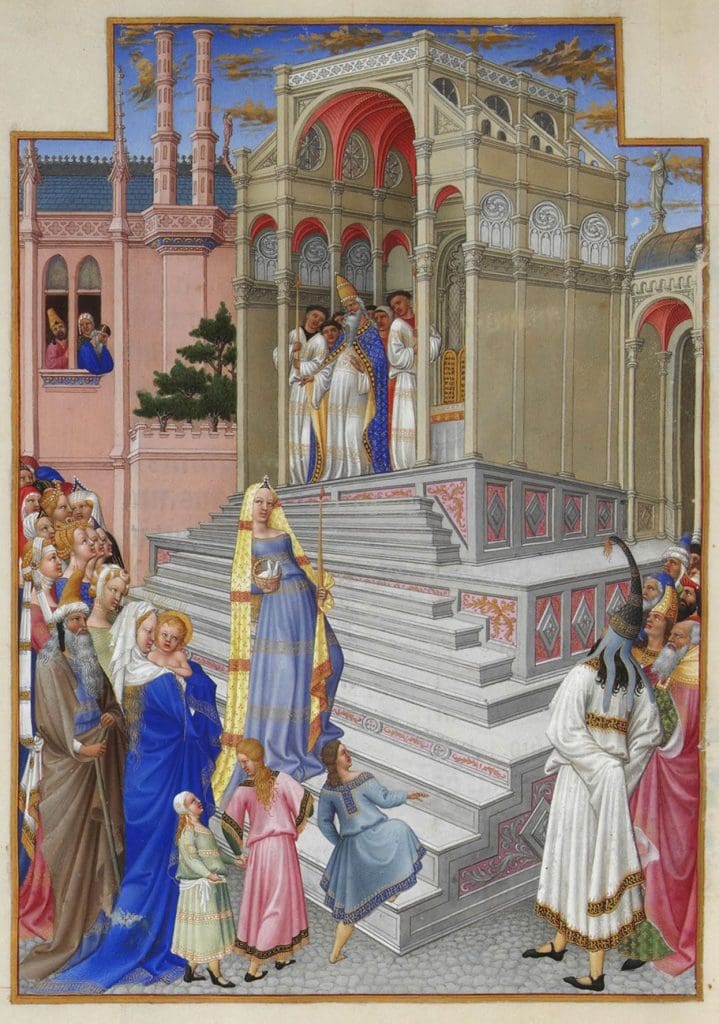
Fig. 11. Presentation of Christ/Purification of the Virgin. Très riches heures, Paris, 1412-16. Chantilly, Musée Condé MS 65, fol. 54v.
In the mid-fifteenth century the exceptionally inventive artist of the Hours of Louis of Savoy painted a miniature that turned the Presentation of Christ in the Temple still more completely into a dramatic contemporary event (Fig. 12).[69] The miniature shows a procession of elegant women in contemporary dress moving in profile across the foreground; preceding them, also clothed in modern dress, the biblical Anna, bearing a basket of turtle doves on her head and a lit candle in her hand, turns to mount the stairs of the temple as she follows Joseph, who is seen from the rear. He, in turn, follows the Virgin who, near the top of the stairs, and at some fictive distance from the viewer, starts to turn toward Simeon, who faces the viewer at the arched upper-story entrance to the structure, holding a cloth to receive the Christ Child. Simeon is the only figure not in contemporary dress, a pictorial reminder to the fifteenth-century viewer that he was a priest of the Old Law, whose meeting with Christ led to his enlightenment. As in the Limbourg miniature, the active participants in the procession in the image in the Hours of Louis are all female, a pictorial allusion to the obligation for purification of women forty days after the birth of a child, an Old Testament practice still carried on in the Middle Ages in the ceremony called the “Churching of Women.”[70]
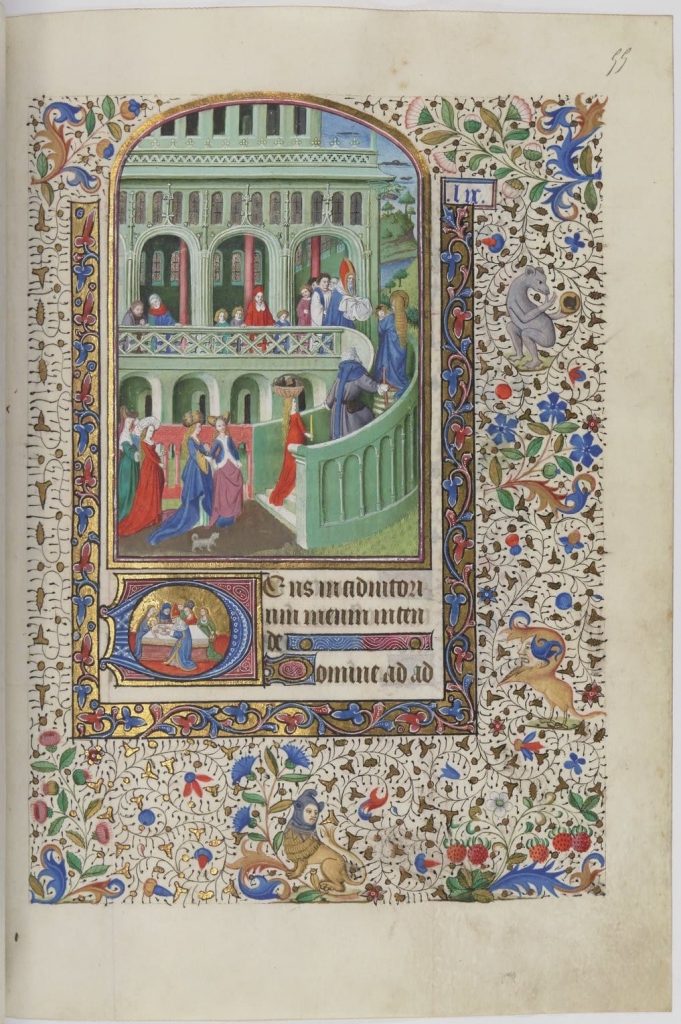
Fig. 12. Procession for Presentation of Christ/Purification of the Virgin. Hours of Louis of Savoy, duchy of Savoy, 1445-50. Paris, Bibliothèque nationale de France MS latin 9473, fol. 55.
The Image of the Candlemas Procession as Social Sculpture
The images of Candlemas processions discussed in this essay record social practice to varying degrees. In some ways most faithful to actual ritual as known from liturgical texts is the illustration in the Sainte Abbaye (Fig. 10) because the procession takes place within the precincts of an ecclesiastical structure. Yet the image is primarily allegorical, not factual; the nuns in the procession are the personified virtues who inhabit a symbolic convent, itself constructed and governed by the virtues. The other processional images discussed here are not allegorical but imaginative historical reconstructions: the illustration for the entry on Justinian in the Morgan Library chronicle (Fig. 5) shows an event that occurred in the distant past and in a distant place as a contemporary Marian procession, in all likelihood drawing on an image-bank in the artist’s memory as much as visual experience of actual processions; the Limbourg artist (Fig. 11) and the Master of the Hours of Louis of Savoy (Fig. 12) introduced allusions to non-scriptural Candlemas processions into their representations of the biblical subject of the Presentation of Christ in the Temple, depicting the participants as living in the present; similarly, the artist of the Bedford calendar February procession (Fig. 8) showed a ritual event, in this case from Roman history, as a contemporary happening; finally, the artist of the Bedford Apocalypse cycle moralization (Figs. 1-3) imagined the institution of the feast of Candlemas as a Marian procession taking place in Byzantium, where it was said to have originated.
Down to the present day, religious processions in which images of holy figures, or holy images themselves are carried can be viewed as instances of social sculpture in that they arouse acts of fervent piety. On August 15, 2019, with the headline “Emotional Paris Ceremony near Notre Dame for Assumption Day,” Associated Press News reported that “Catholic pilgrims have held an emotional procession past fire-ravaged Notre Dame Cathedral, singing and parading with a statue of the virgin Mary rescued from the flames” (Fig. 13).[71] But what was the response to representations of processions in medieval manuscripts such as the Bedford Hours? The “lesson” of the Bedford Candlemas image is evidently that devotion to the Virgin Mary, the Ark of the Covenant, could save a whole city, a message as applicable to the unsettled political conditions in fifteenth-century Paris as to sixth-century Constantinople. Considering the societal position of the aristocratic reader/viewer/owner of the book, it is probable that the entire pictorial program in the margins of the manuscript was directed by the creators—its concepteurs, including the designer of the illustrations and those who painted them—not only toward this individual’s own spiritual and moral development, and visual enjoyment, but toward his education in the conduct demanded of a member of the ruling class. In this way it could be said that the creators of the Bedford Hours were sculptors shaping the persona of the reader/viewer of the manuscript so that in turn this princely figure would act as a sculptor of the society of his time.[72]
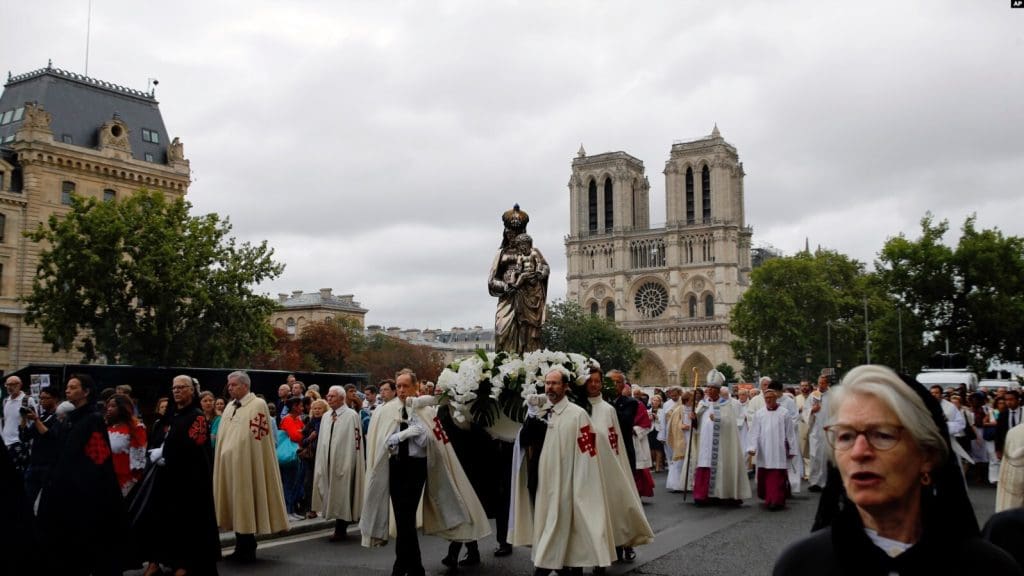
Fig. 13. Assumption Day procession from Notre Dame to Saint-Sulpice, Paris, August 15, 2019. Photo: AP News online.
For warm friendship and generous scholarly advice on the subject of the Bedford Hours and illumination in early fifteenth-century Paris I am most grateful to the late Prof. Elizabeth A. R. Brown, Dr. Kathleen Doyle, Dr. Catherine Reynolds, Dr. Jenny Stratford, and Dr. Chantry Westwell.
References
| ↑1 | See Sabine Felbecker, Die Prozession: Historische und systematische Untersuchungen zu einer liturgischen Ausdruckshandlung (Altenburg, 1995); for a theoretical study, see C. Clifford Flanigan, “The Moving Subject: Medieval Liturgical Processions in Semiotic and Cultural Perspective,” in Moving Subjects: Processional Performance in the Middle Ages and Renaissance, eds. Kathleen Ashley and Wim Hüsken (Leiden, 2001), pp. 35-51, https://doi.org/10.1163/9789401200240_004. |
|---|---|
| ↑2 | London, British Library (hereafter BL) Add. MS 18850; for description and extensive bibliography see https://searcharchives.bl.uk/ |
| ↑3 | See Lucy Freeman Sandler, “Pictorial Typology and the Bedford Hours,” in Opening Manuscripts: Tributes to Elly Miller (Turnhout, 2024), pp. 296-317. |
| ↑4 | It is usually suggested that these captions were inserted c. 1430, in the last stages of the manuscript production. The texts do not always match the pictorial subjects. |
| ↑5 | Scriptural quotations in English from the Douay-Rheims Version. |
| ↑6 | Transcriptions of the captions by Dr. Chantry Westwell and me; English translations of French are mine. In the caption the phrase “qui estoyt ouvert” seems to refer to the temple that was opened, but the phrase “the temple in” was omitted; in the medallion image itself the temple structure is also absent, only the ark of the testament being shown, as closed, not open. |
| ↑7 | Celebrated in the Use of Rome and elsewhere in western Europe as a duplum or duplex festum, a feast of nine lessons with antiphons chanted in full. In Byzantium Hypapante was one of the twelve major feasts of the year; in general see Catholic Encyclopdia, 16 vols., New York, 1913, III, s.v. Candlemas. |
| ↑8 | For the earliest ordo treating the Candlemas procession see Michel Andrieu, Les ordines romani du haut moyen age, III, Les textes (suite), Spicilegium sacrum Lovaniense, 24 (Leuven/Louvain, 1961), pp. 229-36, on Ordo XX of the late eighth century. See also Edmond Martène, De antiquis ecclesiae ritibus, IV (Antwerp, 1738), cols. 297-306, with extracts of instructions for Candlemas processions from multiple textual sources. |
| ↑9 | John 8.12; see Ioannis Motsianos, “The Role of Candelae and Lampadae in the Processions of Hypapante and Candlemas,” Transylvania 10 (2015), 43-47. |
| ↑10 | See, for example, the sermon of Pope Innocent III (d. 1216) for the feast of the Presentation/Purification (“In solemnitate purificationis gloriosissimae semper virginis mariae,” PL 217, col. 510): “in Purificatione Virginis cereos accensos portamus, ut purificati per gratiam, cum accensis lampadibus quasi prudentes virgines ad nuptias ingredi mereamur” (we carry lit candles at the Purification of the Virgin so that we may merit purification by grace like the wise virgins who came to the wedding with lit lamps). Unless otherwise noted, English translations from Latin are mine. |
| ↑11 | See Guillelmi Duranti rationale divinorum officiorum, Corpus christianorum continuatio mediaevalis 140B, ed. A. Davril, T. Thibodeau, and B. G. Guyot (Turnhout, 2000), VII.vii, on the feast days of the Church. The work was translated into French by Jean Golein in 1374 for Charles V of France; early Latin copies were unillustrated; some French copies had an illustration at the beginning of each of the seven books of the text, see, for example, BnF, MS français 176 and MS français 437, both of the late fourteenth century; see archivesetmanuscrits.bnf.fr; digitized online at gallica.bnf.fr. |
| ↑12 | Annals and chronicles such as the Grandes chroniques de France offer a wide range of such images; see Anne D. Hedeman, The Royal Image: Illustrations of the Grandes chroniques de France, 1274-1422 (Berkeley, 1991) and Eléonore Fournié, Catalogue des manuscrits de la Bible historiale (1/3-3/3), online at http://journals.openedition.org/acrh. |
| ↑13 | On the representation of the Presentation see Dorothy C. Shorr, “The Iconographic Development of the Presentation in the Temple,” Art Bulletin 28 (1946), 17-32, https://doi.org/10.1080/00043079.1946.11407736. |
| ↑14 | Nicholas de Lyra’s commentaries were composed between 1322 and 1339; see, most recently, Philip D. W. Krey and Lesley Smith, eds., Nicholas of Lyra, The Senses of Scripture (Leiden, 2000), esp. “Introduction,” pp. 2-18, and “The Apocalypse Commentary of 1329,” pp. 267-88; hundreds of manuscript copies of the text survive, in whole or in parts; for a printed edition of the entire commentary, see Biblia latina cum postilla Nicolai de Lyra et additionibus Pauli Burgensis, 4 vols., Nuremberg, 1497, online at Proquest Early European Books; for an early printed edition of the Apocalypse commentary, see Postilla super Actas Apstolorum, Epistolae Canonicales et Apocalypsim, Mantua, 1480, online at Proquest Early European Books; and Philip D. W. Krey, trans., Nicholas of Lyra’s Apocalypse Commentary (Kalamazoo, 1997). For French translations of various portions of Nicholas’ Postilla, see H. Labrosse, “Oeuvres de Nicolas de Lyre, Postilla literalis,” Études franciscaines, 19 (1908), 369-79. In an essay of 1995 Richard Emmerson characterized all the pictorial moralizations of the Apocalypse subjects in the Bedford Hours as “a skillful mixture of four interpretive strategies . . . the ecclesiological [i.e., the Church as an institution], the moral, the prophetic, and the historical,” and discussed Nicholas of Lyra, although he did not connect his Postillae directly with the Bedford Hours cycles; see Richard K Emmerson, “The Apocalypse Cycle in the Bedford Hours,” Traditio 50 (1995), 173-98, here quoting p. 178. Krey, p. 12, observed that one of Nicholas’ interpretative methods “is characterized by citing an image, symbol, or phrase from the Apocalypse and finding the appropriate fulfillment of its implications in an historical character or event.” |
| ↑15 | Quoted from Krey, Nicholas of Lyra’s Apocalypse Commentary, pp. 135-36. |
| ↑16 | On the plague of 541 see, among many other studies, Mischa Meier, Das andere Zeitalter Justinians. Kontingenzerfahrung und Kontingenzbewältigung im 6. Jahrhundert n. Chr. (Göttingen, 2004), pp. 570-86; idem, “‘The Justinianic Plague’. The Economic Consequences of the Pandemic in the Eastern Roman Empire and Its Cultural and Religious Effects,” Early Medieval Europe 24 (2016), 267-92, esp. 285, https://doi.org/10.1111/emed.12152. |
| ↑17 | See Bert Groen, “The Festival of the Presentation of the Lord: Its Origin, Structure and Theology in the Byzantine and Roman Rites,” in Christian Feast and Festival: The Dynamics of Western Liturgy and Culture, ed. P. Post et al. (Leuven, 2001), pp. 345-81, esp. pp. 346-51 reporting on the account of the pilgrim Egeria’s travels to Jerusalem between 381 and 384, in which she described the rites, including a procession, that took place at the feast of the Presentation; see further, Pierre Maraval, ed., Égérie. Journal de voyage (Itinéraire), Sources chrétiennes 296 (Paris, 1997), pp. 254-57. On the development of the feast in the West, see Groen, pp. 364-71, citing the Liber pontificalis account of Pope Sergius I (698-701) and the late eighth-century Roman Ordo XX; see Louis Duchesne, Le liber pontificalis: Texte, introduction et commentaire, I (Paris, 1886), p. 376 and Andrieu, Les ordines romani, pp. 229-36. |
| ↑18 | See Meier, Das andere Zeitalter Justinians, pp. 570-86. For the rise of the cult of the Virgin and the related feasts, see Leslie Brubaker, ed., The Cult of the Mother of God in Byzantium: Texts and Images (Farnham, 2011). |
| ↑19 | Meier, p. 571, quoting Theophanes, Chronographia, text in Greek with his German translation. |
| ↑20 | For the Chronicon of Hugh of Fleury (d. 1110) see Bernhard Rottendorff, Hugonis Floriacensi, Monachi Benedictini Chronicon (Münster, 1638), pp. 138-39; I consulted British Library Royal MS 13 A II, England, late twelfth century, fols. 10v-11r. |
| ↑21 | Rottendorff, Hugonis Floriacensi, p. 138: “. . . facta est mortalitas magna. Qua de causa eodem anno [541] cępit celebrari solemnitas Purificationis sanctę Dei genitricis Mariae seconda die Febr. Mensis, & cessavit mortalitas illa.” Other early Western chroniclers, such as Sigebert of Gembloux (d. 1112), following the Byzantine sources, simply listed the onset of the plague and the institution of the feast in sequence without connecting them; see Sigeberti Gemblacensis coenobitae chronicon ab anno 381 ad 1113 cum insertionibus ex historia Galfridi et additionibus Roberti abbatis Montis centum et tres sequentes annos complectentibus promovente egregio patre D. G. Parvo doctore theologo, confessore regio, nunc primum in lucem emissum (Paris, 1513), n.p, under 542: “Constantinopoli mortalitate magna insurgente/statuta est solemnitas purificationis beatę marię.” |
| ↑22 | Martinus Oppaviensis, Chronicon pontificum et imperatorum, Monumenta Germaniae historica, Scriptores in folio (SS) 22 (Hannover, 1872), p. 455; see now A. D. van der Brincken, “Studien zur Uberlieferung des Chronik des Martin von Troppau,” Deutsches Archiv für Erforschung des Mittelalters 41 (1985), 460-531, listing 275 Latin manuscripts classified by text format. Van der Brincken (p. 461) notes the wide dissemination of the chronicle in vernacular versions. The 1423 inventory of the library of Charles VI lists five copies of Martinus’ chronicle, either complete or abridged, all in French translation; see Inventaire de la bibliothèque du roi Charles VI, ed. Louis Douët d’Arcq (Paris, 1867), nos. 24, 34, 37, 383, 393. |
| ↑23 | For the account of Justinian in a fourteenth-century chronicle in French see the anonymous Les fleurs des chroniques, extant in a few copies, one of which (BnF MS NAF 1409, fols. 72r-72v) was owned by Charles V of France, who signed the volume in 1368; fully digitized online at gallica.bnf.fr: “En lan .xie. de lempere iustinian fu moult grant mortalite en constantinoble. En ce temps commenca la presentacion de nostre seigneur. Cest le iour de la purificacion nostre dame estre celebree ou secont iuour de fevrier” (In the eleventh year of the emperor Justinian there was a great death in Constantinople. At this time the Presentation of Our Lord began. This is the day of the Purification of Our Lady to be celebrated on the second day of February). For an edition see Thomas F. Coffey, “Les fleurs des Chroniques: An Edition with Introduction and Commentary,” unpublished PhD dissertation, Washington, D.C., Catholic University of America, 1974, passage cited above on p. 338. |
| ↑24 | For William of Malmesbury, Miracula sanctae Mariae Virginis, see Rodney Thompson and Michael Winterbottom, eds., William of Malmesbury, Miracles of the Blessed Virgin Mary (Woodbridge, 2015), pp. 128-31 (with English translation); Thompson, p. xvi, dated the composition to 1136-39. For Adgar’s Gracial, see, most recently, Jean-Louis Benoit and Jerry Root, eds., Adgar, le Gracial: Miracles de la Vierge (Turnhout, 2021), pp. 458-63. Meier, Das andere Zeitalter Justinians, pp. 570-86, cited no Western account earlier than Adgar’s, which he used as proof of the role of Justinian in refocusing the celebration of the feast on the Virgin. In general, on the miracle, titled “Purification” in collections of miracles of the Virgin, see Adolfo Mussafia, Studien zu den mittelalterlichen Marienlegenden, 6 vols. (Vienna, 1887-91), I, pp. 962, 964, 981, II, pp. 8, 27, 31, 37, 46, IV, pp. 5, 17, 43; Henry L. D. Ward, Catalogue of Romances in the Department of Manuscripts in the British Museum, II (London, 1893), p. 638, listing Royal MS 6 B xiv (fols. 85r-85v); other British Library copies cited by Ward are Royal MS 5 A viii (fols. 148v-149r), Harley MS 2316 (fol. 59r), these in Latin prose, and Royal MS 8 C ix (fol. 20r), Royal MS 20 B xiv (fols. 164v-165), and Egerton MS 612 (fol. 68/69), these in Anglo-Norman verse. Among copies of the Miracles of the Virgin of French origin that include “Purification” are BnF MS latin 12593, ca. 1270, from the abbey of Saint-Germain des prés (fol. 149v) and BnF MS latin 17491, end thirteenth century, from the Paris Dominican convent (fols. 22-22v); for these see Evelyn Faye Wilson, The Stella maris of John of Garland Cambridge, MA, 1946), pp. 16-37. The most widely circulated collection of Marian miracles in French, the verse Miracles Nostre Dame of Gautier de Coincy (d. 1236) does not include “Purification;” see Gautier de Coinci, Les miracles de Nostre Dame, ed. V. Frederic Koenig, 4 vols. (Geneva, 1955-70); extensive further bibliography online at www.arlima.net, s.v. Gautier de Coinci. |
| ↑25 | Ward, Catalogue of Romances, p. 638. |
| ↑26 | Quoted from the translation by Thompson, William of Malmesbury, pp. 129, 131. For the comparable passage in Adgar’s Gracial, see Benoit, Adgar, pp. 460, 462. |
| ↑27 | New York, Pierpont Morgan Library and Museum MS M751, fols. 63-63v. The manuscript, with 228 miniatures, is almost unknown, catalogued in typescript in 1937 by the library as a “Universal chronicle to the year 1220 A.D., compiled from various unidentified sources and introduced by the preface to Petrus Pictaviensis’ Compendium Historiae in Genealogia Christi,” mentioned briefly by Alison Stones, Gothic Manuscripts 1260-1320, A Catalogue of Manuscripts Illuminated in France, 4 vols., Pt. I, vol. I (Turnhout, 2013), p. 26; the processional image was mentioned, also briefly, and illustrated by Michael Camille, The Gothic Idol: Ideology and Image-Making in Medieval Art (Cambridge, 1989), p. 230 and fig. 123, who noted its “social purpose.” The textual format—multiple series in which a chronological sequence of popes is followed by a sequence of emperors—parallels that of copies of the Latin chronicle of Martinus Polonus classified as IVa by Van der Brincken, “Studien.” |
| ↑28 | Innocent III, De sacro altaris mysterio libri sex, I.64; PL 217, col. 800. |
| ↑29 | Biblioteca apostolica Vaticana MS Vat. gr. 1613, fols. 142, 204, 350, 353, and 355; fully digitized online at www.mss.vatlib.it. |
| ↑30 | For instance, Biblioteca apostolica Vaticana MS Vat. gr. 746, pt. 2, fol. 265v (Constantinople, twelfth century), fully digitized online at digi.vatlib.it. |
| ↑31 | Bedford Hours, fol. 272v, an illustration of the suffrage of St. Maur. |
| ↑32 | See Nancy P. Ševčenko, “Icons in the Liturgy,” Dumbarton Oaks Papers 45 (1991) 45-57, esp. 55-56, https://doi.org/10.2307/1291691. |
| ↑33 | Constantinopolitan processions honoring the Virgin began as early as the sixth century; see Ševčenko, “Icons,” 51, citing Michel van Esbroeck, “Le culte de la Vierge de Jerusalem à Constantinople au 6e – 7e siècles,” Revue des études byzantines 90 (1988), 181-90; however, records that describe the carrying of icons on the processional route date from after the end of iconoclasm, not earlier than the tenth century; see Bissera V. Pentcheva, “The Supernatural Protector of Constantinople: the Virgin and Her Icon in the Tradition of the Avar Siege,” Byzantine and Modern Greek Studies 26 (2002), 2-41, esp. 15-22, https://doi.org/10.1179/030701302806932222. |
| ↑34 | The most famous Byzantine representation of a Marian procession in which an image of the Virgin is carried is the late fourteenth-century fresco of Markov Monastery, near Skopje in Northern Macedonia; see Marka Tomić Djurić, The Frescoes of Marko’s Monastery [in Serbian with English Summary] (Belgrade, 2019), pp. 332, 560-62, figs. 159-60. The painting illustrates Stanza 23 of the Eastern Orthodox Akathistos hymn to the Virgin, in which she is hailed as the “ark, gilded by the Spirit,” a parallel to the Western interpretation of Mary as the ark of the testament, or covenant; see text above at note 15 and Fig. 3, and for Akathistos text, among many other translations, see Ioannis Spatharakis, The Pictorial Cycles of the Akathistos Hymn for the Virgin (Leiden, 2005), p. 194. |
| ↑35 | Most famously, the so-called Maria Advocata, an eastern Mediterranean icon of the Hagiosoritissa, brought to Rome possibly as early as the sixth century, now housed in the convent of Santa Maria del Rosario; copies in numerous Roman churches; see Hans Belting, Likeness and Presence: A History of the Image before the Era of Art (Chicago, 1994) pp. 314-17, pl. V, figs. 188-91, 195. Representations of the Hagiosoritissa of Constantinopolitan origin, often as components of Deësis images, were transported to western Europe in the Middle Ages; see, for example, the tenth-century ivory Deësis in the cover of the Bernward Gospels (Hildesheim, Dom und Diozesanmuseum), owned by Bernward, bishop of Hildesheim (fl. ca. 993-1022); small, portable Constantinopolitan objects decorated with images of the Hagiosoritissa also circulated in western Europe, for example, the reliquary in the treasury of the Basilica of Our Lady, Maastricht, a work of the eleventh century; for a summary of the subject of Byzantine art in the West, see William D. Wixom, “Byzantine Art and the Latin West,” in The Glory of Byzantium: Art and Culture of the Middle Byzantine Era, A.D. 843-1261 (New York, 1997), pp. 435-49, and on the Bernward ivory, no. 305 pp. 466-68 (entry by Charles Little) and on the Maastricht reliquary, no. 113, pp. 164-65 (entry by Annemarie Weyl Carr). See also the Deësis image in the Melisende Psalter (BL Egerton MS 1139, fol. 12v), produced in the crusader kingdom of Jerusalem between 1131 and 1143; the manuscript reached western Europe at an unknown date. |
| ↑36 | See Maria Vassilaki, “Praying for the Salvation of the Empire,” in Images of the Mother of God: Perceptions of the Theotokos of Byzantium (Aldershot, 2004), pp. 263-74. The icon was evidently overpainted in the fourteenth century at which time, appropriate to the mission of the beleaguered Byzantine emperor, the inscription “Maria, Mother of God, Hope of the Hopeless” was added. |
| ↑37 | See, for example, the reredos panel signed and dated 1271 by the Florentine Meliore di Jacopo showing Christ flanked by the Virgin Mary and St. John the Evangelist, with Sts. Peter and Paul, all half-length figures framed by round arches; Florence, Uffizi Gallery inv. no. 1890. 9153. It appears that in the thirteenth and fourteenth centuries some Byzantine images of the intercessory Virgin on round-topped panels were produced in Venice or Crete, adopting a shape common in Tuscany. |
| ↑38 | For descriptions of the calendar see Richard Gough, An Account of a Rich Illuminated Missal Executed for John Duke of Bedford (London, 1794), which includes a transcription of the captions; also Alphonse Vallet de Viriville, “Notice de quelques manuscrits précieux sous le rapport de l’art,” Gazette des beaux-arts 21, issue 123 (1866), 275-85, esp. 275-79, and König, Bedford Hours, pp. 93-95. |
| ↑39 | A connection with Ovid’s Fasti was mentioned first by Gough, Account, p. 4, in describing the images and captions for the month of June. |
| ↑40 | See fol. 2 (February), fol. 3 (March), fols. 4, 4v (April), and fol. 12v (December). |
| ↑41 | Paul Durrieu, “Souvenirs de la mythologie antique dans un livre d’heures exécuté en France entre 1423 et 1430,” Comptes rendus des séances de l’Académie des inscriptions et belles-lettres 60 (1916), 191-209, at 200, https://doi.org/10.3406/crai.1916.73698 |
| ↑42 | I am most grateful to Dr. Eleanor Jackson, formerly of the British Library, for checking the reading of this water-damaged caption |
| ↑43 | See Paul the Deacon’s widely circulated epitome (ca. 720-ca. 799) of Festus’ second-century De verborum significatu, which gives a variety of alternative meanings of februarius: Sexti Pompei Festi de verborum significatu quae supersunt cum Pauli epitome, ed. Wallace M. Lindsay (Leipzig, 1913), pp. 75-76, “Februarius mensis dictus . . . quod tum . . . populus februaretur, id est lustraretur ac purgaretur, vel a Iunone Februata, quam alii Februalem, Romani Februlim vocant, quod ipsi eo mense sacra fiebant, eisuque feriae erant Lupercalia, quo die mulieres februabantur a lupercis amiculo Iunonis, id est pelle caprina . . . .” (February is said to be the month . . . when . . . the populace is purified, that is, lustrated, or purged, or [is said to be] from Juno, the purified . . . .). As the caption for the medallion of Februa (i.e., Juno februata) says, “Comment fevrier et nome dune femme quon apeloit februa mere de mars dieu des batailles selon les poetes/qui disoient que februa avoyt conceu le dieu dez batailles en baisant et en adorant une fleur” (How February is named for a woman called Februa, mother of Mars, god of battles according to the poets, who say that Februa conceived the god of battles by kissing and by smelling a flower). The story of the conception of Mars by Juno through the agency of a magic flower given to her by Flora was recounted in Ovid’s Fasti, V.229-60. |
| ↑44 | See William M. Green, “The Lupercalia in the Fifth Century,” Classical Philology 26 (1931), 60-69, https://doi.org/10.1086/361308. |
| ↑45 | Durrieu, “Souvenirs,” 199: “Cette ‘procession’ et cette ‘feste avec fols’ nous représentent évidemment un souvenir des ‘Lupercales.’” (This “procession” and this “feast with fools” [the subject of the lower medallion on the February page] evidently show us a pictorial memorial of Lupercalia). |
| ↑46 | For a broad survey see Krešimir Vuković. “The Roman Festival of Lupercalia: Myth, History, Ritual and Its Indo-European Heritage,” D.Phil thesis (Oxford, 2015), pp. 39-50. |
| ↑47 | Macrobius, Saturnalia I.13,3; see Macrobius: Saturnalia, ed. Robert A. Kaster, 3 vols. (London, 2011), I, pp. 156-57, https://doi.org/10.4159/DLCL.macrobius-saturnalia.2011. |
| ↑48 | See Bedae opera de temporibus, ed. C. W. Jones (Cambridge, MA, 1943), De tempore ratione, XII.56-68, De mensibus romani, pp. 207-08. For English translation, notes and commentary, see Faith Wallis, Bede: The Reckoning of Time (Liverpool, 1999), pp. 48, 49, 284. As Wallis noted, p. 48, Bede’s description of the Roman rite was drawn directly from Macrobius’ Saturnalia (see preceding note). Bede’s characterization of the other months of the Roman year differs from the captions and illustrations in the Bedford Hours. |
| ↑49 | Guillelmi Duranti, VII.vii, 12-14, pp. 40-42; see Donatien De Bruyne, “L’origine des processions de la Chandeleur et de Rogations à propos d’un sermon inédit,” Revue Bénédictine 54 (1922), 14-26, esp. 18-26, quoting an anonymous tenth-century sermon and later writers such as Jean Beleth (ca. 1160) and Durandus who identified the Roman rite of purification related to the Purification of the Virgin as Amburbale, rather than Lupercalia. |
| ↑50 | Guillelmi Duranti, pp. 41-42. |
| ↑51 | See Legenda aurea, ed. Th. Graesse (Leipzig, 1850), pp. 163-64. Noted by the Corpus christianorum editors (Guillelmi Duranti, pp. 41-42), citing Jacobus de Voragine, The Golden Legend, Readings on the Saints, transl. William Granger Ryan (Princeton, 2012), p. 148. |
| ↑52 | See Hilary Maddocks, “Pictures for Aristocrats: the Manuscripts of the Légende dorée,” in Medieval Texts and Images. Studies of Manuscripts from the Middle Ages, ed. Margaret Manion and Bernard Muir (Sydney, 1991), pp. 1-29, https://doi.org/10.4324/9780429197970-1. For the Légende dorée entry on the Purification of the Virgin the standard pictorial subject is the Presentation of Christ in the Temple. |
| ↑53 | See Sandler, “Pictorial Typology,” p. 308 and fig. 6a. |
| ↑54 | Quoted from BnF MS français 241, fol. 64, Paris, 1348 (online at gallica.bnf.fr); see La légende dorée: Édition critique, ed. Brenda Dunn-Lardeau (Paris, 1997), pp. 198-99, an edition of the text as revised by Jean Batailler in 1476. |
| ↑55 | Brussels, Bibliothèque royale de Belgique MS 1799, fols. 106v-110r and MS 4334, fols. 99v-105r (online at belgica.kbr.be); for discussion, see Rebecca Baltzer, “Performance Practice, the Notre-Dame Calendar, and the Earliest Latin Liturgical Motets” (conference paper, Wolfenbüttel, 1985) published online at Archivum de musica medii aevi, 2013; also eadem, “The Geography of the Liturgy at Notre-Dame of Paris,” in Plainsong in the Age of Polyphony, ed. Thomas F. Kelly (Cambridge, 1992), pp. 45-64, esp. p. 57. For the printed processional, see Caeremoniale parisiense, ed. Martin Sonnet (Paris, 1662), pp. 298-304. |
| ↑56 | Caeremoniale parisiense, p. 302. |
| ↑57 | Caeremoniale parisiense, p. 303. |
| ↑58 | BL Yates Thompson MS 11, fol. 6v; on the manuscript see Montague Rhodes James, A Descriptive Catalogue of Fifty Manuscripts from the Collection of Henry Yates Thompson (Cambridge, 1898) pp. 225-32; Aden Kumler, Translating Truth; Ambitious Images and Religious Knowledge in Late Medieval France and England (New Haven, 2011), pp. 160-235, discussed the present volume as the second part of a work that originally began with the Somme le roi, now BL Add. MS 28162, as first recognized by Richard H. Rouse and Mary A. Rouse, Manuscripts and Their Makers, Commercial Book Producers in Medieval Paris 1200-1500, 2 vols. (Turnhout, 2000), I, pp. 155-57. On the text see, most recently, Janice Pinder, The Abbaye du Saint Esprit: Spiritual Instruction for Laywomen, 1250-1500 (Turnhout, 2020), pp. 159-64. |
| ↑59 | For a wide-ranging analysis of this miniature see Kumler, Translating Truth, pp. 217-22; more concisely, see Lucy Freeman Sandler, Penned & Painted: The Art and Meaning of Books in Medieval and Renaissance Manuscripts (London, 2022), pp. 142-43. |
| ↑60 | Kumler, Translating Truth, pp. 217-22, offered no explanation of the choice of the mass of the Purification of the Virgin. |
| ↑61 | Journal d’un bourgeois de Paris, 1405-1449, Publié d’après les manuscrits de Rome et de Paris, ed. Alexandre Tuetey (Paris, 1881); La chronique d’Enguerran de Monstrelet, ed. Louis Douët-D’Arcq, 6 vols. (Paris, 1857-62); Jean Jouvenal des Ursins, Histoire de Charles VI, roi de France, in Nouvelle collection des mémoires pour servir à l’histoire de France, depuis le xiiie siècle jusqu’à la fin du xviiie, II (Paris, 1836). |
| ↑62 | Journal d’un bourgeois, p. 20. |
| ↑63 | Journal d’un bourgeois, p. 22. Alexandre Tuetey, the nineteenth-century editor of the Journal, commented (p. 24, n. 1) that the clergy of Paris conducted procession after procession during these months, “avec un zèle infatigble” (with indefatigable zeal). See further Jacques Chiffoleau, “ Les processions Parisiennes de 1412. Analyse d’un rituel flamboyant,” Revue historique 284 (1990), 17-76. |
| ↑64 | Journal d’un bourgeois, p. 20. |
| ↑65 | Journal d’un bourgeois, pp. 20-21. |
| ↑66 | Chronique d’Enguerran de Monstrelet, IV, p. 122. |
| ↑67 | Chronique d’Enguerran de Monstrelet, IV, p. 122. |
| ↑68 | Chantilly, Musée Condé MS 65, fol. 54v, None of the Hours of the Virgin; see Millard Meiss, The Limbourgs and Their Contemporaries, 2 vols. (London and New York, 1974), text vol., pp. 157-59. Meiss suggested that the miniature might originally have been intended as an illustration for the mass of the Purification of the Virgin at the end of the book. |
| ↑69 | BnF MS lat. 9473, fol. 55, None of the Hours of the Virgin, made in the duchy of Savoy for Louis, duke of Savoy, between 1444 and 1450, and ca. 1460 (online at gallica.bnf.fr); see François Avril and Nicole Reynaud, Les manuscrits à peintures en France, 1440-1520 (Paris, 1994), pp. 208-09. |
| ↑70 | See Paula Rieder, On the Purification of Women, Churching in Northern France, 1100-1500 (New York, 2006), esp. pp. 126-31. |
| ↑71 | APNews online for August 15, 2019; the photo of the Assumption procession in Paris was published after the fire at Notre Dame; on that day the Archbishop of Paris rededicated France to the Virgin Mary, see Vatican News online, August 16, 2019. |
| ↑72 | Without using the term “social sculpture,” I have previously discussed the creative processes of the concepteur/designer/artists of the marginal cycles of the Bedford Hours as well as the possible impact of the pictorial program on the recipient of the manuscript; see Sandler, “Pictorial Typology,” especially the sections subtitled “The Cultural Milieu of the Creators” and “Conclusion: The Intended Use of the Bedford Hours Typological Cycle,” pp. 314-17. |