
Jordan Koel • University of Michigan
Recommended citation: Jordan Koel, “Statue Marriage and Medieval Iconophilia,” Different Visions: New Perspectives on Medieval Art 13 (2026). https://doi.org/10.61302/OCAM9515.
Prelude
There is a story that tells of a young grammar student at Oxford during the late twelfth century. The boy, about twelve, compelled by an innate sense of virtue and fervent devotion, wished to promise his chastity to the Virgin Mary. Entering the silent and empty chapel with his confessor, he approached a familiar sculpture of the Virgin and knelt before it. Under the watchful eye of his confessor, he made his ardent and tearful vows. As a final gesture, he gently slid a golden ring onto the statue’s finger. After completing his surreptitious ritual, the boy, concerned about the questions the sudden appearance of the ring might raise, attempted to remove it. No matter how he tried, though, the ring held fast. The moment of panic quickly passed as the boy recognized this as a sign of the Virgin’s approval and acceptance of his vow.
Introduction
Among the many remarkable aspects of this story is its ostensible grounding in history. It is not recounted as a fabulous exemplum or miracle tale concerning an anonymous individual in a faraway land. Rather, it appears as a biographical episode in the life of a well-known figure. The young student was, in fact, Edmund of Abingdon (ca. 1174–1240), who would go on to serve as the Archbishop of Canterbury from 1234 until his death. A short version of the episode was entered into the Chronicon de Lanercost under the events of the year 1228 (though the text was likely written sometime near the end of the century), while a far more dramatic version was included as one of the earliest events in the Vita sancti Edmundi, composed by Matthew Paris (d. 1259) between 1247 and 1253.[1]
Another remarkable aspect of this incident in Edmund’s biography is how aptly it underscores themes that are fundamental to a vibrant and integrated understanding of the medieval function of devotional sculpture. First and foremost, it highlights the interactive and participatory potential of the relationship between devotees and images. In this sense, it can be explored as a literal interpretation of the concept of “social sculpture.” Edmund does not simply perform his ritual in front of the statue of the Virgin, but with it. He speaks to it and engages with it physically. The statue’s purported animation, while subtle, further alerts us to a desire to recognize it not as an inert, static object, but as an active and responsive agent in the performance. In this respect, this story is not unique. Medieval sources, from saints’ vitae, to chronicles, to miracle collections, are replete with reports of verbal and physical interaction between beholders and vivified sculpted bodies. The prevalence and persistence of such stories signals that relationships between beholder and image were not characterized by aesthetic distance but rather a desire for intimacy with the embodied presence of the divine.[2]
Investigations of sculpture—ancient, medieval, and modern—have increasingly recognized the importance of considering not just the materiality and physicality of sculpture, but the sensorium of an embodied viewer and the haptics of encounter.[3] For example, Mary Carruthers argued for the reprioritization of corporeal human sensation as a corrective to what she saw as “over-theologized and over-moralized” studies that obscured an understanding of the medieval aesthetic experience in general.[4] Likewise, scholars such as Jacqueline E. Jung, Alexa Sand, and Thomas E.A. Dale have grounded their studies of medieval sculpture in the kinetic and tactile experience of beholders.[5] The relevance of approaches like these is supported by the emphasis on touch in Edmund’s sculptural encounter. The focal point of the entire interaction, after all, is the meeting of Edmund’s and the Virgin’s hands. Not only does he first gently slide a ring onto her finger, but he then vigorously attempts to pry it off her hand with his. His reported actions are a vivid example of the transgression of a distanced and purely visual experience and highlight the medieval importance of the interactive, sensual, and intimate characteristics of real and imagined relationships with sculpted bodies.[6]
In its focus on this transformation of social norms, at the center of which is the interactive and performative relationship with sculpture, this study may be seen as a multifaceted investigation of “social sculpture.”[7] While the physical interaction with a sculpted body may be seen as the literal facet on the scale of the individual, the role of texts, such as miracle tales, and their relationship to images can be seen as the complementary cultural facet. It is not simply that the following stories are about sculpture, but, as Robert Ford Campany asserts, such texts “are rich historical sources precisely because they both reflect and were attempts to persuasively shape what these groups…thought and did.”[8] Likewise, Michelle Wang has argued that “the composition, circulation, and compilation of miracle tales may be considered as performative acts.”[9] In other words, these sources are not merely reflections of an ongoing transformation, but can—and should—also be understood as vital agents of it. The creation and transmission of the stories themselves, as much as the reported actions of beholders reported in them, represent performative acts that shaped how sculpted bodies were perceived and how audiences were taught to act in relationship to them.
Edmund’s story aptly illustrates the literal and figural embrace of devotional sculpture by western medieval audiences. The fact that the tale is utilized so naturally as a proof of the young archbishop’s sanctity, however, obscures the fact that the integration of sculpture as a licit component of medieval Christian devotion which it represents runs contrary to the religion’s aniconic roots and centuries of iconophobic rhetoric. Though the reemergence of monumental sculpture was underway by the late tenth century, and perhaps even earlier, it is the twelfth and thirteenth centuries that saw a marked increase in the defense and justification of sculpted images in religious life. The following pages do not seek the causes of, or propose explanations for, this shift. Rather, the trope of statue marriage, of which Edmund’s story is but one medieval iteration, is used as an index of the changing social patterns relating to the creation and use of sculpture in devotional practices.
Medieval Statue Marriage
Edmund’s miraculous interaction with a three-dimensional anthropomorphic image of a kind ubiquitous in the era provides rich material for gaining insight into the medieval sculptural imaginary. His purported actions were not invented ex nihilo by his biographers. Rather, the story appears to be an example of the hagiographical practice of utilizing a familiar trope to underscore a facet of the subject’s character, in this case Edmund’s “exceptional purity, abstinence, and vigilance.”[10] During the middle of the thirteenth century, that is, at the same that that Edmund’s vita was taking shape, the popularity and circulation of anthologies of miracle tales—an increasing number of which were illuminated—was reaching new heights. One story found in such miracle collections is that of the son of wealthy and pious parents who was exceedingly devoted to the Virgin. This boy of ten spent every free moment in his family’s chapel in the presence of an exquisite wooden statue of the Virgin said to be of such fine craftsmanship that one might even think it alive.[11]
One day, in response to the boy’s fervent devotion, the Virgin spoke through her statue. He professed his love for her above all others. She, in turn, promised that he would enter heaven with his virginity intact. Instead of presenting the Virgin with a ring, the youth sealed their vows by kissing the hand of the animated statue. It is this tender moment that the illuminator of a thirteenth-century copy of the Vie des pères (VdP), in which one version of this story appears, has chosen to depict (Fig. 1). The image of the Virgin is shown extending her hand towards the kneeling youth while the infant Christ—conspicuously absent in the text—stands in his mother’s lap and gestures towards her. The worn and smudged faces of the Virgin and Child in the manuscript suggest that its readers may have mirrored the youth’s devotion by touching, or even kissing, the representation of the exquisite wooden sculpture that had acted as the Virgin herself. The violent fulfillment of the vow, however, is not shown in this manuscript, as the youth will duly break his neck running from the church in defiance of an arranged marriage.
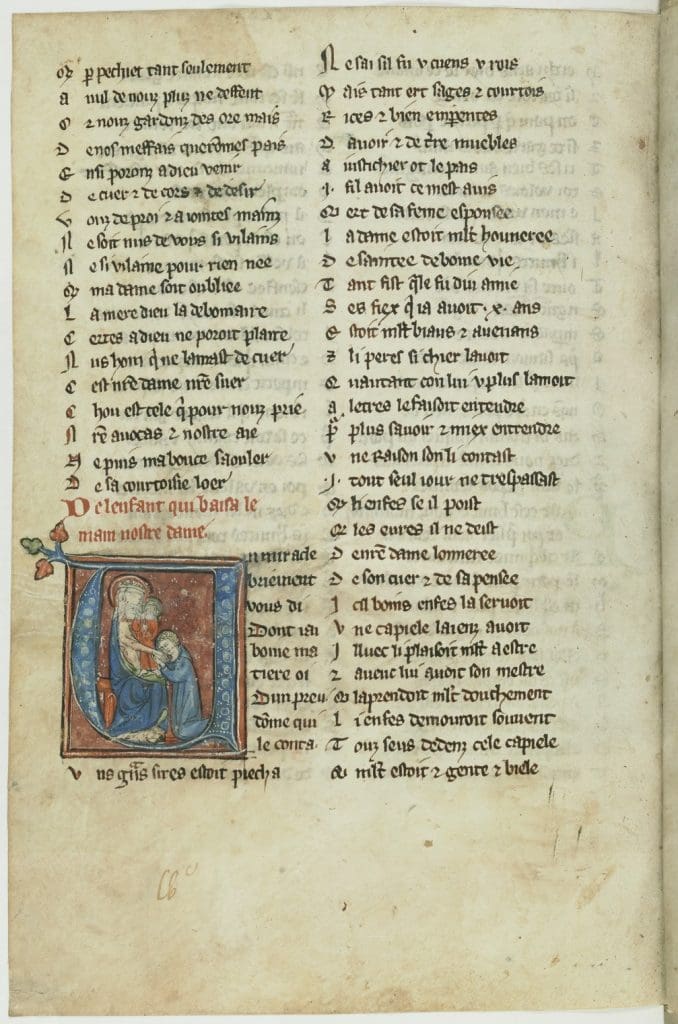
Fig. 1. “Image de Notre-Dame,” or “Of the child who kissed the hand of Our Lady,” from a later recension of the Vie des pères, BnF Fr. 1039, fol. 211v, thirteenth century (photo: Bibliothèque nationale de France) https://gallica.bnf.fr/ark:/12148/btv1b10022506j/f434.item.
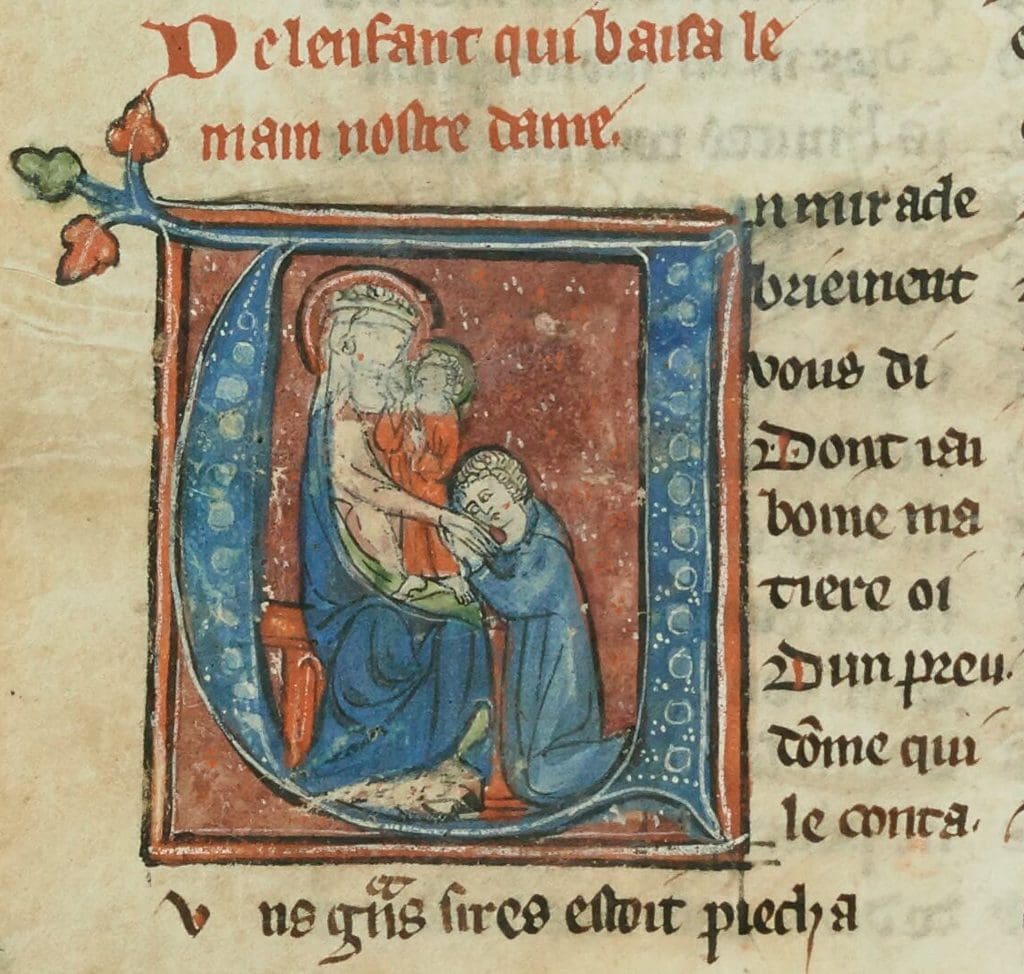
Fig. 1, detail.
Variations on this theme abound. For example, another tale with characteristics in common with Edmund’s vita is to be found in the seventh book of the Speculum historiale, concerning the miracles of the Virgin, compiled by Vincent of Beauvais (ca. 1190–1264). As depicted in a late fourteenth-century Old French translation (Fig. 2), a group of young clerks set about playing a ball game in front of a church. One of the young men had a ring, a token from his lover, that he wanted to keep safe. Looking for an appropriate place to store his ring, he entered the church. Inside, he admired the beauty of a sculpted image of the Virgin and devoutly knelt before the statue. He then placed his ring on its finger and prayed that he might be found worthy of her love in return. As he looked on in astonishment, the statue bent its finger (digitum suum imago constrinxit), ensuring the ring could not be removed and, in doing so, acknowledges the youth’s prayer. Later, with the memory of the encounter having nearly faded from his memory, the youth is married. On his wedding night, however, the Virgin appeared and accused him of infidelity. Terrified by the Virgin’s threats, he left straightaway to become a monk and serve her the rest of his days.[12]
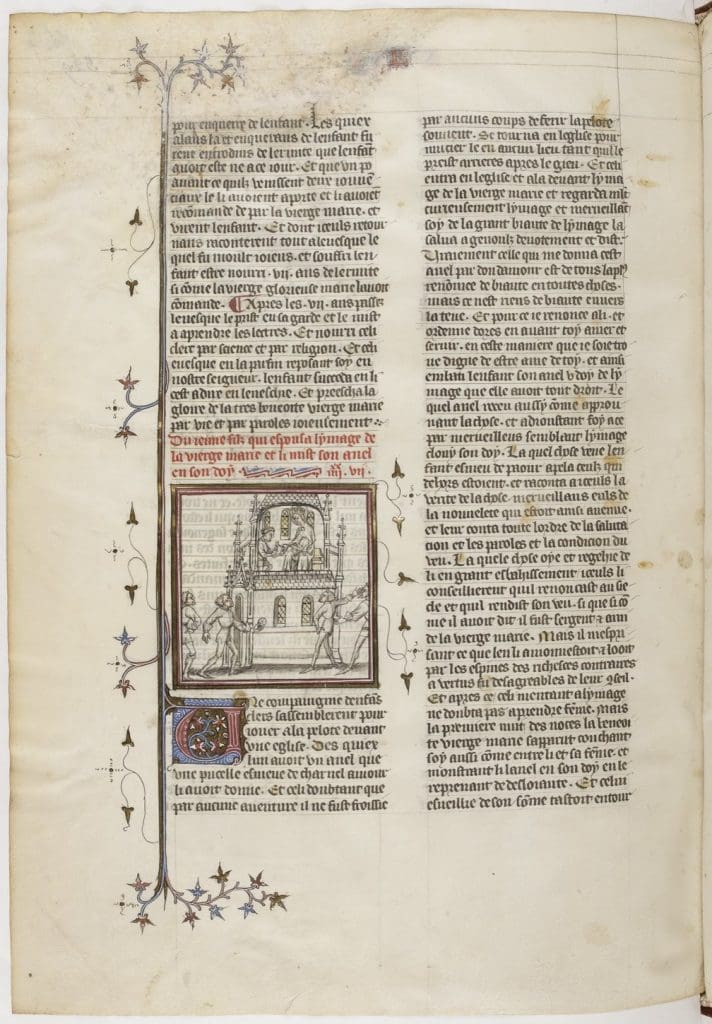
Fig. 2. “The youth who married the image of the Virgin,” from the Miroir historial (an Old French version of the Speculum historiale by Vincent of Beauvais, translated by Jean de Vignay), illumination attributed to the Maître de la mort and Perrin Remiet, BnF Fr. 312, fol. 329v, 1396 (photo: Bibliothèque nationale de France) https://gallica.bnf.fr/ark:/12148/btv1b8452197q/f664.item.
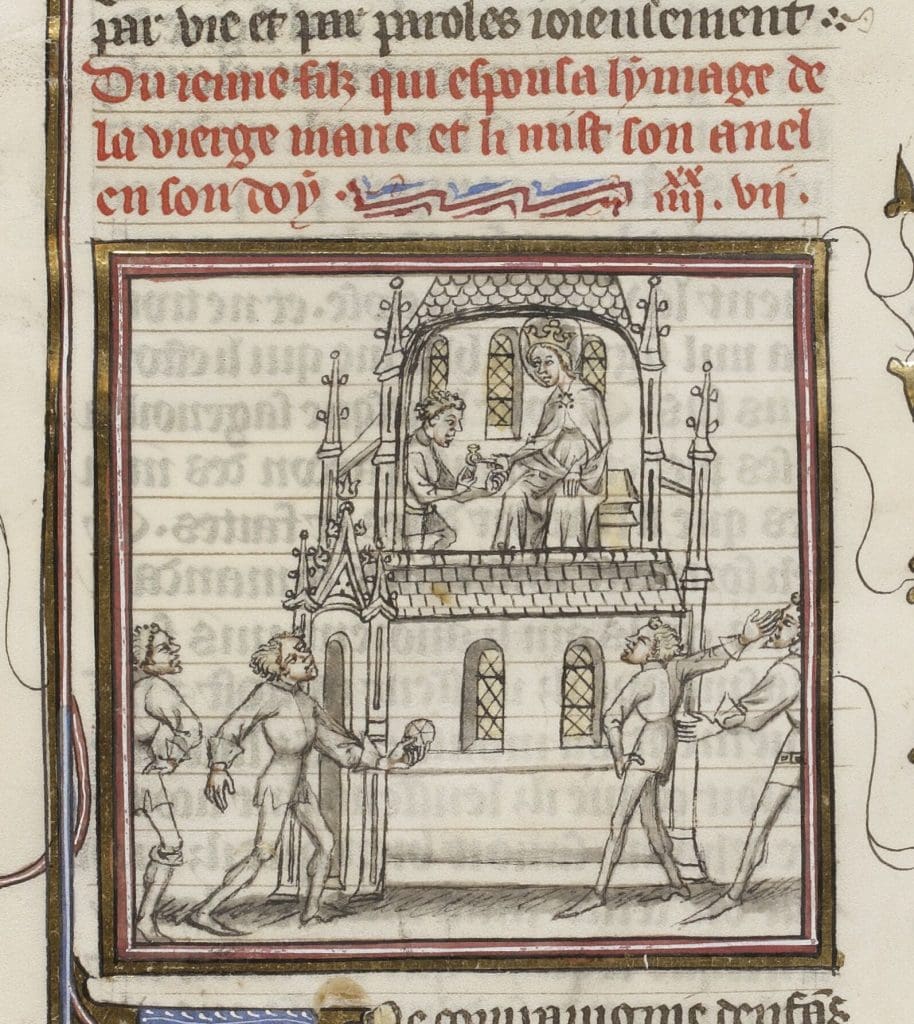
Fig. 2, detail.
Whether young Edmund was himself inspired by similar tales, which seem to have been circulating since at least the twelfth century, or the chroniclers posthumously inserted the tale into his life, it is clear that medieval audiences were familiar with the trope of statue marriage through word and image.[13] His and the similar “marriages” to the Virgin, however, represent a relatively narrow, fully Christianized manifestation of the trope. If we step back and survey the landscape of medieval literature with a wider lens, we find a range of distinct yet clearly related stories circulating concurrently in northern Europe. Broadly speaking—at least in terms of the present study—“statue marriage” may be considered a delicate shorthand for any instance of love or lust directed toward a statue, from boyish vows of chastity made to a sculpture of the Virgin to tales of agalmatophilia. Furthermore, for the purposes of this exploration, it is not necessary to concern ourselves with the legal and social intricacies of medieval marriage customs. Instead, the value of the trope lies in the fact that it underscores notions of attraction to and relationships with three-dimensional anthropomorphic images.
In the end, it is the manner in which the trope is utilized that emerges as the most revealing factor. In fact, it is remarkable that such stories are told at all in the contexts of a saint’s vita or miracle collection. The centrality of the sculpture to the ritual, its subtle yet unmistakable expression of agency, and the favorable light the interaction shines on the protagonist all seem to defy centuries of Christian warnings about the potential dangers of sculpted images and attempts to limit their use in devotional practices. The presentation of these youths’ interactions with sculpted images of the Virgin as natural, exemplary, even charming, belies the fact that even a century or two earlier the same actions might well have been portrayed as idolatrous. This sea-change of attitudes, beliefs, and practices must be set against the long tradition within Christian rhetoric of deriding figural sculpture. Other crafts and media had been easily legitimized through stories around figures such as the Old Testament craftsman, Bezaleel, or later, the saintly Merovingian goldsmith, Eligius. An unsavory stigma had, however, clung to anthropomorphic sculpture. Rather than being able to rely on scripture for justification, which offered little more than invectives against “idols,” the craft of sculpture was forced to swim upstream against that rhetoric.
The significance of the circulation of tales of statue marriage as positive exempla in Christian contexts is magnified further when the trope’s ancient—and decidedly “pagan”—origins are understood. Evidence suggests that the trope itself is a vestige of the custom of ritual sacred marriage which can be traced back millennia in the Mediterranean and Near Eastern worlds.[14] These rituals began, it seems, as the symbolic union of two deities, represented by their images, or of a human, such as a king or priest in a ceremonial role, with a deity. The myth of Pygmalion is, in fact, a direct offshoot of these traditions. As will be discussed, in the earliest versions of the myth, before it was adapted by Ovid, Pygmalion was a king of Cyprus—the center of the cult of Aphrodite (Venus)—who was consumed by an uncontrollable attraction to the statue of the goddess. Later, in Ovid’s telling, the statue was vivified by Venus herself in answer to Pygmalion’s prayer for a wife (coniunx) like his ivory maiden.[15] The memory of this ancient rite, which lived on in the figure of Pygmalion, was taken up by early Christian apologists in their attacks on paganism, especially pagan religions’ link with sculpted idols. During the twelfth and thirteenth centuries, however, as will emerge, medieval authors are found seizing upon the trope and endowing it with positive exemplary potential.
Here, it is also helpful to pause briefly to acknowledge a temptation to link the trope of statue marriage with the concept of mystical marriage as developed in the exegesis of the Song of Songs, where the bride (sponsa) is variously interpreted as the individual Christian soul, the entirety of the Christian Church, or the Virgin Mary herself.[16] A tale like Edmund’s indeed lends itself to such a reading, his actions potentially seen as structurally equivalent to the ritual consecration of nuns.[17] This interpretation, while not wholly implausible, risks the danger of misunderstanding the trope’s significance and function for at least three reasons. First, it takes for granted that a story centered on statuary came to be used in exemplary contexts in a religion that long derided such images as idols. Second, as will be shown, the origins of the trope of statue marriage are distinct, older, and its literary functions more diverse. Third, and most importantly, the nature of the animation displayed by statues in miracle tales of the twelfth and thirteenth centuries, including instances of statue marriage, replaces the strictly symbolic actions of the earlier period with behavior meant to underscore the equivalence, presence, and efficacy of the sculpted devotional image. As Michael Camille pointed out, statues in the medieval imagination during this time begin to “do more than ‘act out’ theological roles…. They start to do some very human things.”[18] In other words, they cease being symbolic objects performing symbolic acts and begin to be presented in ways that promote their potential to function as physical presences. This does not necessarily negate a symbolic reading but should also alert us to the complexities of a society’s changing relationship with religious sculpture.
The transformation of the trope of statue marriage from a warning about the dangers of idolatry to an exemplary device can be viewed as one vivid indicator of changing perceptions of sculpture, now granted a licit place within para- and extra-liturgical devotion. During this period, there emerges a discernable pattern of the inversion of Christian rhetoric against sculpted bodies. By this is meant that the arguments drawn from scripture to buttress the church’s position on images—specifically three-dimensional anthropomorphic images—can be seen, in many instances, as being quite literally reversed. Where once the iconophobic voices of saintly protagonists represented a conservative and generally accepted orthodoxy, their battle cries against the idols of the pagans are later found emanating from the mouths of antagonists. At best, those who give voice to these anti-sculptural sentiments are cast as outdated and out of touch, while at worst they may be characterized as bordering on heretical. The function of these iconophobic voices shifts to serve as a foil to new voices that champion the efficacy of sculpted images and provide justification for those who fashion them. The appearance of statue marriage as a trope of exemplary devotion is among the most powerful manifestations of this inversion.
From Venus to the Virgin in the Vie des pères
The trope of statue marriage flourishes within an expansive and variegated forest of related stories and customs from which it draws its force and meaning. Its roots can be found reaching deep into the ancient world while its tendrils have crept into the modern world as robotics and AI strive to make the dream of the living statue a reality.[19] It would not be possible in the space of this study to catalogue all of these precedents and parallels, nor is it necessary. What is key is that not long before Edmund’s vita was composed, statue marriage was a narrative device employed primarily to attack paganism. Instead of being used to convey devotion and chastity, it is found signaling deviance and serving to ridicule idols. This function of the trope is brought into clear focus when we recognize that before the ring was given to the Virgin, it was given to Venus.
The earliest direct medieval precedent for Edmund’s betrothal to a statue is found in the Gesta regum Anglorum by William of Malmesbury (d. ca. 1143), composed in the early decades of the twelfth century.[20] As something of an urtext for one of the main medieval branches of this trope, a detailed synopsis is appropriate. William’s tale is set in Rome, a city renowned for being replete with statues of pagan deities. It tells of a young man from a high-ranking family, recently married, who threw a feast. As part of the festivities, he and his friends went to the Campus Martius for some exercise and sport. Before they began, he placed his wedding ring on the outstretched finger of a bronze statue (anulum sponsalitium digito extento statuae aereae) for safekeeping.[21] The text does not at this point specify the statue’s identity, nor does it make any comment on its appearance other than its material. When he returned, he found that the statue’s finger had curved around the ring making it impossible to remove. He concealed this turn of events for the time being but returned during the night with his servants to retrieve it. To his surprise, he found that the statue’s finger was once again outstretched though the ring was gone!
That evening, as he lay in bed with his wife, he felt an eerie presence. Something invisible, dense but nebulous (nebulosum et densum), kept the newlyweds apart as they lay in bed. Suddenly, he heard the voice of Venus claiming him as her own.[22] Night after night, for “a considerable time” (elapsum est in hoc multum tempus), he and his wife were kept apart by this invisible force (though, as William took care to note, the man was otherwise fit and full of vigor). Finally, the couple and their families resorted to a priest named Palumbus who appears to have been more adept at necromancy and magic than the mass.[23] For the promise of a considerable fee, this priest provided the young man with a sealed letter and instructed him to stand at a crossroads. There, in the dead of night, he saw a ghostly procession. At the end of the ghastly retinue was a figure taller than the rest who appeared to be their master. Without saying a word, the young man delivered the letter to the demon who recognized the seal (demon, notum sigillum). Compelled by the contents of the letter, the demon shouted a curse to God against Palumbus and sent his servants to take the ring from Venus, thereby freeing the young man from his impotence. As for Palumbus the magician, he is said to have met a violent end after confessing his crimes before the pope and whole city.
This story, though untitled in William’s text, has come to be referred to as “The Bachelor of Rome.” Aside from being set in an at least partially Christianized Rome overseen by a pope, there is nothing overtly Christian about this early version. The demon at the end of the procession—easily read as the Devil—was defeated by magic, not a Christian miracle. Venus was forced to return the ring, relinquishing her claim on the young man, which allowed the sexually frustrated couple to finally consummate their marriage. The Virgin, who will appear in later variants of “The Bachelor of Rome,” is conspicuously absent. If one were to extract any lessons from the story, they might be not to practice magic (even if capable of compelling the Devil) and to beware of pagan statues, like that of the idol Venus, as they might be a vessel for a demon.
It is a bizarre and striking tale that clearly resonated with the medieval imagination. At some point between the appearance of William of Malmesbury’s tale told in the Gesta regum Anglorum (ca. 1125) and Matthew Paris’s vita of Edmund (ca. 1246), a new branch of the story had sprouted which saw the recipient of the ring change from a pagan statue of Venus to a devotional image of the Virgin. Though it is unclear when exactly this new variation emerged, we do know that in the early thirteenth century, likely around 1215–30, an anonymous author adapted William’s Latin text (or similar retelling) into their own unique composition in Old French known as the Vie des pères.
Though frequently copied into or bound with other miracle collections, the fabliaux-like exempla that comprise the text of the first recension of the VdP give it a distinct tone that set it apart.[24] The anonymous author was a keen observer of contemporary life and the text was meant to resonate with the values and perspectives of a thirteenth-century urbanized borjois.[25] As Adrian Tudor has pointed out, the text of the first recension, in effect, “acts as an idealized manifesto of popular religion, beliefs, and behavior.”[26] In other words, the text as a whole is a creative synthesis of elements that speaks to relevant observations and anxieties of a broad audience by melding existing tales, familiar images, and persistent questions.
The conte known simply as the “Image de pierre” in modern editions demonstrates how the author of the VdP offers a fresh perspective on inherited lore. To classify this story as simply a retelling of William of Malmesbury’s “original” would be to misrepresent it entirely. While the author of the VdP indeed borrowed William’s story, here it forms the nucleus of a far more expansive and complex narrative. In fact, less than one fifth of its verses can be said to be derived from William’s version.[27] It is also distinct from the popular fully-Christianized inversion of William’s tale found in Vincent of Beauvais’ Speculum historiale (see Fig. 2, above), Gautier de Coinci’s Miracles de Nostre Dame, the Cantigas de Santa Maria, Jean Gobi’s Scala coeli, and other texts which essentially swap Venus for the Virgin.[28] In the VdP, statues of the pagan goddess and the Virgin Mary both appear in a story that explicitly describes a turning point in Christian visual culture.
Given the story’s exceptional character and the insight it is capable of providing, a detailed synopsis is again necessary. After a prologue that offers musings about pride and the fleeting nature of life, the story proper opens in Rome during Gregory the Great’s papacy (590–604). In order to rid the Eternal City of its pagan error, Gregory had ordered that all of the statues in the city be mutilated. The remnants of their stone bodies were then gathered in places such as the Colosseum so that all could see that the gods of the pagans were nothing more than material images, readily destroyed, “because in wood or in stone one cannot reasonably find knowledge or truth.”[29] Ironically, it is this sentiment that the story will eventually upend.
With the stage set and an atmosphere of iconophobia established, the narrative now retells the story of the ring on Venus’ finger that can be traced back to William, though with a few notable modifications. For one, the author is careful to note that the youth, upon seeing a statue of a woman—apparently one that had survived Gregory’s iconoclastic campaign unscathed—with its hand open as if ready to receive a ring, is amused at the situation and “marries” the statue in jest.[30] Curiously, the troublesome statue is never actually identified as Venus in the text. When first encountered by the young man, it is described only as an image sculpted in the form of a woman (Une ymaige…en forme de feme entailliee) and afterwards only referred to as “the image” (l’ymaige).[31] Nevertheless, context and its obvious relationship to William’s source material make the identity of “l’ymaige de pierre” clear.[32]
In a late thirteenth-century manuscript (BL Add. MS 32678), the initial “S” at the opening of the prologue to the tale, though small and partially worn (Fig. 3), shows the young man, wearing a red tunic and green leggings, placing a ring on the figure of the “ymaige de pierre,” a robed female figure painted white with blue accents. The identity of this figure as a pagan idol is conveyed in two ways. First, the figure, following long-standing convention, is set atop a column as indicated by a capital with blue volutes and red abacus below her feet. Second, its specific identity as Venus is suggested by the coy gesture of the figure’s left hand. This gesture recalls the Venus pudica pose of the famous Knidian Aphrodite of Praxiteles, known through copies including the Capitoline Venus in Rome (Fig. 4) or the Medici Venus (Fig. 5) in Florence.[33]
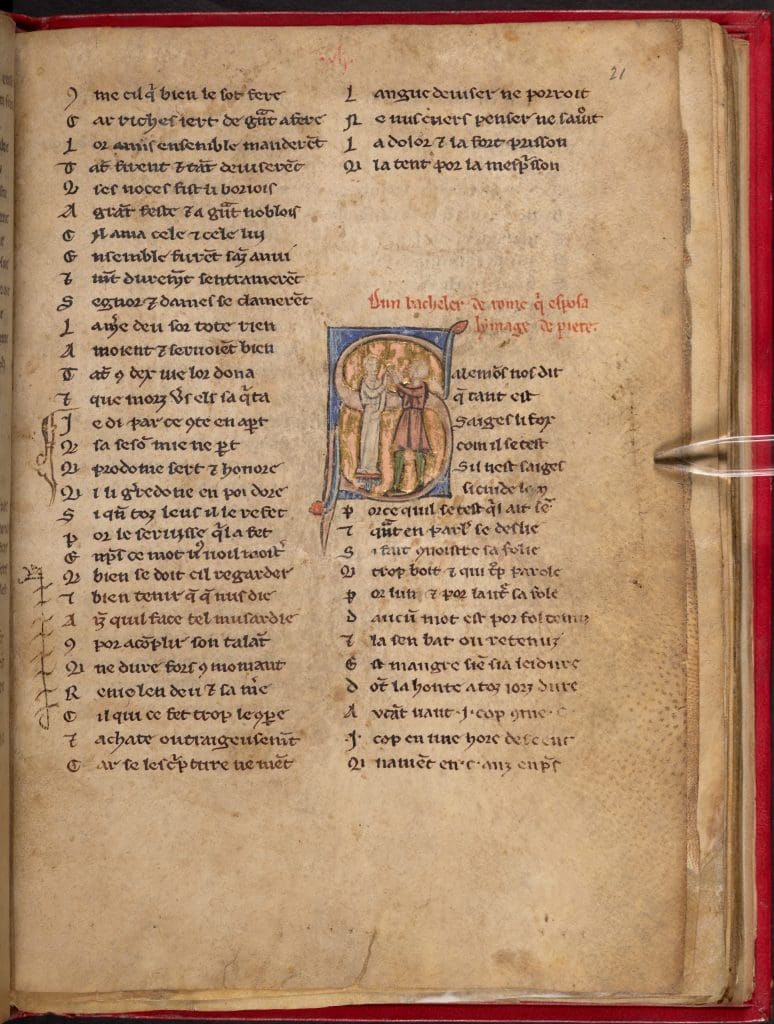
Fig. 3. “L’ymage de pierre,” as told in the first recension of the Vie des pères (here as Vie des
anciens pères), from the British Library Collection, Additional MS 32678, fol. 21r, late thirteenth century (photo: The British Library).
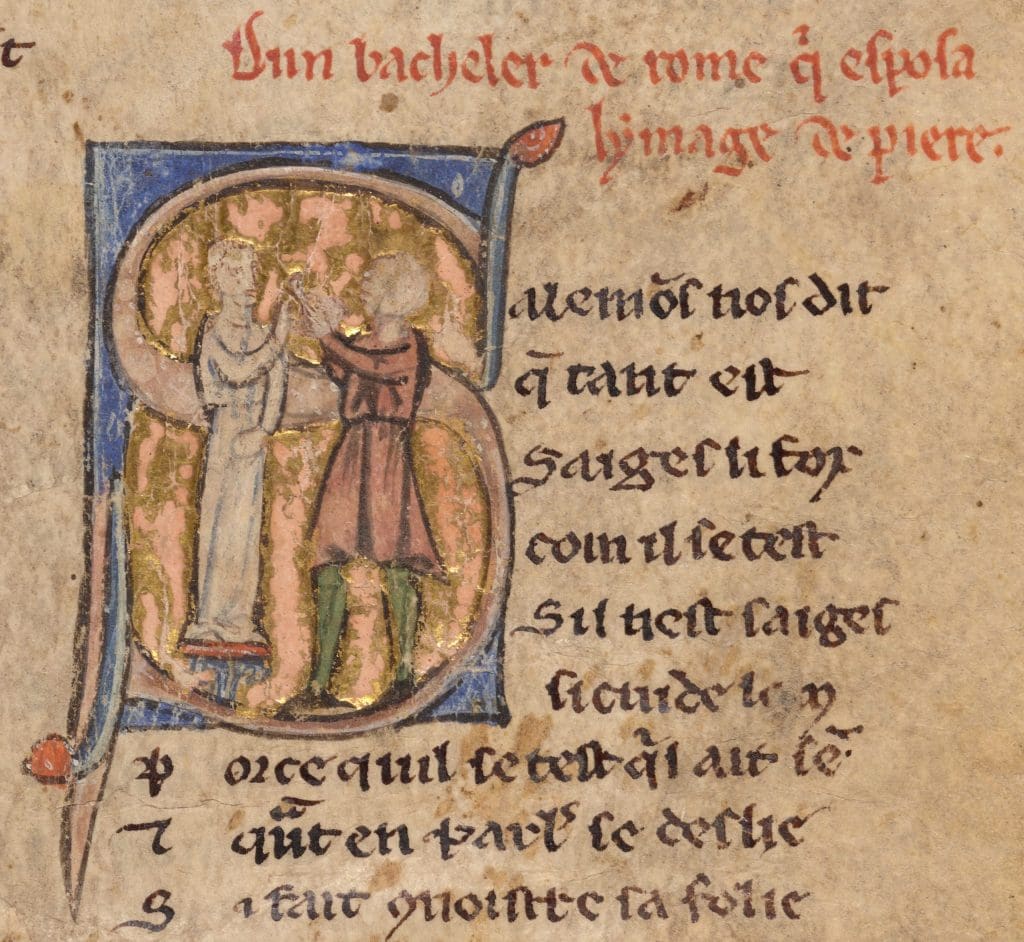
Fig. 3, detail.
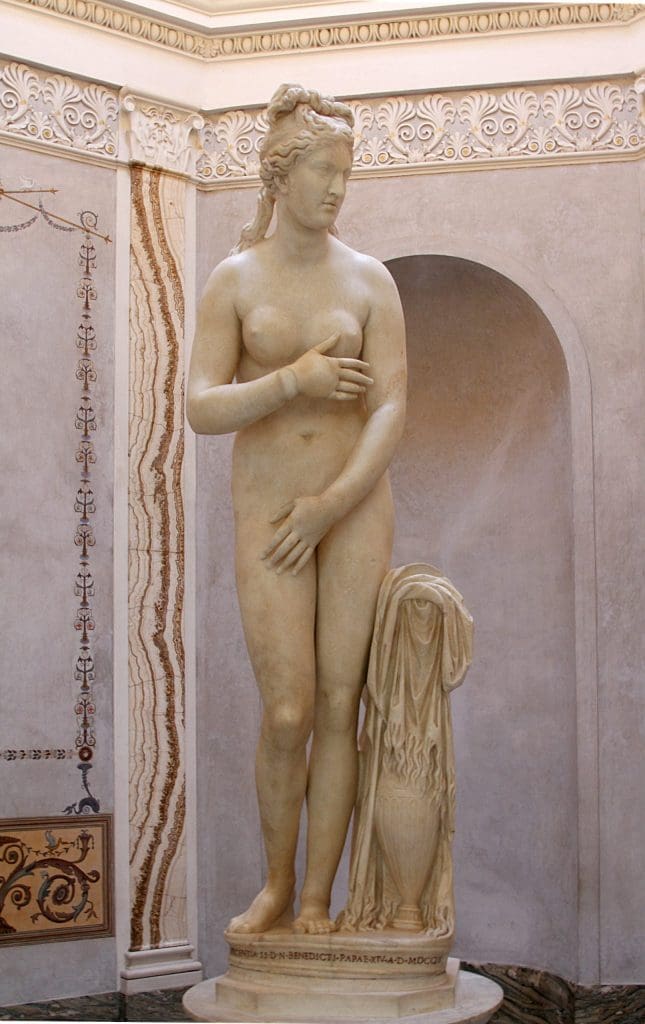
Fig. 4. Capitoline Venus, marble, copy of the fourth-century BCE original by Praxiteles, Rome, Capitoline Museum, inv. MC0409 (photo: José Luiz Bernardes Ribeiro, CC BY-SA 4.0, Wikimedia Commons).
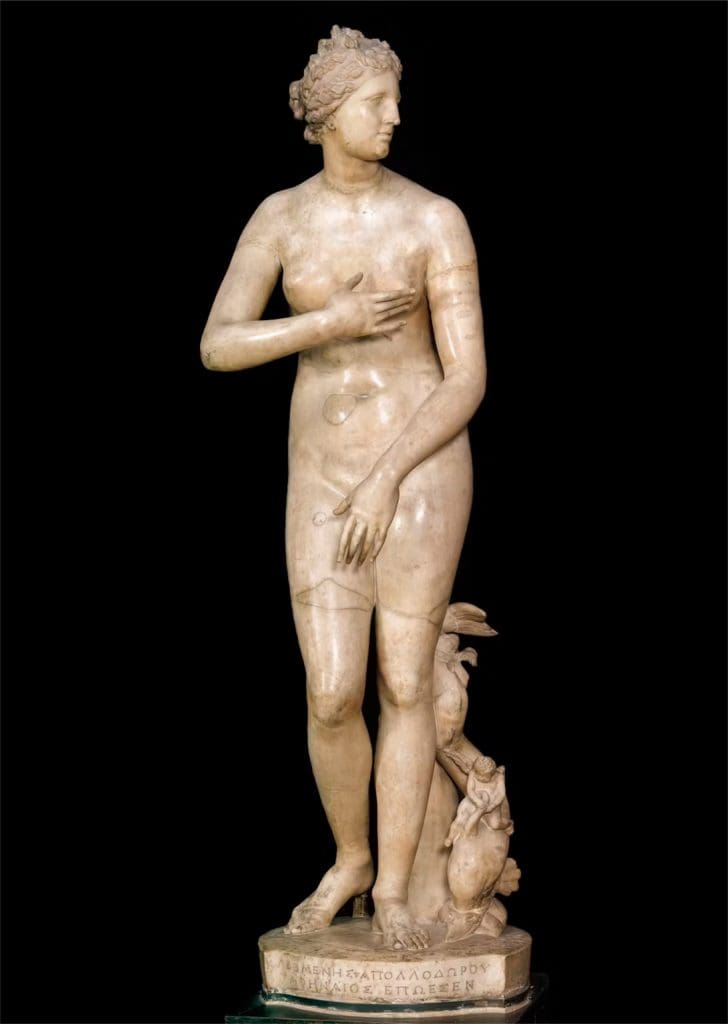
Fig. 5. Medici Venus, copy of the fourth-century BCE original by Praxiteles, The Uffizi, Florence, inv. 1914 n. 224. https://www.uffizi.it/en/artworks/medici-venus.[34]
At least one similar sculpture was known to thirteenth-century audiences. In the twelfth chapter of Master Gregory’s Narracio de mirabilibus urbis Romae, in which he describes his impressions of the monuments of Rome, a marble statue of a nude Venus emerges as having been particularly captivating.[35] The illuminator of the copy in the British Library has opted for modesty and represented the figure fully clothed in a long-sleeved belted tunic that gathers at her feet. Yet, her pose echoes the ancient sculptural type. While the left hand reaches down as if to cover her pudenda, her right arm is bent sharply at the elbow and held across the chest, where her hand is met by the hand of the young man bestowing the ring. Many surviving antique sculptures of Venus depict the goddess with the fingers of her right hand extended as she attempts to cover herself in feigned surprise, a gesture that all but invites the bestowal of a ring. The text of the VdP recalls this sculptural detail, specifically stating that the statue’s right hand was open.[36]
Another noteworthy modification of William’s story found in the VdP is that rather than a ghostly cloud interrupting the newlyweds in their bed, it is “l’ymaige” itself that haunts them. The physicality of the statue is insisted upon by the text which states that the couple was forced to leap out of bed naked to avoid being crushed when it attempted to join them. The image’s materiality is also emphasized in an early fourteenth-century manuscript of the VdP in The Hague (KB MS 71 A 24) (Fig. 6) in which the illuminator seems to take liberties with the text. Rather than representing the “ymaige de pierre” as white marble as one might expect, it is rendered in olive drab, suggestive of the patina one might expect on the statuae aereae found in William of Malmesbury’s account. In the right panel, the youth and the statue—whose positions mirror those of the left panel—stand over the bed in which his bride still lies as Venus accuses the youth of infidelity. The monochrome animated statue now dramatically points to the living woman, depicted with white skin and rosy cheeks, further underscoring the difference between artificial and organic bodies. Finally, while the couple resort to calling a priest to aid them as they do in William’s version, in the VdP they are aided by a devout Christian chaplain who proves to be not nearly as effective as Palumbus had been.
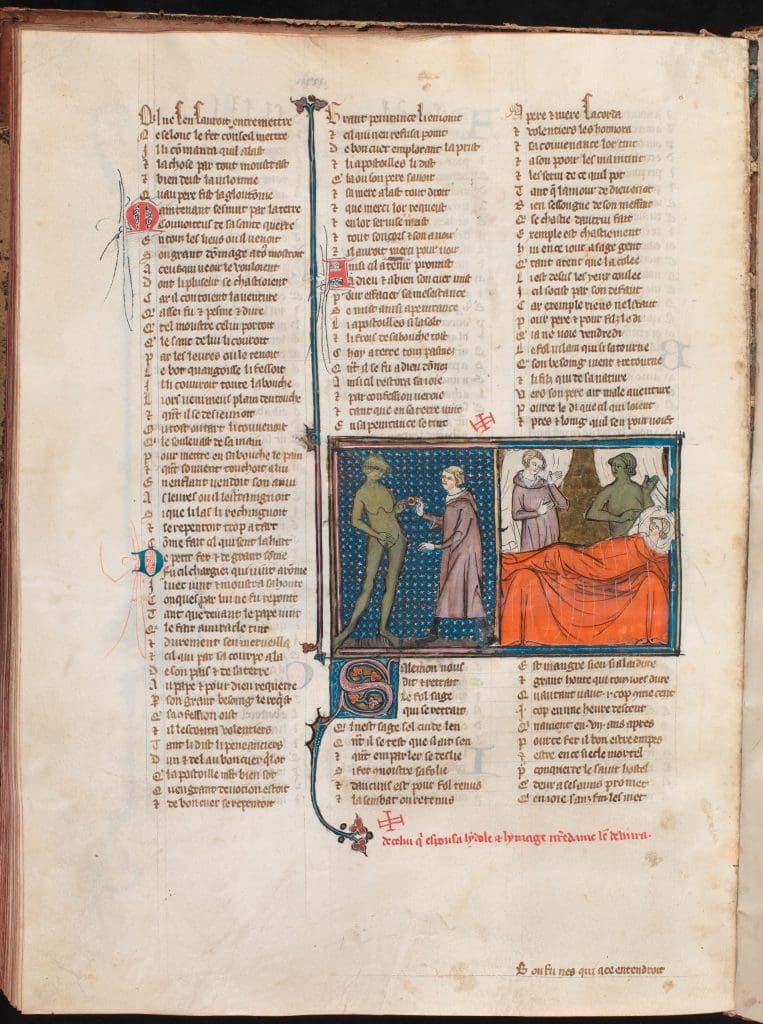
Fig. 6. “Image de pierre,” from the Vie des pères, The Hague, KB, National Library of the Netherlands 71 A 24, fol. 104v, 1327 (photo: National Library of the Netherlands).
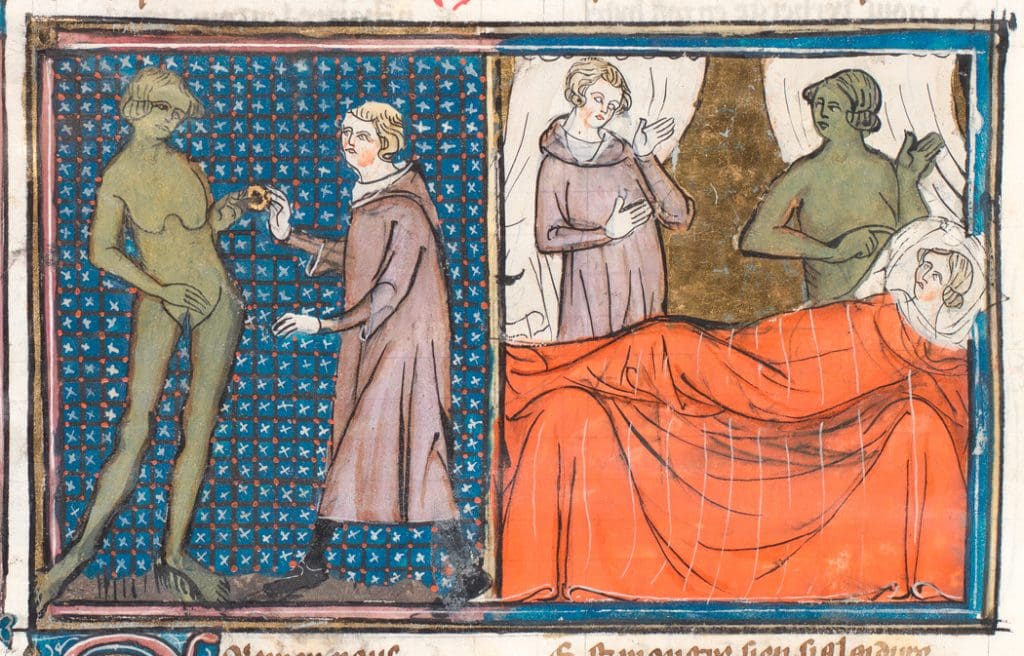
Fig. 6, detail.
It is at this point that the story diverges from its source material and ventures into new and otherwise unattested territory. The chaplain has the couple get into bed together in order to provoke the demonic ymaige. When the statue returns, fully animated, it speaks. As it presents the priest with the ring, it points out that the youth married her/it of his own free will and suggests that to presume such a vow means nothing would mean deviating from their own Christian laws. Outmaneuvered by the demonic statue, and with his holy water, stole, and crucifix proving to be ineffective, the priest flees, leaving the young couple to the statue’s mercy. With nowhere left to turn, they bring their predicament to Pope Gregory himself. The pope, recognizing the legal bind that the youth has found himself in, is also at a loss. He orders the youth to abstain from relations with his wife and to not tell anyone about the matter.
Unable to resign himself to this fate, the youth eventually leaves Rome in search of a renowned hermit whom he believes can help. The hermit advises him to devote himself to the Virgin, which he does, spending a good deal of effort and money building up her cult. Eventually, the Virgin, moved by his devotion, appears to him in a vision and commands him to have an image of her made. She specifies that it should depict her holding her son in front of her—an image conforming to the ubiquitous “throne of wisdom” type—and that he should spare no expense so that it is so exquisite, so well carved and painted, that no one could find fault with it.[37]
For the early thirteenth-century author and his audience, this description would have called to mind elegant contemporary images exemplified by the enthroned Virgin and Child now held in the Metropolitan Museum (Fig. 7). Traces of polychromy and numerous cavities once filled with semiprecious stones suggest the original radiance of the regal image. Moreover, this carved oak figure stands at just over four feet meaning that one would be virtually eye-to-eye with the Virgin if kneeling before it on the same plane. The stately presence of this and similar sculpted images of the Virgin was, however, undoubtedly amplified once placed on an altar. Understandably shocked by his vision demanding the creation of such an image, the youth consulted the pope, conveying the Virgin’s command and seeking council.
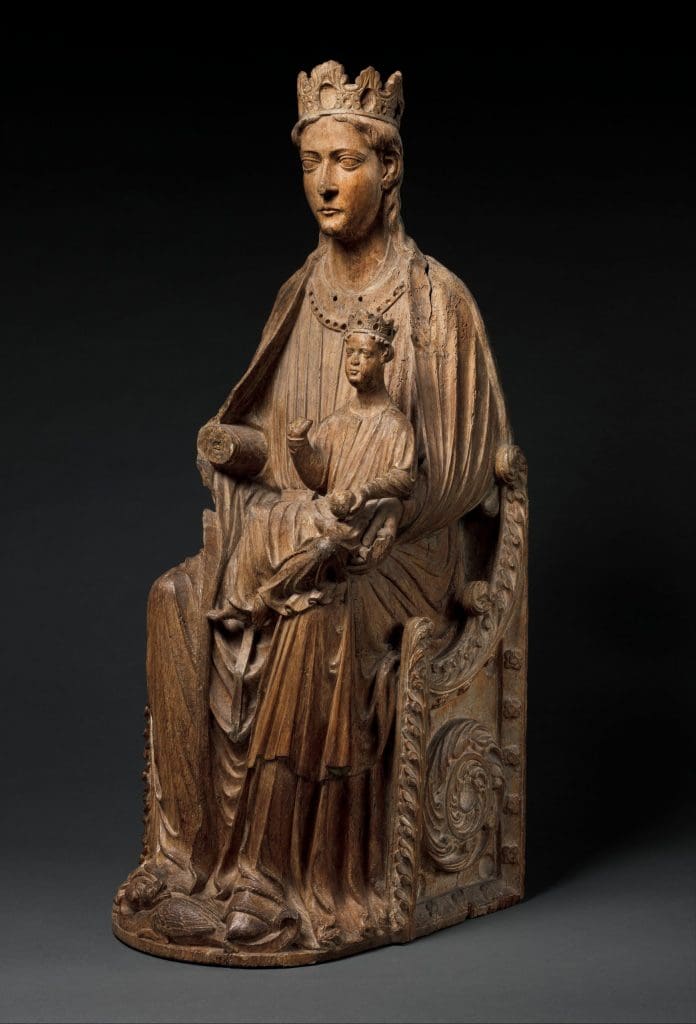
Fig. 7. Enthroned Virgin and Child, oak with traces of polychromy, produced in the Meuse Valley, ca. 1210–20, acc. no. 41.190.283 (photo: Metropolitan Museum of Art) https://www.metmuseum.org/art/collection/search/467997.
It is here that the story’s relationship to the history of sculpture snaps into sharp focus. Pope Gregory, in opposition to the wishes of the Virgin, warns the youth that statues of any kind are strictly forbidden and that anyone who sets one up—even if it is of the Virgin—would be subject to the church’s justice. Recalling the story’s opening, the author reminds the reader that sculpture had been forbidden because, as they say, such images were worshiped by weak minds.[38] The youth heeds the pope’s council and returns home, resigned to defying the Virgin’s command. But she then appears to him on a second and third night, her anger multiplying each time she is disobeyed. During her third visit, she vehemently chastises the youth and asks why she should not be worshipped everywhere throughout the city just as the pagan gods were?[39] Is she not more worthy of statues than those demons? The youth is given a deadline and threatened with death and damnation should he continue to disregard her wishes.
Gregory, finally convinced, allows the youth to fulfill the Virgin’s wishes. The young man then seeks out the best craftsmen in the city who fashion a statue of the Virgin adorned with silver and gold, so perfect that it was admired by all. The image was set up in Santa Maria Rotonda (the Pantheon) and word quickly spread of the new and exceedingly beautiful statue.[40] Soon, the church was crowded with people who came to prostrate themselves before it and pay homage to the Virgin. The author of the VdP is careful to note that the fame of the Virgin’s statue was due not only to its enchanting beauty but also because no one had ever seen anything like it since it was the first of its kind (por ce ke c’estoit la premiere).[41]
The story does not end there. The youth continued to serve the Virgin until one day, in the presence of a large crowd of clerics and laymen, knights and ladies, the statue of the Virgin miraculously disappeared. It soon reappeared, though now wearing a ring that the youth recognizes as that which he had jestingly presented to the demonic statue. The first thread of the story is tied off as the Virgin, having freed the youth from his bond with Venus, gives back the ring, thus allowing him to return to his marriage after seven long years. The second thread is resolved when Gregory orders similar statues of the Virgin to be set up throughout Christendom while the remnants of the pagan statues that had littered the city were used to pave the roads and sewers of Rome.
The climactic moment of the Virgin’s reappearance is depicted in the right panel of a trio of images that illustrate this story in a manuscript in the Royal Library of Belgium (MS. 9229–30) (Fig. 8). In this image, the illuminator has deviated from the text by showing the ring in the infant Christ’s hand rather than in the Virgin’s, perhaps a careful concession that while the youth has relied on the intercession of the Virgin, it was in fact the power of Christ that has freed him from his bond to the statue/demon. As a whole, this triptych depicts the illicit pagan idol at the far left while the newly licit statue of the Virgin and Child is shown at the far right. Between these two images of animated statues is a scene of the youths wrestling. This central scene of contestation, positioned like a fulcrum between the pagan past and Christian future, visually underscores the Virgin’s challenge to Venus, Pope Gregory, and centuries of Christian iconophobia.
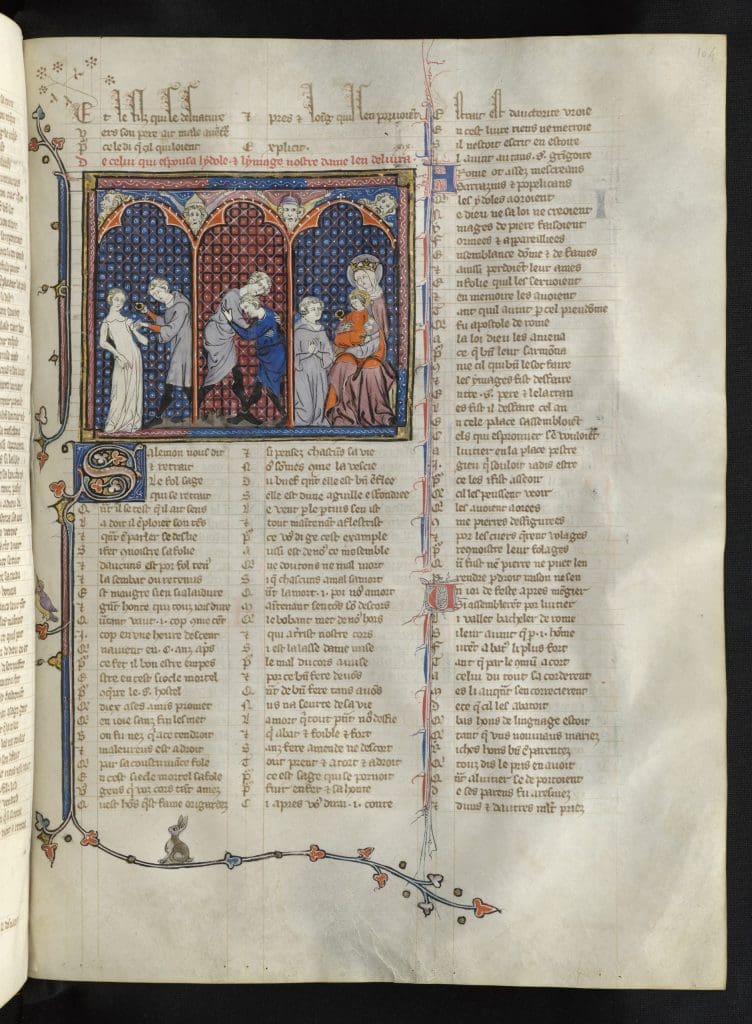
Fig. 8. “Image de pierre,” Vie des pères, Royal Library of Belgium (Koninklijke Bibliotheek van België), MS. 9229-30 [Recueil de légendes pieuses, vol. 2], fol. 104r (digitized index number 211), early fourteenth century, https://opac.kbr.be/LIBRARY/doc/SYRACUSE/18412937.
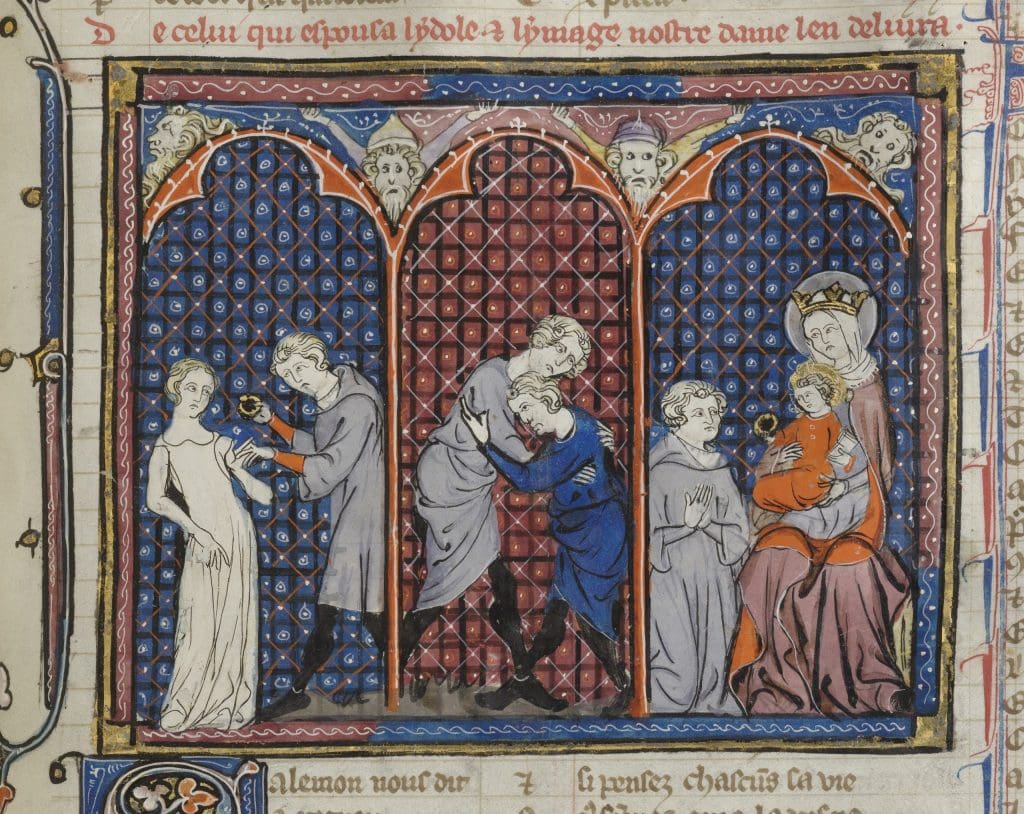
Fig. 8, detail.
It is difficult to overstate the value of this text in the VdP as a source of insight into the thirteenth-century sculptural imagination. Far more than a run-of-the-mill miracle tale, this story seeks to capture an important moment—albeit an imagined one—in the history of Christian sculpture. It specifically calls attention to a decided reversal in the church’s stance on images as it recounts the imagined genesis of sculpted images of the Virgin.
The Inversion of Rhetoric
Among the many things that make the text of the VdP remarkable is the historical and artistic awareness it evinces. While the tale ostensibly has moral lessons to convey, it can also be read as the recognition of a demonstrable change in mainstream medieval French visual culture. At the center of a tale about a statue animated by diabolical forces and a thwarted sexual relationship is an origin story of the sedes sapientiae sculptural type along with divine justification for the proliferation of statues of the Virgin. A key plot point is the introduction of Christian devotional sculpture—specifically statues of the Virgin—as a replacement for, or better yet, a challenge to ancient pagan statuary, made at the command of the Virgin herself. Central to the narrative is an awareness that Christian iconophobic rhetoric ran so deep that, at least in the context of the tale, it took nothing short of divine intervention to overcome it.
That this story about the reversal of Christian rhetoric against sculpted images should be set in the time of Gregory the Great was, without a doubt, deliberate. By the thirteenth century, Gregory’s reputation as an iconoclast had been firmly established. In the twelfth century, for example, John of Salisbury (d. 1180) attributed the burning of the library on the Palatine to Gregory while the widely read and much-copied thirteenth-century chronicle of Martinus Polonus (d. 1278), the Chronicon pontificum et imperatorum, asserted that Gregory was responsible for ordering “the heads and limbs of the images [statues] of the demons” to be struck off.[42] When the author of the VdP described Rome under Pope Gregory as a city in which one would have found collections of the fragmented statues of the pagan past, it was an image that would have been familiar to a contemporary audience. Given this reputation, Gregory serves as an apt figure to voice the traditional iconophobic—even iconoclastic—position long held by the church. His voice functions as the foil to the “new normal” which is articulated by the youth acting as messenger for the Virgin.
The eleventh-century Liber miraculorum sancte Fidis offers invaluable insight into the early phase of this transitional period. Throughout, its author, Bernard of Angers (fl. ca. 1015), observes, records, and reflects on tensions and contesting attitudes with respect to the efficacy of sculpted devotional images. In chapter eleven, for example, he recounts the events surrounding a land dispute between the monks of Conques and a local noblewoman. The monks, hoping to leverage divine assistance to resolve the matter in their favor, threatened to involve their saint, Foy (Fig. 9). Hearing of their plan, one of noblewoman’s men, full of food, wine, and hubris, “asserted that he would not care a straw if the monks carried her statue (imaginem), which he thought of as a demon (larvam) that should be ridiculed and spat upon (ridendam et conspuendam), to the estate over which the two parties were wrangling.”[43] The man’s disrespect did not go unanswered as almost immediately the building collapsed, killing him and his family while all others were miraculously unhurt.
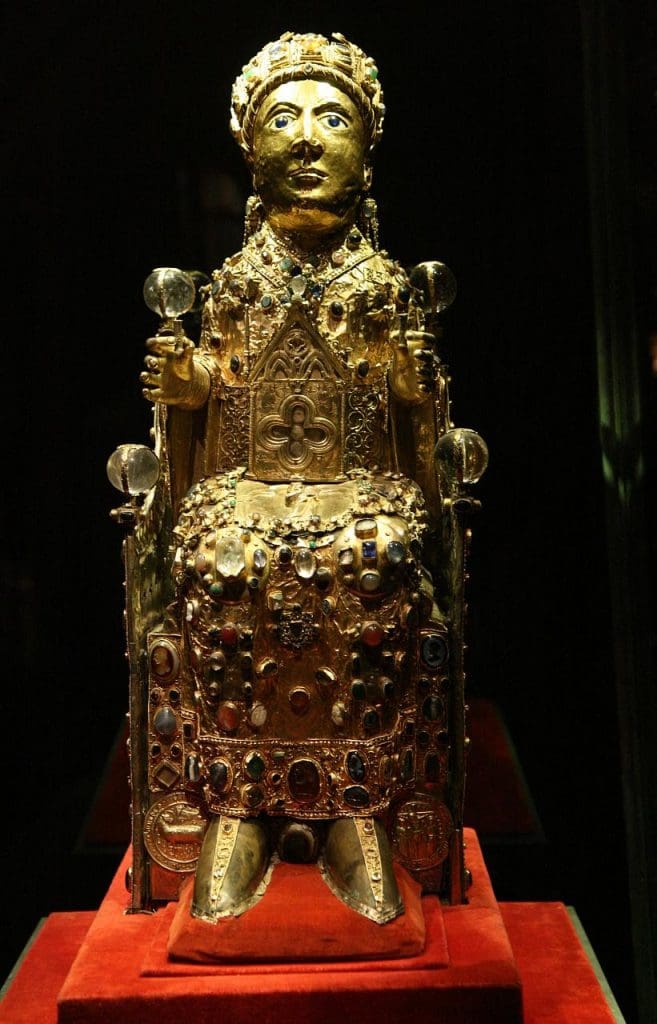
Fig. 9. Reliquary statue of St. Foy, Late Antique mask incorporated into a late tenth-century reliquary with later additions, Abbey Church of St. Foy, Conques (photo: Holly Hayes, CC BY-NC 2.0).
The drunkard’s attitude toward the reliquary image of St. Foy is not so far from Bernard’s initial view when he arrived in Conques. His position is, in fact, in line with earlier critiques of images and does not necessarily characterize him as unchristian. In this episode, however, the drunkard’s disrespect—and his now outdated view of images—casts him as the antagonist and the object of a cautionary tale. Of further significance in this case is that the equivalency between representation and represented, something that Christian rhetoric had repeatedly denied, is here insisted upon.[44] Words, actions, and attitudes—negative or positive—were understood to be capable of provoking responses from the statue/saint. Bernard’s text is replete with instances in which the image of St. Foy was indirectly responsive, efficacious, and equated with the saint herself—all inversions of even the most forgiving rhetoric against sculpted images that had long circulated.
Over the course of the next two centuries, the new stance towards images is encountered in a flood of stories of animated Christian images, tales found in histories, biographies, and miracle collections, the last a genre whose increasing popularity was linked, at least in part, to the flourishing cult of the Virgin. In his history of Glastonbury up to the year 1126, William of Malmesbury had included at least three references to animated images: a crucifix that spoke, another that shook, and another that bled when pierced.[45] A short time later, Walter of Cluny included in his De miraculis beate virginis Mariæ (1141) the story of an image of the Christ child which spoke to the boy who offered it bread.[46] Later still, Reginald of Durham (d. ca. 1190), in his life of Godric of Finchale (d. 1170), described in detail at least three episodes that center on the physical animation of images.[47] After one such event, in which Godric and a companion witnessed the actions of an animated crucifix, the saint is reported to have turned to his companion and said:
Human faith cannot doubt that the son of God, who underwent death for us, can pour the spirit of life into whatever he wishes. For he who just now gave the spirit of life to a piece of wood clearly demonstrates by such a prodigious sign of wonder that he lives always and sees everything. So, the power which comes from him gives life to everything which is born by breathing life into it.[48]
No medieval Christian would confess outright to worshiping the crucifix, a sculpted image of the enthroned Virgin, or a statue of a saint. Still, the rhetoric of the twelfth and thirteenth centuries assigned to sculpted images an ever-greater potential for efficacy and equivalency. This equivalency could be perceived as the presence of the saints themselves or as a sign of divine agency signaled through animation. In this regard, the object’s base materiality was crucial to the meaning and magnitude of the sign. God’s power was such that it could be infused into any matter, thus vivifying even inorganic material as if it were a living body. There is a clear shift of emphasis from warnings about the dangers of mere material images to using the potential of agency and animation of sculpted images as proof of divine power.
By the end of the twelfth century, sculpted images of Christ, Mary, and the saints had become objects integral to Christian devotion and were promoted in terms that would have been almost unthinkable a few centuries earlier. The Cistercian Caesarius of Heisterbach provided what is perhaps the most vivid and enthusiastic endorsement of religious images in the seventh book of his Dialogus miraculorum, written between 1219 and 1223. Following two consecutive stories of a particularly active image at Veldenz (near Trier), the interlocutors of his text, a Monk and a Novice, discuss the veracity and meaning of these miraculous occurrences.
Novice: I did not know up to now that there are such great consolations in the images of saints.
Monk: Saints work many wonders in and through these images, especially in those places where they are venerated. […]
Novice: [A]stonishment comes over me when I hear about a voice for speaking in wood, a hand for striking, a bending of the body, or standing upright, sitting, and the rest of the vital movements. […]
Monk: The divine spirit is in every creature through essence and potency; to it, nothing is impossible, nothing is miraculous. Every day this spirit works to affect these actions and ones similar to these to the honor of his saints.[49]
First, images—particularly anthropomorphic sculpted images—are no longer relegated to being, at best, mere ornament or, at worst, a potential spiritual pitfall. Instead, they are unequivocally understood to be efficacious and beneficial. Second, echoing the earlier sentiments of Godric, the belief that images have the potential to be animated by the Spirit of God and to behave as real bodies do is to be accepted without question.
All told, this exchange captures in exemplary fashion the ongoing process of the inversion of rhetoric regarding sculpted devotional images. Throughout the text of the Dialogus, and especially at this point, the character of the Novice voices passé, slightly naïve attitudes, thereby providing the figure of the Monk opportunities to guide him towards correct understanding. The apprehension that the Novice conveys during this exchange is based on Old Testament invectives against idols, specifically that there is no life or breath in them.[50] While this view of images may appear scripturally sound, it has become, as he learns from the Monk, incorrect, at least within the framework of this new strain of exegesis.
This same inversion of rhetoric in which a scripturally based critique of images is represented as outmoded and supplanted by new iconophilic teachings can be found in song 297 in the late thirteenth-century Cantigas of Alfonso the Wise. In it, a friar boldly ridicules a beautiful statue of the Virgin, which is said to perform miracles daily, that the king always carried with him. The friar asserted that all those who believe in such things are blind or mad since, as he proclaimed, “there is no power in carved wood that neither speaks nor moves.”[51] The friar’s words, just like those of the Novice in the Dialogus, derive from Old Testament verses. Among the Psalms, for example, one finds multiple passages that ridicule sculpted images as mere things made by human hands, as having no senses, as being inert objects that cannot speak or move.[52] Likewise, in Isaiah 44, the prophet asks mockingly, “Shall I bow down to a block of wood?”[53] The sentiments expressed in these Old Testament books are echoed almost verbatim by the friar of the Cantigas.
Like Gregory in the VdP or the Novice in the Dialogus, the friar’s criticism in the Cantigas is soundly rooted in traditional Christian doctrine. However, by the thirteenth century, the religious and artistic landscape had shifted to such a degree that these same criticisms no longer held, even becoming heterodox. In accusing an image-bearing king of idolatry and offending the Virgin in the process, the friar is portrayed not as a hero and champion of Christian doctrine—a figure that could still be found circulating saints’ lives—but is cast as ignorant of truth and is punished for his transgression and disbelief, cursed to go “mad without a doubt from then on.”[54]
The text of the Cantigas makes it abundantly clear that the sculpture of the Virgin was not to be viewed as merely a mute, senseless block of wood, but rather as an object vibrating with potential. The preface to this particular narrative unequivocally states that “[God’s] great power is such that it can act through that thing which He deems worthy to be thus empowered. This is the true reason why the one who sincerely believes finds power in a statue.”[55] Such an explicit assertation that power can reside in a statue makes plain the new emphasis on the potentiality of sculpture. By the end of the twelfth century—and certainly by the thirteenth— images could serve purposes beyond mere ornament, commemoration, or teaching aids.[56] In this new framework, an artform that had once been deemed to be of limited spiritual value—in some cases perhaps even dangerous—was embraced as efficacious and possessing spiritual potential. These stories and the many like them indicate an ongoing process that functioned to quell the doubts of Christians who might still harbor skepticism about the efficacy or legitimacy of sculpted images in orthodox practice. The tide had turned.
The Redemption of Pygmalion
The phenomenon of the inversion of iconophobic rhetoric is observable in a range of sources dating from across the eleventh through thirteenth centuries. The texts cited above, however, are explicitly Christian texts—saints’ lives, miracle collections, etc.—which were composed by authors who lived in a culture increasingly saturated with carved images and who were primed to promote the spiritual efficacy of sculpted devotional images. As a further means to evaluate the phenomenon of this inversion, the medieval reception of the ancient myth of Pygmalion is presented here as a test case. It is, first and foremost, the quintessential story of statue marriage in the western tradition. Perhaps the oldest coherent story based on the theme, it has, moreover undergone centuries—if not millennia—of reinterpretation. Second, as a myth about a pagan deity (Venus), thus falling outside the sphere of Christian biblical exegesis, medieval Christian authors had no immediate need to provide a positive explication or justification for the sculptor’s relation to a sculpted work. Tracing the trajectory of the reception of Pygmalion, we find a figure who was once closely associated with iconophobic Christian rhetoric but who, by the early fourteenth century, had become capable of being cast as the symbol par excellence of licit iconophilia.
The roots of the Pygmalion story are murky. What is certain is that long before he was Ovid’s master sculptor, Pygmalion was thought to be a mad king of Cyprus—the center of the cult of Aphrodite.[57] Our view of this early version of the myth, however, is narrow and colored by the agenda of early Christian authors. Sometime in the late third century BCE, the Greek author Philostephanus of Cyrene (fl. 215 BCE) incorporated the story into a text on the history of Cyprus. It was this lost text—not Ovid’s Metamorphoses (8 CE)—that was cited by both Clement of Alexandria (fl. ca. 200) and Arnobius of Sicca (fl. ca. 300) when they introduced Pygmalion into their polemics against paganism.[58] It is clear that in Philostephanus’s telling the story served as a cautionary exemplar about the perversion of the ancient rite of statue marriage. Pygmalion is presented as being unable to distinguish his ceremonial role as king/priest from reality as he becomes blinded by lust for the ancient and holy cult statue of the goddess.[59] Taken up by early Christian apologists, the story offered a prime opportunity to lambast pagan rites and idolatry.
In their effort to emphasize the theme of madness and unnatural lust, Clement and Arnobius both linked Pygmalion’s tale to a similar story, this one involving the cult statue of Aphrodite at Knidos.[60] Today best known through the writings of Lucian, it tells of a young man who was so consumed by an uncontrollable lust for the statue of the goddess that he snuck into her sanctuary to satisfy his desire, only to later throw himself from a cliff in shame.[61] Arnobius asks why, if the gods indeed inhabited their statues, would they let themselves be degraded in such ways? Clement, meanwhile, pointed out that only someone who had lost all reason would be so taken in by a work of artifice. The iconophilia—or more specifically the agalmatophilia—exhibited by Pygmalion and the Knidian youth is presented as a sign of madness and both characters are held up as negative exemplars, warnings about the perils of letting oneself be taken in by the outward beauty of empty idols.
As Ovid’s Metamorphoses reemerged in the medieval literary landscape, Pygmalion continued to be seen through the same condemnatory lens.[62] The terse gloss on the myth found in the work of Arnulf of Orleans, writing in the late twelfth century, is typical of the time. Arnulf writes: “Pygmalion’s statue [transformed] from ivory into a living woman. In truth, Pygmalion, the marvelous craftsman, made an ivory statue, and, conceiving a love for it, took it to abuse as if it were an actual woman.”[63] Arnulf finds no substantive allegorical meaning or deeper lesson to be learned from Ovid’s tale. In fact, he strips it of all its poetic potential and brings the reader crashing back to reality (re vera). The idea that Pygmalion’s statue could be thought of as having come to life finds no footing in Arnulf’s imagination. Nor is he sensitive to themes of artistry, beauty, or love. All that is left is a tale about unnatural lust and perverted sexual proclivities. Although he notes that Pygmalion was a marvelous artisan, he is certainly not presented as a figure to emulate.
Only at the end of the thirteenth century did Pygmalion come to be seen through more rose-colored lenses. In the unabashedly secular continuation of the Roman de la rose (figs. 10 and 11)—the lengthy extension of Guillaume de Lorris’ work produced by Jean de Meun around 1270–80—Pygmalion’s image is softened as he becomes a slightly more sympathetic figure. In this text, Pygmalion demonstrates a level of self-awareness, even shame, over his inexplicable and unnatural desire that was absent in previous renditions. He calls himself a fool, recognizes his thoughts and actions as despicable, his love as mad, and declares that Nature has a terrible son in him.[64] In an attempt to justify his feelings, Pygmalion compares his love to the unrequited love of courtiers who pine for ladies beyond their reach. He poignantly asks if his love is any more foolish or any less a fantasy than theirs.[65] In contrast to the glosses of the monastic schools, Pygmalion is here portrayed not as a madman but as a victim. In this drama populated by personifications, it is Love who captures Pygmalion in his net and robs him of his intelligence and wisdom.[66] It should come as no surprise that in the end Pygmalion is, to a certain extent, redeemed in this bawdy tale in which Chastity plays the villain and Venus the heroine. Despite its overtly carnal themes, the Roman de la rose would signal a seismic shift in Pygmalion’s reputation.
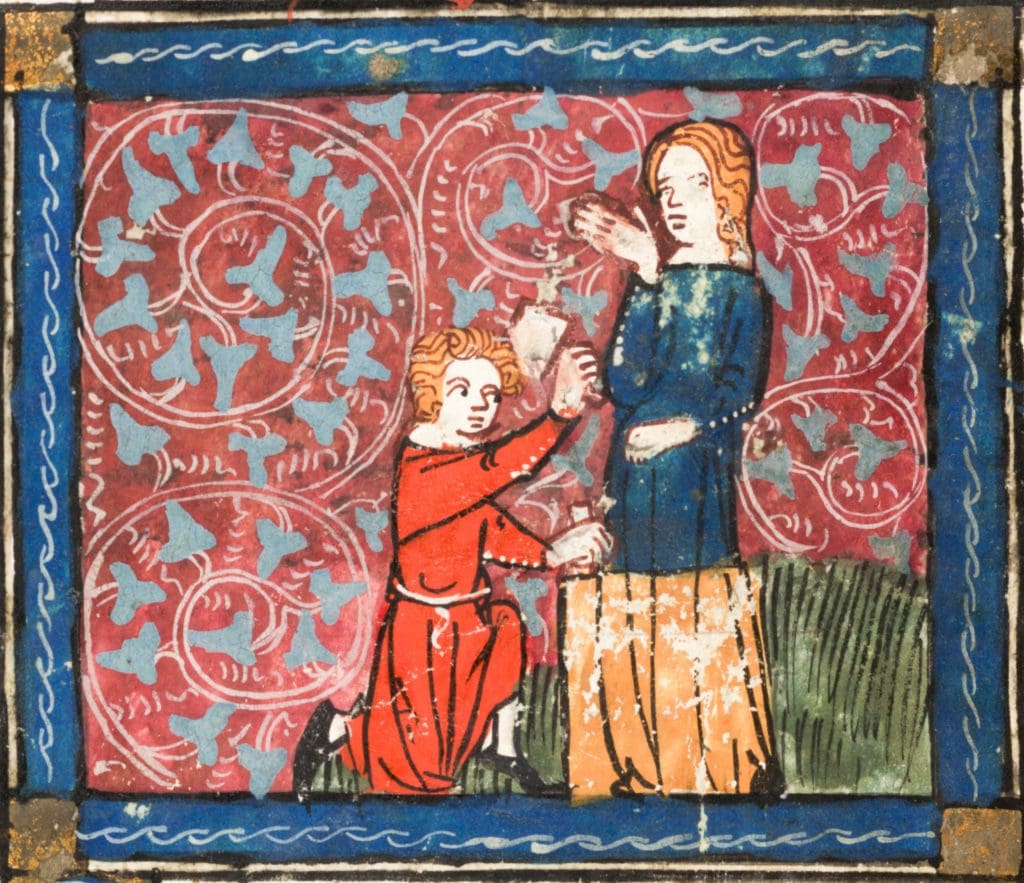
Fig. 10. Pygmalion carves the image, from Le roman de la rose, The Walters Art Museum, Baltimore, W.143, fol. 136v, mid fourteenth century (photo: The Walters Art Museum, The Digital Walters).
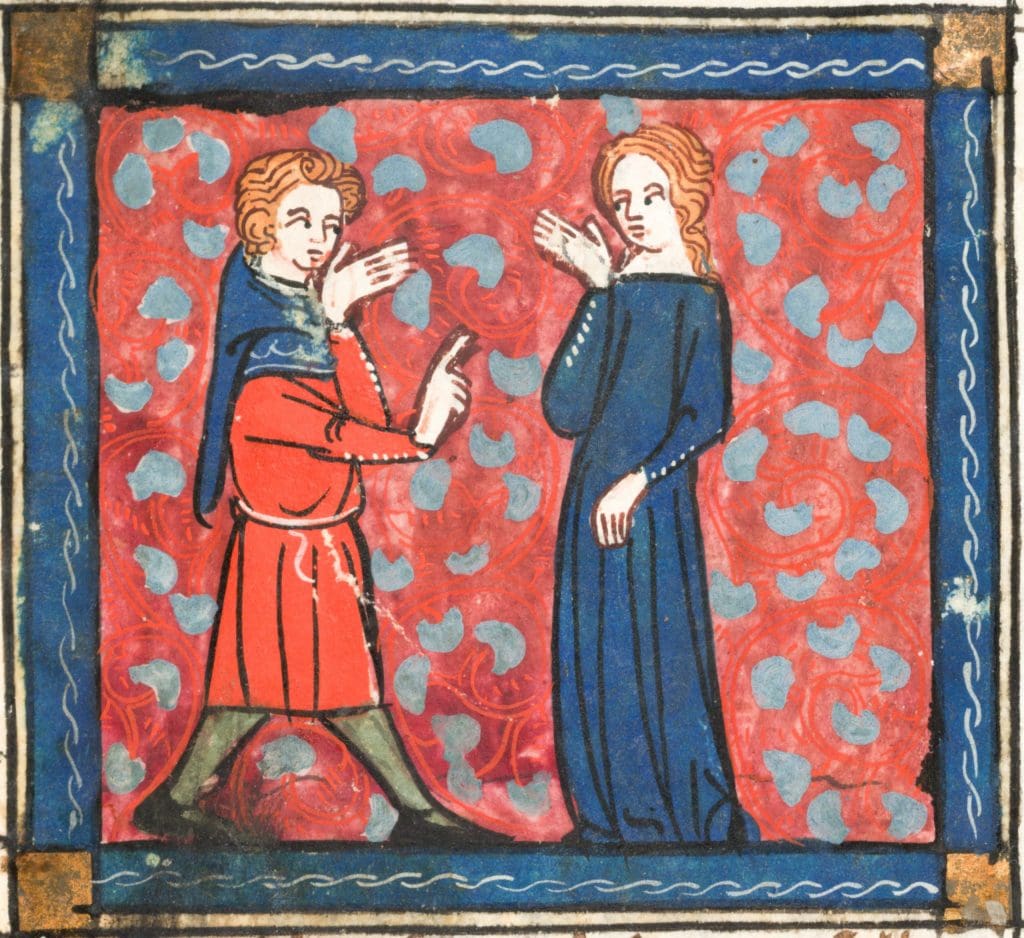
Fig. 11. Pygmalion finds his sculpture alive after returning from the altar of Venus, from Le roman de la rose, The Walters Art Museum, Baltimore, W.143, fol. 139r, mid fourteenth century (photo: The Walters Art Museum, The Digital Walters).
A few decades later, most likely in the years around 1320, an anonymous author composed an innovative retelling of Ovid’s Metamorphoses known as the Ovide moralisé (figs. 12 and 13).[67] The redemption of Pygmalion that had begun in the Roman de la rose is fully realized in this text. No longer reduced to a symbol of sexual deviance, Pygmalion is provided with two separate identities, both of which—at least to an early fourteenth-century audience—paint him in a favorable light.[68] In the first of these, he is presented as a rich man who falls in love with a beautiful but unrefined servant girl, taking it upon himself to transform her into a well-dressed and well-spoken woman suitable to marry (the inspiration, of course, for George Bernard Shaw’s play and all its subsequent retellings).
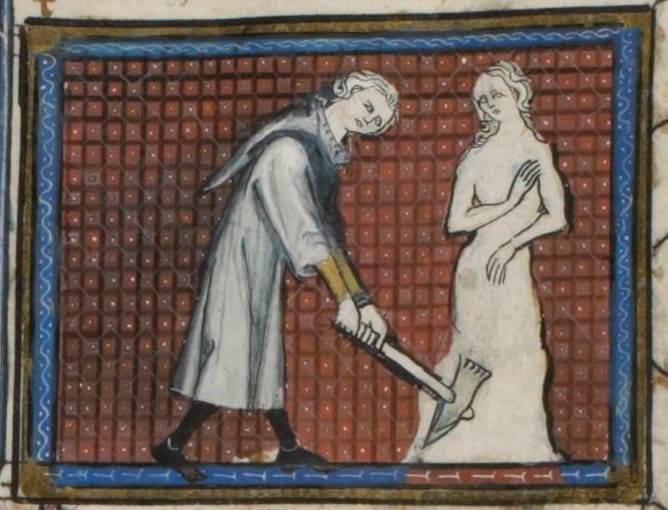
Fig. 12. Pygmalion sculpts, Ovide moralisé, Bibliothèque municipal de Rouen Ms 0 4 [Rouen, BM, Ms. 1044], fol. 252r, ca. 1325 (photo: Bibliothèque nationale de France) https://gallica.bnf.fr/ark:/12148/btv1b10102188w/f504.item and https://portail.biblissima.fr/fr/ark:/43093/mdata9a5108f8606eda5b95ad3e5e33dfd3cb362768bb.
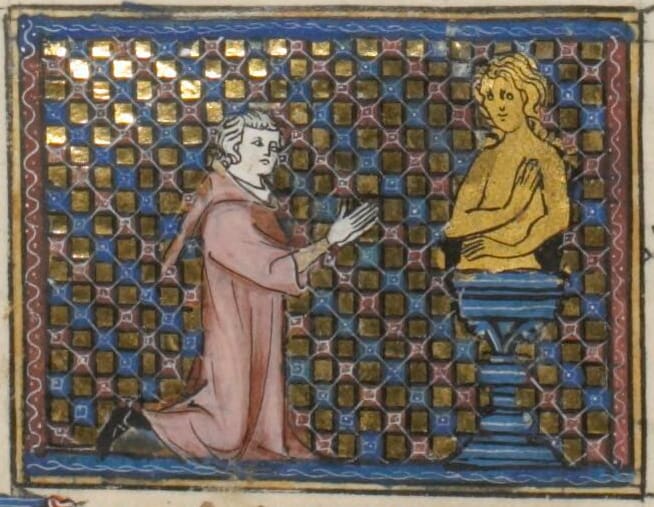
Fig. 13. Pygmalion prays to Venus, Ovide moralisé, Bibliothèque municipal de Rouen Ms 0 4 [Rouen, BM, Ms. 1044], fol. 252v, ca. 1325. (photo: Bibliothèque nationale de France) https://gallica.bnf.fr/ark:/12148/btv1b10102188w/f505.item and https://portail.biblissima.fr/fr/ark:/43093/mdata9a5108f8606eda5b95ad3e5e33dfd3cb362768bb.
The second interpretation is a far more complex allegory in which Pygmalion is transformed into the mirabilis artifex, the smith responsible for all of creation, specifically humanity as represented by the ivory maiden.[69] In the allegorical treatment, the clothes, flowers, jewels, and animals bestowed on Pygmalion’s maiden become gifts of virtues that God bestows upon his creation.[70] In effect, the author of the Ovide moralisé presents the union of Pygmalion and his statue as a mystical marriage, not between an individual and a deity, but between the creator and his creation—humanity. The innovation of the Ovide moralisé is that its author synthesized Christian exegesis with classical mythology, thus rehabilitating the ignominious figure of Pygmalion. What emerged was an image of the sculptor that was altogether different than his counterpart found in twelfth-century glosses.
The Pygmalion of the early fourteenth century is almost unrecognizable from his counterpart in the works of the early Christian apologists. In this new version, the sculptor’s madness and sexual deviancy have been all but expunged from both the narrative and interpretation. The trajectory of this rehabilitation from a warning against the dangers of idolatry and sexual perversion to a figure capable of standing as an allegory for the divine creator can be seen as an echo of the trajectory that had taken place with respect to rehabilitation of free-standing sculpture itself. Though best known as the quintessential myth of the sculptor, it is still fundamentally a story of statue marriage. This trope survived in a group of related myths and legends that, just like Pygmalion, underwent a process of integration and evolution from cautionary tale to serve in the justification of sculptors and their creations.
Illicit Statue Marriage
The appearance of fully Christianized versions of the trope of statue marriage was an expression of the phenomenon of the inversion of anti-sculptural rhetoric. The evolution of this trope, however, did not mean that its previous forms and meanings went extinct. Rather, the old forms coexisted with the new, retaining their potency as a tool for ridicule and parody. Variations are to be found in an assortment of medieval literary genres and demonstrate that the trope was mutable enough to be applied in numerous contexts and was not confined to the Venus/Virgin dichotomy.
If statue marriage to the Virgin was present in the minds of the clergy as a viable act, it could, if abused, be used to condemn a figure utterly. Such is the case of Tanchelm, an itinerant priest active in the Low Countries around the years 1112–1115. Tanchelm was clearly a thorn in the side of the clergy of the diocese of Utrecht who painted him as a nefarious heretic—their very own Antichrist (antichristus noster)—in their letters to the archbishop.[71] Among the bevy of accusations leveled at him, he is said to have preached against the sacraments, claimed that only he and his followers were the true church, and even distributed his own bath water as a sacred relic. According to the clergy of Utrecht, he was also a known sexual deviant and was characterized as having been as charismatic as he was lascivious.
Among the reports of his outrageous and offensive deeds, Tanchelm is said to have commanded that a statue of the Virgin (imaginem sancte Marie) be brought to him.[72] He then took the statue’s carved hand in his and betrothed himself to it/her (et accedens manumque imaginis manu contingens sub tipo illius sanctam M. sibi desponsavit). After he did this, he pointed the crowd’s attention to two boxes, one positioned on either side of the image, and asked the crowd to contribute to the wedding fund, challenging the sexes to demonstrate their greater devotion by filling their respective casket. It is unclear what Tanchelm’s motives were for this performance. It is possible that this was the act of a dramatic priest who was attempting to preach against vanity and luxury and instead urge the crowd to donate their wealth to the church.[73] The clergy of Utrecht, however, portrayed it as an act of personal enrichment, noting that through his most savage sacrilege he gained boundless sums of money. In this dramatic case, statue marriage—even to the Virgin—is utilized as a means of character assassination, one act among many portraying the individual as deranged, deviant, and dangerous.
An even more sinister version of the trope was employed by the Viennese poet, Jans Enikel (ca. 1230–1290), who incorporated a scurrilous story about the famed Virgil in his Weltchronik (World Chronicle). The medieval Virgil was something of a sorcerer, a genius to whom a variety of marvelous creations were attributed existing in the murky space between magic and mechanics. Enikel includes a story regarding the diabolical source of Virgil’s knowledge explaining that while he was digging in a vineyard one day, he unearthed a bottle that contained a multitude of demons. In exchange for their freedom, they taught him the art of magic. Enikel went on to say:
This very same Virgil set out for Rome to ascertain if his art was truly the devil’s power. At Rome he sculpted by magic a woman of stone who had such a body that whenever a rogue or an evil man wanted to go to a woman, he, the evil one, the impure one, went to the stone and lay with the stone as if it were truly a woman. I shouldn’t continue. You know my opinion well.[74]
This medieval tale of agalmatophilia is presented as the first test by which Virgil gauges his newly acquired black magic.
This use of the trope of statue marriage existed outside of the medieval Christian literary tradition as well. It appears in Jewish lore in a biographical record related to golem mythology. It is a curious tale regarding Solomon Ibn Gabirol, a Jewish Neoplatonist who lived in Al-Andalus (Spain) during the middle of the eleventh century (ca. 1021–1058).[75] These traditions transmitted an account of an incident in which Gabirol, who in his own autobiographical statements notes that he was afflicted with a disfiguring disease (perhaps a skin ailment), was said to have constructed a female golem. Instead of being made of clay or mud, his golem was made of wood and hinges.
Much like the bronze maidens who waited on Hephaestus in the Iliad, this wooden woman is said to have acted as a helper or servant to Gabirol. However, when the authorities caught wind of it, he was denounced. In order to defend himself from accusations of impropriety, Gabirol demonstrated that it was “not a perfect creature” by disassembling it and laying bare the thing for its collection of material parts.[76] In many ways, it resonates with the tale told about Virgil in that it speaks to both the intellectual and technical prowess of Gabirol while also incorporating insinuations, or at least potential doubts, about his moral character. It is another example of how the specter of illicit “statue marriage” could rear its ugly head to mar a reputation.
The trope was still capable of characterizing heathens and heretics even in contexts that were not overtly sexual. Such is the case of Jarl Hákon (Haakon Sigurdsson) in the Færeying saga (Saga of the Faroe Islanders). Set amid the period of Scandinavian transition to Christianity, the part of the pagan goddess, typically played by Venus, is here mapped onto the figure of Þorgerðr Holgabrúðr.[77] In some texts she is described as a flagð (flagðinu), a term meaning witch, troll, or ogress—a sort of female monster.[78] However, judging from the way that Hákon interacts with her, it is clear that she is to be understood as an analogue to Venus in similar tales of statue marriage.
In chapter twenty-three of the Færeying saga, we find an episode that resembles, at least in broad strokes, the typical statue marriage narrative.[79] Jarl Hákon, the last non-Christian ruler of Norway, and Sigmundr visit an ornate temple in the forest to ask for good fortune from the gods for their upcoming voyage. The temple is described as having an extravagantly ornamented exterior inlaid with gold and silver designs while beautiful glass windows (glergluggar) bathe the entire interior in light, a description that could just as easily be applied to a gothic cathedral. Housed within the temple are a number of idols (fjöldi goða, literally “many gods”), but pride of place went to a magnificently adorned figure of a woman, an idol of Þorgerðr Holgabrúðr.
Hákon prostrated himself before the image and solicited her blessing. He then stood and told Sigmundr that they would know they had the goddess’s approval if she let him take the ring she held in her hand.[80] Initially, the image of Þorgerðr closed her fist around the ring (beygja að hnefann), though she eventually acquiesced, releasing the ring after more fervent prayers were offered. It is hard to not see parallels between this story and the tale told in Edmund’s vita. At the heart of the story is a man seeking to strengthen his relationship with a goddess, who, with a subtle hand gesture and the exchange of a ring, acknowledges his worship. Yet, set against the Christianization of the north, such a ritual could once again easily be employed as source of ridicule of the pagan past.
One further story relating to Þorgerðr Holgabrúðr is particularly relevant. Contained in the Flateyjarbok (GkS 1005 fol.), a late fourteenth-century compendium of Old Icelandic sagas, is another story that emphasizes Hákon’s paganism.[81] The events take place in the aftermath of the conflict between Hákon, an adherent to the pagan past and the last non-Christian Norwegian ruler, and Olav (Óláfr Tryggvason), the famed christianizer and Hákon’s successor. After Hákon is killed, a point is made of mocking his paganism, demonstrating that the new order is Christianity. Not content to simply strip the gold, silver, and fine textiles from the idol found within a pagan temple he has looted, Olav topples the idol (líkneskja, literally shape, form, or “graven image”) identified as Þorgerðr Holgabrúðr and drags it behind his horse. He mocks the image further by asking his men if any of them want to buy a wife. This jest, and the prolonged dialogue that ensues between him and his men, functions, at least in part, on the logic of statue marriage. As a test of his people’s faith, Olav once again set the idol up to see if anyone paid reverence to it, though none did. Afterward, it, along with another idol, are violently broken and burned. Though this tale does not strictly conform to the standard form—there is no ring, no vow, no animation—it nonetheless serves as a pointed reminder of how the trope of statue marriage could still serve as a potent tool of ridicule.
Conclusion
The trope of statue marriage functions as a remarkably apt means to track nuances in the developing iconophilia that characterized the sculptural imagination of the twelfth through fourteenth centuries. The transformation of this trope can be seen as a manifestation of a cultural shift relating to the legitimization of anthropomorphic sculpture and especially devotional practices that centered on sculpted images. The antique pagan connotations of the ring-on-the-finger trope were subverted and transformed through a process of substitution and inversion. These inversions, found in a variety of texts and confirmed in visual depictions, are indicative of the changing valuation of sculpture and its function in religious life.
Coda: Modern Reverberations
The tales of vivified sculpture discussed above, one could say, find their modern counterpart in stories of rebellious robots and sentient androids. Whether these artificial bodies are brought to life by a divine spark or technological ingenuity—or perhaps a bit of both—they force us to confront our relationship with technology and “things” while also serving as a mirror, allowing us to reflect on our own emotions and our connections with others.[82] Many of the issues raised by these objects and the stories in which they appear are timeless. Modern advances in AI and robotics, however, have thrust such questions and problems to the foreground and demonstrated that they are not simply relevant to the present moment, but exigent. What was half a century ago pure science fiction is today, in some cases, reality.
If we understand the stories we tell as manifestations of our collective aspirations and anxieties, it becomes evident that our relationship with artificial animated bodies is undergoing a fundamental reevaluation and transformation. There is no denying that much of what we see in modern science fiction pushes current technology to extremes, though perhaps not as much as one might think.[83] Consider the number of companies currently developing and marketing humanoid robots designed for both the domestic and industrial spheres, such as Ameca, NEO Gamma, and Helix.[84] At the same time, companies such as RealDoll are creating animated artificial bodies designed to cater to the most intimate forms of robot-human interaction. These androids in particular have reignited conversations about agalmatophilia and present a prime example of contemporary “statue marriage.”
While robots and androids are on the brink of becoming more common in workplaces and homes, they have also begun appearing in places of worship and devotional contexts. This should come as no surprise given that technology and religion have long been bedfellows.[85] In fact, an entire sub-genre of machines dubbed “theomorphic robots” has appeared over approximately the last decade, sparking public interest and religious debate.[86] According to a recent survey, robots of varying degrees of complexity have appeared in Christian (Catholic and Protestant), Buddhist, Hindu, and Muslim contexts.[87] These robots—such as Mindar,[88] Xian’er,[89] and SanTO,[90] vary widely in their level of anthropomorphism and their capability to directly interact with devotees. They do, however, serve a variety of functions such as performing rites and rituals, teaching, and providing various forms of spiritual care.
Medieval society in Western Europe, as this study has shown, grappled with the place and function of artificial bodies in religious devotion, entangled as they were in theological debates, associations with the pagan past, and perceived dangers of the Other.[91] Today, in a way that is not altogether different, we are in the midst of a reconfiguration of society’s relationship with artificial bodies as they are poised to have an ever-greater presence in our homes, businesses, and places of worship. Certainly, technology has changed and modern ethical and social concerns have emerged. Still, fundamental issues of how one perceives and interacts with these bodies endure. Roboticists are actively pushing the limits of both software and hardware in attempts to make their creations more responsive and interactive. The modern counterparts to Venus and the Virgin are no longer mute blocks of wood or stone without eyes to see or voices to speak, but bodies made of metal and plastic capable of seeing you, speaking to you, and even reaching out to touch you.[92]
References
| ↑1 | The Chronicon is preserved in British Library, Cotton MS Claudius D VII. See esp. fol. 181v. Joseph Stevenson, ed., Chronicon de Lanercost, 1201–1346 (Impressum Edinburgi, 1839), 36. The entry for the date of 1228 in the Chronicon is in relation to the death of Stephen Langton, Archbishop, 1207–1228. The Vita sancti Edmundi is preserved in British Library, Cotton MS Julius D VI. See esp. fols. 124r–124v. C.H. Lawrence, St. Edmund of Abingdon: A Study in Hagiography and History (Oxford University Press, 1960), 224–25. For an English translation, see C.H. Lawrence, trans., The Life of St. Edmund (Alan Sutton Publishing Limited, 1996), 119–120 (commentary on page 7). For a biography of Matthew Paris and the date of composition, see pages 101–117, esp. 116. |
|---|---|
| ↑2 | See, for example, Katherine Allen Smith, “Bodies of Unsurpassed Beauty: ‘Living’ Images of the Virgin in the High Middle Ages,” Viator 37 (2006): 167–87. https://doi.org/10.1484/J.VIATOR.2.3017483. |
| ↑3 | For examples of approaches to sculpture in this vein beyond the medieval era, see for example: Caroline van Eck, Art, Agency and Living Presence: From the Animated Image to the Excessive Object (De Gruyter, 2015); Peter Dent, ed., Sculpture and Touch, Subject/Object: New Studies in Sculpture (Routledge, 2014); Kenneth Gross, The Dream of the Moving Statue (The Pennsylvania State University Press, 2006). |
| ↑4 | Mary Carruthers, The Experience of Beauty in the Middle Ages, Oxford-Warburg Studies (Oxford University Press, 2013), 8. https://doi.org/10.1093/acprof:osobl/9780199590322.001.0001. |
| ↑5 | Jacqueline E. Jung, Eloquent Bodies: Movement, Expression, and the Human Figure in Gothic Sculpture (Yale University Press, 2020); Jacqueline E. Jung, “The Tactile and the Visionary: Notes on the Place of Sculpture in the Medieval Religious Imagination,” in Looking Beyond: Visions, Dreams, and Insights in Medieval Art and History, ed. Colum Hourihane (Index of Christian Art, Department of Art and Archaeology, Princeton University in association with Penn State University Press, 2010); Alexa Sand, “Materia Meditandi: Haptic Perception and Some Parisian Ivories of the Virgin and Child, ca. 1300,” Different Visions: A Journal of New Perspectives on Medieval Art, no. 4 (January 2014): 1–28. https://doi.org/10.61302/FBJV9093; Thomas E.A. Dale, Pygmalion’s Power: Romanesque Sculpture, the Senses, and Religious Experience (The Pennsylvania State University Press, 2019). |
| ↑6 | Victor Stoichita, for example, opens his investigation of the simulacrum with the idea of the transgressive nature of touch and its consequence, in the modern aesthetic framework, of “demoting” an “image” or work of art to a mere “thing.” Victor I. Stoichita, The Pygmalion Effect: From Ovid to Hitchcock, trans. Alison Anderson (The University of Chicago Press, 2008), 1–3. |
| ↑7 | For example, see Erika Biddle’s explanation of social sculpture as something that “involves exploring new values, new forms of thinking and new ways of being in the world,” and pointing out that “Beuys conceived social sculpture to ‘mould and shape the world in which we live.’” Erika Biddle, “Re-Animating Joseph Beuys’ ‘Social Sculpture’: Artistic Interventions and the Occupy Movement,” Communication and Critical/Cultural Studies 11, no. 1 (2014): 28 and 26 respectively. https://doi.org/10.1080/14791420.2013.830810. |
| ↑8 | Robert Ford Campany, Signs from the Unseen Realm: Buddhist Miracle Tales from Early Modern China (University of Hawai’i Press, 2012), xiv. https://doi.org/10.21313/hawaii/9780824836023.001.0001. Emphasis in the original. |
| ↑9 | Michelle C. Wang, “Early Chinese Buddhist Sculptures as Animate Bodies and Living Presences,” Ars Orientalis 46 (2016): 32. https://doi.org/10.3998/ars.13441566.0046.002. Emphasis in the original. |
| ↑10 | [V]ir eximiae munditiae, abstinentiae et vigiliae. Stevenson, Chronicon, 36. |
| ↑11 | Vie des pères, vv. 25123–27: [M]out sot tres bien en fust taillier / li maistres qui cele oevre fist; / la faiture si bien assist, / pour peu que vive ne sambloit, / si bien enluminee estoit. Felix Lecoy, ed., La Vie des pères (Société des Anciens Textes Français, 1999), 3:185. For a modern French translation, see Paul Bretel, trans., La Vie des pères: Recueils 2 et 3, Moyen âge en traduction (Classiques Garnier, 2021), 115. |
| ↑12 | Vincent of Beauvais, Speculum historiale, bk. 7.87. Michel Tarayre, ed., La Vierge et Le Miracle: Le Speculum Historiale de Vincent de Beauvais (Honoré Champion, 1999), 54–55. |
| ↑13 | The history of this narrative and its many variations, from the medieval period through the early twentieth century, was explored by Paull Franklin Baum, “The Young Man Betrothed to a Statue,” Publications of the Modern Language Association of America 34, no. 4 (1919): 523–79. https://doi.org/10.2307/456884; Paull Franklin Baum, “The Young Man Betrothed to a Statue: Additional Note,” Publications of the Modern Language Association of America 35, no. 1 (1920): 60–62. Baum’s work is an essential starting point for understanding the prevalence and popularity of this trope. Just as Baum hoped to carry forward the work of Arturo Graf and others, here I hope to carry their work and this line of inquiry forward further still, if only little. See also John Esten Keller, “The Motif of the Statue Bride in the ‘Cantigas’ of Alfonso the Learned,” Studies in Philology 56, no. 3 (1959): 453–58. For a more recent study, see Claudio Galderisi, “Le récit du mariage avec la statue. Résurgences et modalités,” Romania 119, no. 473 (2001): 170–95. https://doi.org/10.3406/roma.2001.1552. |
| ↑14 | George L. Hersey, Falling in Love with Statues: Artificial Humans from Pygmalion to the Present (University of Chicago Press, 2009). See especially chapter five and the subsections “Sacred Marriage” and “Ptolemaic Statue Marriage.” Particularly informative sources cited by Hersey include: Walter Burkert, Homo Necans: Intèrpretationen altgriechischer Opferriten und Mythen, 2nd ed. (Walter de Gruyter, 1997), 259–63; Hetty Goldman, “The Origin of the Greek Herm,” American Journal of Archaeology 46, no. 1 (1942): passim. https://doi.org/10.2307/499105; Lewis Farnell, Greece and Babylon: A Comparative Sketch of Mesopotamian, Anatolian and Hellenic Religions (T. & T. Clark, 1911), 263–68. |
| ↑15 | Ovid, Metamorphoses, bk. 10. |
| ↑16 | For an introduction to the concept and history of Christian mystical marriage, see Carolyn Diskant Muir, Saintly Brides and Bridegrooms: The Mystic Marriage in Norther Renaissance Art (Harvey Miller, 2012), especially the introduction, pages 1–15. See also E. Ann Matter, The Voice of My Beloved: The Song of Songs in Western Medieval Christianity, Middle Ages Series (University of Pennsylvania Press, 1990). |
| ↑17 | René Metz, La consécration des vierges: Hier, aujourd’hui, demain (Les Éditions du Cerf, 2001), esp. 76–77, 86–89, and 103–105. |
| ↑18 | Michael Camille, The Gothic Idol: Ideology and Image-Making in Medieval Art (Cambridge University Press, 1989), 224. Camille engages briefly with a few examples of statue marriage in the section, “Virgin or Venus?”, especially pages 237–41. He argues that such stories involving Venus result from a need to “substantiate” Christian images “in the face of threatening and attractive images of the Other” through appropriation, a process he calls “iconotropy.” I argue that by the twelfth and thirteenth centuries, such “pagan” images posed little actual threat in areas that had been Christianized since Late Antiquity. Instead, the circulation of miracle tales, including the trope of statue marriage, are the result of the church’s need to clarify and assert its own position on the efficacy of images, especially sculpture. |
| ↑19 | Stephen Nellis, “NVIDIA CEO: Humanoid Robot Revolution Is Closer than You Think,” Reuters, March 19, 2025, https://www.reuters.com/technology/nvidia-ceo-humanoid-robot-revolution-is-closer-than-you-think-2025-03-19/. See also David Levy, Love and Sex with Robots: The Evolution of Human-Robot Relationships (Harper, 2007); Adrian David Cheok et al., eds., Love and Sex with Robots: Second International Conference, LSR 2016 London, UK, December 19–20, 2016 Revised Selected Papers, Lecture Notes in Artificial Intelligence (Springer, 2017). The keynote talk for this conference, given by David Levy, was “Why Not Marry a Robot?” |
| ↑20 | Arturo Graf, Roma nella memoria e nelle immaginazioni del medio evo (Hermann Loescher, 1883), 2:388; Baum, “The Young Man Betrothed to a Statue,” 524. Baum notes the existence of some sources that claim earlier attribution, though he points out their unreliability. He concludes by stating that, “[a]t all events, nothing can be gained by using [these references] as a warrant for a literary version of the Venus story before William of Malmesbury.” |
| ↑21 | William of Malmesbury, Gesta regum Anglorum, bk. 2.205. R.A.B. Mynors, trans., Gesta Regum Anglorum (The History of the English Kings), Oxford Medieval Texts (Clarendon Press, 1998), 1:380–85. For further discussion, see Baum, “The Young Man Betrothed to a Statue,” 524–533. See also Herbert of Clairvaux, Liber visionum et miraculorum Clarevallensium, chap. 112. Giancarlo Zichi et al., eds., Liber visionum, CCCM 277; Exempla Medii Aevi 8 (Brepols, 2017), 213–15. Herbert’s text, written several decades later, is a nearly verbatim copy of William’s. |
| ↑22 | “Ego sum Venus, cuius digito apposuisti anulum; habeo illum, nec reddam.” William of Malmesbury, Gesta regum Anglorum, 2.205. Mynors, Gesta Regum Anglorum, 1:380–81. |
| ↑23 | Erat is nigromanticis artibus instructus magicas excitare figuras, demones territare et ad quodlibet offitium impellere. William of Malmesbury, Gesta regum Anglorum, 2.205. Mynors, Gesta Regum Anglorum, 1:382–83. The figure of Palumbus is curious. His status—pagan or Christian–is not made explicit, and, as Baum notes, “[h]e is one of those transitional anomalies in which the two religions were for a time blended, on one side a minister of the black arts, and on the other a priest of the church. Nor is the distinction of the two faiths clearly maintained in the rest of the story.” Baum, “The Young Man Betrothed to a Statue,” 532. |
| ↑24 | As Tudor points out, “[i]t is only the first Vie, however, dating from around 1215–1230, and by a single author, that has any real claim to the title Vie des pères.” Adrian P. Tudor, Tales of Vice and Virtue: The First Old French Vie des pères, Faux Titre 253 (Rodopi, 2005), 15. https://doi.org/10.1163/9789004488229_005. |
| ↑25 | For the authorship of the Vie des pères and its context, see the introduction to Tudor, Tales, esp. 17. |
| ↑26 | Tudor, Tales, 28. |
| ↑27 | Of 662 total verses, fewer than 120 can be said to be directly reliant on this earlier tradition. |
| ↑28 | See The Oxford Cantigas de Santa Maria Database for cantiga no. 42 and concordances. https://csm.mml.ox.ac.uk/index.php?p=poemdata_view&rec=42. |
| ↑29 | [Q]u’en fust n’en pierre ne puet l’en / trover per droit reson ne sen. Vie des pères, vv. 8340–41. Felix Lecoy, ed., La Vie des pères (Société des Anciens Textes Français, 1987), 1:270; Paul Bretel, trans., La Vie des pères: Premier recueil, Moyen âge en traduction (Classiques Garnier, 2020), 196. |
| ↑30 | [P]ar s’envoiseüre dist, ‘Feme, de cest anel t’espous.’ Vie des pères, vv. 8371–72. Lecoy, La Vie des pères, 1:271; Bretel, La Vie des pères: Premier recueil, 197. For further comments, see Tudor, Tales, 543–44. |
| ↑31 | Vie des pères, vv. 8365–66. Lecoy, La Vie des pères, 1:271. |
| ↑32 | Vie des pères, v. 8382. Lecoy, La Vie des pères, 1:272. This phrase is also found in the rubric. |
| ↑33 | For discussion of these statues and this sculptural type, see Andrew Stewart, “A Tale of Seven Nudes: The Capitoline and Medici Aphrodites, Four Nymphs at Elean Herakleia, and an Aphrodite at Megalopolis,” Antichthon 44 (2010): 12–32. https://doi.org/10.1017/S0066477400002057. |
| ↑34 | A three-dimensional scan of the Medici Venus has been carried out as part of The Uffizi Digitization Project: http://www.digitalsculpture.org/florence/main/model/31df125d63b747af841d8fca4eb7b8f8. See also https://sketchfab.com/3d-models/medici-venus-inv-1914-n-224-4304bcdb575a4c62af5172ffa475dc43. |
| ↑35 | Magister Gregorius, Narracio de mirabilibus urbis Rome, chap. 12. R.B.C. Huygens, ed., Narracio, Textus Minores 42 (Brill, 1970), 20–21. https://doi.org/10.1163/9789004621091; John Osborne, trans., The Marvels of Rome, Medieval Sources in Translation 31 (Pontifical Institute of Medieval Studies, 1987), 26. See pages 59–60 for commentary. Gregory’s identity and the date of the text’s composition are matters of some speculation. Based on available evidence, Osborne leans towards a date of composition sometime in the early thirteenth century. See esp. pages 11 and 14 of the introduction. |
| ↑36 | [L]a destre main overte. Vie des pères, v. 8368. Lecoy, La Vie des pères, 1:271; Bretel, La Vie des pères: Premier recueil, 197. |
| ↑37 | This is a loose translation of the text which reads: “Amis frere, je te comant / q’une ymaige de mon semblant, / et devant soi tiegne son fil, / faces ou a chier ou a vil, / bien entailliee et eslevee, / si bien pointe et si bien ovree / que nus n’i saiche ke reprendre.” Vie des pères, vv. 8614–20. Lecoy, La Vie des pères, 1:279; Bretel, La Vie des pères: Premier recueil, 200. Bretel’s translation, “sculptée en relief,” however, is awkward given the context. |
| ↑38 | Vie des pères, vv. 8646–48. Lecoy, La Vie des pères, 1:280; Bretel, La Vie des pères: Premier recueil, 200. |
| ↑39 | For the Virgin’s dramatic speech, see vv. 8672–93. Lecoy, La Vie des pères, 1:281; Bretel, La Vie des pères: Premier recueil, 201. For further discussion, see Tudor, Tales, 550. |
| ↑40 | The story, it should be noted, does not correspond to the historical record. The Pantheon was not consecrated as a church under Pope Gregory I (d. 604), but several years later under Boniface IV, in 609 (or possibly 610 or 613). Furthermore, its consecration has often been linked to an icon—not a statue—in the Pantheon, though the earliest record of it is from the pontificate of Stephen III (768–772). See Erik Thunø, “The Pantheon in the Middle Ages,” in The Pantheon: From Antiquity to the Present, ed. Tod A. Marder and Mark Wilson Jones (Cambridge University Press, 2015), esp. 236–38 for a brief history of the icon and further bibliography. |
| ↑41 | Vie des pères, v. 8735 Lecoy, La Vie des pères, 1:283; Bretel, La Vie des pères: Premier recueil, 202. |
| ↑42 | Tilmann Buddensieg, “Gregory the Great, the Destroyer of Pagan Idols. The History of a Medieval Legend Concerning the Decline of Ancient Art and Literature,” Journal of the Warburg and Courtauld Institutes 28 (1965): passim, esp. 46–47. https://doi.org/10.2307/750663. For digital copies of the Chronicon, see for example, Ms. Clm 2691, fol. 12v, München, Bayerische Staatsbibliothek (BSB) (https://www.digitale-sammlungen.de/view/bsb00134596?page=26) and Bob Jones University Library MS 1, fol. 43v, (accessed through the University of South Carolina, https://digital.tcl.sc.edu/digital/collection/pfp/id/1263). |
| ↑43 | Bernard of Angers, Liber miraculorum sancte Fidis, bk 1.11. Luigi G.G. Ricci, ed., Liber miraculorum sancte Fidis: Il racconto dei prodigi di una sancta bambina, trans. Luca Robertini, Per Verba. Testi mediolatini con traduzione 25 (SISMEL, Edizioni del Galluzzo, 2010), 140–141; Pamela Sheingorn, The Book of Sainte Foy, trans. Pamela Sheingorn and Robert L.A. Clark, Middle Ages Series (University of Pennsylvania Press, 1995), 72. https://doi.org/10.9783/9780812200522. The term larvam is interesting as it is comparatively rare but striking, with connotations of that which is ghostly, possessed, or demonic. |
| ↑44 | For example, in the Libri Carolini, bk. 1.2, we read: Inter hominem autem pictum et verum hoc principaliter interest, quod unus illorum est verus, alter falsus, nec uspiam nisi in nominis societate iunguntur. Ann Freeman and Paul Meyvaert, eds., Opus Caroli regis contra synodum (libri Carolini), MGH: Leges: 4, Concilia; T. 2, Suppl. 1 (Hahn, 1998), 117 (lines 20–22). https://www.dmgh.de/mgh_conc_2__suppl_1/index.htm#page/117/mode/1up. |
| ↑45 | William of Malmesbury, De antiquitate Glastonie ecclesie, chapters 26, 27, 28, and 78. John Scott, trans., The Early History of Glastonbury (The Boydell Press, 1981), 78–81 and 156–59. |
| ↑46 | Walter of Cluny, De Miraculis beate virginis Mariæ, chap. 3. PL 173, 1383–84. |
| ↑47 | Reginald of Durham, Libellus de vita et miraculis sancti Godrici, Heremite de Finchale, 41.90; 69.149; and 70.147–48. Margaret Coombe, trans., The Life and Miracles of Saint Godric, Hermit of Finchale (Clarendon Press, 2022), 182–85; 274–81. |
| ↑48 | “Nec fides humana potest diffidere quod Dei filius, qui pro nobis mortem subiit, cui voluerit spiritum vite possit infundere. Qui enim ligno infudit nunc vitalem spiritum, ipse semper se vivere et cuncta se videre, manifeste ostendit per tanti signi prodigiale mysterium. Virtus enim qua de ipso progreditur, animando vivificat omne quod nascitur.” Reginald of Durham, Libellus, 69.146. Coombe, Life and Miracles of St. Godric, 276–77. For the same passage in the Old French version of Godric’s life, see Margaret Coombe et al., eds., Reginald of Durham’s Life of St. Godric: An Old French Version, Anglo-Norman Text Society Occasional Publications Series 9 (Anglo-Norman Text Society, 2019), 96. |
| ↑49 | Caesarius of Heisterbach, Dialogus Miraculorum, bk. 7.45. Ronald E. Pepin, trans., The Dialogue on Miracles, Cistercian Fathers 90 (Cistercian Publications, Liturgical Press, 2023), 2:76–77; Josephus Strange, ed., Dialogus Miraculorum (J.M. Heberle, 1851), 2:64. |
| ↑50 | See Jeremiah 10:14; Jeremiah 51:17; Habakkuk 2:19. |
| ↑51 | Kathleen Kulp-Hill, Songs of Holy Mary of Alfonso X, The Wise: A Translation of the Cantigas de Santa Maria, Medieval and Renaissance Texts and Studies 173 (Arizona Center for Medieval and Renaissance Studies, 2000), 360; Walter Mettmann, ed., Cantigas de Santa María (Castalia, 1989), 3:89–91. An invaluable resource for the study of the Cantigas, and medieval miracle collections in general, is the Oxford Cantigas de Santa Maria database (csm.mml.ox.ac.uk). |
| ↑52 | See, among others, Psalms 115 and 135 (113 and 134 of the Vulgate). |
| ↑53 | [A]nte truncum ligni procidam[?]. Isaiah 44:19. See also Isaiah 45:20 where the prophet mocks idols as “lignum sculpturae.” |
| ↑54 | Kulp-Hill, Songs, 360; Mettmann, Cantigas, 3:91. |
| ↑55 | Kulp-Hill, Songs, 360; Mettmann, Cantigas, 3:89. Emphasis mine. |
| ↑56 | For discussion of the limited role afforded to images in the early medieval period, see: David F. Appleby, “Instruction and Inspiration through Images in the Carolingian Period,” in Word, Image, Number: Communication in the Middle Ages, ed. John J. Contreni and Santa Casciani, Micrologus Library 8 (SISMEL, Edizioni del Galluzzo, 2002); David F. Appleby, “Holy Relic and Holy Image: Saints’ Relics in the Western Controversy Over Images in the Eighth and Ninth Centuries,” Word & Image 8, no. 4 (1992): 333–43. https://doi.org/10.1080/02666286.1992.10435845; Celia M. Chazelle, “Pictures, Books, and the Illiterate: Pope Gregory’s I’s Letters to Serenus of Marseilles,” Word & Image 6, no. 2 (1990): 138–53; William Diebold, “The Carolingian Idol: Exegetes and Idols,” in Seeing the Invisible in Late Antiquity and the Early Middle Ages, ed. Giselle de Nie et al., Utrecht Studies in Medieval Literacy (Brepols, 2005), esp. 457; Ann Freeman, “Scripture and Images in the Libri Carolini,” in Theodulf of Orléans: Charlemagne’s Spokesman against the Second Council of Nicaea, Variorum Collected Studies Series CS772 (Ashgate, 2003). Note that even in the most enthusiastic defenses of images, figural sculpture is essentially absent. |
| ↑57 | For the birth of Aphrodite and her coming ashore on Cyprus, see Hesiod, Theogony, 193 (and surrounding lines). Glenn W. Most, trans., Theogony, Loeb Classical Library 57 (Harvard University Press, 2018), 18–19. For a study of the cult of Aphrodite on Cyprus, see Philip H. Young, “The Cypriot Aphrodite Cult: Paphos, Rantidi, and Saint Barnabas,” Journal of Near Eastern Studies 64, no. 1 (2005): 23–44. https://doi.org/10.1086/429165. The importance of Cyprus is investigated in Hersey, Falling in Love with Statues, 22–72 (chapters 2–4). |
| ↑58 | Clement of Alexandria, The Exhortation to the Greeks. The Rich Man’s Salvation. To the Newly Baptized, trans. G.W. Butterworth, Loeb Classical Library 92 (Harvard University Press, 1919), 130–33; Bernard Fragu, ed., Contre les gentils (Contre les païens) Tome VI, Livres VI–VII, trans. Bernard Fragu, Collection des Universités de France, Série latine (Les Belles Lettres, 2010), 20; George E. McCracken, trans., The Case Against the Pagans, 2: Books Four–Seven, Ancient Christian Writers 8 (The Newman Press and Longmans, Green and Co., 1949), 475; See also Karl Müller, ed., Fragmenta Historicorum Graecorum (Ambrosio Firmin Didot, 1849), 3:30–31. |
| ↑59 | Philostephanus in Cypriacis auctor est, Pygmalionem regem Cypri simulacrum Veneris quod sanctitatis apud Cyprios et religionis habebatur antiquae, adamasse ut feminam, mente anima lumine rationis judicioque caecatis solitumque dementem, tamquam si uxoria res esset, subleuato in lectulum numine copularier amplexibus atque ore resque alias agere libidini vacuae imaginatione frustrabiles. Arnobius of Sicca, The Case Against the Pagans, bk. 6.22.3. Fragu, Contre les gentils, 20. |
| ↑60 | Pliny, Natural History, 36.20. For further discussion, see Stewart, “A Tale of Seven Nudes.” See also Olga Palagia, ed., Handbook of Greek Sculpture, Ancient Greek and Roman Art and Architecture 1 (De Gruyter, 2019), 379; “Aphrodite of Knidos,” Museum of Classical Archaeology Databases (University of Cambridge), accessed October 23, 2024, https://museum.classics.cam.ac.uk/collections/casts/aphrodite-knidos-0. |
| ↑61 | An account of the Temple of Venus and the tale of the Knidian youth appear in Lucian, Erōtes, §§ 13–16. M.D. MacLeod, trans., Amores, Loeb Classical Library 432 (Harvard University Press, 1967), 168–177. For further discussion, see A. Scobie and J.W. Taylor, “Perversions Ancient and Modern: I. Agalmatophilia, the Statue Syndrome,” Journal of the History of the Behavioral Sciences 11, no. 1 (1975): 49–54. |
| ↑62 | Frank T. Coulson, “Ovid’s Metamorphoses in the School Tradition of France, 1180–1400: Texts, Manuscript Traditions, Manuscript Settings,” in Ovid in the Middle Ages, ed. James G. Clark et al. (Cambridge University Press, 2011); Ralph Hexter, “Medieval Articulation of Ovid’s Metamorphoses: From Lactantian Segmentation to Arnulfian Allegory,” Mediaevalia 13 (1987): esp. 66 and 76. Although Ovid’s text and commentaries had survived since Antiquity, they did so in a fragmentary state and did not enjoy a revival of interest or a central place in the medieval curriculum until the twelfth century. |
| ↑63 | Statua Pigmalionis de eburnea in vivam mulierem. Re vera Pigmalion mirabilis artifex eburneam fecit statuam cuius amorem concipiens ea cepit abuti ad modum vere mulieris. “Arnulphi Aurelianensis Allegoriae super Ovidii Metamorphosin,” in Arnolfo d’Orléans: Un cultore di Ovidio nel secolo XII, ed. Fausto Ghisalberti (U. Hoepli, 1932), 223. An almost identical gloss is found in the later text of Thomas Walshingham. See Robert A. van Kluyve, ed., De Archana Deorum (Duke University Press, 1968), 154. For further discussion of Pygmalion in medieval literature, see Essaka Joshua, Pygmalion and Galatea: The History of a Narrative in English Literature, Nineteenth Century Series (Ashgate, 2001), 6–20 and 161–62. |
| ↑64 | “Or sui je le plus fos du sicle! … mes ceste amour est si horrible / qu’el ne vient mie de Nature. / Trop mauvesement m’i nature, / Nature en moi mauvés fill a; / quant me fist formant s’avilla. / Si ne l’an doi je pas blamer / se je veill folement amer.” Guillaume de Lorris and Jean de Meun, Le Roman de la rose, vv. 20827–38. Félix Lecoy, ed., Le Roman de la Rose, Les classiques de l’histoire de France au Moyen Age (Honoré Champion, 1970), 3:126. For a prose translation, see Charles Dahlberg, trans., The Romance of the Rose (Princeton University Press, 1971), 341. |
| ↑65 | Roman de la rose, vv. 20859–63. Lecoy, Le Roman de la Rose, 3:127; Dahlberg, The Romance of the Rose, 341. |
| ↑66 | Roman de la rose, vv. 20808–10 and the verses surrounding v. 20894. Lecoy, Le Roman de la Rose, 3:125 and 128; Dahlberg, The Romance of the Rose, 341–42. |
| ↑67 | Cornelis de Boer, ed., “Ovid moralisé”: Poème du commencement du quatorzième siècle publié d’après tous les manuscrits connus (N.V. Noord-Hollandsche Uitgevers-Maatschappij, 1936), 4:33–37 and 96–98. For a discussion on the date and authorship of the text see Richard Trachsler, “Auteur, milieu et date,” in Ovide moralisé: Livre I, ed. Craig Baker et al., vol. 1, Publications de la Société des anciens textes français 113 (Société des anciens textes français and F. Paillart, 2018). |
| ↑68 | For a very brief summation of both interpretations, see Jane M. Miller, “Some Versions of Pygmalion,” in Ovid Renewed: Ovidian Influences on Literature and Art from the Middle Ages to the Twentieth Century, ed. Charles Martindale (Cambridge University Press, 1988). |
| ↑69 | Li forgierres, plains de savoir, / De cui toute science habonde, / Li forgierres de tout le monde / A sa forme et à sa figure / Forga nostre humaine nature / Par sa sapience divine, / Si li dona forme eborine. Boer, Ovid moralisé, 4:96, ll. 3587–93. |
| ↑70 | The list of virtues is long, drawing on a mix of sources. For a brief discussion, see Marylène Possamaï-Pérez, “Le mythe de Pygmalion dans l’Ovide moralisé en vers du début du XIVe siècle,” in Mythe, histoire et littérature au Moyen Âge, ed. Catherine Croizy-Naquet et al., Rencontres 282, Civilisation médiévale 23 (Classiques Garnier, 2017), 137–38. |
| ↑71 | For a biographical sketch and translations of select texts, see Walter L. Wakefield and Austin P. Evans, Heresies of the High Middle Ages, Records of Civilizations: Sources and Studies (Columbia University Press, 1969), 96–101. For a transcription of the Latin text, see Klaus Nass, ed., Codex Udalrici, MGH: Die Briefe der deutschen Kaiserzeit 10 (Harrassowitz, 2017), 2:521–24 (no. 309). See also Paul Fredericq, ed., Corpus Documentorum Inquisitionis Haereticae Pravitatis Neerlandicae (J. Vuylsteke, 1889), 1:15–18 and 22–29, though, as noted by Wakefield, the text found in Fredericq differs slightly. |
| ↑72 | Nass, Codex Udalrici, 2:523 (line 13); Wakefield and Evans, Heresies, 99. |
| ↑73 | For this suggestion, see also Malcolm Lambert, Medieval Heresy: Popular Movements from the Gregorian Reform to the Reformation, 3rd ed. (Blackwell, 2002), 58. |
| ↑74 | Jans Enikel, Weltchronik, ll. 23765 and following. Jan M. Ziolkowski and Michael C. Putnam, eds., The Virgilian Tradition: The First Fifteen Hundred Years (Yale University Press, 2008), 926–28. |
| ↑75 | Shelomoh ben Yehudah Ibn Gabirol in Hebrew, or Avicebron in Latin. |
| ↑76 | Byron L. Sherwin, The Golem Legend: Origins and Implications (University Press of America, 1985), 15–16; Moshe Idel, Golem: Jewish Magical and Mystical Traditions on the Artificial Anthropoid (State University of New York Press, 1990), 233–34; Elizabeth R. Baer, The Golem Redux: From Prague to Post-Holocaust Fiction (Wayne State University Press, 2012), 20. For background, see Sarah Pessin, “Solomon Ibn Gabirol [Avicebron],” in The Stanford Encyclopedia of Philosophy, Winter 2016, ed. Edward N. Zalta, 2016, https://plato.stanford.edu/archives/win2016/entries/ibn-gabirol/. It is unclear exactly when this particular legend originated, though the authors who commented on it in the early seventeenth century understood to be based on a long-standing tradition. |
| ↑77 | For consistency, I follow the spelling used in John McKinnell, Meeting the Other in Norse Myth and Legend (D.S. Brewer, 2005), esp. 81–85. |
| ↑78 | N.F. Blake, trans., Jómsvíkinga Saga (The Saga of the Jomsvikings), Nelson’s Icelandic Texts (Thomas Nelson and Sons Ltd, 1962), 37. For Old Icelandic, see the online version of A Concise Dictionary of Old Icelandic by Geir Zoëga (https://old-icelandic.vercel.app/). |
| ↑79 | Færeyinga saga, chap. 23. Ólafur Halldórsson, ed., Færeyinga Saga (Jóns Helgasonar, 1967), 43–45. See also Sigurðr Nordal, ed., Flateyjarbók (Akraness, 1944), 1:157–58 (chap. 114). |
| ↑80 | Að eg vildi að hún lèti lausan hring þann. Halldórsson, Færeyinga Saga, 44; Nordal, Flateyjarbók, 1:158. The ring in this case could just as easily be an arm ring as a finger ring. |
| ↑81 | Flateyjarbók, chap. 326. Nordal, Flateyjarbók, 1:452–455; For a brief synopsis, see McKinnell, Meeting the Other in Norse Myth and Legend, 83–84 (no. 4). A digitization of the Flateyjarbók can be found at https://handrit.is/manuscript/view/is/GKS02-1005/0#mode/2up. |
| ↑82 | The issue of interpersonal connection is integral to the work of roboticists like Hiroshi Ishiguro. See for example Alex Mar, “Love in the Time of Robots,” WIRED, November 2017, https://www.wired.com/2017/10/hiroshi-ishiguro-when-robots-act-just-like-humans/. |
| ↑83 | See footnote 19 above. |
| ↑84 | https://engineeredarts.com/robot/ameca/; https://www.1x.tech/neo; https://www.figure.ai/news/helix. The list of humanoid robots currently being marketed or developed which could be put to use in any number of scenarios goes on, including Atlas from Boston Dynamics, Tesla’s Optimus, Robotera’s Star1, and others. |
| ↑85 | For an introduction, see the following: Christina Neilson, “Ingenious Monks and Their Machines: Trickery and Wonder in Sculptures with Movable Parts in Pre- and Reformation-Era Europe,” in Ingenuity in the Making: Matter and Technique in Early Modern Europe, ed. Richard J. Oosterhoff et al. (University of Pittsburgh Press, 2021); Johannes Tripps, “The Joy of Automata and Cistercian Monasteries: From Boxley in Kent to San Galgano in Tuscany,” Sculpture Journal 25, no. 1 (2016): 7–28; Frederik Poulsen, “Talking, Weeping and Bleeding Sculptures: A Chapter in the History of Religious Fraud,” Acta Archaeologica 16 (1945): 178–95. |
| ↑86 | Gabriele Trovato et al., “Introducing ‘Theomorphic Robots,’” 2016 IEEE-RAS 16th International Conference on Humanoid Robots (Humanoids), 2016, 1245–50. https://doi.org/10.1109/HUMANOIDS.2016.7803429; William F. Clocksin, “Religion and the Android,” Zygon 59, no. 3 (2024): 717–28. https://doi.org/10.16995/zygon.11017; Simon Balle, “Theological Dimensions of Humanlike Robots: A Roadmap for Theological Inquiry,” Theology and Science 21, no. 1 (2023): 132–56. https://doi.org/10.1080/14746700.2022.2155916; Joshua Conrad Jackson et al., “Exposure to Robot Preachers Undermines Religious Commitment,” Journal of Experimental Psychology: General 152, no. 12 (2023): 3344–58. |
| ↑87 | Jonas Simmerlein and Max Tretter, “Robots in Religious Practices: A Review,” Theology and Science 22, no. 2 (2024): 265–266. https://doi.org/10.1080/14746700.2024.2351639. |
| ↑88 | Simona Stano, “Dis- and Re-Embodiment in Religious Practices: Semiotic, Ethical, and Normative Implications of Robotic Officiants,” International Journal for the Semiotics of Law 37, no. 4 (2024): 1213–1214; Jackson et al., “Exposure to Robot Preachers Undermines Religious Commitment,” esp. pp. 2–3; J. Loewen-Colón and Sharday C. Mosurinjohn, “Fabulation, Machine Agents, and Spiritually Authorizing Encounters,” Religions 12 (2022): § 5. |
| ↑89 | Stano, “Dis- and Re-Embodiment in Religious Practices,” esp. 1210; Simmerlein and Tretter, “Robots in Religious Practices: A Review,” esp. 260–262. |
| ↑90 | G. Trovato et al., “The Creation of SanTO: A Robot with ‘Divine’ Features,” 2018 15th International Conference on Ubiquitous Robots (UR), June 26, 2018, 437–42. https://doi.org/10.1109/URAI.2018.8442207; G. Trovato et al., “Communicating with SanTO – the First Catholic Robot,” 2019 28th IEEE International Conference on Robot and Human Interactive Communication (RO-MAN), 2019, 1–6. https://doi.org/10.1109/RO-MAN46459.2019.8956250; G. Trovato et al., “SanTO in Exhibition – A Sacred Robot in the Profane,” 2023 32nd IEEE International Conference on Robot and Human Interactive Communication (RO-MAN), 2023, 1991–96. https://doi.org/10.1109/RO-MAN57019.2023.10309448. |
| ↑91 | For an in-depth study of these issues see: Suzanne Conklin Akbari, Idols in the East: European Representations of Islam and the Orient, 1100–1450 (Cornell University Press, 2009); Camille, Gothic Idol. |
| ↑92 | See note 52 above. |