
Michelle Oing • Pomona College
Recommended citation: Michelle Oing, “Sculpture in the Deceptive Mode? The Shifting Social Sculptures at Bern and Boxley,” Different Visions: New Perspectives on Medieval Art 13 (2026). https://doi.org/10.61302/OCMR7422.
At an unknown date, perhaps in the fifteenth century, two wooden sculptures came into being. One was a pietà destined for a Swiss monastery, the other a crucifix with mechanical parts in a monastery in England. In their first decades, their social role seems to have been in keeping with what we know of other such examples in late medieval Europe. The depiction of the mother of God and her dead son was a site for penitent reflection for the Dominican monks and people of Bern, and the detailed rendering of Christ dying on the cross served a similar function for the Cistercians and pilgrims at Boxley.
In the sixteenth century, however, the social valence of these sculptures was completely transformed. In Bern, the pietà was part of a campaign of what were ruled to be fabricated miracles, made to cry tears of paint. In Boxley, Protestant Reformers accused the wooden Rood of being an engine of deception, used by Catholic monks to extort money and prayers from the unsuspecting faithful.
Since their scandalous moments in the first decades of the sixteenth century, an extensive literature has grown up around both the Rood and the pietà.[1] In both cases, Protestant Reformers led the charge, citing these cases of alleged deception by Catholics as proof of the corruption of the institution writ large. This interpretation has largely been echoed even by scholars of more recent generations, who still use both the Rood and the pietà as paradigmatic examples of the problems with Catholic image culture that served as catalysts for the Protestant Reformations that swept across Europe.[2] As Stuart Clark has put it, both the Boxley Rood and the Bern pietà “seem to have seized the reformed imagination and become iconic as a result.”[3]
While the Rood and the pietà may remain “iconic” in scholarship today due in large part to the ways their stories were deployed by Protestant Reformers, this article argues that it would be a mistake to see them as interchangeable examples of “bad” images. What their moments of scandal reveal, instead, is that what was really at stake in Bern and Boxley was not the images themselves, but rather the issue of what the social role of images could, or should, be.
Here, Joseph Beuys’ idea of “social sculpture” provides a useful theoretical entry point. For Beuys, “social sculpture” was a way to talk about art beyond the museum or gallery, beyond the artist as individual, as a process that was constantly underway.[4] In this concept, “sculpture” could mean almost anything: if sculpture could be defined as the transformation of matter, and matter could include ideas, perspectives, opinions, then any change or shift or adjustment was a sculptural process, a carving and recarving of the world and all that lay within it.[5] Such a view of art as an expanded network may feel familiar now, given ongoing discussions in art history around agency, object-oriented ontology, and thing theory; this is especially true for scholars of pre- and early modern art, for whom attention to qualities beyond the formal and material are necessary to understand a crucifix or a reliquary or an altarpiece. Beuys’ call that we understand “everyone an artist,” then, provides another way for art historians of this period to underscore the back-and-forth between humans, objects, spaces, texts, and concepts that make medieval art legible (at least in part, incompletely, striving) to us today.
In what follows, then, I suggest that the Boxley Rood and the Bern pietà are analogous to “social sculpture.” In the time before they became embroiled in controversy, these sculptures existed in a world in which they were only made complete through interaction with their (active) users (not mere consumers), the human faithful who understood them as bridges to or access points for divine encounters, rendering “everyone an artist.”[6] Turning next to their moments of scandal, I explore how the charges leveled against these images reveal sharply different attitudes towards the idea of “social sculpture” within Christian practice on the threshold of the Protestant Reformations. I conclude by reflecting on the afterlives of the Rood and the pietà, their “iconic” status within both emic and etic interpretations of the Reformation, and how they have come to represent a new kind of “social sculpture,” one that speaks a more violent language, but where, still, “everyone [is] an artist.”
Iconic Controversies
In the five hundred years since their scandals, the stories of the Boxley Rood and the Bern pietà have been told and retold. Despite their shared usage by Protestant Reformers as examples of alleged Catholic corruption, the circumstances around their cases have significant differences. It is therefore important to begin with a brief résumé of the historical events that transformed the Bern pietà and the Boxley Rood from ordinary church images to scandalous actors.
The Jetzerhandel, or Jetzer Affair, was a scandal that consumed Bern beginning in 1507, when the lay brother Hans Jetzer began reporting a series of miraculous visions at the city’s Dominican monastery. Over time these visions became more elaborate and even left behind material traces, like pieces of cloth stained with the Virgin’s blood. Indeed, the trial records of the Jetzerhandel read like a digest of possible medieval supernatural occurrences, ranging from visions of demonic dogs to appearances of the Virgin and saints. Also included were the production of miraculous material relics, like the swaddling clothes of Christ dotted with his blood, and a consecrated host which miraculously became bloodied. Even non-divine humans were transformed, as in the case of Jetzer’s purported stigmata.[7] The alleged miracles continued to escalate, and on June 24-25, 1507, members of the laity of Bern witnessed a truly astonishing sight: the pietà that wept tears of blood.[8]
Church and city officials involved in investigating the veracity of these miracles quickly grew suspicious, and Jetzer was arrested on October 1, 1507. While under torture during his trial, he accused his Dominican superiors of fabricating the miracles and trying to frame him as the sole responsible party. A new trial, authorized by the Pope, investigated these charges against four Dominican friars in the summer of 1508. Eventually (and under torture), the brothers admitted to faking the miracles, and after a second trial were sentenced to death by burning at the stake on May 31, 1509. Jetzer was also found guilty but escaped punishment and disappeared.[9]
It should be noted that the question of guilt and motivation in the Jetzerhandel is very difficult to determine from the extant sources, not least because the majority of what we know comes from legal documents whose evidence was collected through torture of the defendants. Indeed, the culpability of the four Dominicans was challenged in the nineteenth century by Swiss historians, who argued instead that Jetzer was the true mastermind, and the Dominicans were victims of a Justizmord, or judicial murder, in the words of Nikolaus Paulus.[10] The recent and exhaustive book by Kathrin Utz Tremp, however, makes a compelling case for the guilt of the Dominicans, as she argues that the theological messages imparted by the fraudulent miracles speaks to a degree of intellectual sophistication that would be difficult to attribute to the novice Jetzer.[11] Thus, Utz Tremp posits that the Dominicans fabricated these miracles as part of an ongoing campaign to champion the concept of maculate conception, which holds that only Christ was born without sin. The opposing doctrine of immaculate conception – favored by the Franciscans – maintains that both Christ and his mother were born without sin.[12] Mary’s bloody tears, then, were meant to indicate her remorse that she was mistakenly believed to be without sin, when this honor should only go to her son.[13] Indeed, this was the topic of the discussion between Mary and her son that Jetzer reported witnessing when he first saw the statue’s bloody tears.[14] Though the assignment of culpability is not the main focus of this article, I follow Utz Trump’s conclusion regarding the Dominicans’ central role in the bloody tears of the pietà, which all sources – both civic and ecclesiastical – suggest were the result of deliberate manipulation in order to falsify a miracle.[15]
Here, let me emphasize the fact that the trial of Jetzer and the Dominicans took place some years before Protestant reforms of Catholic image culture were systematically implemented across Switzerland. To be sure, critiques of the use of images in Christianity are as old as the religion itself, and debates around the cult of images were au courant in fifteenth- and early sixteenth-century Switzerland, as well.[16] However, the Jetzerhandel was itself a wholly Catholic, and largely regional, affair, involving Dominican monks, Swiss civic leaders, and a papal inquisition. While it is true that the Jetzerhandel more broadly was deployed by Protestant sympathizers as part of their campaigns against the Dominican Order and, by extension, the Catholic Church, it would be misleading to assume that this was how it was understood in its own time.[17]
The events that made the Boxley Rood infamous, by contrast, were explicitly embedded in the ongoing conflicts between the Catholic Church in England and the newly-formed Anglican Church. Here, the Rood served as a convenient illustration of the alleged program of deception of the Catholic Church. As Peter Marshall has argued, Henry VIII’s decision to form a new church, separate from the Catholic Church, very obviously opened him up to charges of heresy. The tactic that he and his advisors took to forestall such accusations was to portray the king as the head of valiant efforts to find and expose the corruption of the Catholic Church.[18] The Boxley Rood served this purpose well.
The Rood came to the attention of Geoffrey Chamber, a commissioner of the Church of England, in 1538, when he arrived at the abbey of Boxley in Kent to carry out the king’s order of the dissolution of the monasteries. In a letter to Thomas Cromwell, he described finding a “Roode” containing mechanical parts that could be manipulated to move its eyes and lower lip. Another letter by John Hooker tells of the Rood’s journey of infamy following its removal from the abbey, as it was brought to London to show to the king and his court before being brought to Paul’s Cross for public display. Here, following a sermon denouncing the Rood and idolatry by John Hilsey, the Rood was thrown to the crowd, who, “ashamed to find they have been so deluded by an idol [idolo],” destroyed it immediately.[19] This supposed deceit of the Rood is echoed in a final account from 1538, from the diaries of the Londoner Charles Wriothesley, who claims that the monks of Boxley used the Rood to extort money from the faithful by telling them that the crucifix “had so moved by the power of God.”[20] Later accounts of the Rood’s deception would amplify its movements and nefarious intentions, but the accusation that it was designed to fool the faithful into thinking they were witnessing a miraculously moving statue was present from the start.[21]
Thus, in both Bern and Boxley, the sculptures are accused of taking part in the fabrication of miracles to further the interests – be they theological or financial – of a religious community. And yet, despite this shared accusation, the outcome of these cases was dramatically different. The Boxley Rood was spectacularly destroyed in October of 1538, while the Bern pietà simply disappears from the record. To understand how these two “deceptive” images met such different fates, we must now explore their lives before scandal hit.
Bern and Boxley Before: Late Medieval “Social Sculpture”
What we know about both the Boxley Rood and the Bern pietà comes mostly from descriptions of what they did in the sixteenth century, as part of the controversies summarized above. However, by reading these accounts alongside other information on similar sculptures from the late medieval period, we can begin to reconstruct the worlds they inhabited prior to their moments of infamy, in the Marian chapel of the Dominican priory in Bern and a Cistercian abbey in Kent.
The Bern Vesperbild
A brief word is necessary here on the sources of information for the Bern pietà and its role in the Jetzerhandel. Here, I will draw most of my evidence from the earliest Latin and German sources, published during or shortly after the trials were taking place between 1507-1509: the Latin Defensorium, transcriptions of the German-language trial proceedings, and the Falsche History and the Wahre History published around 1509. Despite the apparent contradiction of their titles, both sources take an anti-Dominican position and claim to relate the real events of the Jetzer affair – that is, how the Dominicans fooled and then manipulated Jetzer to support their misdeeds.[22] In the following decades the story was told and retold again, in poetry and prose, as evidence of Dominican – and, later, Catholic – malfeasance; I will return to this point later.[23]
The Latin sources tell us that the sculpture in the Marienkapelle was made of wood (imaginem beate Marie de nemore fabricatam), a fact repeated by Jetzer when he testifies in his first trial that he saw the Virgin’s wooden lips move in speech on the night before the bloody tears, as she addressed her son and lamented the incorrect doctrine of immaculate conception.[24] German translations of these records use the word Vesperbild, referring to an image type that began to appear in German-speaking regions around 1300.[25] Today perhaps more commonly referred to as a pietà, the Vesperbild represents a specific moment in the story of the Passion: Christ, removed from the cross, is placed in his mother’s lap before being buried. This aligns with what we learn from the Falsche History, which states that the figure of Christ was on the Virgin’s lap (schoß).[26] Though the moment depicted in the pietà is not found in the Bible – and indeed, Mary is noted as present at the Crucifixion only in the Gospel of John – it appears in theological and mystical writings about the Passion of around the same time, reflecting a growing interest in Mary’s suffering.[27] While Marian devotion had been on the rise since the twelfth century, this turn to her suffering with Christ – her compassio – was a new aspect that found expression in theology, literature, theater, and art.[28] Though a range of theologians wrote about Mary’s suffering at her son’s death, perhaps the most important for our purposes here are the writings of the Dominican mystic Henry Suso (1295-1366). Indeed, some have argued that Suso’s reflections on the compassio of Mary are the direct source for this new image type, though more recent work complicates a straightforward line from text to image.[29] In his Büchlein der Ewigen Weisheit of 1327 or 1328, Suso wrote from the perspective of the Virgin at her son’s violent death: “Then did I take my tender Child on to my lap, and look at Him. I looked at Him, and He was dead!”[30] Whether or not Suso’s words inspired a new image type, his writings were certainly influential for Dominican theology, suggesting a possible reason for the decision to place a pietà in the chapel at Bern.
In visual art, the Vesperbild type first appeared as a sculptural motif, dominating depictions of Mary and her son in the late fourteenth and early fifteenth centuries.[31] While we do not have any information about the facture of the Bern Vesperbild, it may have been made for the Dominican monastery during a period of expansion and decoration in the second half of the fifteenth century.[32] This rough date, along with images made to illustrate the published trial records, allows us to hypothesize about the sculpture’s appearance. While the earliest pietàs tended to focus on Christ’s suffering body and the Virgin’s emotional distress, as for example in the famous (and graphic) Röttgen Pietà of the first quarter of the fourteenth century (fig. 1), by the fifteenth century both Mary and her son appear somewhat more subdued. One such limewood sculpture, now in the collection of the Metropolitan Museum of Art in New York City, comes from a Cistercian convent in Swabia and dates to around 1435-1440 (fig. 2). Here the Virgin’s head is bowed, her eyes directed at her son’s emaciated body and prominent side wound. Though she holds Christ’s neck with her right hand, his head falls dramatically back, emphasizing his lifelessness. At about three feet tall, it is not quite life-sized, but still a sizeable piece, suggesting a public rather than private devotional use. This scale is also found in three fifteenth- and early sixteenth-century pietà sculptures from what is now Switzerland, currently in the collections of the Schweizerisches Landesmuseums Zürich (figs. 3, 4, 5).[33] Notably, all three of these, as well as the Met pietà, are unfinished in the back, suggesting that they were placed on or against a wall – perhaps that of an altar.[34] The Bern Vesperbild was also an altar figure, as Jetzer’s testimony tells us; in the first trial, he claimed that he knelt next to it on the altar because he was transported there by angels, though in the second trial he accused the Dominican friars of placing him on the altar and forcing him to lie about how he had arrived there.[35] Regardless of what really happened that evening, Jetzer’s testimony regarding his position on the altar remains unchanged. The trial records also reveals that this statue was located in the Marienkapelle, a chapel to the south side of the abbey church’s choir that was also open to the public.[36]
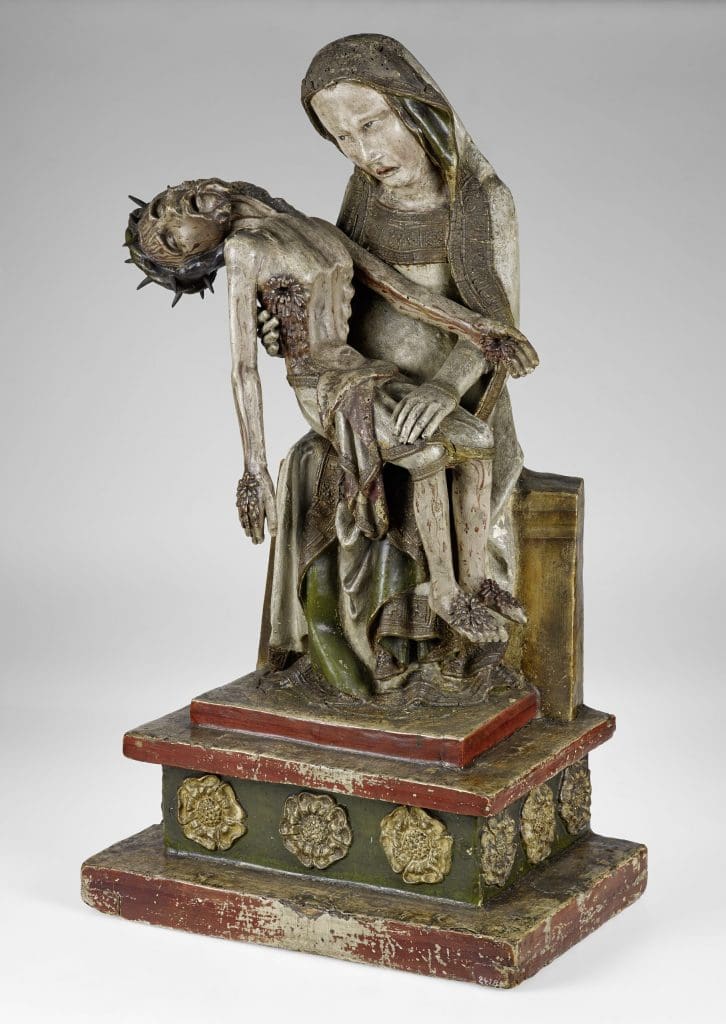
Fig. 1. Röttgen Pietà, c. 1300-1325, H: 34.5 in, Painted wood, LVR-Landesmuseum Bonn, photo: Juergen Vogel.
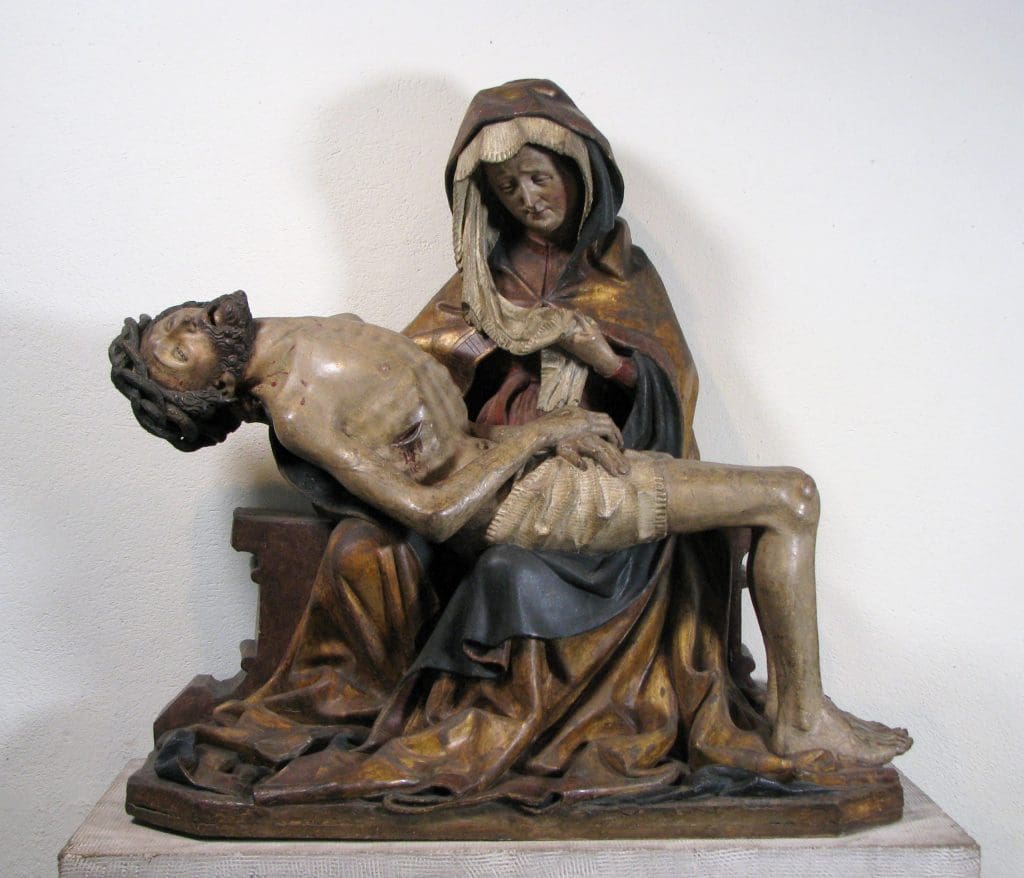
Fig. 2. Pietà, 1435-40, Wood, paint, and gilt, 35 x 38 x 17 in., Metropolitan Museum of Art, New York City, acc. no. 64.80.
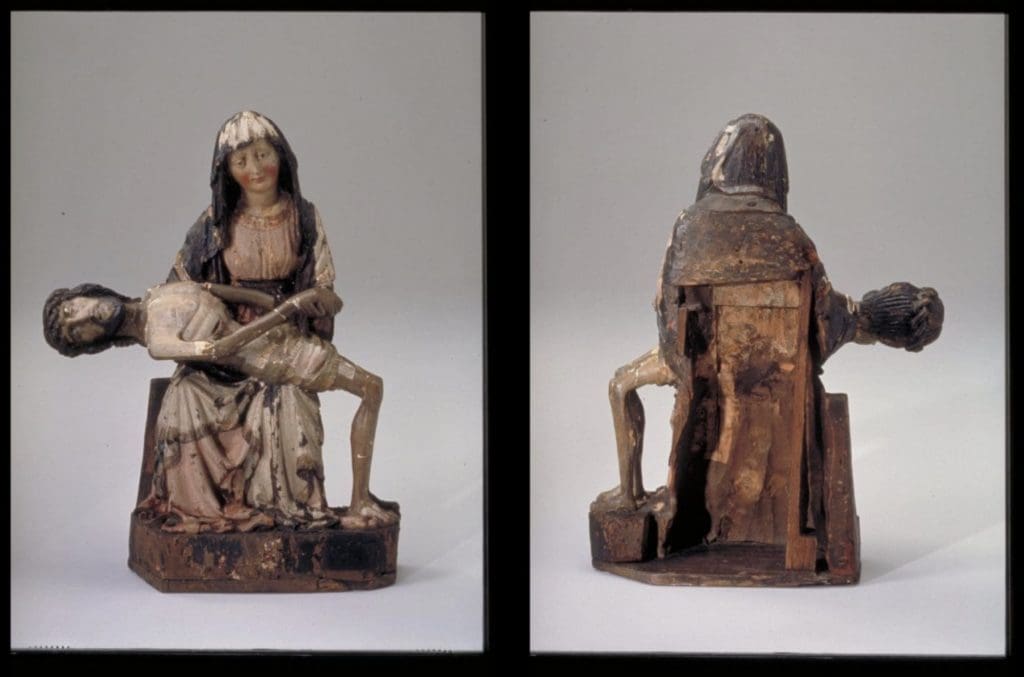
Figs. 3a (left) and 3b (right). Pietà, c. 1420, Lindenwood and paint, 74.5 x 57.5 x 23.5 cm, Schweizerisches Nationalmuseum Zürich, inv. no. LM-6931.
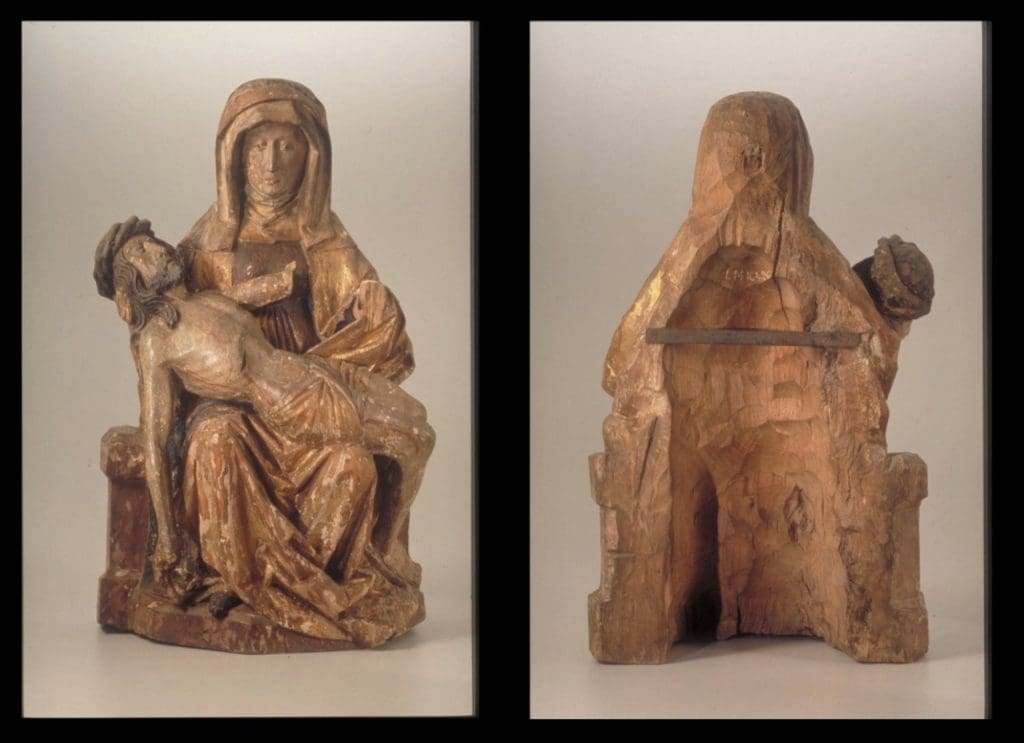
Figs. 4a (left) and 4b (right). Pietà, c. 1500, Lindenwood and paint, 73 x 47 x 27 cm., Schweizerisches Nationalmuseum Zürich, inv. no. LM 10426.
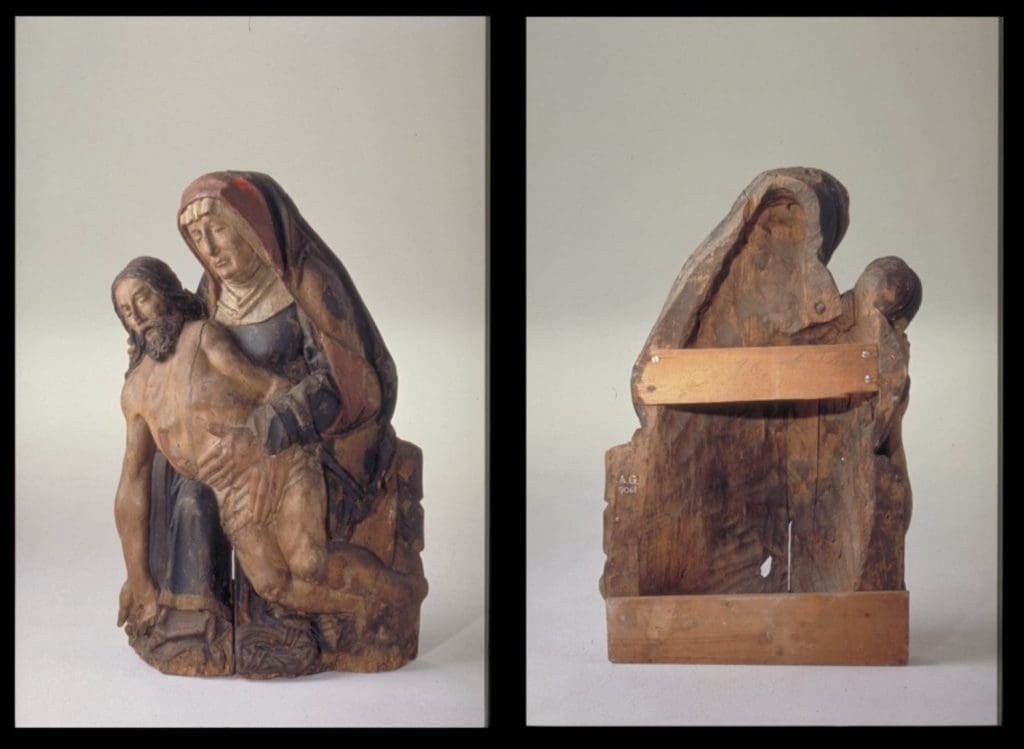
Figs. 5a (left) and 5b (right). Pietà, c. 1500-1550, Lindenwood and paint, 65.5 x 41.5 x 17.5 cm, Schweizerisches Nationalmuseum Zürich, inv. no. AG-9061.
Looking at these comparanda, it therefore seems reasonable to imagine the Bern Vesperbild as a larger-scale depiction of the Virgin and her dead son, made of wood, the central figure for an altar display. These details are also supported by Urs Graf’s woodcut of the moment where Jetzer heard the conversation between the sculpted Virgin and her son, included in the 1509 Franciscan publication of the trial records (fig. 6).[37] Here, the Vesperbild is shown life-size, at the same scale as Jetzer, who kneels before it on the elevated altar, his stigmata visible on the soles of his feet, and the group of inquisitors and monks to his right. The image conflates several moments, showing the bloody tears on the sculpted Virgin’s face as well as a concealed figure to the left. Partially hidden behind a curtain, a Dominican monk points the small reed in his mouth towards the head of the dead Christ. This strange detail depicts further trickery on the part of the monks, as here a certain Brother Steffan is using a small reed (rorlin) to make it seem as though the Virgin and child were having a conversation, witnessed by Jetzer.[38] The frontispiece to a treatise by the Franciscan Jacobus de Marcepallo, dating to around 1510, shows the pietà on a recognizable altar, framed in the background by pointed gables and tracery, as if to suggest altar decoration. A dazed Jetzer lies next to it, with his alleged stigmata prominently displayed (fig. 7). Another, later depiction of the statue shows it as almost life-size, as well, in the 1513 Bilderchronik by Diebold Schilling (fig. 8). To be sure, these images could have taken liberties with the actual size of the sculpture; however, the sources also tell us that the people who entered the chapel the following day seem almost immediately to have perceived that the image appeared to be crying blood.[39] Taking this along with what we know about contemporaneous Vesperbilder designed for altar display, it seems likely that the Bern statue was indeed a larger-scale image designed to stand out in the Marienkapelle.
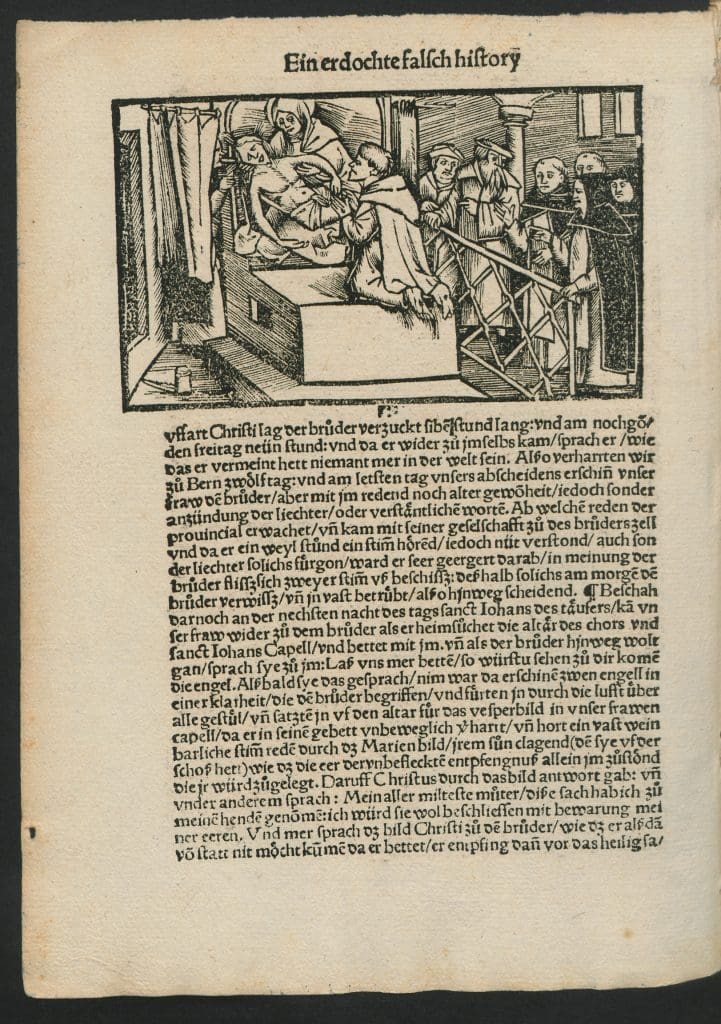
Fig. 6. The Alleged Miracle of the Pietà. Engraving by Urs Graf, as printed in Ein erdocht falsch history etlicher Prediger munch, Basel: Gregor Bartholomäus, 1509. Staatsbibliothek zu Berlin – Preußischer Kulturbesitz, Department of Manuscripts and Historical Prints Shelfmark: Yg 6285 [a] : R., Blatt C iii verse.
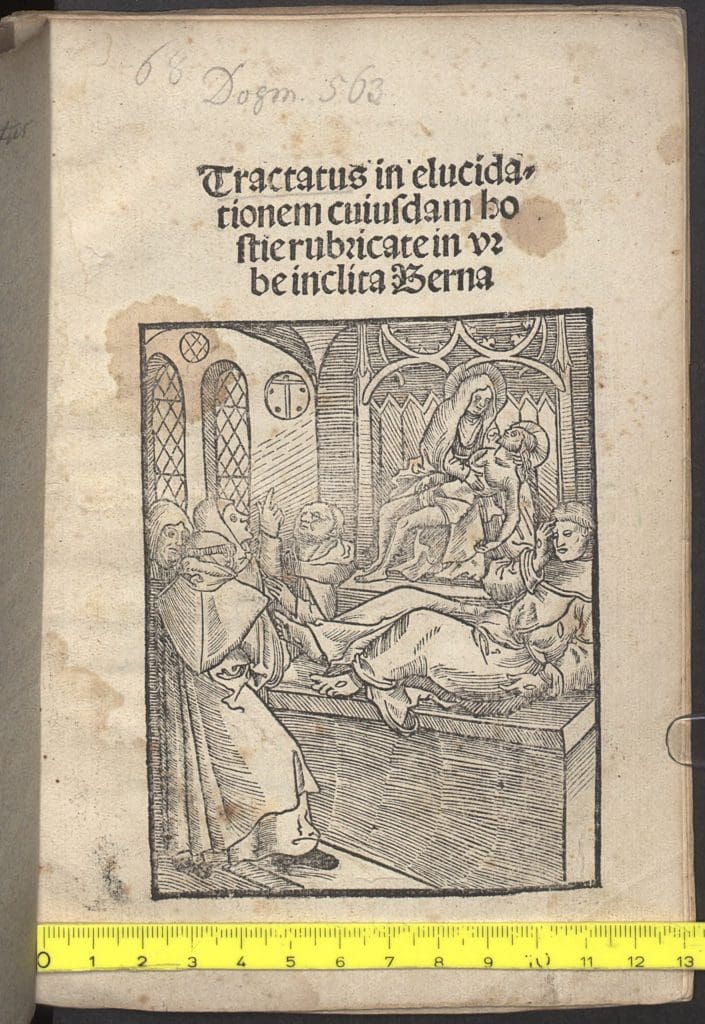
Fig. 7. The Alleged Miracle of the Pietà, As printed in Jacobus de Marcepallo, Tractatus in elucidationem cuiusdam hostie rubricate in urbe inclita Berna, Bayerische Staatsbibliothek München, Res/4 Dogm. 563, frontispiece.
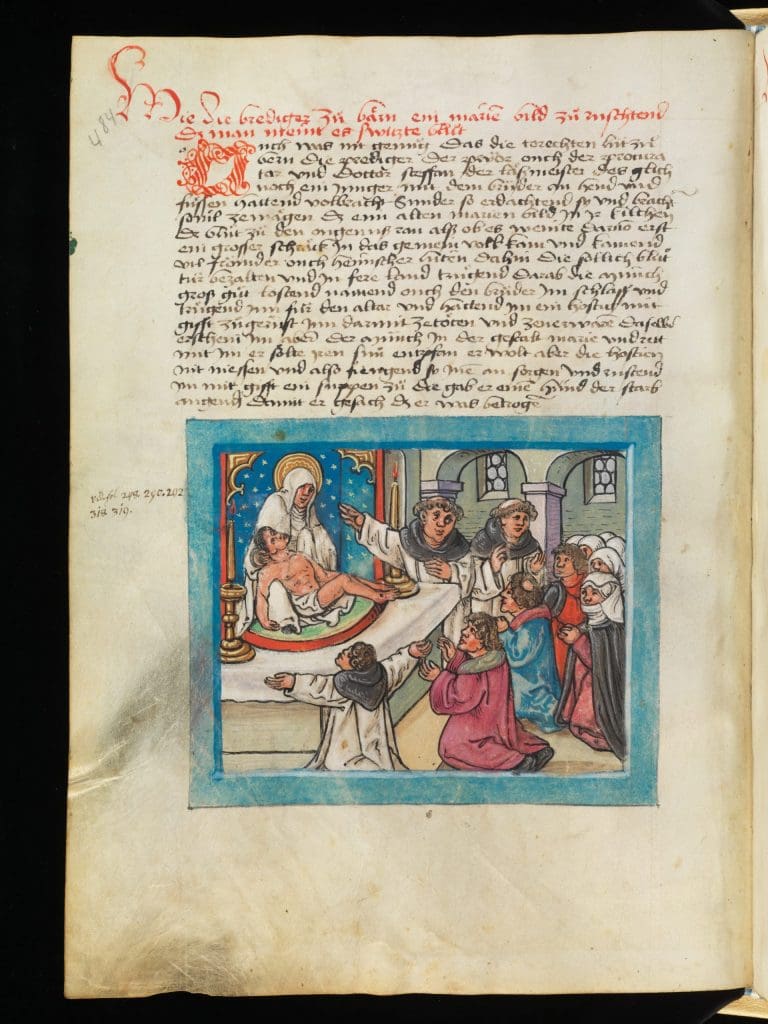
Fig. 8. The Alleged Miracle of the Pietà, As printed in the Diebold Schilling-Chronik 1513, S. 23 fol. Eigentum Korporation Luzern, Standort: ZHB Luzern Sondersammlung.
The Boxley Mechanical Crucifix
As with the Bern Vesperbild, we can look at the records around the Boxley Rood in order to try and reconstruct its “before.” These come mostly in the form of accounts by eyewitnesses who encountered the Rood in 1538. The most descriptive of these was authored by the aforementioned Geoffrey Chamber, in his letter of report to Cromwell. His description is worth including in full:
I founde in the Image of the Roode called the Roode of Grace, the whiche heretofore hath beene had in greate veneracion of people, certen ingynes and olde wyer, wyth olde roton stykkes in the backe of the same, that dyd cause the eyes of the same to move and stere in the hede thereof lyke unto a lyvelye thyng; and also the nether lippe in lyke wise to move as thoughe itt shulde speke.[40]
This account gives little indication of the size or use of the Rood, but it does reveal that it possessed moving parts, the eyes and the lower lip. Chamber also reveals here something of its construction, and his suggestion that these mechanisms are old and rotten could perhaps indicate the dilapidated, aged state of the Rood by 1538. Charles Wriotheseley’s account of the Rood’s final performance on February 24, 1538, in Paul’s Cross, next to the Cathedral of Saint Paul, provides some more information on its facture, stating that it “was made of paper and cloutes from the legges upward; ech legges and armes were of timber.”[41] In a letter also dating from 1538, John Hooker gives another piece of information about the Rood, stating that it was torn down from a wall in the abbey.[42] Wriothesley and Hooker also tell us that the crucifix was mostly of wood, making it easy for the enraged crowd to destroy.[43] Describing this destruction, Wriothesley tells us that the destructive act began not with the people, but the preacher, John Hilsey, himself: “after the sermon was done, the bishop took the said image of the rood into the pulpit and broke the vice” – that is, the mechanical device inside of it, that permitted its aforementioned movement – “and after gave it to the people again, and then the rude people and boyes brake the same image in peeces, so that they left not one peece whole.” This account suggests that the Rood was not a huge sculpture; though big enough for its movements to be seen by at least some of those in the crowd, it was small enough for the preacher to break its mechanical parts on his own. Indeed, it may not even have been necessary for the crowd to have had a clear view of the crucifix, as the preacher’s words on idolatry seem to have been enough to work the crowd into a frenzy.[44]
As noted earlier, these critics of the Catholic Church used the Boxley Rood to argue for the widespread deception at that institution’s heart. Indeed, as Colin Flight and Peter Marshall have shown, the Rood became imbricated with another alleged example of the Catholic Church’s corruption, the holy blood of Hailes.[45] In his sermon before the Rood’s destruction, Hilsey claimed that it had been confessed to him that this blood was not that of Christ, but of a duck; later investigations were inconclusive, though Cromwell perpetrated the idea that it was in fact honey colored with saffron.[46] Still, this sermon joined the Rood and the “fake” blood in the public’s mind, underscoring the Reformers’ claims that the Rood, too, was designed specifically to mislead. This assessment of the Rood was repeated and expanded over the years, by English Protestants as well as by some much more recent scholars.[47]
The latest work on the Boxley Rood, however, shows that this alleged deception was likely a wholesale invention by the Reformers. Kamil Kopania, Colin Flight, and Leanne Groeneveld have argued that later sources describing the Rood exaggerated its possible motions, and Kopania has suggested that the Rood’s movement was probably confined to its face – as indicated in the earliest accounts about it.[48] Johannes Tripps agrees, suggesting that the Rood was likely an “altar figure which, with the help of cords, depicted the agonizing death of Christ on the cross.”[49] Both Tripps and Kopania refer to a small fifteenth-century figure of the “bad thief,” now in Paris, which would have formed part of a larger Crucifixion group. This wooden sculpture was operated with cords by which it could open and close its eyes and move its mouth, in imitation of suffering on the cross.[50]
While an image of Christ with moving eyes and lips might strike us today as strange, such articulated sculptures of the crucified Christ were in fact quite common in the later medieval period across Europe.[51] Kamil Kopania’s exhaustive work on these objects has catalogued 126 surviving examples across Europe, in addition to references to twenty-three more in written sources.[52] No doubt this body of evidence represents only a small piece of such sculptures, especially in a place like England where the destruction of Catholic images (like the Rood) was carried out aggressively during the Reformation.[53] The surviving objects demonstrate a wide range of functionality, with the simplest involving jointed shoulders, and the most complex equipped with multiple joints at the shoulders, arms, legs, hips, and even mouths and tongues.[54]
Like Vesperbilder, moveable crucifixes seem to have arisen out of a widespread interest, starting in the thirteenth century, in describing, depicting, and meditating on certain affective moments from Christ’s Passion.[55] One way to do this, the evidence suggests, was to design special sculptures of the crucified Christ to be used in liturgical and paraliturgical performances of the Christ’s Passion. Here, moveable parts – most commonly arms that could be raised and lowered to the corpus’ side – permitted the statue to perform the role of the dead Christ in reenactments of his Deposition (fig. 9).[56]
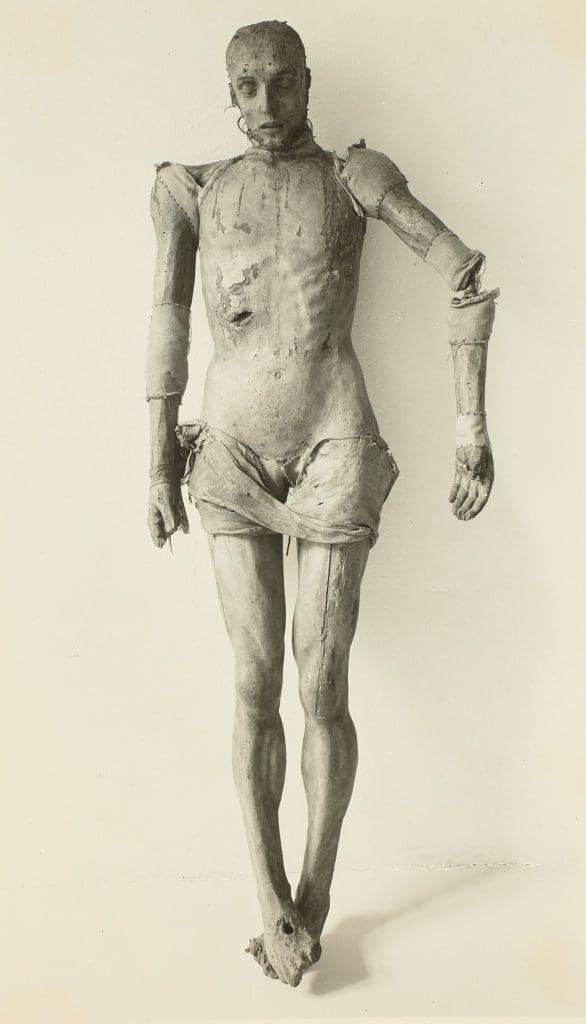
Fig. 9. Jointed Christ, c. 1510 (photograph from 1955), Wood, leather, canvas, real (animal) hair, 190 x 182 x 37.5 cm, Stadtkirche St. Nicolai, Döbeln, Germany, Photo: Bildarchiv Foto Marburg.
The evidence about the Rood’s moveable parts, limited to its eyes and lips, suggests a different use from this more common type of crucifix. Kopania and Tripps have argued that it was more likely a type of “preacher’s Christ,” a small-scale figure that might have been used by a preacher delivering a sermon to illustrate Christ’s suffering.[57] Tripps points to the evidence of two fifteenth-century pilgrim badges from Boxley, the first of which shows a crucifix of the lignum vitae type, and the second, a fragment, depicting Christ’s head with what appear to be tears falling from its eyes (fig. 10 and fig. 11). This latter evidence, he suggests, might indicate that in addition to having moveable eyes, this crucifix may have had a reservoir for water in its head so it could produce tears, a “special effect” that has been attested in a pietà from Rostock, Germany, dating to 1399.[58]
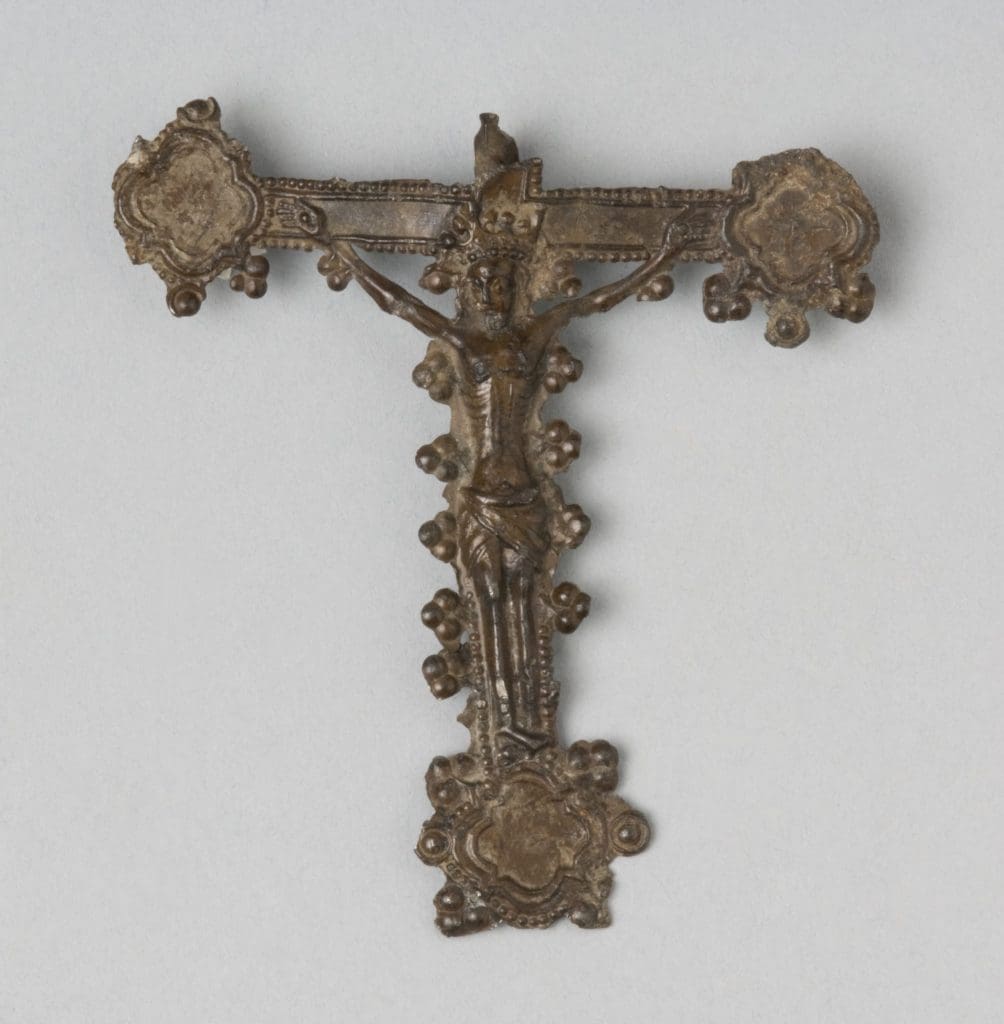
Fig. 10. Pilgrim Badge with the “Rood of Grace” from Boxley Abbey, Kent, 15th c., Lead-tin alloy, 7.6 x 7 x 1.3 cm., Philadelphia Museum of Art: Purchased with funds from the estate of Suzanne Batten, 2009-97-1.
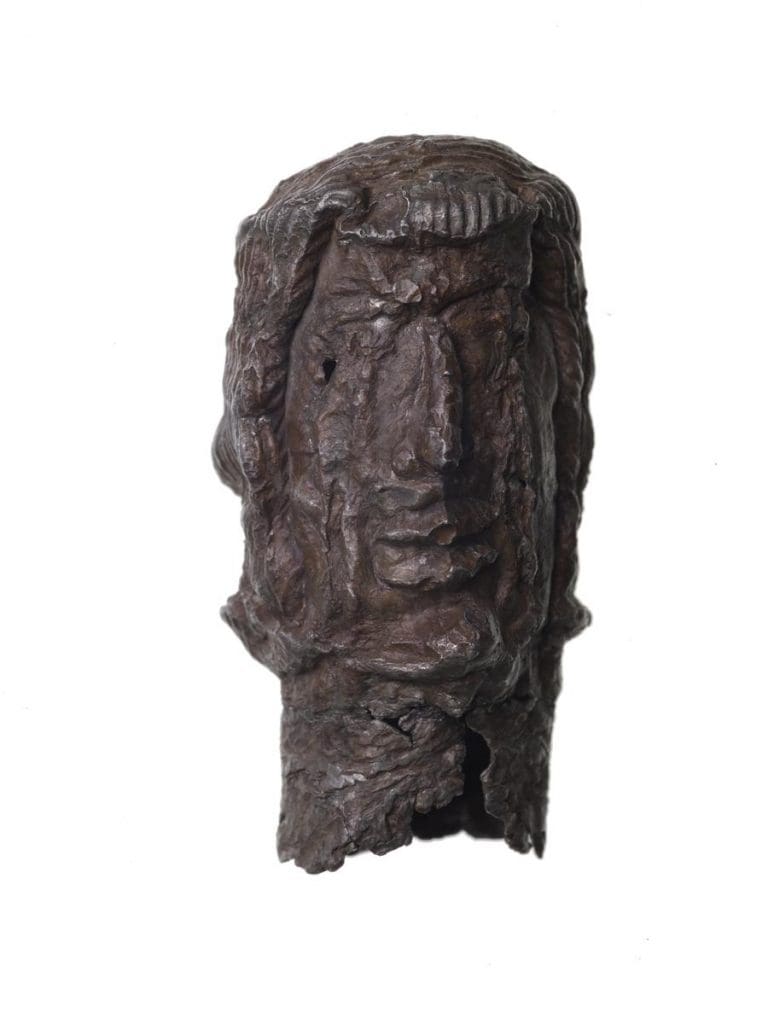
Fig. 11. Pilgrim Badge from Boxley Abbey, Kent, 15th c., Pewter, 4.8 x 2.4 x 2.7 cm., © London Museum, 97.84.
This potential tear mechanism may suggest a connection with the Bern Vesperbild’s fabricated tears, but here it vital to note that there is no indication that the Boxley Rood was in fact designed to deceive, with tears or lip movements or anything else. Returning to Geoffrey Chamber’s account of the Rood in 1538, he notes that this sculpture “hath been had in greate veneracion of people.”[59] Located on the way to Canterbury, a well-known and much visited pilgrimage site, the abbey at Boxley seems to have enjoyed a steady stream of pilgrims. Indeed, even Henry VIII is recorded as having offered a donation to the abbey of Boxley in 1510, prior to his schism from the Catholic Church, though the records do not indicate whether or not he visited the abbey or the Rood in person.[60] The appeal of the Rood, however, does not seem to have been its mechanical movements, and the only mention of anything “miraculous” about it is the story of how it came to the abbey itself. According to a version of this story recorded by William Lambarde in 1576, the Rood was created by a carpenter in France who then transported it to England. He was separated from his horse, who trotted on to Boxley. Though the carpenter tried to retrieve it from the monks there, the Rood was miraculously rendered immoveable, apparently expressing its desire to remain at the monastery.[61] Citing T. E. Bridgett’s 1888 article, Groeneveld notes that Lambarde frames this account by stating that the monks circulated this story themselves in a pamphlet, which also included a description of the sculpture’s special moving elements. If this were, indeed, information provided by the monks to the faithful, it seems likely that many of these pilgrims would have been aware of how this image operated.[62] It was, in other words, a special but not unusual kind of devotional object. Its depiction of the suffering Christ likely shared much with such images across media, and its moveable parts, too, were part of the wider category of objects found in the medieval Church. Like the Bern sculpture, it sought to render visually an affective moment in the story of Christ’s Passion, with a premium placed on the depiction of the suffering of Christ, in the Rood, and Mary and son, in the Vesperbild.
But what was the purpose of depicting the passio of Christ and compassio of his mother? What I wish to argue here is that such depictions demanded that the viewer be more than a passive spectator – that he become, rather, a user, whose interaction with and contemplation of the Bern Vesperbild or Boxley Rood was necessary in order to complete the sculptures themselves. In other words, these were “social sculptures” in Beuys’ sense, insofar as their meaning was constructed not only by their materials and formal qualities – the carved, downcast eyes of the Virgin, the articulated lips of Christ – but also by their audience, how they responded to and understood the sculptures in their encounters. It was precisely this co-created network of meaning between sculpted object and human audience that was disrupted and ultimately (and violently) redefined by the events in Bern and Boxley described above.
Networked Images: Bern and Boxley as “Social Sculptures”
As I have suggested, the larger categories of sculpture referred to as Vesperbilder and articulated sculptures of Christ developed around the same time, apparently out of a growing (and pan-European) interest in elaborating the passio of Christ and the compassio of his mother. Much has been written about this development in late medieval religious culture, often referred to as “affective piety,” that made itself known across media, from devotional texts to visual iconography and theatrical representation.[63] Often, “affective piety” is explained as a new kind of piety that valued direct, bodily experience of sacred events; in this argument, the purpose of the overabundance of details about Christ’s suffering – rendered as gruesome side wounds in sculpture, or descriptive language in devotional texts – is an appeal to realism, to overcoming or even erasing the gap between the reality of Christ’s death and the physical and temporal remove of the viewer/reader.[64] As I have argued elsewhere, however, the texts and images that characterize this new piety make constant appeals to their viewers/readers qua viewers/readers – that is, as people inhabiting the role of audience, who bring with them their discernment and appreciation of representation, be it visual, literary, and theatrical.[65] Take for example the much-circulated Meditationes Vitae Christi, a fourteenth-century pseudo-Bonaventuran devotional text that described the events of Christ’s life (and death) in minute, vivid detail. As Sarah McNamer has demonstrated, medieval users of these texts seem to have especially appreciated those aspects that inspired emotional engagement.[66] However, here I also wish to draw attention to how the Meditationes calls attention to its own narrative frame, thereby engaging with the reader qua reader, not just as an absorbed spectator. Throughout the text, invitations to “[c]ontemplate and watch carefully all the actions and each and every affliction of your Lord” precede detailed descriptions of these afflictions, and commands to “watch” alternate with commands to “suffer with” Christ.[67] The reader, in other words, is constantly asked to shift roles, from concerned spectator to active sufferer, and, ultimately, to discerning reader, the active agent working with the text to construct its meaning.[68]
I see similar processes at play with late medieval sculptures – including Vesperbilder and articulated crucifixes – that sought to render visually (and often, haptically) accessible the suffering of Christ and the Virgin. In the fifteenth-century German Vesperbild from the Met mentioned earlier, Mary and her son are depicted in a way that highlights two very contradictory yet vital things: their close connection, and their sudden separation (fig. 2). Draped on her lap, Christ is the clear focal point of his mother’s downcast eyes, his curved chest inverting the curve of her veil. This veil seems to be of the same material as Christ’s loincloth, again suggesting their connection, and possibly in reference to contemporary liturgical stagings of the Lamentation where Mary used her veil to cover Christ’s nakedness.[69] At the same time, the dramatic tilt of Christ’s head, along with the still-bleeding side wound, emphasize his deadness, in contrast to the living Mary who supports him. They are as close as they appear in sculpted depictions of the Virgin and Child, and yet clearly separated by Christ’s brutal death. Though it is Mary’s suffering that is the subject of the Vesperbild, it is Christ’s body that is most clearly on display. Mary’s presence, then, is an invitation to the viewer: look on this body, too, and weep as she weeps. Again, contemporary dramatic renderings of this scene provide insight into this provocation. In some Lamentation texts used in performance, Mary asks the other women (and by extension, the audience) to mourn along with her; in this sculpture, it is the viewer to whom she directs this request, expressed not in words but in the display of her dead son.[70] The Vesperbild, then, is more than an illustration; it is an invitation that relies on the viewer to become a user, to see in the sculpted form the tension between Mary as mother and Mary as mourner, to see Christ as both her son and as the dead Savior.
Likewise, articulated crucifixes play with the paradoxes of representing the dead Christ with “dead” materials, as I have argued elsewhere.[71] In its probable role as a preacher’s Christ, the Boxley Rood very clearly functioned as an invitation to its audience to do more than look and listen. We can imagine a moment in the sermon where the priest would use the mechanisms to move the lips to deliver Christ’s famous lament on the cross – “O God, why have you forsaken me?” – or his last words, “It is finished.”[72] The eyelids might then flutter a final time, before closing to indicate that he was really dead. Though obviously not Christ at Golgotha, but rather a statue made of wood mounted on the wall of the abbey, this moment has great affective potential, punctuating the story of Christ’s death with dramatic flair. Those who heard this sermon were asked, in a sense, to lean in, to focus their attention on a sculpted piece of wood, and for a moment see in it something of the “real” moment of Christ’s death. It was their willingness to do this that completed the sculpture, taking it from a sculpted representation with mechanical elements to a valued devotional object.
To be sure, it was entirely within the realm of possibility for late medieval Christians that an image could be a site of miraculous movement. A famous example is the vision of Rupert of Deutz (c. 1075-1130). As he gazed on a crucifix in a church he saw in a dream, the figure of Jesus moved its right arm to make the sign of the cross, and Rupert rose to meet the figure in a mirrored embrace.[73] As Jacqueline Jung has demonstrated, throughout the telling of this vision Rupert is very clear that he was interacting with “an artificial body”[74]; that is, a representation of Christ, the movement of which signaled that something otherworldly was happening. Though Rupert’s experience was a special one, it speaks to the potential of sculpted images like the crucifix to be sites of encounter with the divine – even if such potential was only rarely filled. Similarly, there are many stories of images of the Virgin that bleed or weep or otherwise show “signs of life,” to borrow a phrase from Anna Russakoff, again suggesting that images could be and were places where the divine could made itself miraculously known.[75] One such story is that of the siege of Orléans, part of Gautier de Coincy’s thirteenth-century collection of Marian miracles, where an image of the Virgin bent its knee to block an arrow from hitting her devotee.[76] In his fourteenth-century illumination of this story, the painter Jean Pucelle captures this miraculous moment by showing the framed image of the Virgin with an arrow protruding from the knee, circled by a spot of blood (fig. 12).
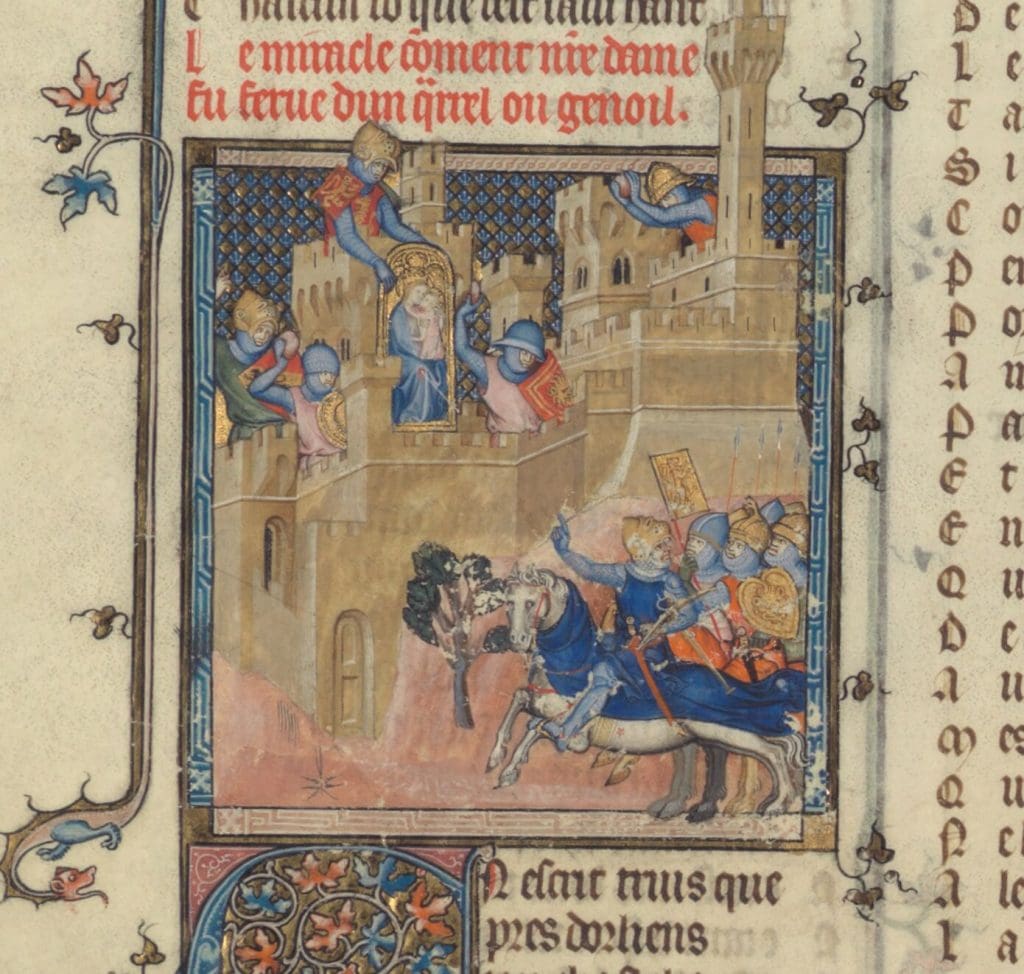
Fig. 12. The Siege of Orléans, Jean Pucelle, c. 1330-40, In Gautier de Coinci, Miracles des Nostre Dame, Bibliothèque nationale de France, nouv. acq. fr. 24541, fol. 70v.
Thus, though the Bern Vesperbild’s bloody tears turned out to be red paint, they were clearly intended to imitate accepted examples of statues that exhibited miraculous signs of life. By contrast, it seems highly unlikely that the Boxley Rood’s movement was intended to feign something miraculous; instead, its movement was a further “special effect” to induce or encourage affective contemplation. In other words, both the Vesperbild and the Rood were, in and of themselves, not guilty of deception; their style and facture accords with what we know about the devotional culture in which they were originally embedded. It was only with the manipulation of these images by human actors that this normative social role was radically altered – albeit with strikingly different outcomes for the sculptures themselves.
Deceptive Images?
The nature of the manipulation of the Bern Vesperbild comes to light in the trial records. In his initial testimony, Jetzer claimed that he heard a conversation between the sculpted Virgin and her son and saw that the Virgin was weeping bloody tears. News of this alleged miracle spread quickly, and large crowds came to the chapel to witness it beginning on the following day, June 25. Almost immediately, however, some doubted the authenticity of this miracle; a member of the Bernese Grand Council named Anton Noll claimed that during his visit to the chapel, he saw the priest Johannes Teschenmacher touch the bloody tears and exclaim that they were merely made of paint.[77] This led the city and church authorities to call the artist Hans Fries to Bern “to test and know, whether or not the red appearance of tears was brought about by human industry or art.”[78] After two years of trials, Jetzer accused the four Dominican brothers of fabricating the bloody tears as well as the other miracles he had originally reported, and the paint was found to have been obtained from Lazarus von Adlau, the monastery’s manuscript illuminator.[79]
The four Dominicans were convicted of a range of charges, including heresy and idolatry. Here it is important to note that the charge of idolatry was not about the Vesperbild, but about the fabrication of a miraculously bleeding Host. Colored red, this wafer was used by the Dominicans during an “appearance” of the Virgin and two angels to Jetzer, and subsequently put on display to be venerated by the community and the laity of Bern.[80] This was an undeniable case of idolatry in the late medieval world, as a wafer that had been tampered with (certainly by paint, and possibly with poison) was given the devotion (latria) that should only be given to Christ – including to His real blood and body as present in a consecrated – and otherwise untainted – Host.[81] The monks were sentenced to death and burned at the stake on May 31, 1509.
The fate of the Vesperbild, on the other hand, does not appear in the trial records. Though involved in – and indeed, central to – the fabrication of a miracle, the image does not seem to have been destroyed, or at the very least its fate was not worth mentioning. Unlike the falsified wafer, this image was not accused of encouraging idolatry, for though the people were led to believe that a miracle had occurred to make the (inanimate) statue cry (real) tears, the existential nature of the sculpture itself was unchanged. In other words, it was an accepted practice in the pietà’s late medieval “social sculpture” network to receive prayers, with the understanding that the prayers that were given to the image of the Virgin and Christ were passed on to the prototype.[82] Though its bloody tears were false, this essential function remained unchanged.
Following the trial, it is possible that the painted tears were stripped and the statue returned to the altar in the Marienkapelle, but it seems more likely that its connection to the scandal would have forever marred the image. Kathrin Utz Tremp has suggested that a painted altarpiece by Niklaus Manuel, commissioned in 1515, may have been destined for the Marienkapelle.[83] Though no definite information survives about its original location within the Dominican church, its dedication to Saint Anne, the mother of the Virgin, may have made it a good fit for the Marienkapelle. If this hypothesis is correct, this altarpiece would likely have replaced the Vesperbild, which may have been put in storage and forgotten. Even if it survived following the trial, it was likely destroyed or at least removed from the church in 1528, when the city of Bern ordered the clearing of the churches in response to public sympathy for the Protestant position regarding images.[84] Nevertheless, the silence in the trial records about this sculpture’s fate immediately following the trials underscores the fact that the image was not found guilty; rather, it had been (mis)used by the Dominican friars. Its social role as a devotional object, a depiction of compassio intended to evoke meditations on and affective responses to the Passion, was never questioned. In other words, the idea that images like the pietà could serve as points of access to the divine remained undisputed. The issue, instead, was that bad actors had tried to trick others into believing that this pietà was something more than a devotional image: that is was the site of a miracle, of a real incursion of the divine into the mundane. The guilty humans were thus the ones punished, not the image.
The Boxley Rood was also accused of deception, but here that charge was about more than the “misuse” of images; it was about whether or not “social sculptures” like the Rood had a place in Christianity at all. As Eamon Duffy and Margaret Aston, among others, have shown, the charge of idolatry in the Anglican church was a totalizing one, leveled against images of all kinds in the (Catholic) church, as well as practices around them like making offerings or going on pilgrimages to visit them.[85] Images were punished in ways analogous to criminals, as for example in the public “execution” of cult images of Mary from popular pilgrimage sites like Walsingham at Smithfield, where human offenders were also put to death – which occurred in the same year as the Boxley Rood’s violent destruction by the mob at Paul’s Cross.[86]
The earliest reports on the Rood focus on its alleged deception, with the Anglican sympathizers claiming that its mechanical parts, concealed as they were in the corpus of the crucifix, could only be proof of a desire to deceive. The parties responsible for this deception, however, are somewhat nebulous in these early accounts. Wriothesley names the monks of Boxley as responsible, explaining that it was shown in Maidstone so that “all the people there might see the illusion that had bene used in the sayde image by the monckes of the saide place of manye years tyme out of mynde, whereby they had gotten great riches in deceavinge the people thinckinge that the sayde image had so moved by the power of God, which now playnlye appeared to the contrarye.”[87] Chamber’s original letter avoids naming the monks specifically, perhaps because he notes that the monks he met at Boxley “declare themselff to be ignorante” of the Rood’s moving parts. Thus he speaks of the Rood’s deception in the passive, with its performance at Maidstone intended to display “the false, crafty, and sottell handelying thereof, to the dishonor of God, and illusion of the sayd people.”[88] In these accounts, the Rood’s deception emerges as a Catholic conspiracy by nameless agents, so that the Rood becomes the only tangible party to actually accuse.
Notably, the Rood itself takes on more and more agential qualities in the following years, as Groeneveld and Flight have shown, but even in these accounts of 1538 we see the beginnings of this transformation.[89] Unlike the Bern Vesperbild, the Boxley Rood is not just a site upon which deception is enacted; it becomes deception itself. It is not simply its “handelying” that is false, crafty, and subtle, it is the image qua image. Here, idolatry is a far-reaching charge. While no record of John Hilsey’s sermon survives, Wriothesley’s text discusses some of what he covered. It seems that Hilsey did not spend much time on the Rood’s moveable parts, using the Rood instead to claim that the Catholic Church encouraged widespread idolatry. Pairing the Rood with the fake holy blood of Hailes, mentioned earlier, Hilsey was able to launch into a rant against the use of images in the Church, which he argued “hath caused great idolatrie to be used in this realme, and shewed how he thincketh that the idolatrie will neaver be left till the said images be taken awaie.”[90] For Hilsey, it seems, it was not important to speak of the moving lips and eyes of the Rood, because the most grievous deception was not in the monks’ use of such images to extort offerings or fool the faithful, but in the use of images in the Church writ large.
In these discussions of the Rood we see a move away from assigning individual guilt, and towards the denunciation of an entire tradition of image-making and use. The monks at Boxley, as far as we know, were not specially singled out and accused of idolatry; the Anglican campaign was far more totalizing. In Bern, those who sought to deceive the faithful could be (and were) found and rooted out; in Boxley, the image – now cast as the idol – was the only clear guilty party. Interestingly, this shift away from human agency resulted in the Rood’s greater agency – and specifically, as a demonic agent. This is made explicit in the letter of John Hooker, who writes to his friend Rudolph Gwalther with triumphant reports of the strides the nascent Anglican Church is making against idolatry across the country: “The Azotic Dagon falls down everywhere in this country. That Babylonian Bel has already been broken to pieces.”[91] He goes on to tell the story of the Rood, referring to it as “a wooden God of the Kentish folk, a hanging Christ who might have vied with Proteus himself.”[92] This figure becomes very active indeed in Hooker’s account, where it is described as acting “most cunningly, to nod with his head, to scowl with his eyes, to wag his beard, to curve his body, to reject and receive the prayers of pilgrims.”[93] The Rood is an ambiguous agent here, to be sure, and the use of the passive voice in the original Latin makes it hard to trace who or what the subject of all these actions may be.[94] Overall, however, Hooker treats the Rood as an individual agent who misleads the people, is exhibited at Kent, and visits the Royal Court as the king’s new guest (novus hospes). Here, the Rood puts on quite a show: “He acts – scowls with his eyes – turns his face away – distorts his nostrils – casts down his head – sets up a hump-back – assents – and dissents!” (Agit ille, minatur oculis, aversatur ore, distorquet nares, mittit deorsum caput, incurvat deorsum corpus, annuit, renuit); there is no mention of a human manipulator or puppeteer, so that the Rood seems to act of its own accord.[95] In its final moments, Hooker calls it the “Kentish Bel,” making clear its demonic associations, thus justifying its ultimate destruction at the hands of the excited crowd: “he is snatched, torn, broken in pieces bit by bit, split up into a thousand fragments, and at last thrown into the fire; and there was an end of him!” (Rapitur, laceratur, frustillatim conscinditur, in mille confractus partes tandem in ignem mittitur, et hic tulit exitus illum).[96]
It is this portrait of the Rood as a demonic agent that would be repeated and elaborated in the decades following its destruction. It was given new and even more “lively” forms of movement, far beyond the lips and eyes; it was referred to as a “he” that would frown or turn away if offended by the size the offering made to it.[97] However, for my purposes here, the most striking part in the accounts of the Rood by those who saw it is that the accusation that the Rood’s mechanical parts were designed to imitate a miraculous moving statue were far outpaced by a different accusation of deception: the wholesale charge of idolatry. There was no escape from this accusation, no possibility of simply removing the wires and mechanisms and placing it back in the church to assist in pious devotion; its destruction was the only possible outcome. Thus, while the outcome of the trials in Bern does not seem to have significantly altered conceptions of the acceptable use of images within (Catholic) Christian practice, the trial-by-popular-opinion and resultant destruction of the Rood was a definitive – and lasting – rejection of late medieval image use.
Conclusion: Violent Transformations
In many ways, it is this moment of destruction of the Boxley Rood that best exemplifies Beuys’ concept of social sculpture. Here, a brief discussion of one of Beuys’ most well-known works of social sculpture, 7000 Eichen (7000 Oaks), will set the stage. For the 1982 documenta exhibition in Kassel, Germany, Beuys set out to plant seven thousand saplings paired with basalt columns (fig. 13). These trees were planted not only by Beuys, but by many members of the community and visitors to documenta, and it was not until 1987, over a year after Beuys’s death, that all seven thousand trees were planted. Other planting projects followed across the globe.[98] Thus, as Beuys had hoped, the project extended beyond his life, and beyond the purview of any single individual. The combination of fragile young trees and sturdy stone columns evokes both permanence and impermanence, the ever-changing and the never-changing (at least by most human scales), inviting all to become “artists” by participating in the project he called social sculpture.
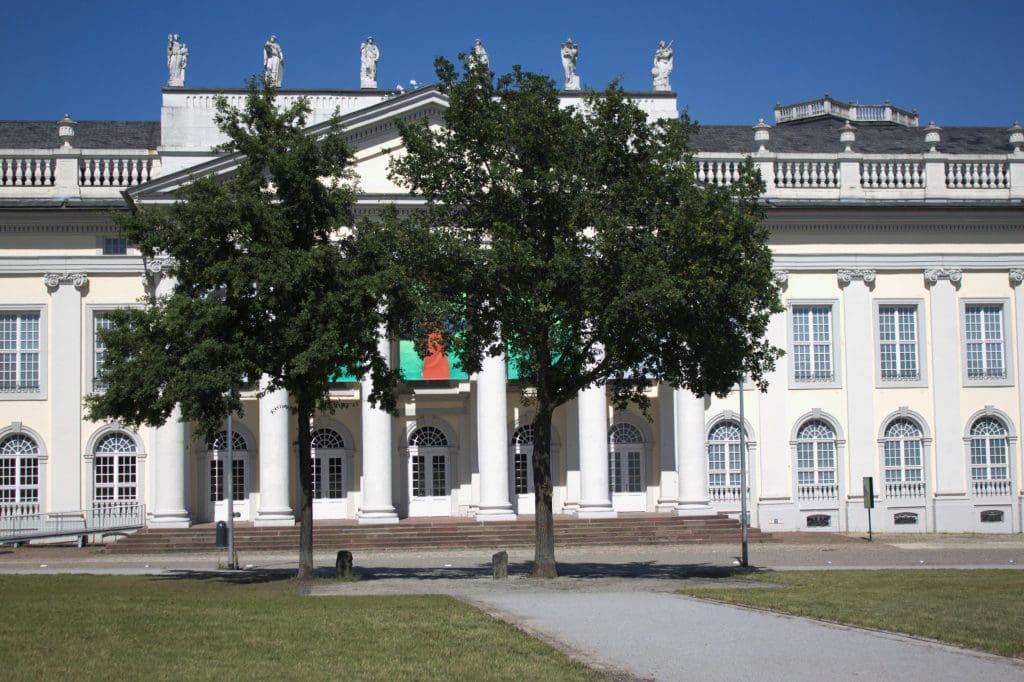
Fig 13. 7000 Eichen (7000 Oaks), Joseph Beuys, View of two oak trees planted at the Museum Fridericianum, Kassel, 1982, Photo from 2020 Creative Commons BY-SA 4.0, https://de.wikipedia.org/wiki/7000_Eichen#/media/Datei:7000_Eichen_vor_Fridericianum.jpg.
For Beuys, 7000 Eichen spoke to the utopian aims he saw as central to social sculpture. In an interview before documenta 1982, he expressed his hope that the planting of the oaks would “raise ecological consciousness – raise it increasingly, in the course of years to come, because we shall never stop planting.”[99] However, as Daniel Spaulding has shown, social sculpture may not only be utopian – if the goal is that all social practice should be a kind of art, this would include destruction just as much as production.[100] Thus I understand the destruction of the Rood as social sculpture insofar as it aimed at a similarly expansive shift in consciousness as that which Beuys sought to bring about with 7000 Eichen. For the Rood, however, the issue was not about “ecological consciousness,” but rather about remaking the “ecology” of images within Christian practice. The shift in consciousness evidenced by the Rood’s spectacular destruction is a shift from images as active participants in the connection between the earthly and the divine, to images as merely dead things, distractions at best and demonic at worst. The subsequent iconoclasms that erupted across Britain and Switzerland (and many other parts of Europe) suggest that such a transformation was, indeed, realized, at least in Protestant domains.
While the destruction of the Boxley Rood can be understood as marking a moment of transformation, this article has sought to show that the disappearance of the Bern pietà is something else entirely. Its trial elicited no such sea change in the “ecology” of images; it was only several decades later that the iconoclastic wave of the Reformation reached Swiss shores. This may seem a minor distinction, but in fact it is a vital one for understanding the world of images in Christian practice in the late medieval period. The fates of the Rood and the pietà speak to two distinct logics regarding the proper role of images, as I have shown. Depicting the death of Christ and the suffering of his mother, images like the Boxley Rood and the Bern pietà asked their viewers to play an active role, not simply looking but also feeling, reflecting, and meditating on the beliefs at the core of the faith. These two sculptures, then, are more than well-known examples of the abuse of images within late medieval Christian practice. Instead, their controversies provide two opposing answers to the question of the place of images in Christian devotion, with the treatment of the Bern pietà affirming the image’s potential as a devotional aid, and the destruction of the Boxley Rood denying any productive place for images at all. To ignore this distinction would be to risk advancing or continuing a narrative that the iconoclasms of the Reformation were somehow an inevitable outcome of late medieval image culture, that “affective piety” spoke to an unsustainable decadence and even a moral failing – in other words, to reiterate the accusations of Protestant Reformers, centuries later.
Just as any work of scholarship on Beuys’ 7000 Eichen must reckon with the first installation of oak trees and columns in Kassel in 1982, so too is it valuable to reckon with the social worlds of late medieval devotional sculpture on their own terms. Here I must confess an intellectual sympathy with Beuys’ utopianism, his call that we see “how we mould and shape the world in which we live”[101] – looking at these moments of “before” for the Rood and the Vesperbild, we can find traces, perhaps, of how a distant “we,” and the images they valued, molded and shaped a different world.
References
| ↑1 | The Jetzerhandel has been studied by many commentators and scholars since the sixteenth century. My work relies heavily on the scholarship of Kathrin Utz Tremp, including her exhaustive, two-volume study of the trial, Warum Maria blutige Tränen weinte: Der Jetzerhandel und die Jetzerprozesse in Bern (1507-1509), vols. 1–2 (Wiesbaden: Harrassowitz Verlag, 2022). See also Romy Günthart, ed., Von Den Vier Ketzern (Zurich: Chronos Verlag, 2009), and Rudolf Steck, ed., Die Akten des Jetzerprozesses nebst dem Defensorium (Basel: Verlag der Basler Buch- und Antiquariatshandlung, 1904). The bibliography on the Boxley Rood is similarly extensive. On its use by supporters of the Anglican church, see Peter Marshall, “The Rood of Boxley, the Blood of Hailes and the Defence of the Henrician Church,” The Journal of Ecclesiastical History 46, no. 4 (October 1995): 689–96. See also recent work on the Rood by Colin Flight, “The Rood of Grace,” Colin Flight’s Website, 2013, https://www.durobrivis.net/articles/ rood-of-grace.pdf ; Leanne Groeneveld, “A Theatrical Miracle: The Boxley Rood of Grace as Puppet,” Early Theatre 10, no. 2 (January 1, 2007): 11–50, and “‘lyke unto a lyvelye thyng’: The Boxley Rood of Grace and Medieval Performance,” in Medieval Theatre Performance: Actors, Dancers, Automata and Their Audiences, ed. Philip Butterworth and Katie Normington (Boydell & Brewer, 2017), 197–214. https://doi.org/10.1515/9781787440784-016; and Johannes Tripps, “The Joy of Automata and Cistercian Monasteries: From Boxley in Kent to San Galgano in Tuscany,” Sculpture Journal 25, no. 1 (2016): 7–28. https://doi.org/10.3828/sj.2016.25.2. |
|---|---|
| ↑2 | See for example Joseph Koerner, The Reformation of the Image (University of Chicago Press, 2004), 147, and Bruce Gordon, The Swiss Reformation (Manchester: Manchester University Press, 2008). |
| ↑3 | Stuart Clark, Vanities of the Eye : Vision in Early Modern European Culture (Oxford University Press, 2007),174. |
| ↑4 | Joseph Beuys, What is art? (Clairview Books, 2004), 9. |
| ↑5 | David Levi Strauss, “Beuys in Ireland: 7000 Oaks on the Hill of Uisneach,” Alternatives: Global, Local, Political 31, no. 1 (2006): 102. https://doi.org/10.1177/030437540603100105. |
| ↑6 | Beuys, What is art?, 9. |
| ↑7 | See Utz Tremp, Warum Maria blutige Tränen weinte, vol. 1, for extensive treatment of the alleged miracles and the confessions by Jetzer and the friars. |
| ↑8 | For a helpful summary of the events of the Jetzer Affair and its trial, see Kathrin Utz Tremp’s blogpost for the Landesmuseum Zürich at https://blog.nationalmuseum.ch/en/2023/03/the-jetzer-affair/. See also Günthart,Von den Vier Ketzern, 126-127, 195-196, and Kathrin Utz Tremp, “Topographische Verhältnisse in Kloster und Kirche zur Zeit des Jetzerhandels (1507-1509),” in Französisiche Kirche, Ehemaliges Predigerkloster: Archäologische und Historische Untersuchungen 1988-1990 Zu Kirche und Ehemaligen Konventgebäuden, ed. Georges Descœudres and Kathrin Utz Tremp (Staatlicher Lehrmittelverlag, 1993), 154-157. |
| ↑9 | See Utz Tremp, “Topographische Verhältnisse,” 143-160. |
| ↑10 | Nikolaus Paulus, “Ein Justizmord, an vier Dominikanern begangen,” Frankfurter zeitgemässe Broschüren 18 (1897): 65-106. See also Georg Rettig, “Urkunden des Jetzerprozesses,” Archiv des Historischen Vereins des Kantons Bern 11 (1886): 179-248, 275-344, 501-566. |
| ↑11 | Kathrin Utz Tremp discusses other motivations and issues that may have led the Dominicans to their actions at length. See Utz Tremp, Warum Maria blutige Tränen weinte, vol. 2, esp. pp. 655-719. |
| ↑12 | Though eventually the Franciscan position would win out, the official recognition of immaculate conception did not come until centuries later, in 1854, and was thus an ongoing matter of debate. |
| ↑13 | Günthart, Von den Vier Ketzern, 126-7. |
| ↑14 | Günthart, Von den Vier Ketzern, 126-7. |
| ↑15 | For a more complete discussion of the evidence surrounding the pietà in the trial and the various experts and witnesses involved, see Tamara Golan, “‘ut experiri et scire posset’: Pictorial Evidence and Judiciary Inquiry in Hans Fries’ Kleiner Johannes Altar,” in The Art of Law, ed. S. Huygebaert (Springer International, 2018). |
| ↑16 | On iconophobia and iconophilia in Christianity, see for example Hans Belting, Likeness and Presence: A History of the Image before the Era of Art (Chicago: University of Chicago Press, 1994). On critiques of images in and before the Swiss Reformation, see Bruce Gordon, The Swiss Reformation and Koerner, The Reformation of the Image. |
| ↑17 | See Steck, Die Akten des Jetzerprozesses nebst dem Defensorium, XX; Günthart, Von den Vier Ketzern, 20-21; and Utz Tremp, Warum Maria blutige Tränen weinte, 62-75. |
| ↑18 | Marshall, “The Rood of Boxley, the Blood of Hailes and the Defence of the Henrician Church,” 694. |
| ↑19 | Here I am using the English translation of the original Latin by G. C. Gorham, in Gleanings of a few scattered ears (London, 1857), as reprinted in Flight, “The Rood of Grace,” 18. However, I have changed his translation of idolo from “puppet” to “idol.” |
| ↑20 | Charles Wriothesley, A Chronicle of England during the Reign of the Tudors (London: Camden Society, 1875), 74. As quoted in Flight, “The Rood of Grace,” 7. |
| ↑21 | For a summary of the ways the Rood’s powers were exaggerated over the years, see Groeneveld, “A Theatrical Miracle,” 34-39. |
| ↑22 | For the edited version of these texts, see Günthart, Von der Vier Ketzern. |
| ↑23 | Günthart, Von der Vier Ketzern, 18-22. |
| ↑24 | Steck, Die Akten des Jetzerprozesses nebst dem Defensorium, 17, 163. |
| ↑25 | Günthart, Von der Vier Ketzern, 126, 195. On Vesperbilder, see Wilhelm Pinder, Die Deutsche Plastik vom Ausgehenden Mittelalter bis zum Ende der Renaissance (Wildpark-Potsdam: Akademische Verlagsgesellschaft Athenaion, 1924) and Ludmila Kvapilová, Vesperbilder in Bayern (Petersberg: Michael Imhof Verlag, 2017). |
| ↑26 | Günthart, Von der Vier Ketzern, 126. |
| ↑27 | Kvapilová, Vesperbilder in Bayern, 27. |
| ↑28 | Kvapilová, Vesperbilder in Bayern, 33ff. |
| ↑29 | Kvapilová, Vesperbilder in Bayern, 37-43. |
| ↑30 | From Henry Suso’s Little Book of Eternal Wisdom, as quoted in Kvapilová, Vesperbilder in Bayern, 42: “Ich nam min zartes kint uf min schoze und sah in an, – do waz er tot.” |
| ↑31 | Kvapilová, Vesperbilder in Bayern, 35 |
| ↑32 | Günthart, Von der Vier Ketzern, 10 |
| ↑33 | See catalogue entries n. 93, 95, and 96 in Die Holzfiguren des Mittelalters. Katalog der Sammlung des Schweizerischen Landesmuseum Zürich (Zürich: Schweizerisches Landesmuseum Zürich, 2007). |
| ↑34 | For the use of Vesperbilder as altar figures, see Kvapilová, Vesperbilder in Bayern, 249. |
| ↑35 | Steck, Die Akten des Jetzerprozesses nebst dem Defensorium, 580-1. |
| ↑36 | The plan of the Dominican church can be found in Utz Tremp, “Topographische Verhältnisse in Kloster und Kirche zur Zeit des Jetzerhandels (1507-1509),” 147. In the Latin trial records, the chapel is referred to as the “capellam virginis Mariae” (cf. Steck Die Akten des Jetzerprozesses nebst dem Defensorium, 581), and in the Falsche History it is called the “frawen capel” (cf. Günthart, Von der Vier Ketzern,125). |
| ↑37 | Günthart, Von der Vier Ketzern, 22-23. The question of who commissioned the Graf woodcuts is a matter of some debate, as they appear in both the Falsche History and Wahre History. Günthart echoes the opinion of most scholars that the Falsche History was published first, and it was for this edition that Graf made his woodcuts. However, another hypothesis, first proposed by Hans Koegler and recently restated by Caroline Callard, argues that the woodcuts were commissioned by the Dominicans in support of their position, and were only later edited to reflect the trial’s outcome. See Hans Koegler, Beschreibendes Verzeichnis der Basler Handzeichnungen des Urs Graf (Benno Schwabe, 1926), and Caroline Callard, Spectralities in the Renaissance (Oxford University Press, 2022), 177-199. This argument rests on the idea that the first twelve woodcuts were intended to show the “reality” of the apparitions and thus support the Dominican case. However, one of these twelve woodcuts includes the image of the crying Vesperbild, discussed in this paragraph, which clearly shows an obscured friar using a reed to make it seem to speak. I therefore concur with Günthart’s assessment that the woodcuts were never made in collaboration with the Dominicans, but specifically for the Falsche History. |
| ↑38 | Günthart, Von der Vier Ketzern, 195. It should be noted that there is no mention of the use of a reed in the trial records; it seems to have been an artistic embellishment intended to make the Dominicans’ deception even more spectacular. |
| ↑39 | Steck, Die Akten des Jetzerprozesses nebst dem Defensorium, 163, and Günthart, Von der Vier Ketzern, 127, 196. |
| ↑40 | As quoted in Groeneveld, “A Theatrical Miracle: The Boxley Rood of Grace as Puppet,” 14. The original text can be found in full in Original Letters Illustrative of English History (London, 1846; New York, 1970), vol. 3, 168. |
| ↑41 | W. D. Hamilton (ed.), A Chronicle of England…by Charles Wriothesley (Westminster: Camden Society, 1875), 75. |
| ↑42 | Gorham, Gleanings of a few scattered ears, 17. As quoted in Flight, “The Rood of Grace,” 8. |
| ↑43 | Gorham, Gleanings of a few scattered ears, 17-18, and Hamilton, A Chronicle of England, 75-6. |
| ↑44 | Gorham, Gleanings of a few scattered ears, 19. |
| ↑45 | Flight, “The Rood of Grace,” and Marshall, “The Rood of Boxley, the Blood of Hailes and the Defence of the Henrician Church.” |
| ↑46 | Flight, “The Rood of Grace,” 19-20. |
| ↑47 | This interpretation is implied by Philip Butterworth, who dismisses the possibility that the Rood be considered as a puppet because its mechanisms were hidden. Butterworth goes on to suggest that the faithful would thus have been “deceived” into thinking that this object moved on its own. Philip Butterworth, Magic on the Early English Stage (Cambridge: Cambridge University Press, 2005), 126-7. |
| ↑48 | Flight, “The Rood of Grace”; Groeneveld, “A Theatrical Miracle: The Boxley Rood of Grace as Puppet”; and Kamil Kopania, “‘The Idolle That Stode There, in Myne Opynyon a Very Monstrous Sight.’ On a Number of Late-Medieval Animated Figures of Crucified Christ,” in Material of Sculpture: Between Technique and Semantics, ed. Aleksandra Lipińska (Wrocław: Wydawn, 2006), 131–48. |
| ↑49 | Johannes Tripps, “The Joy of Automata and Cistercian Monasteries: From Boxley in Kent to San Galgano in Tuscany,” Sculpture Journal 25, no. 1 (2016): 24. |
| ↑50 | This figure is now at the Musée de Cluny in Paris, inv. CL3322. It is mentioned by Alfred Chapuis and Édouard Gélis in Le monde des automates: étude historique et technique, Paris, 1928, vol. 1: 95-7. Kamil Kopania, Animated Sculptures of the Crucified Christ in the Religious Culture of the Latin Middle Ages (Warsaw: Wydawn. “Neriton,” 2010), 118. Tripps, “The Joy of Automata and Cistercian Monasteries,” 148. |
| ↑51 | For the most recent and exhaustive treatment of this subject, see Kopania, Animated Sculptures of the Crucified Christ. |
| ↑52 | Kopania, Animated Sculptures of the Crucified Christ, 37. |
| ↑53 | Kopania, Animated Sculptures of the Crucified Christ, 188-207. |
| ↑54 | Kopania, Animated Sculptures of the Crucified Christ, 101-119. |
| ↑55 | Scholarship on the wide-spread changes in devotional practice in the thirteenth century is too extensive to summarize here. The work of Caroline Walker Bynum remains essential, including Christian Materiality: An Essay on Religion in Late Medieval Europe (Princeton UP, 2015). Regarding moveable crucifixes, see Johannes Tripps, Das Handelnde Bildwerk in der Gotik: Forschungen zu den Bedeutungs-Geschichten des Kirchengebäudes und Seiner Ausstattung in der Hoch- und Spätgotik (Mann, 1998). |
| ↑56 | See the recent article by the present author for more bibliography on this topic. Michelle K. Oing, “Performing Death: A Medieval Puppet of Christ,” in Puppet and Spirit: Ritual, Religion, and Performing Objects, ed. Tim Cusack (Taylor & Francis, 2023), 197–208. https://doi.org/10.4324/9781003150367-20. |
| ↑57 | Kopania, “The Idolle That Stode There” and Tripps, “The Joy of Automata and Cistercian Monasteries.” |
| ↑58 | Tripps, “The Joy of Automata and Cistercian Monasteries,” 16. |
| ↑59 | Henry Ellis (ed.), Original letters, illustrative of English history – third series, vol. 3, London, 1846, 136-137. As quoted in Flight, “The Rood of Grace,” 4. |
| ↑60 | Flight, “The Rood of Grace,” 3-4. |
| ↑61 | Groeneveld, “A Theatrical Miracle: The Boxley Rood of Grace as Puppet,” 41. |
| ↑62 | Groeneveld, “A Theatrical Miracle: The Boxley Rood of Grace as Puppet,” 40-44. See also T. E. Bridgett, “The Rood of Boxley; or, How a Lie Grows,” The Dublin Review 19.1 (1888): 14. |
| ↑63 | A foundational work on the so-called “affective piety” of this period in visual art is Hans Belting’s The Image and its Public in the Middle Ages: Form and Function of Early Paintings of the Passion (Aristide D. Caratzas, 1990). For work on literary and dramatic texts, important books include Sarah Beckwith, Christ’s Body: Identity, Culture and Society in Late Medieval Writings (Routledge, 1993) and Sarah McNamer, Affective Meditation and the Invention of Medieval Compassion (University of Pennsylvania Press, 2010). For a recent article that reexamines the concept of affective piety, see Evelyn Reynolds, “Trance of Involvement: Absorption and Denial in Fifteenth-Century Middle English Pietàs,” The Journal of English and Germanic Philology 116.4 (2017): 438-463. https://doi.org/10.5406/jenglgermphil.116.4.0438. |
| ↑64 | This interpretation can be found in Kopania, Animated Sculptures of the Crucified Christ, 165 and passim; and Tripps, Das handelnde Bildwerk, 12 and passim. For a treatment of how this works in devotional texts, see McNamer, Affective Meditation and the Invention of Medieval Compassion. |
| ↑65 | Michelle K. Oing, “Puppet Potential: Moveable Sculpture and Religious Performance in Late Medieval Northern Europe,” Dissertation (Yale University, 2020). My argument draws from several other works on this topic, including McNamer, Affective Meditation and the Invention of Medieval Compassion, and Jill Stevenson, Performance, Cognitive Theory, and Devotional Culture: Sensual Piety in Late Medieval York (Palgrave MacMillan, 2010). |
| ↑66 | McNamer, Affective Meditation and the Invention of Medieval Compassion, 115. |
| ↑67 | Meditations on the Life of Christ, trans. and ed. Francis X. Taney, Sr., Anne Miller, C. Mary Stallings-Taney, (Pegasus Press, 2000), 243. |
| ↑68 | Reynolds, “Trance of Involvement.” |
| ↑69 | For more on these Lamentation texts and their dramatic staging, see Tripps, “The Joy of Automata,” 18-19. |
| ↑70 | Kvapilová, Vesperbilder in Bayern, 33. |
| ↑71 | Michelle K. Oing, “Performing Death: A Medieval Puppet of Christ.” |
| ↑72 | Cf. Matthew 27:46 and John 19:30. |
| ↑73 | Jacqueline E. Jung, “The Tactile and the Visionary: Notes on the Place of Sculpture in the Medieval Religious Imagination.,” in Looking Beyond: Visions, Dreams and Insights in Medieval Art and History, ed. Colum Hourihane (Index of Christian Art, 2010), 203–40. |
| ↑74 | Jacqueline E. Jung, “The Tactile and the Visionary,” 220. |
| ↑75 | Anna D. Russakoff, Imagining the Miraculous: Miraculous Images of the Virgin Mary in French Illuminated Manuscripts, ca. 1250 – ca. 1450 (Pontifical Institute of Mediaeval Studies, 2019). See also Oing, “Puppet Potential,” 52-56, for my interpretation of “signs of life.” |
| ↑76 | Oing, “Puppet Potential,” 80-82. |
| ↑77 | As quoted in Golan, “‘ut experiri et scire posset,’” 319–320. |
| ↑78 | Golan, “‘ut experiri et scire posset,’” 310. |
| ↑79 | Golan, “‘ut experiri et scire posset,’” 325. |
| ↑80 | Kathrin Utz Tremp, “Eine Werbekampagne für die befleckte Empfängnis: Der Jetzerhandel in Bern (1507-1509),” in Maria in der Welt: Marienverehrung im Kontext der Sozialgeschichte 10.-18. Jahrhundert, ed. Claudia Opitz (Zurich: Chronos Verlag, 1993), 326. |
| ↑81 | Utz Tremp, Warum Maria blutige Träne weinte, 683-697. |
| ↑82 | The question of the relationship with the image (e.g., a crucifix) and its prototype (e.g. Christ in heaven) was at the center of debates about the role of images in Christianity since its orgins. Its original formulation was put forth by Basil (c. 330-379): “[T]he honor (of the veneration) of the image is transferred to its prototype,” Basil the Great, Liber de Spiritu Sancto 18, 45, PG 32 149C. This dictum was repeated by future iconophiles, including John of Damascus and Theodore the Studite. In the West, theologians like Bonaventure and Aquinas took up this distinction as well. For a fuller history of these debates, see the appendices of David Freedberg, The Power of Images: Studies in the History and Theory of Response (University of Chicago Press, 1989). |
| ↑83 | Utz Tremp, Warum Maria blutige Tränen weinte, 918-919. The surviving altar panels can be viewed at www.niklaus-manuel.ch, Kat. 3.01-3.04. |
| ↑84 | Martin Sallmann, “The Reformation in Bern,” in A Companion to the Swiss Reformation, ed. Amy Nelson Burnett and Emidio Campi (Leiden, Boston: Brill, 2016), 149. https://doi.org/10.1163/9789004316355_005. |
| ↑85 | Eamon Duffy, The Stripping of the Altars: Traditional Religion in England, C.1400-c.1580 (Yale University Press, 2005). Margaret Aston, Broken Idols of the English Reformation (Cambridge University Press, 2015). |
| ↑86 | Stacy Boldrick, “Idol and Idolatry,” Oxford Research Encyclopedia of Religion, June 19, 2023. https://doi.org/10.1093/acrefore/9780199340378.013.781. See also Michael Camille, The Gothic Idol: Ideology and Image-Making in Medieval Art (Cambridge University Press, 1989), 224. |
| ↑87 | Hamilton, A Chronicle of England, 76. As quoted in Flight, “The Rood of Grace,” 7. |
| ↑88 | Ellis, Original letters, illustrative of English, 136-137. As quoted in Flight, “The Rood of Grace,” 4-5. |
| ↑89 | Flight, “The Rood of Grace,” and Groeneveld, “A Theatrical Miracle: The Boxley Rood of Grace as Puppet.” |
| ↑90 | Hamilton, A Chronicle of England, 76. As quoted in Flight, “The Rood of Grace,” 8. |
| ↑91 | Gorham, Gleanings of a few scattered ears, 19. As quoted in Flight, “The Rood of Grace,” 17. |
| ↑92 | Gorham, Gleanings of a few scattered ears, 19. As quoted in Flight, “The Rood of Grace,” 17. |
| ↑93 | Gorham, Gleanings of a few scattered ears, 19. As quoted in Flight, “The Rood of Grace,” 17. |
| ↑94 | Hans Ulrich Bächtold and Rainer Heinrich (eds.), Heinrich Bullinger, Briefwechsel, Band 8: Briefe des Jahres 1538, Theologischer Verlag Zürich, 2000. As quoted in Flight, “The Rood of Grace,” 16. |
| ↑95 | Bächtold and Heinrich, Heinrich Bullinger, and Gorham, Gleanings of a few scattered ears, 19. As quoted in Flight, “The Rood of Grace,” 16-17. |
| ↑96 | Gorham, Gleanings of a few scattered ears, 19. As quoted in Flight, “The Rood of Grace,” 17-18. |
| ↑97 | Groeneveld, “A Theatrical Miracle: The Boxley Rood of Grace as Puppet,” 34-39. |
| ↑98 | For example, the first iteration of this project in the United States was at Dia: Beacon in New York City. Matilde Guidelli-Guidi, “Dia: Joseph Beuys, 7000 Eichen (7000 Oaks), 1982-,” diaart.org. |
| ↑99 | As quoted in Guidelli-Guidi, “Dia: Joseph Beuys, 7000 Eichen (7000 Oaks), 1982-.” Originally published in Johannes Stüttgen (ed.), Bruni Mayor (trans.), Beschreibung eines Kunstwerkes: Joseph Beuys, 7000 Eichen, Kassel: Sander, 1982, 1. |
| ↑100 | Daniel Spaulding, “Beuys, Terror, Value: 1967-1979,” PhD diss., Yale University, 2017, 150. |
| ↑101 | Beuys, What is Art?, 9. |