Edited by Bryan C. Keene • Riverside City College; formerly Getty Museum
Different Visions invites proposals for contributions to a forthcoming special issue, “Queer Sanctity: Contemporary Visions of Medieval and Renaissance Art.”
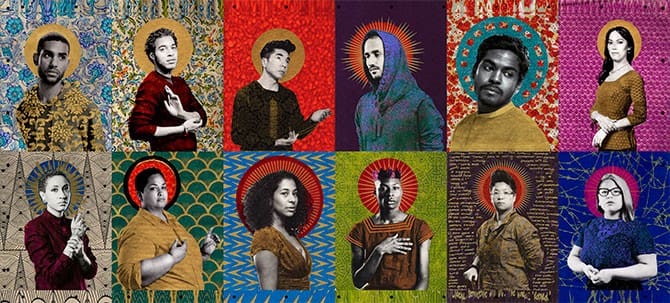
Gabriel Garcia Roman’s Queer Icon series, 2014. Artist’s studio, Los Angeles.
This volume will take the form of a virtual and imaginary exhibition catalogue examining the ways queer- and trans-identifying contemporary artists working in North America over the last forty years have drawn on medieval and Renaissance visual and material culture (ca. 500–1600 CE) to imagine inclusive futures and advocate for justice in LGBTQIA2+ communities. By juxtaposing historical objects with contemporary works, this issue seeks to interrogate the continuities and ruptures across time in how sanctity, sexuality, and gender identity are represented, perceived, and contested.
The art of the Middle Ages and Renaissance in Europe has inspired creators of the LGBTQIA2+ communities in North America for decades. Themes of religion, the body, disease, and human relationships under the law are as urgent now as they were in the past. This project brings together historical objects made from about 500-1600 with contemporary art from the 1980s to today with the goal of deepening an understanding of gender and sexuality across time and the draw queer- and trans-identifying creators today have with these time periods.
The diversity of queer and trans artists included emphasizes intersectionality, that is, how individuals, especially those who are Black, Indigenous, People of Color (BIPOC) or with multiple intersecting identities of (dis)ability, class, gender, race, religion, and sexuality face marginalization, prejudice, and discrimination. Some of the narratives related to HIV/AIDS and hate crimes are painful and may be triggering. Stories of coming out and pride offer hope for a future of care, inclusion, and justice. All are welcome and invited to reflect, question, admire, and heal.
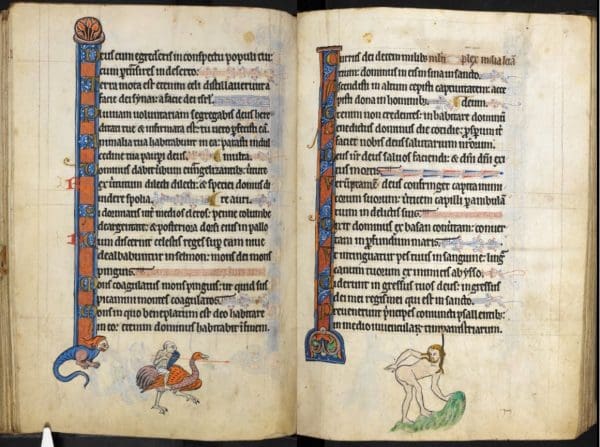
The Rutland Psalter, about 1260. London, The British Library, Add MS 62925.
“Queering” the past has revealed histories that have been erased or censored, while destabilizing cis-heteronormative frameworks that still dominate both medieval studies and museum practice. In pairing premodern art with works by contemporary artists, Queer Sanctity aims to deepen discourse around gender, sexuality, and sacred art.
We envision including works by the following artists (listed alphabetically), with the possibility for revision as the project develops: Ron Athey, Jean-Michel Basquiat, Cassils, Jordan Eagles, Rubén Esparza, Robert Flynt, Gabriel García-Roman, Daniel Goldstein, Félix González-Torres, Keith Haring, Kang Seung Lee, Alma Lopez, Robert Mapplethorpe, Julie Mehretu, Meredith Monk, Kent Monkman, Carlos Motta, Rashaad Newsome, Catherine Opie, Jacolby Satterwhite, Andy Warhol, and Kehinde Wiley.
To learn more, please watch this video introduction. You can also read a detailed description of the format and potential themes below.
Format and Potential Themes
The special issue will be divided into five sections to allow for a sharper focus on the role of gender identity and sexuality in historicizing works of contemporary art. In some sections, premodern art will be paired with contemporary objects not only to demonstrate the connections across time, but also to provide insights into the wide range of ideas about gender and sexual identity from the Middle Ages and Renaissance.
Section I – Introduction
The LGBTQIA2+ community has historically been viewed as outcasts from certain religions, and yet many queer and trans artists have been drawn to and have worked within these visual traditions from the Middle Ages to today. We envision this section designed around a series of sacred spaces, in which photographs, paintings, and sculptures by contemporary artists are presented as “altarpieces” or devotional aids as we interrogate the question, “Why are queer artists drawn to premodern sacred art?”
Section II – Play, Piety, & Perversity in Queer Premodern Europe
This section draws inspiration from an article about marginalia in illuminated manuscripts by the late medievalist Michael Camille (1958-2002), who advanced scholarship on queer visuality in the Middle Ages. This section will consider the connections between premodern and contemporary ideas about gender identity and sexuality. The section will be comprised primarily of historical objects discussed with a selection of contemporary pieces. The section would form a roadmap for the themes presented in the rest of the volume. Readers will be introduced to less familiar aspects of premodern sanctity, spirituality, and sexuality—ideas that might surprise and will hopefully delight them.
Section III – Death and the Memory of AIDS in the 1980s and 1990s
Taking a closer look at the tension and attraction between queer artists and religion, this section would examine the relationship between medieval cults of healing with contemporary artists’ responses to AIDS/HIV. The gallery begins with a focus on Saint Sebastian, a medieval plague saint who has become a modern queer icon, especially during the onset of the spread of AIDS in the 1980s. Prayers in devotional and liturgical manuscripts petitioned the saint for protection during times of pandemic. The section will also include works specifically created to commemorate those who died of AIDS, including a triptych by Keith Haring and light installation by Felix Gonzalez-Torres.
Section IV – Culture Wars and Hate Crimes
The theme of censorship already emerged in the presentation of works by Alma Lopez and Ron Athey. Amidst this prejudice – shared by the art world and some segments of society – is the equally painful reality of hate crimes against LGBTQIA2+ individuals.
This section could be set off from the rest of the volume to allow space for reflection or to respect the possible concerns about the sensitive nature of the topic for some readers.
Section V – From Pride and Activism to Coming Out Today
This section looks at strategies for LGBTQIA2+ activism, a theme that critiques the legacies of premodern colonization and prejudice. The volume would end with a positive vision for a future of dialogue, community building, and visibility.
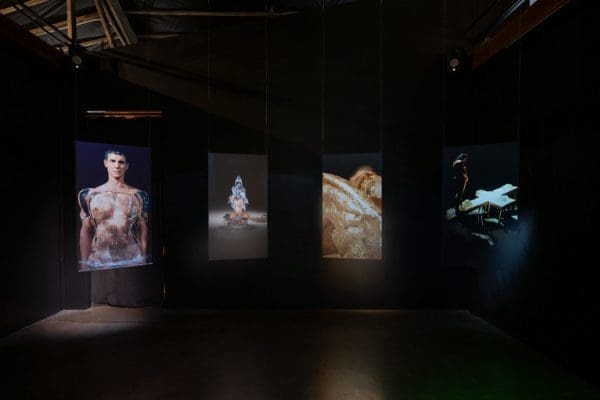
Cassils and Rafa Esparza, Solutions, 2018.
Submissions
We welcome contributions from art historians, medievalists, curators, artists, and scholars working across disciplines. Submissions may take the form of:
- Scholarly essays (2,000–8,000 words)
- Shorter position pieces or artist statements (1,500–3,000 words)
- Case Study or Museum Exhibition Catalogue-Style Entry (shorter contributions)
- Interviews, reflections, or multimedia formats – we welcome your creativity!
To express interest in contributing to this project, please fill out this form by March 15, 2026. A zoom meeting will follow to explore possibilities as a group, with this tentative timeline: abstracts for proposed contributions due early fall 2026, full text due winter 2027, publication late 2027.
For questions or informal discussion of ideas, feel free to reach out to the special issue editor:
- Bryan C. Keene: bryan.keene@rcc.edu