
Martin F. Lešák • The Norwegian Institute in Rome (University of Oslo)
Recommended citation: Martin F. Lešák, “Healing Old Wounds, Forging Strong Alliances: Transferring Sainte Foy’s Relics from Conques to Agen in 1879,” Different Visions: New Perspectives on Medieval Art 13 (2025). https://doi.org/10.61302/IRDH1805.
Arriving in Lalbenque, exhausted and weary, Arinisdus – a monk from Conques – collapsed into the shadow of a tree, his heart pounding from the journey.[1] He had little time to recover before the sound of approaching riders forced him to stillness. A search party from Agen had arrived, hunting a thief who had passed through carrying stolen relics – not just any, but those of Sainte Foy, their patroness and pride. They questioned him, scrutinized his face, pressed for details. He gave them nothing but the flat composure of a tired monk, eyes lowered, voice level. The silence stretched, taut as a drawn bowstring. Then, with a shrug and a curse, they turned their horses and rode on. They never knew that the fugitive they sought had just slipped through their grasp, breath sour, robe sweat-stained, watching them vanish down the road. Adrenaline still coursing through his veins, Arinisdus wasted no time and pressed forward toward Conques.
Perhaps this is how a twenty-first-century writer might stage the dramatic episode borrowed from a medieval text, describing how the relics of Sainte Foy, a young third-century martyr, were transferred from Agen to Conques in the second half of the ninth century, ultimately transforming the monastery into a renowned site of miracles.[2] Nearly a thousand years later, the repercussions of the purported sacred theft (furtum sacrum) still echoed when the bishop of Rodez and Vabres, Joseph-Christian-Ernest Bourret, whose diocese included the Conques Abbey, sent fragments of Sainte Foy’s relics in the opposite direction, from Conques to Agen. To mark the solemn transfer of the martyr’s relics, a triumphal procession honoring Sainte Foy was held on May 25, 1879, weaving through the streets of the city, an event inherently intertwined with historical trauma. The spectacle centered around a small adaptation of a medieval reliquary, the so-called Coffret of Boniface, which was discovered at Conques in 1875 (Figs. 1–2).[3] This new reliquary, commissioned by Bishop Bourret for the occasion, was donated to the city of Agen along with the relics it contained. By delving into contemporary programs and reports published in the local press, the present text aims to shed light on the context and reception of the event, which both healed old wounds and forged strong alliances. The story told in this article is of two communities at odds and how one bishop sought to unite them through the installation of a massive, triumphal, community-wide procession. With these festivities, he hoped to sculpt the social dynamics of the region anew.
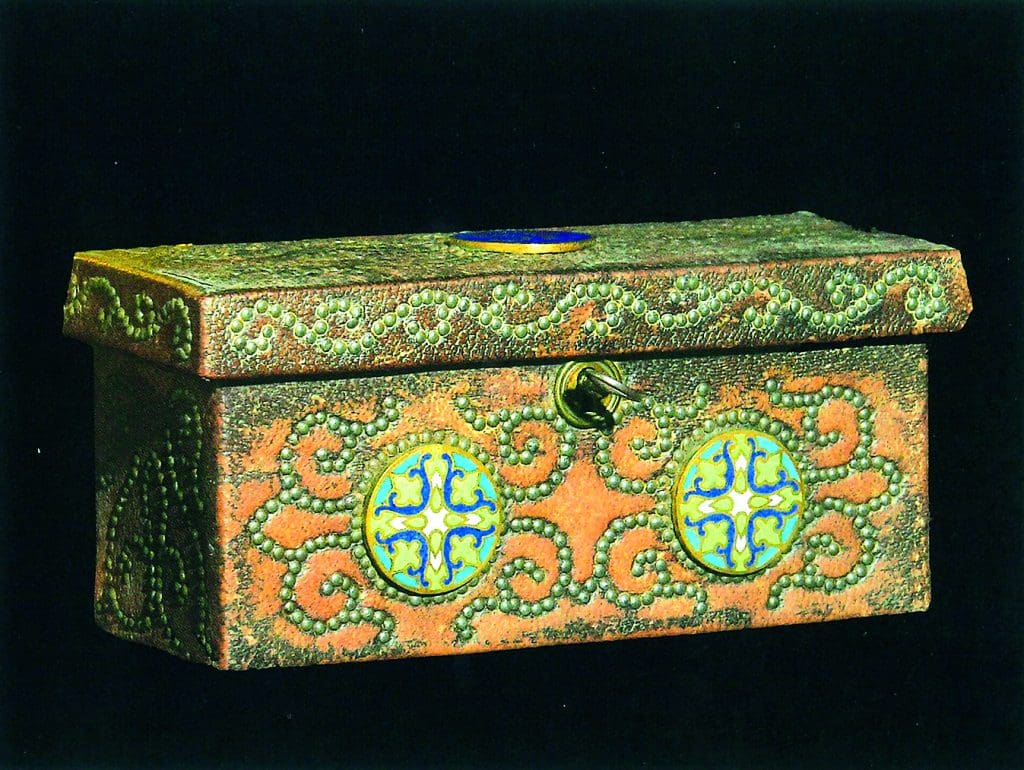
Fig. 1. One of the small reliquaries/adaptations of the so-called Coffret of Boniface, created in the workshop of Placide Poussielgue-Rusand in Paris, 1879. From Bernard Berthod and Gaël Favier, Conques, un trésor millénaire (Éditions CLD, Paris, 2019), 127.
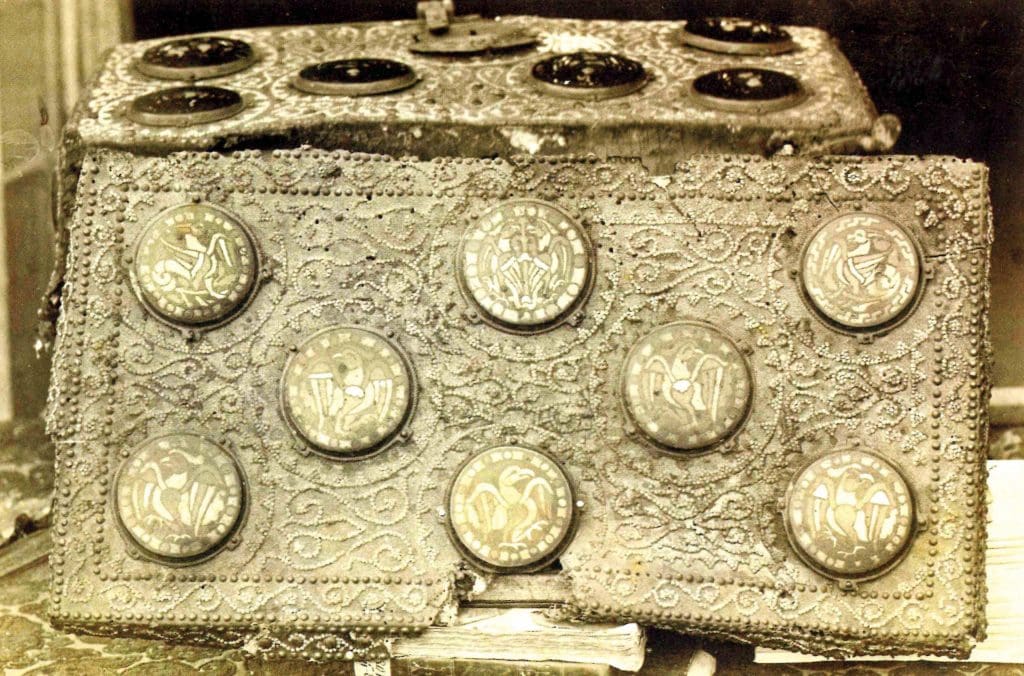
Fig. 2. The so-called Coffret of Boniface as found in 1875, ca. 1110–1130. From Bernard Berthod and Gaël Favier, Conques, un trésor millénaire (Éditions CLD, Paris, 2019), 109.
Religious ritual processions, such as the one at the center of this discussion, can readily be examined within the framework of social sculpture—a concept developed and coined by Joseph Beuys in the 1960s and 1970s, and the very notion to which this special issue is dedicated. Rather than merely an aesthetic creation, this performative and participatory form of sculpture operates within Beuys’ art theory as a tool for social, political, and democratic transformation, and is intended to be enacted by all people, including non-professional artists.[4] A community of bodies in motion, performed texts and actions, mobile objects, and even the environment all together form a coalescence of materials that constitute the social sculpture of ritual processions, as Kris N. Racaniello recently argued (Video 1).[5] From Beuys’ perspective, these processions can be seen as artistic acts that shape society, politics, and culture, empowering diverse individuals to engage in the creative and peaceful transformation of their reality. This article takes the artist’s idea of the omnipresent potential for artistic creation – and, indeed, social change – as a springboard to investigate the diocese of Rodez and Vabres’s response to the growing impact of materialistic thinking – framed Beuys’ terms – on Catholics in France during the 1870s. To counter the unwelcome transformations, Bishop Bourret, initiated a vigorous campaign to resuscitate the cult of Sainte Foy a few years after the establishment of the French Third Republic.[6] Rather than Beuys’ notion of art, he viewed the church and faith – embodied by Sainte Foy (Saint Faith) – as the rightful force to regenerate and heal society. The ritual processions with the martyr’s relics played a crucial role in his renewal movement.
Video 1. The procession of the Majesty of Sainte Foy entering the abbey church at Conques during the Fête de Sainte Foy on Sunday, October 8, 2023, 1:24. © Center for Early Medieval Studies (Masaryk University), recorded by Gajane Achverdjanová.
The Old Wound: The Sacred Theft of Sainte Foy’s Relics
Sainte Foy was allegedly born into a noble family in Agen, probably in the later third century, as revealed by the oldest extant recension of her Passio, possibly composed in Agen during the ninth century.[7] Still as a young girl, she was martyred by prefect Dacian because she refused to renounce her Christian faith, inspiring Saint Caprais to seek out the martyrial palm of triumph in her wake. Her relics were, according to the Passio, initially hidden rather than buried and later translated to a newly constructed basilica during the bishopric of Saint Dulcidius, likely in the fifth century, though some suggest the sixth.[8] Sainte Foy became a “very illustrious daughter” and a “patron” of Agen, respectively, through her birth and death in the city.[9]
The old wound which the present article explores is a purported sacred theft – furtum sacrum – of Sainte Foy’s relics from Agen, plotted by monks from Conques Abbey, probably during the second half of the ninth century and before 883.[10] The eleventh-century Translatio of Sainte Foy – a true medieval thriller – recounts how a monk from Conques, Arinisdus, infiltrated the religious circles in Agen posing as a pilgrim to steal the sacred remains from the basilica situated in a northern suburb outside the city’s walls.[11] After being promoted to guardian of the church, he stole the relics on the feast of the Lord’s Epiphany, shattering the covering stone of the martyr’s marble mausoleum and collecting the sacred fragments into a small sack. Under the cover of night, Arinisdus (together with his companion) fled Agen. A search party on horseback caught up with him in Lalbenque – roughly halfway between Agen and Conques – but failed to recognize him as he rested beneath a shady tree. He therefore continued through Quercy (already without his companion) and arrived to Figeac, where Sainte Foy healed a blind man. According to the Translatio, this was just one of many miracles she performed along the way. The monks as well as other faithful from Conques traveled some distance to meet the martyr, welcoming her with due reverence before processing with her back to the abbey church. (The relics’ arrival allegedly took place on January 14.) Arinisdus thus successfully completed the mission, committing “fortunate sacrilege” justified by Sainte Foy’s desire to be relocated.[12] After all, according to the logic of this text, composed within the monastic circles of Conques Abbey, if it had not been the martyr’s will, the monk would have simply failed and rightfully faced punishment for his actions.[13]
The arrival of Sainte Foy’s relics increased the visibility of the monastery, which had been founded at the end of the eighth century by Louis the Pious and the site’s first hermit, Dadon (or Datus), as could be inferred from the earliest historical records.[14] It is probably no coincidence that the purported theft occurred during a period of growing rivalry between the monastic communities of Conques and Figeac (Novas Concas), the latter of which was founded in 838 according to a forged but still ninth-century diploma of Pippin I of Aquitaine.[15] The struggle for independence and power in the region could have motivated the monks to attract visitors and secure economic stability by acquiring the relics of the famous saint and promoting her cult, as Pamela Sheingorn argued.[16] The presence of the martyr was further reinforced by the famous statue-reliquary, the so-called Majesty of Sainte Foy, which, although likely created shortly after the transfer, was reshaped over time through gifts from pilgrims and worshippers until the late Middle Ages (Fig. 3).[17]
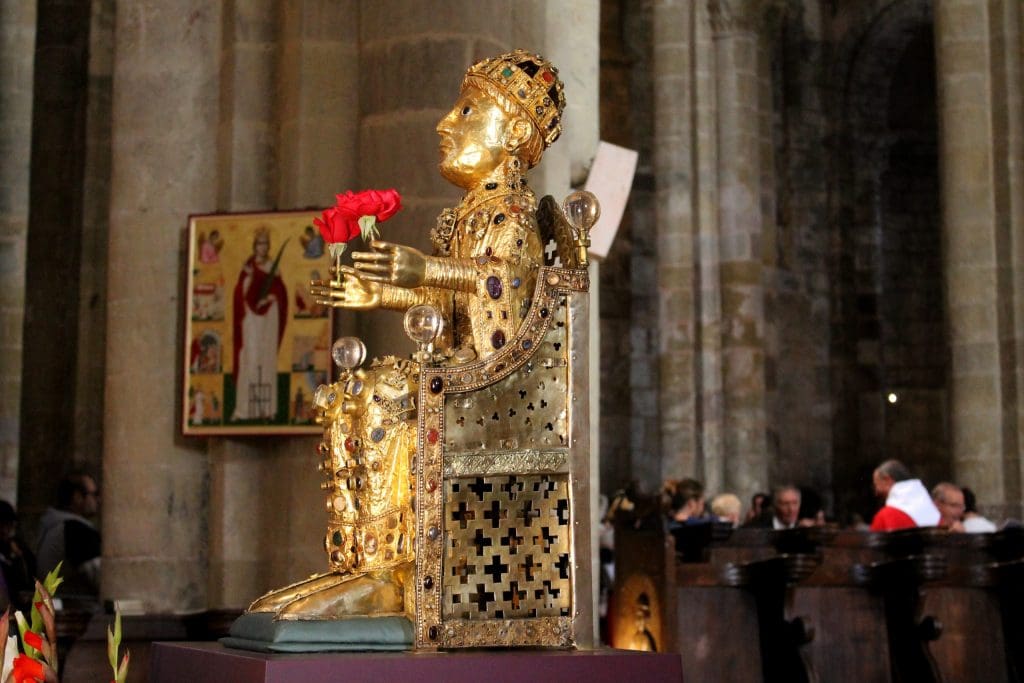
Fig. 3. The Majesty of Sainte Foy on display in the abbey church at Conques during the Fête de Sainte Foy on Sunday, October 8, 2023. © Photograph by the author.
There is, of course, no certainty regarding the historical credibility of the Translatio, as scholars have previously pointed out. Jean-Claude Fau argued that the relics were not stolen but rather transferred to Conques from Agen to protect them from Viking raids along the Garonne River in the ninth century.[18] Jean Angély even regarded the translation story as a fabrication by the monks of Conques, tracing the presence of Sainte Foy’s relics in Agen – his hometown – from the eleventh century to 1792.[19] But rather than debating the historical value of the events described in the eleventh-century text, this article explores how the purported furtum sacrum resonated in 1879, when Bishop Bourret sent Sainte Foy’s relics in the opposite direction – from Conques to Agen.[20] It delves into the motivations behind this action and the response of a city that, according to the Translatio, was once “deeply afflicted with extreme, heartfelt grief” at their loss.[21]
Forging Strong Alliances: Bishop Bourret and the Renewal of Sainte Foy’s Cult
The transfer of relics to Agen marked a next phase in the renewal of Sainte Foy’s cult during the 1870s, as will be discussed further. It is of course no coincidence that this renewal occurred during that decade. The proclamation of the Third French Republic in September 1870 marked a period of profound political and social transformation. The collapse of the Second Empire during the Franco-Prussian War (July 1870–May 1871) and the subsequent Paris Commune (March–May 1871) were accompanied by disputes over national identity, secularism, and the role of the Catholic Church in France.[22] Simultaneously, the First Vatican Council (December 1869–October 1870), which defined papal infallibility, coincided with the loss of the Papal States to Italian unification, diminishing the church’s temporal power.[23] In response, the Catholic authorities sought new ways to reaffirm its influence, turning to the revival of saint cults as a means of strengthening their position and fostering social cohesion. In France, where tensions between the republic and the church intensified, local bishops mobilized public religious displays to reclaim their standing in society. Against this backdrop, Bishop Bourret organized the transfer of Sainte Foy’s relics to Agen to claim the spiritual and political dominance of the church in its struggle with the state. It is from within this framework that this paper will now narrow from a national scale to an inter-regional one, to consider the use of cult ritual as a socially sculpting medium between Conques and Agen in 1879.

Fig. 4. Antoine René Trinquart, Photograph of Bishop Bourret, 1870–1890 / Paris, Musée Carnavalet – Histoire de Paris, no. inv. PH47684. © CCØ 1.0 Universal.
Born on December 11, 1827, into a religious farming family in the hamlet of Labro, near Saint-Étienne-de-Lugdarès, Joseph-Christian-Ernest Bourret (1827–1896) received an excellent ecclesiastical education (Fig. 4).[24] He studied at Saint-Sulpice Seminary from 1846 and the recently established École des Carmes from 1850, both in Paris. Remaining in the capital, he was ordained a priest in 1851 and later earned doctorates in law (utroque jure), humanities (lettres), and theology. His doctoral theses in humanities L’école chrétienne de Séville, sous la monarchie des Visigoths and De schola Cordubae christiana, sub gentis Ommiaditarum imperio were both published in 1855.[25] However, because the dean of the faculty rejected the former, Bourret was awarded the degree only in early 1857.[26] This exceptional formation helped him establish strong connections within Parisian religious circles, shaped his ultramontane convictions, and undoubtedly contributed to his successful career.[27] He became secretary to the archbishop of Tours, Joseph Hippolyte Guibert, in 1857 and returned to Paris in December 1861 after securing a teaching position in the Department of Ecclesiastical Law at the Faculty of Theology. As secretary and theologian to the bishop of Périgueux, Joseph Dabert, Bourret participated in the First Vatican Council (December 1869–October 1870), which, as noted above, reinforced the authority of the Roman popes. He was appointed bishop of Rodez on November 30, 1871,[28] and was elevated to cardinal in 1893.
The turbulent events following the proclamation of the Third French Republic in September 1870 certainly left traces on Bourret and strongly reverberated at the beginning of his bishopric.[29] Jean-Claude Fau interpreted his first pastoral letter, De la désorganisation morale des temps présents et de la nécessité de revenir aux principes chrétiens pour y porter remède, as a direct response to the Paris Commune, while André Maury attributed its sentiment of “guilty decadence” (coupable décadence) to France’s recent defeat by a coalition of German states led by Prussia.[30] This letter was read in all the churches of the diocese of Rodez and republished in its weekly journal, Revue religieuse, which today serves as a valuable historical source, offering a glimpse into the intellectual milieu of the diocese and the broader community of the faithful in the region.[31] The texts published in this periodical clearly reflected concerns about the consequences of the dynamic transformations and rising anticlericalism of the 1870s on the practices of Catholics living in the cities and countryside. The renewal of Sainte Foy’s pilgrimage and cult at Conques during that decade was one of Bourret’s strategies to strengthen the position of the church which,[32] as he inferred in 1873, should not be denying “its public and social character,” but instead it “must show itself as a living and active society.”[33] In his view, only such an institution would have been able to return, through the prayers of the faithful to Sainte Foy, “our afflicted and mutilated homeland to the practice of the virtues which alone can restore its place among the nations.”[34]
Bourret’s erudition pervades these statements. It is enlightening to compare them with what he had written in his rejected 1855 dissertation on the early medieval Christian school of Seville. In the fifth chapter, he articulates his perspective on the church’s social mission:
The church is, in fact, not a speculative school of science and morality, carelessly casting its doctrines without regard for their practical application. Rather, it is a visible and enduring society that seeks the intellectual and physical improvement of its members – a regenerative association that works to instill the great theories it teaches into the customs, laws, and language of nations.[35]
In sixth- and seventh-century Spain in particular, he continues, “it is the church that strives to rebuild the social structure overturned by the impact of the barbarian invasions.”[36] Becoming a bishop during a period of significant political and social change gave Bourret the opportunity to emulate the bishops of Seville – especially Saint Leander and Saint Isidore – in their efforts to combat “the widespread decline of morale.”[37] In Rodez, he could have simply put theory into practice, fighting against the perceived dangers of republican modernity, or even, to borrow his own words, against the “modern Dacians,” the governmental executioners of Christianity.[38] It seems that he aspired to become a “natural defender” of his flock, embodying the ideals he believed bishops once upheld.[39]
Conques Abbey and the cult of Sainte Foy were ideal for showcasing the church’s regenerative character, because both suffered especially during the French First Republic at the end of the eighteenth century, which, as claimed in the Revue religieuse, destroyed the monastery more completely than the “Saracens”[40] in the early Middle Ages.[41] Of course, Prosper Mérimée – Inspector General of Historical Monuments since 1834 – oversaw the careful initial restoration of the abbey church after his first visit in 1837, and he secured its inclusion in the first official list of historical monuments published in 1840, fulfilling his patriotic duty to safeguard national heritage.[42] Yet it was only in 1874 that the young architect Jean-Camille Formigé, dispatched to Conques by the Commission for Historical Monuments at the instigation of the bishop, undertook more radical interventions: he substantially reworked the façade in pursuit of what he deemed its authentic form, while adapting the building to serve once again as a functioning monastic space.[43] In this sense, state institutions collaborated with Bourret on the restoration of the medieval abbey – though for quite different reasons – acknowledging Conques’ artistic significance within French history.[44]
Bourret achieved the renewal or “recharging” of the cult of Sainte Foy, to use present-day scholars’ terminology, through several stages and various initiatives.[45] In 1873, he decided to entrust the parish of Conques to the Premonstratensians, the same year he decreed the renewal of the pilgrimage and the cult of Sainte Foy of Conques.[46] Historians were invited to write the history of Conques Abbey and Sainte Foy to introduce it to nineteenth-century pilgrims,[47] while new poems and chants were composed in honor of the martyr.[48] Not only the façade, but also the choir of the abbey church was renovated, leading to the discovery of the so-called Coffret of Boniface, which contained the relics of the martyr, on April 21, 1875 (Fig. 2).[49] The rectangular leather-covered wooden core of this box (31.5 x 57.6 x 31.5 cm) is adorned with an interlacing abstract ornament made of silvered nails, surrounding thirty-one gilt-copper enameled medallions representing fabulous animals or abstract motifs. This artifact together with the Majesty of Sainte Foy (Fig. 3) were also restored and the relics these objects contained were authenticated on October 4, 1878.[50] New protective shrines/reliquary-vitrines, designed by Gonzague Grinda, were created for these medieval objects in the workshop of Placide Poussielgue-Rusand in Paris, where they were also restored. These were carried in a two-day procession from Rodez to Conques on October 12 and 13 of the same year (Figs. 5–6).[51] This event was regarded as the triumph of Sainte Foy and a milestone in the renewal campaign.
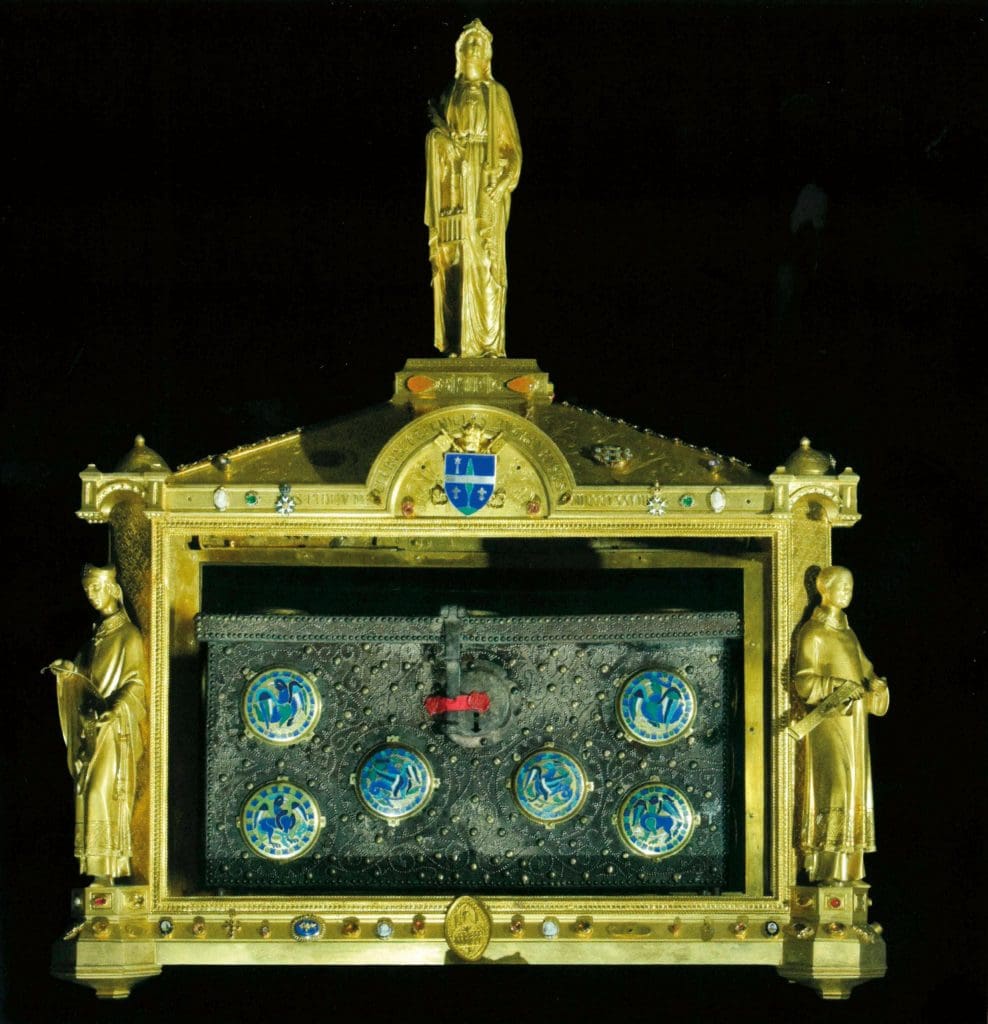
Fig. 5. The coffret within the protective shrine/reliquary-vitrine, created in the workshop of Placide Poussielgue-Rusand in Paris, 1878. From Bernard Berthod and Gaël Favier, Conques, un trésor millénaire (Éditions CLD, Paris, 2019), 121.
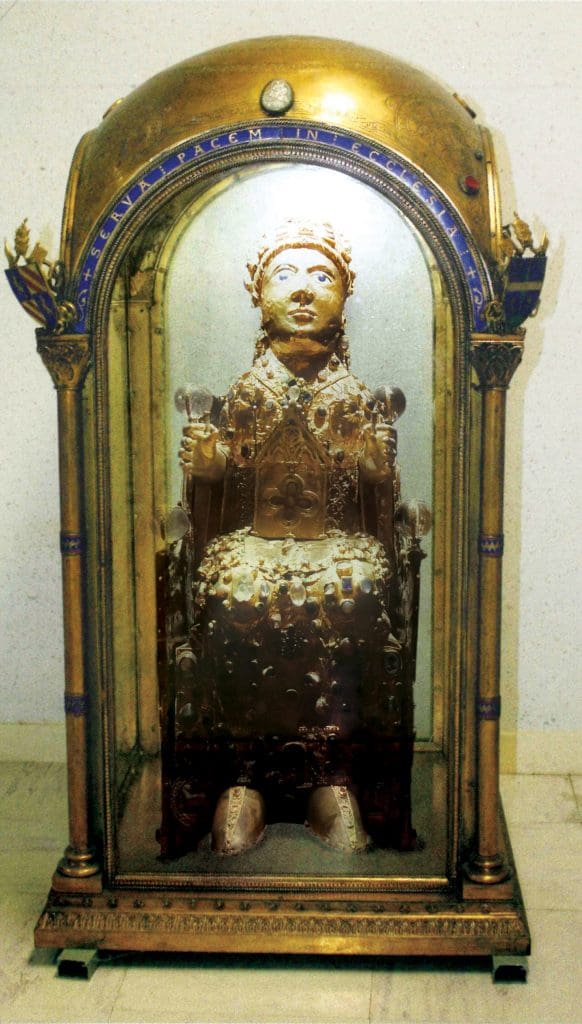
Fig. 6. The Majesty of Sainte Foy within the protective shrine/reliquary-vitrine, created at the workshop of Placide Poussielgue-Rusand in Paris, 1878 (a hypothetical reconstruction by Anna Kelblová). From Martin F. Lešák, “Festive Rituals at Conques in the 1870s,” in Conques Across Time: Inventions and Reinventions (9th–21st Centuries), ed. Ivan Foletti and Adrien Palladino (Viella and Masaryk University Press, 2025), 361.
The cult of the martyr and the ritual life of Conques were heavily promoted in the local press and created numerous opportunities for high-ranking clerics, especially from southern France, and other worshippers to gather. These events forged strong networks and alliances while also showcasing the church as a “living and active society,” which Bourret thought was capable of confronting the anticlerical threat. During the festive rituals of Sainte Foy in 1873, held from October 6 to 12, archbishops, bishops, and one cardinal visited Conques for the occasion of the official renewal of the pilgrimage.[52] Among the attending clerics was Jean-Émile Fonteneau, the vicar general of Bordeaux at the time. This vicar was consecrated bishop of Agen in January 1875 and, from that day forward, was compared to Dulcidius – the bishop who was allegedly responsible for translating the relics of Sainte Foy to the newly constructed church in Agen.[53] In his new role, he undertook a long and arduous journey to revisit the rugged valley of Conques in October of the same year, a visit commented upon in the Revue religieuse:
The prelate’s presence was particularly important for a very special reason. Sainte Foy […] was originally from Agen and had suffered martyrdom there. The monks of Conques, as is well known, took the relics of this illustrious saint from that town. Father Edmond, receiving the pontiff at the entrance to the choir, did not fail to remind His Grandeur of the pious abduction committed by the Conques monks a thousand years ago, but immediately legitimized by the most dazzling miracles. Monseigneur gracefully replied that he could not help ratifying an abduction that heaven itself had already ratified so highly, and that moreover the relics of the glorious saint would have run too great a risk in Agen; they would probably have perished there, whereas they have been so well preserved in these mountains, and today Providence is bringing them out, at the hour of restoration, from a new obscurity, from a new tomb where they have remained intact.[54]
Besides underscoring the theme of restoration – once again alluding to contemporary political and social tensions – the text highlights Fonteneau’s ratification of the ninth-century abduction of Sainte Foy’s relics. This was probably a significant moment at Conques and for the diocese of Rodez, as suggested by repeated mention of the bishop’s ratification during the triumphant festive rituals of 1878, in which he also participated.[55] The need to highlight these affirmations could be interpreted as evidence that Catholic elites were well aware of the negative emotions the idea of the sacred theft could still stir, and sought to suppress them in order to successfully revive the cult of Sainte Foy at Conques. In the alliances forged by Bourret during the time of perceived danger, there was simply neither room nor time for lingering resentment over past wounds – unless, of course, it could be used to fuel the cult’s spread and heighten its fervor, as the following section reveals.
The Triumphal Procession of Sainte Foy in Agen
Following the successful renewal of the cult at Conques, Bishop Bourret initiated the next phase in 1879, when he distributed the relics of Sainte Foy to various allied parishes with historical connection to the martyr, including Sainte Foy of Agen. This campaign further expanded her cult and reinforced the connections within the “regenerative association” which the church was meant to embody, according to the bishop. To house the relics, he commissioned several small adaptations (8.5 x 16.5 x 6.6 cm) of the Coffret of Boniface, which was discovered in 1875 in the abbey church of Conques (Figs. 1–2).[56] These artifacts were similar leather-covered wooden boxes, studded with silvered nails and adorned with three replicas of the enameled medallions from the medieval reliquary (Fig. 7). Although they are sometimes described as small “facsimiles” or “replicas” in both contemporary nineteenth-century sources and present-day scholarship, there are clear discrepancies – particularly in the placement of the medallions and the studwork patterns – when compared with the medieval original.[57]

Fig. 7. Illustrations of the enamels from the Coffret of Boniface and the Chasse of Bellac. From Ernest Rupin, L’Œuvre de Limoges (Alphonse Picard, 1890), frontispiece image.
These small reliquaries were fashioned in the Parisian workshop of Poussielgue-Rusand, a leading firm company in the diffusion of the neo-medieval style in nineteenth-century France. Significantly, the same workshop transformed Eugène Viollet-le-Duc’s drawings into the modern crown of thorns reliquary at Notre-Dame in Paris in 1862, and in 1878 produced the aforementioned protective shrines for Conques.[58] While the two vitrine-like artifacts of 1878 were executed in Paris on the commission of Bourret and on the basis of drawings by Grinda, it can only be hypothesized that the small reliquaries were conceived primarily within the large workshop itself (probably without the mediation of an artist such as Grinda), in accordance with the general requirements set forth by the bishop’s commission. However, the goldsmith company that restored the Coffret of Boniface was certainly well equipped to carry out these instructions, whatever their exact formulation. Derived from the medieval reliquary discovered at Conques in 1875, the content and form of these small objects materialized the idea of the successful and indeed providential renewal of the cult during the anticlerical threat. By invoking medieval ideals and visuality, they furthermore served to unite various places in France and beyond, which received them. Unsurprisingly, the bishop instructed the receiving towns to organize grand feasts for the occasion to properly celebrate the translation and reception of the relics these objects contained.[59]
The relics destined for the church of Sainte Foy in Agen included a six-centimeter-long fragment of humerus (upper arm bone) from the Coffret of Boniface and a fragment of temporal bone taken from the Majesty of Sainte Foy.[60] Their solemn translation to Agen, referred to by contemporaries as “a new triumph of Sainte Foy”,[61] was scheduled for Sunday, May 25, 1879.[62] In addition to the bishops of Agen and Rodez, the event was attended by the archbishop of Auch, Pierre-Henri Gérault de Langalerie, and Father Edmond Boulbon, abbot of the Premonstratensian abbey of Saint-Michel-de-Frigolet and provost of Conques. In one of the contemporary reports, these four prelates were designated as “the apostles of Sainte Foy’s cult.”[63] The itinerary of the day was as follows: First, a translation of the relics from the bishop’s residence, where they had initially been deposited, to the cathedral of Saint Caprais at 9:30 AM. Second, a pontifical mass at Agen Cathedral at 10:00 AM, officiated by Bishop Bourret, who bowed after the offertory and incensed the reliquary placed on a specially raised throne at the front of the choir. Third, vespers, most probably at 3:00 PM (although 2:30 PM is mentioned once in the contemporary documents), followed by a panegyric of Sainte Foy delivered by the archbishop of Auch, also at the cathedral.[64] Fourth, an over two-hour procession around the city from the cathedral to the church of Sainte Foy, beginning at 5:00 PM.[65] Fifth, a solemn benediction of the Blessed Sacrament followed by an allegedly improvised speech by Bishop Bourret in the church.[66] Finally, evening celebrations, when all the religious buildings and many private houses were brilliantly illuminated.
The contemporary accounts of the afternoon procession – a social sculpture par excellence – describe an event in which the entire town took part.[67] Young women, dressed in white, carried oriflammes and golden lamps (Fig. 8), while a brass band accompanied the cortege, adding a lively rhythm to the occasion. The streets were adorned with flowers, garlands stretched from one side to the other, house façades along the route were richly embellished, and oriflammes fluttered in the windows.[68] Banners with various inscriptions – such as Hæc est quæ vincit mundum fides nostra (It is our faith/Faith that conquers the world) – and all the bells in the city ringing at 6:00 PM completed the vibrant and festive atmosphere. Through this jubilant cityscape, the centerpiece of it all – the relics of the martyr – was carried, according to one report, on the shoulders of four deacons, suggesting that the small reliquary had been placed inside a larger protective shrine.[69] Further research would be required to identify this reliquary-vitrine. However, we can hypothesize about the significance of displaying and recontextualizing the medieval-like artifact within the distinct aesthetics of modern Catholicism. Similar to the triumphal procession of 1878 in Conques, this ensemble would have displayed the small reliquary as both a revered historical relic of a glorious past and a sacred object still very much alive in Christian worship. The assemblage of two formally distinct artifacts embodied this fusion, as past and present converged with each step of the procession through the city.

Fig. 8. Photograph of a late nineteenth-century procession of Sainte Foy in Liège. From Auguste Bouillet and Louis Servières, Sainte Foy, vierge et martyre (E. Carrère, 1900), 65.
The church of Sainte Foy in Agen was, according to nineteenth-century authors, built on the site where the martyr underwent torture, although this location is not specified in her martyrdom story (Fig. 9).[70] Additionally, they associated it with the basilica commissioned by Dulcidius, from which her relics were stolen. The interior was probably meticulously arranged to welcome the martyr’s return, although the reports only highlight an altar adorned with flowers and illuminated by light.[71] From a pulpit located in front of it, Bishop Bourret allegedly improvised a speech following a chant performed by a choir of young women. Wearing his miter and holding his crozier, he invited the worshippers in Agen to invoke the martyr frequently, remember her example, and let it resonate in their own lives. He concluded:
Oh! Agenais, if you were oblivious to what I am asking of you, today, well, I will not hesitate, I will come down from my mountains, I will come back to you and I will say to you: Give her back to me, let me take her all back to my people who so appreciate her protection, extol her glory, and bless her name, give her back to me, you who should be so happy and so proud to have had her cradle and to tread this soil that her blood has soaked, give her back to me. But no, you will not give this pain to my heart and to the heart of your bishop. Everything I have seen today, everything that has so deeply edified me, is a guarantee of your fidelity to the cult of your Agenais saints.[72]
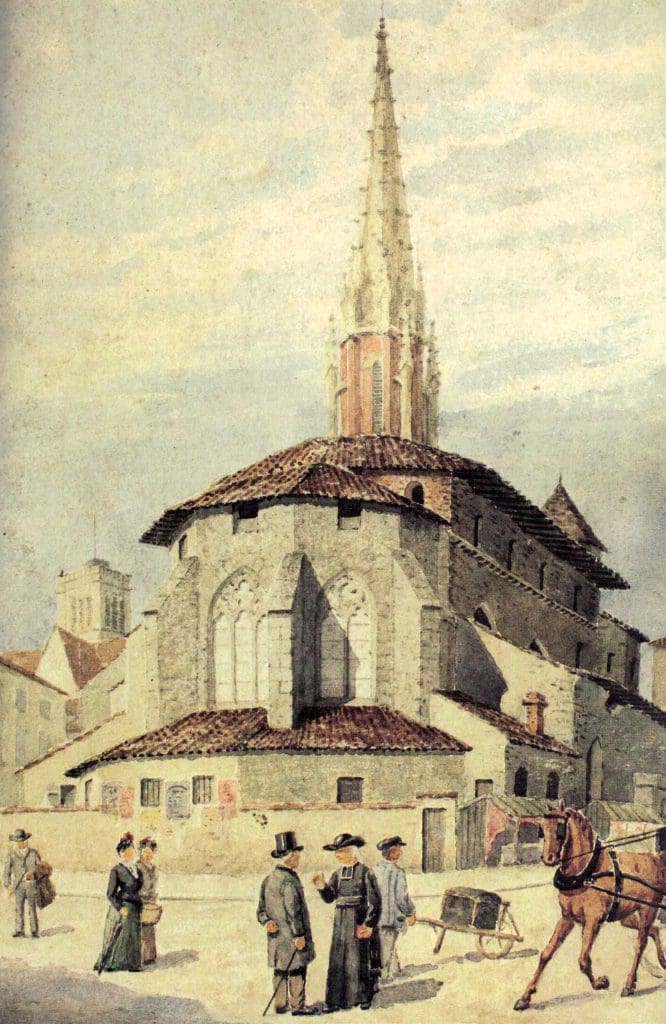
Fig. 9. Benjamin Rabu, Église Sainte-Foy (depicted with its 1877 neo-gothic bell tower before its partial demolition in 1892), aquarelle, 1892. From Hervé Bouillac and Francis Stephanus, “Église Sainte-Foi,“ in Agen, ed. Sandrine Lavaud, 2 vols (Ausonius, 2017), 2: 134–139, esp. 139.
Rather than emphasizing Agen’s significance for the cult of Sainte Foy and recalling the sacred theft orchestrated by the medieval monks of Conques, Bourret, in these conclusive moments, threatened the town with a potential reoccurrence of events from centuries ago – Agen could lose its martyr once again! Although the bishop quickly added that the events would surely not unfold in such a manner, the enduring rivalry between the two towns still resurfaces in these statements. From his perspective, healing old historical wounds appears to have been, at best, a secondary concern. What was needed, he believed, was “social regeneration,” not historical, and this could only be achieved through faith/Faith, as he ambiguously remarked a few days later, still in Agen.[73] In other words, Bourret’s primary motivation for the transfer was the desire to expand and revive the cult of “his fiancée from the mountains and Saint Agnes of Gaul.”[74] To ensure the success of his mission, he was even willing to leverage the rivalry, effectively putting a little salt into the stubborn wound.
The perspective of locals may have differed slightly. Bishop Fonteneau, naturally, addressed the issue of sacred theft with caution and diplomacy in a letter to his parishioners on May 17, eight days before the translation. He recounted the numerous miracles performed by Sainte Foy in Agen, the crowds drawn to the basilica constructed in her honor by Dulcidius, and the envy her saintly reputation inspired in rival cities. Despite emphasizing the martyr’s connection to Agen, he remained reconciliatory regarding the furtum sacrum, as he had at Conques in 1875:[75]
If we are to believe the chroniclers, this translation [to Conques] was the fruit of one of those old thefts, common to those times of faith, when people were convinced that, since the saints were the protectors of all the faithful, their relics should be common treasures. Let us not be unforgiving about these “furtive translations.” While it is true that they did not quite comply with the right of ownership, they were justified by the custom that seemed to tolerate them, and by the spirit of religion that inspired them. Moreover, Heaven itself seemed to smile upon these abductions, often deigning to work miracles in their course.[76]
The appeal to the locals not to be unforgiving about the past seems significant here, as it paradoxically alludes to an emotion that worshippers from Agen could have experienced during the festive rituals. For them, healing old wounds could have been a much stronger motif than it was for Bishop Bourret. This can also be inferred from a text published several months after the relics’ translation by a parishioner from Sainte Foy of Agen. Recalling first the widespread success of the martyr’s cult in the Middle Ages, the author then writes bittersweetly: “one day the city of Agen lost its saint. What crime had it committed?”[77] Leaving the question unanswered, the parishioner continues on an optimistic note, as the saint’s relics had recently been returned to the city. The notion of generous restitution of the sacred deposit, employed by the author, indeed perfectly captures what transpired – from the perspective of locals – when Sainte Foy’s relics arrived after the long procession to her church.[78] The medieval form of the small reliquary would have probably reinforced this line of thought.
Conclusion: The Aftermath of the Social Sculpture
The feast of May 25 sparked a reawakening of the martyr’s cult in the town. In the days following the event, an association of prayers under the intercession of Sainte Foy was inaugurated in the church, with many people registering and kissing the reliquary as part of the occasion. Shortly after its establishment, the association launched a collection for a new reliquary, as the one displaying the relics in the church was deemed unworthy of the martyr.[79] This information could be linked to the above-mentioned reliquary-vitrine where the small reliquary from Bishop Bourret was possibly placed and carried from the cathedral to the church on May 25. The association could have drawn inspiration from Conques, where the Coffret of Boniface was placed in a new protective shrine in 1878.[80] However, the rationale for the necessity of this new artifact, published on June 15 and 28, complicates this interpretation – the shrine in the church’s possession was reportedly too modestly ornamented and, more importantly, too small to contain the sacred bones.[81] This could suggest that the gifted reliquary was not considered worthy enough and needed to be replaced, which, of the two scenarios, seems less likely.
The association grew steadily in the following months, and with it, the cult of Sainte Foy flourished. A new canticle for the martyr was composed and printed, along with sheets outlining the obligations for association members.[82] Its aim was nothing less than to “preserve, strengthen, and spread the precious gift of faith,”[83] which, as noted in the journal, was under attack.[84] To further promote the association, Bishop Fonteneau granted forty days of indulgence to each member for venerating Sainte Foy’s sacred body, shortly before her feast day on October 6.[85] In line with its main objective, he then dispatched a fragment of the martyr’s relics even to Sainte-Foy-la-Petite near Duras, France – referred to as the “corner of the world” – to continue renewing her cult and spreading the faith in the process.[86] The activities of Bishop Fonteneau and the newly founded association mirrored those employed by Bishop Bourret in the diocese of Rodez. In essence, the ideas, rhetoric, and strategies were transferred together with relics of Sainte Foy from Conques to Agen and beyond.
Amid the political and social tensions of the late 1870s, Touzery interpreted the martyr’s translation to her hometown as “the new victory of Sainte Foy over our [the nineteenth] century and its incredulity” and “a sweet dawn of the resurrection of Christ’s social reign,” accomplished by nothing other than Sainte Foy’s “clericalism.”[87] In shaping this resurrected social reign of Christ, relic processions served as a powerful tool. As a true social sculpture, à la Beuys, it enabled individuals to engage in the creative act of social transformation and healing. For the people in Agen, the procession represented a once-in-a-lifetime opportunity to accompany the sacred bones, housed in the small reliquary, back to their home church. The centuries-old sacred theft was finally atoned for, thanks to the “generous restitution.“ This idea likely formed an essential part of the locals’ experience and understanding of the event. For Bishop Bourret, the translation was just another step in forging a tightly interwoven network of strong alliances and advancing the social regeneration he deemed necessary for contemporary France. The theory of the church as a regenerative association, which he had already articulated in the 1850s, was fully in motion in Agen. To sustain this momentum, further strengthening the bond between his diocese and that of Bishop Fonteneau, he sent a sculpture of Sainte Foy the following year – but that, perhaps, is a story for another time.[88]
References
| ↑1 | I am grateful to the two anonymous reviewers for their insightful comments and suggestions. I also wish to thank the editors, and in particular Kris N. Racaniello, for the stimulating discussions that greatly enriched this work. For his valuable feedback, I am also thankful to Adrien Palladino. I am especially indebted to Annalisa Moraschi for her assistance in collecting the nineteenth-century issues of La Semaine catholique du diocèse d’Agen. Finally, this research was made possible through the generous funding provided by the Alexander von Humboldt Foundation. |
|---|---|
| ↑2 | The bibliography on Conques and Sainte Foy is vast. See, among others, Pierre Séguret, Conques: l’art, l’histoire, le sacré (Tricorne, 1997); Marie Renoue and Renaud Dengreville, Conques: moyenâgeuse, mystique, contemporaine (Rouergue, 1997); Kathleen Ashley, The Cults of Sainte Foy and the Cultural Work of Saints (Routledge, 2021); Ivan Foletti and Adrien Palladino, eds., Conques Across Time: Inventions and Reinventions (9th–21st Centuries) (Viella and Masaryk University Press, 2025). For further specific bibliographic references, see below. |
| ↑3 | Texts by Eugène de Barrau, Louis Servières, and Louis de Gonzague on the discovery of the reliquary were published in Revue religieuse de Rodez et de Mende 9, no. 19 (May 7, 1875): 223–227; 9, no. 20 (May 14, 1875): 237–239; 10, no. 32 (August 11, 1876): 502–505. From the more recent bibliography on the discovery and the medieval reliquary, see, for example, Elisabeth Taburet-Delahaye, “Coffret of Abbot Boniface,” in Enamels of Limoges, 1100–1350 (The Metropolitan Museum of Art, 1996), 78–82; Bernard Berthod and Gaël Favier, Conques, un trésor millénaire (Éditions CLD, Paris, 2019), 108–114, 119–121; Ashley, The Cults, 24–25; Ivan Foletti and Adrien Palladino, “Reviving Gallia Christiana, Restoring the Church (1870s),” in Conques Across Time: Inventions and Reinventions (9th–21st Centuries), ed. Ivan Foletti and Adrien Palladino (Viella and Masaryk University Press, 2025), 49–75, esp. 64–69. |
| ↑4 | On the notion of social sculpture, see, besides the introduction to the present volume, Cara M. Jordan, “Joseph Beuys and Social Sculpture in the United States,” (PhD diss., The Graduate Center, City University of New York, 2017); Karen van den Berg, Cara M. Jordan, and Philipp Kleinmichel, eds., The Art of Direct Action: Social Sculpture and Beyond (Sternberg Press, 2019); Patrick Healy, Social Sculpture in Practice: Joseph Beuys, Waldo Bien, and the Free International University World Art Collection, a Report (FIU Amsterdam, 2020); Christoph Menke, “Soziale Plastik: Joseph Beuys’ Konzept einer demokratischen Kunst,” Zeitschrift für Ästhetik und allgemeine Kunstwissenschaft 68, no. 1 (2023): 31–47. From the vast and ever-growing bibliography on Beuys, see recently, for example, Claudia Mesch, Joseph Beuys (Reaktion Books, 2017); Alexander Grönert, “Joseph Beuys und das Ende der Nachkriegszeit: Fluxus, Creamcheese und die Aktionskunst,” in Die Kunstakademie in Düsseldorf 1773–2023: Kunstgeschichte einer Institution, ed. Johannes Myssok (Deutscher Kunstverlag, 2023), 237–249; Lucrezia De Domizio Durini, Beuys (Il Quadrante, 2024). |
| ↑5 | Kris N. Racaniello, “Living Medievalism in the Fête de Sainte Foy Processions Today,” in Conques Across Time: Inventions and Reinventions (9th–21st Centuries), ed. Ivan Foletti and Adrien Palladino (Viella and Masaryk University Press, 2025), 370–392, esp. 390. |
| ↑6 | The renewal of Sainte Foy’s cult at Conques in the 1870s is discussed, for example, in André Maury, “Le Cardinal Bourret. Évêque de Rodez (1827–1896),” Revue du Rouergue 29 (1975): 12–13; Jean-Claude Fau, “Le cardinal Ernest Bourret, évêque de Rodez et de Vabres (1871–1896),” Études aveyronnaises (2017): 365–369; Berthod and Favier, Conques, 106ff.; Ashley, The Cults, 20–26; Ivan Foletti and Adrien Palladino, “La réinvention de Conques ‘romane’: Patrimoine national ou exaltation de la vraie foi?,” in Repenser l’histoire de l’art médiéval en 2023. Recueil d’études offertes à Xavier Barral i Altet, ed. Miljenko Jurković, Elisabetta Scirocco, and Arnaud Timbert (Brepols, 2023), 849–859; Martin F. Lešák, “The ‘Glorious Traveler’. St Foy’s Triumphal March from Rodez to Conques or the Liturgical Afterlife of Two Medieval Reliquaries,” Convivium, Supplementum (ed. Ivan Foletti et al., Contextualizing Conques. Imaginaries, Narratives & Geographies; 2023): 42–63. https://doi.org/10.1484/M.CONVISUP-EB.5.137360; Foletti and Palladino, “Reviving Gallia Christiana,”; Martin F. Lešák, “Festive Rituals at Conques in the 1870s,” in Conques Across Time: Inventions and Reinventions (9th–21st Centuries), ed. Ivan Foletti and Adrien Palladino (Viella and Masaryk University Press, 2025), 355–369. |
| ↑7 | The earliest manuscript evidence of this Passio dates back to the tenth century. See Passio: The Passion of Sainte Foy, transl. Pamela Sheingorn, in The Book of Sainte Foy, ed. and transl. Pamela Sheingorn (University of Pennsylvania Press, 1995), 21–22, 33–38. For the Latin edition of the text, see Auguste Bouillet and Louis Servières, Sainte Foy, vierge et martyre (E. Carrère, 1900), 707–711. On the Passio, see also Louis Saltet, “Étude critique sur la Passion de Sainte Foy et de Saint Caprais,” Bulletin de littérature ecclésiastique 1, no. 6 (June, 1899): 175–190; Luca Robertini, ed., Liber miraculorum sancte Fidis (Centro italiano di studi sull’alto medioevo, 1994), 361–362 (n. 10); Kathleen Ashley and Pamela Sheingorn, Writing Faith. Text, Sign and History in the Miracles of Sainte Foy (The University of Chicago Press, 1999), 3–5; Sébastien Fray, “L’aristocratie laïque au miroir des récits hagiographiques des pays d’Olt et de Dordogne (Xe–XIe siècles),” (PhD diss., Université Paris-Sorbonne, 2011), 59–60, 391, 762; Ashley, The Cults, 59. |
| ↑8 | Sheingorn, Passio: The Passion of Sainte Foy, 37; and Bouillet and Servières, Sainte Foy, 710. Among the scholars who date Dulcidius’ bishopric to the fifth-century are, for example, Bouillet and Servières, Sainte Foy, 39; Ashley, The Cults, 59; Foletti and Palladino, “Reviving Gallia Christiana,” 72. Cf. Saltet, “Étude critique,” 185; Frances Terpak Wands, “The Romanesque Architecture and Sculpture of Saint Caprais in Agen,” 2 vols (PhD diss., Yale University, 1982), 1:16–18, 50. The location of the new basilica, in a northern suburb of the town, is mentioned in the Translatio. See below. |
| ↑9 | Sheingorn, Passio: The Passion of Sainte Foy, 33–34; and Bouillet and Servières, Sainte Foy, 708: “[…] et splendidissima procreata alumna locis ipsius nascendi, sed facta est patrona in re moriendi.” |
| ↑10 | The precise dating of the theft is discussed, for example, in Patrick J. Geary, Furta Sacra: Thefts of Relics in the Central Middle Ages, rev. ed. (Princeton University Press, 1990), 59, 138–141 (with further bibliography); Sheingorn, The Book of Sainte Foy, 8–10, 286 (n. 14), 306 (n. 12); Beate Fricke, Ecce fides: Die Statue von Conques, Götzendienst und Bildkultur im Westen (Wilhelm Fink, 2007), 37–38, 60. https://doi.org/10.30965/9783846744383_004; Katrinette Bodarwé and Moritz Rother, “Die Gründung(en) des Klosters Conques. Die Urkunden Ludwigs des Frommen (bm² 688) und Pippins I. von Aquitanien (d 32),”Archiv für Diplomatik, Schriftgeschichte, Siegel- und Wappenkunde 57, (2011): 1–48, esp. 44–48. On early medieval narratives of furtive relic translations, see, besides Geary’s volume, also Marco Papasidero, “Il genere dei furta sacra: aspetti letterari e funzioni comunicative del testo agiografico,” Rivista di storia della Chiesa in Italia 71, no. 2 (2017): 379–410; and Marco Papasidero, Translatio sanctitatis. I furti di reliquie nell’Italia medievale (Firenze University Press, 2019). |
| ↑11 | Translatio: The Translation of Sainte Foy, Virgin and Martyr, to the Conques Monastery, transl. Pamela Sheingorn, in The Book of Sainte Foy, ed. and transl. Pamela Sheingorn (University of Pennsylvania Press, 1995), 26, 263–274. For the Latin edition, see Translatio altera, in Acta Sanctorum. Octobris, tomus 3, die sexta (1770), 294–300. While Sheingorn dates the text to between 1020 and 1060, Katrinette Bodarwé and Moritz Rother propose a timeframe from the middle to the second half of the eleventh century. See Bodarwé and Rother, “Die Gründung(en),” 39–40. For the location of the church of Sainte Foy in Agen in relation to that of Saint Caprais, see Wands, “The Romanesque Architecture,” 1:16–18, 51–56; and Antoine Ducarton, Sylvie Faravel, and Sandrine Lavaud, “Agen cité épiscopale (Ve siècle–vers 1217),” in Agen, ed. Sandrine Lavaud, 2 vols (Ausonius, 2017), 1:119–144, esp. 120–121, 129–133, 144. |
| ↑12 | Sheingorn, Translatio: The Translation of Sainte Foy, 270; and Translatio altera, p. 298: “Cumque idem felix hoc, si dici fas sacrilegium est, celari diu non posset, paulo post proditum est & ubique per latitudinem terrarum propalatum.” |
| ↑13 | Sheingorn, Translatio: The Translation of Sainte Foy, 269–270; and Translatio altera, 297–298. On the provenance of the Translatio, see, for example, Fray, “L’aristocratie laïque,” 59; Bodarwé and Rother, “Die Gründung(en),” 6. |
| ↑14 | The earliest historical records about the monastic life at Conques are discussed and introduced, for example, in Hervé Oudart, “L’ermite et le prince. Les débuts de la vie monastique à Conques (fin VIIIe–début XIe siècle),” Revue Historique 297, no. 1 (1997): 3–39; Bodarwé and Rother, “Die Gründung(en),” 15–16; Martin F. Lešák, “Transforming a Desert, Claiming the Domain: The Early Medieval Landscape of Conques,” Convivium 9, no. 1 (2022): 152–154. https://doi.org/10.1484/J.CONVI.5.131650; Ivan Foletti, Lei Huang, and Martin F. Lešák, “In the Valley: The Geographical Context and Origins of the Abbey,” in Conques Across Time: Inventions and Reinventions (9th–21st Centuries), ed. Ivan Foletti and Adrien Palladino (Viella and Masaryk University Press, 2025), 89–94. |
| ↑15 | On this document and the foundation, see Bodarwé and Rother, “Die Gründung(en),” 26–35, 37–38; and below n. 17. |
| ↑16 | Sheingorn, The Book of Sainte Foy, 8–10. See also Gustave Desjardins, ed., Cartulaire de I’abbaye de Conques-en-Rouergue (Alphonse Picard, 1879), VII; J. Angély, “La prétendue tumulation de Sainte-Foy d’Agen à Conques,” Revue de l’Agenais 76, no. 3–4 (1950): 99–100; Geary, Furta Sacra, 58–63; Bodarwé and Rother, “Die Gründung(en),” 4, 33; Ashley, The Cults, 17–18. |
| ↑17 | In the context of the rivalry between Conques and Figeac, the Majesty of Sainte Foy is discussed especially in Fricke, Ecce fides, 36, 60. On the statue-reliquary and for its ever-growing bibliography, see, recently, Bissera V. Pentcheva, “The Choros of the Stars: Image, Chant, and Imagination at Sainte Foy at Conques,” in From Words to Space: Textual Sources for Reconstructing and Understanding Medieval Sacred Spaces, ed. Elisabetta Scirocco and Sible de Blaauw (Campisano Editore, 2023), 97–129; Kris N. Racaniello, “A Translike Object? Composing the Majesty of Sainte Foy and Staging Gender,” Convivium, Supplementum (ed. Adrien Palladino, Entangled Histories at Conques. Interdisciplinary Perspectives on a Unique Site of Medieval Heritage; 2024): 102–126. https://doi.org/10.1484/M.CONVISUP-EB.5.149539; Ivan Foletti, “Sainte Foy as Sacred Focus,” in Conques Across Time: Inventions and Reinventions (9th–21st Centuries), ed. Ivan Foletti and Adrien Palladino (Viella and Masaryk University Press, 2025), 108–122. |
| ↑18 | Jean-Claude Fau, Rouergue roman, 3rd ed. (Zodiaque, 1990), 86; Sheingorn, The Book of Sainte Foy, 286 (n. 14). |
| ↑19 | J. Angély, “La prétendue tumulation,” 91; Geary, Furta Sacra, 59, 140–141. |
| ↑20 | This was not necessarily the first translation of Sainte Foy’s relics from Conques to Agen in the nineteenth century. Joseph Barrère asserts that a portion of the relics was returned to Agen in 1807, though he does not cite any historical sources to support this claim. In his view, Sainte Foy’s body was stolen in the mid-ninth century, but Agen retained her skull. At the time he wrote his volume, the latter was allegedly kept in the cathedral, while the returned relics in the church dedicated to the martyr. See Joseph Barrère, Histoire religieuse & monumentale du diocèse d’Agen (Achille Chairou, 1855), 1:39–40. This information was also published in a letter by E. de B. in Revue religieuse de Rodez et de Mende 12, no. 13 (March 29, 1878): 197–198. See also Louis Servières, Histoire de sainte Foy, 4th ed. (E. Carrère, 1879), 79–80; and Joseph-Christian-Ernest Bourret, ed., Procès-verbaux authentiques et autres pièces concernant la reconnaissance des reliques de sainte Foy, vierge et martyre (E. Carrère, 1880), 83–84, 94–106. For the reference to a poem based on the Translatio, possibly dating to the second half of the eleventh century and serving as the foundation of this tradition, see Wands, “The Romanesque Architecture,” 1:53 (n. 8). Additionally, the relics of Sainte Foy in Agen are discussed in Revue religieuse de Rodez et de Mende 13, no. 23 (June 6, 1879): 359–360. |
| ↑21 | Sheingorn, Translatio: The Translation of Sainte Foy, 268; and Translatio altera, 297: “Ad sepulchrum ergo Virginis universa civitas conveniens sacrasque reliquias non reperiens, immoderato dolore cordis omnis ætas intrinsecus tacta […].” |
| ↑22 | For a general introduction, see Alice L. Conklin, Sarah Fishman, and Robert Zaretsky, France and Its Empire Since 1870, 2nd ed. (Oxford University Press, 2015), 29–79. See also Séverine Blenner-Michel, “Les évêques français face à la guerre franco-prussienne: étude comparée des actes épiscopaux du temps de guerre (juillet 1870–mai 1871),” in Les chrétiens, la guerre et la paix. De la paix de Dieu à l’esprit d’Assise, Bruno Béthouart and Xavier Boniface (Presses universitaires de Rennes, 2012), 161–174. |
| ↑23 | See, for example, Klaus Schatz, “Vatikanum I,” Theologische Realenzyklopädie 34 (De Gruyter, 2002): 532–541; Julia Knop and Michael Seewald, eds., Das Erste vatikanische Konzil. Eine Zwischenbilanz 150 Jahre danach (WBG Academic, 2019). |
| ↑24 | On Bourret, see especially Jacques Gadille, La pensée et l’action politiques des évêques français au début de la IIIe République, 1870/1883, 2 vols (Hachette, 1967), 1:34 and passim; André Maury, “Le Cardinal Bourret. Évêque de Rodez (1827–1896),” Revue du Rouergue 27 (1973): 345–355; 28 (1974): 9–20, 119–125; 29 (1975): 5–30, 241–255; Fau, “Le cardinal.” See also Jean-Marie Périé, “Le clergé aveyronnais sous la IIIème République,” in Études sur le Rouergue (P. Carrère, 1974), 269–281, esp. 270; Foletti and Palladino, “Reviving Gallia Christiana,” 63–64. |
| ↑25 | Joseph-Christian-Ernest Bourret, L’école chrétienne de Séville, sous la monarchie des Visigoths (Charles Douniol, 1855); and Joseph-Christian-Ernest Bourret, De schola Cordubae christiana, sub gentis Ommiaditarum imperio (Charles Douniol, 1855). |
| ↑26 | The theses are discussed in the first part of Maury, “Le Cardinal Bourret,” 27 (1973), 353–354. |
| ↑27 | On Ultramontanism, see, for example, Phillipe Boutry, “Les saints des Catacombes. Itinéraires français d’une piété ultramontaine (1800–1881),” Mélanges de l’École française de Rome. Moyen-Âge, Temps modernes 91, no. 2 (1979): 875–930. https://doi.org/10.3406/mefr.1979.2519; Austin Gough, Paris and Rome: The Gallican Church and the Ultramontane Campaign, 1848–1853 (Clarendon Press, 1986); Joseph F. Byrnes, Catholic and French Forever: Religious and National Identity in Modern France (The Pennsylvania State University Press, 2005), 89 and passim; Gisela Fleckenstein and Joachim Schmiedl, eds., Ultramontanus: Tendenzen und Forschung (Bonifatius, 2005); and John W. O’Malley, Vatican I: The Council and the Making of the Ultramontane Church (The Belknap Press, 2018). |
| ↑28 | The appointment date is mentioned in Maury, “Le Cardinal Bourret,” 28 (1974), 19. See also Léon Maret, “Origine, nom, choix, droits et prérogatives des évêques, à l’occasion du sacre de Mgr Joseph-Christian-Ernest Bourret, évêque de Rodez,” Revue religieuse 5, no. 48 (December 1, 1871): 577–578. Cf. Foletti and Palladino, “Reviving Gallia Christiana,” 63. |
| ↑29 | Bourret arrived to Rodez in December. See Maury, “Le Cardinal Bourret,” 28 (1974), 120; Fau, “Le cardinal,” 355. |
| ↑30 | The letter was published as Joseph-Christian-Ernest Bourret, Lettre pastorale et mandement de monseigneur l’évêque de Rodez à l’occasion de la prise de possession de son siège et de son arrivée dans le diocèse. De la désorganisation morale des temps présents et de la nécessité de revenir aux principes chrétiens pour y porter remède (Adrien Le Clere et Cie, 1871); and in Revue religieuse 5, no. 50 (December 15, 1871): 597–606. See also Maury, “Le Cardinal Bourret,” 28 (1974), 120–121; Fau, “Le cardinal,” 355–356. |
| ↑31 | During the 1870s, the weekly journal of the diocese was called initially Revue religieuse and, from 1873, Revue religieuse de Rodez et de Mende. |
| ↑32 | See above, n. 6. |
| ↑33 | Joseph-Christian-Ernest Bourret, “Mandement de Mgr l’évêque de Rodez, au Clergé et aux fidèles de son diocèse. Prescrivant la reprise solennelle de l’antique pèlerinage de Sainte-Foy de Conques,” Revue religieuse de Rodez et de Mende 7, no. 39 (September 26, 1873): 477–478: “Or, la grande erreur actuelle, c’est la négation de son [of the Church] caractère public et social, et c’est pourquoi il faut qu’elle se montre comme une société vivante et agissante […].” |
| ↑34 | Bourret, “Mandement,” 478: “[…] afin de prier de tout votre cœur cette sauve amie de l’agneau pour […] le retour de notre patrie affligée et mutilée à la pratique des vertus qui peuvent seules lui rendre sa place parmi les nations.” |
| ↑35 | Bourret, L’école chrétienne de Séville, 146: “L’Église, en effet, n’est point une école spéculative de science et de morale, jetant au hasard ses doctrines, sans s’occuper de leur application pratique; c’est une société visible et permanente qui cherche le perfectionnement intellectuel et physique de ses membres, une association régénératrice qui travaille à faire passer dans les mœurs, les lois et la langage des peoples, les grandes théories qu’elle enseigne.” |
| ↑36 | Bourret, L’école chrétienne de Séville, 147: “[…] c’est l’Église qui essaie de reconstruire l’édifice social renversé par le choc des barbares.” |
| ↑37 | Bourret, L’école chrétienne de Séville, 4: “[…] c’est à elle [Spain] que revient l’honneur d’avoir empêché, au milieu de la défaillance générale des esprits, une décadence plus profonde de la pensée.” |
| ↑38 | Joseph-Christian-Ernest Bourret, “Mandement de Monseigneur l’évêque de Rodez et de Vabres au clergé et aux fidèles de son diocèse,” Revue religieuse de Rodez et de Mende 12, no. 39 (September 27, 1878): 609–612, esp. 610: “Les Dacien modernes semblaient lui [Sainte Foy] avoir inspiré plus de terreur que ceux qui l’étendirent jadis sur un lit embrasé.” |
| ↑39 | Bourret, L’école chrétienne de Séville, 157: “Le peuple avait confiance dans ses évêques; il voyait en eux ses défenseurs naturels […].” |
| ↑40 | This is a medieval term widely used to describe Muslim peoples, frequently appearing in early medieval sources describing the origins of Conques Abbey. See above, n. 14. On “Saracens” in early medieval literature, see for example Lynn Tarte Ramey, Christian, Saracen and Genre in Medieval French Literature, 2nd ed. (Routledge, 2013). |
| ↑41 | Eugène de Barrau, “Conques, Ste Foi, autrefois St-Sauveur,” Revue religieuse 6, no. 39 (September 27, 1872): 473–475, esp. 474: “[…] la République, qui accomplit une destruction plus complète que celle des Sarrazins.” In this context, some authors published in the journal write about the “’vandalism’ of 93.” For the references, see Lešák, ”Festive Rituals,” 365 (n. 319). |
| ↑42 | Xavier Barral i Altet, Il cantiere romanico di Sainte-Foy de Conques: la ricchezza, i miracoli e le contingenze materiali, dale fonti testuali alla storia dell’arte (University of Zagreb, 2018), 40–44; Ashley, The Cults, 20–22; Ivan Foletti and Adrien Palladino, “Safeguarding: Prosper Mérimée in Conques (1838–1860s),” in Conques Across Time: Inventions and Reinventions (9th–21st Centuries), ed. Ivan Foletti and Adrien Palladino (Viella and Masaryk University Press, 2025), 37–48 (with further bibliography). |
| ↑43 | Barral i Altet, Il cantiere romanico, 45–47, 50–53; Foletti and Palladino, “Reviving Gallia Christiana,” 49–63 (with further bibliography). |
| ↑44 | Foletti and Palladino, “Reviving Gallia Christiana,” 74–75. |
| ↑45 | On the notion of “recharge sacrale,” see especially Philippe Boutry, “Une recharge sacrale. Restauration des reliques et renouveau des polémiques dans la France du XIXe siècle,” in Reliques modernes. Cultes et usages chrétiens des corps saints des Réformes aux révolutions, ed. Philippe Boutry, Pierre Antoine Fabre, and Dominique Julia, 2 vols (Éditions de l’École des hautes études en sciences sociales, 2009), 1:121–173. |
| ↑46 | Bourret, “Mandement,” 478. See also Jean-Marie Périé, “L’installation des Prémontrés de Frigolet à Conques en 1873,” in Les Prémontrés au XIXe siècle: traditions et renouveau, ed. Dominique-Marie Dauzet, Martine Plouvier, and Cécile Souchon (CERF, 2000), 119–122; and Lešák, ”Festive Rituals,” 356–359. |
| ↑47 | From the many publications by historian and local priest Louis Servières published during the 1870s, often dedicated to Bishop Bourret, see Louis Servières, Histoire de l’Église du Rouergue (E. Carrère, 1874); Louis Servières, Guide du pèlerin à Sainte-Foy de Conques (E. Carrère, 1878); Servières, Histoire. See also Desjardins, Cartulaire. |
| ↑48 | The works of local priest Justin Bessou and other authors were published in Bouillet and Servières, Sainte Foy, 717–732. |
| ↑49 | See above, n. 3. |
| ↑50 | Bourret, Procès-verbaux, 87–89. |
| ↑51 | Berthod and Favier, Conques, 119–122; Lešák, “The ‘Glorious Traveler;’” Foletti and Palladino, “Reviving Gallia Christiana,” 69–71; Lešák, “Festive Rituals,” 360–366. |
| ↑52 | Lešák, ”Festive Rituals,” 356–359. |
| ↑53 | Cardinal Ferdinand-François-Auguste Donnet reportedly told him “Vous serez Dulcide” or “soyez Dulcide” during the consecration ritual. See Pierre-Henri Gérault de Langalerie, “Panégyrique de sainte Foy,” La Semaine catholique du diocèse d’Agen 5, no. 22 (May 31, 1879): 341–350, esp. 348; Joseph Touzery, “Un nouveau triomphe de Ste-Foy,” Revue religieuse de Rodez et de Mende 13, no. 23 (June 6, 1879): 357–359, esp. 357. |
| ↑54 | Louis Servières, “Fête de sainte Foy à Conques,” Revue religieuse de Rodez et de Mende 9, no. 42 (October 15, 1875): 519–520, esp. 520: “Un motif tout spécial d’ailleurs ajoutait à la présence du prélat une importance particulière. Ste Foy […] était originaire d’Agen et y avait subi le martyre. Les moines de Conques, comme on sait enlevèrent à cette ville les reliques de l’illustre sainte. Le révérendissime Père Edmond, en recevant le pontife à l’entrée du chœur, n’a pas manqué de rappeler à Sa Grandeur le rapt pieux, commis par les religieux de Conques, il y a mille ans, mais aussitôt légitimé par les miracles les plus éclatants. Monseigneur a répondu avec beaucoup de grâce qu’il ne pouvait s’empêcher de ratifier un enlèvement que le ciel avait déjà ratifié lui-même si hautement, et que d’ailleurs les reliques de la glorieuse sainte auraient couru trop de dangers à Agen; elles y auraient probablement péri, tandis qu’elles ont été si bien conserves dans ces montagnes, et que aujourd’hui la Providence les fait sortir, à l’heure de la restauration, d’une nouvelle obscurité, d’un nouveau tombeau où elles sont demeurées intactes.” |
| ↑55 | Lucien Alazard, “Fêtes de Ste-Foy,” Revue religieuse de Rodez et de Mende 12, no. 42 (October 18, 1878): 657–662, esp. 661. |
| ↑56 | Berthod and Favier, Conques, 125–127; Ariane Dor, “Du culte des reliques à celui du reliquaire, évolution des pratiques en Midi-Pyrénées (de la fin du XIXe siècle aux années 1960),” in Ad Sanctos. Reliques, reliquaries et culte des saints dans le Sud-Ouest de la France, ed. Sophie Brouquet and Michelle Fournié (Presses universitaires du Midi, Toulouse, 2022), 160–161; Foletti and Palladino, “Reviving Gallia Christiana,” 73–74. According to Bernard Berthod and Gaël Favier, the reliquaries were shared with seven parishes in Agen, Liège, Sélestat, Bourg-Saint-Maurice, Sainte-Foy-Tarentaise, Rosureaux (Doubs), and Sainte-Foy-la-Grande. They also note that three prelates were honored to receive them too: Florian-Jules-Félix Desprez, cardinal of Toulouse, the archbishop of Auch, and the bishop of Agen. Bishop Bourret also sent the relics, for example, to the convent of Notre-Dame de la Compassion in Marmande. See Anonymous, “Visite de Mgr l’Evêque de Rodez au couvent de Notre-Dame de la Compassion, à Marmande,” Revue religieuse de Rodez et de Mende 13, no. 24 (June 13, 1879): 379–380. See also Fau, “Le cardinal Ernest Bourret,” 368. For the measurements of the small reliquary received by Agen, see also Bourret, Procès-verbaux, 106. |
| ↑57 | Joseph Touzery writes about “un gracieux petit fac-simile de la chasse récemment découverte, avec une relique extraite de cet abondant et riche trésor que notre ville de Conques est si justement fière de posséder.” See Touzery, “Un nouveau triomphe,” 357. See also Fau, “Le cardinal,” 368; Dor, “Du culte des reliques,” 161; Foletti and Palladino, “Reviving Gallia Christiana,” 73. |
| ↑58 | On the workshop of Placide Poussielgue-Rusand, see Berthod and Favier, Conques, 116–118; Foletti and Palladino, “Reviving Gallia Christiana,” 69–71. Placide Poussielgue-Rusand himself visited Conques and its treasure as a preparation for the creation of the protective shrines. |
| ↑59 | In the report on the translation of the martyr’s relics to Liège, we read that Bishop Bourret “had requested that splendid feasts be organized” (avait demandé qu’on fit de belles fêtes). See Anonymous, “Fête de Ste-Foy, à Liège (Belgique),” Revue religieuse de Rodez et de Mende 13, no. 42 (October 17, 1879): 664–666, esp. 665 (first published in Gazette de Liège). |
| ↑60 | Bourret, Procès-verbaux, 105; Berthod and Favier, Conques, 125. |
| ↑61 | Touzery, “Un nouveau triomphe.” |
| ↑62 | The most concise information about the event can be found, first, in the pastoral letter of Bishop Fonteneau, published on May 17: Jean-Émile Fonteneau, “Lettre Pastorale et Mandement de Monseigneur l’Evêque d’Agen à l’occasion de la translation des Reliques de sainte Foi, vierge et martyre, de Conques à Agen et de la bénédiction solennelle de la première pierre du nouveau sanctuaire de Notre-Dame de Peyragude,” La Semaine catholique du diocèse d’Agen 5, no. 20 (May 17, 1879): 309–320. Second, in contemporary reports on the event: A. C., “La translation d’une parcelle insigne des reliques de Sainte-Foy,” La Semaine catholique du diocèse d’Agen 5, no. 22 (May, 31, 1879): 351–353 (reprinted from Journal de Lot-et-Garonne); Touzery, “Un nouveau triomphe.” Three paragraphs from the May report were also reprinted in Anonymous, “Mgr l’évêque de Rodez à l’église de Ste-Foy, à Agen,” Revue religieuse de Rodez et de Mende 13, no. 23 (June 6, 1879), 361. |
| ↑63 | Touzery, “Un nouveau triomphe,” 358: “C’étaient donc les apôtres du culte de sainte Foy, qui se trouvaient ensemble à l’évêché d’Agen.” |
| ↑64 | The panegyric reflected on the martyr’s life of faith and the practical lessons to be drawn from her example. It was published in full: Langalerie, “Panégyrique.” |
| ↑65 | The procession departed from the cathedral, passing along Boulevard Scaliger, Cours du Gravier, Rue Palissy, Cours Plateforme, Cours Trénac, and Boulevard Sylvain-Dumon, before finally arriving at the church of Sainte Foy. See Fonteneau, “Lettre Pastorale,” 319; and A. C., “La translation,” 352. |
| ↑66 | A section of the speech is cited further below. |
| ↑67 | Various communities participating to the procession are listed in Fonteneau, “Lettre Pastorale,” 319. |
| ↑68 | These details are mentioned in connection with the morning procession but are most probably also applicable to the afternoon cortege. See A. C., “La translation,” 351. The bishop of Agen invited the faithful residing in houses along the route of the afternoon procession to decorate their façades. See Fonteneau, “Lettre Pastorale,” 319. |
| ↑69 | The report states that four deacons carried the relics in “a splendid shrine” (une châsse splendide) on their shoulders, from the bishop’s residence to the cathedral. See A. C., “La translation,” 351. This is how the Coffret of Boniface was transported in a triumphal procession from Rodez to Conques in October 1878. See Lešák, “The ‘Glorious Traveler.’” |
| ↑70 | Touzery, “Un nouveau triomphe,” 358–359; Jean Cayla, Histoire méditée de Sainte Foy, vierge et première martyre d’Agen (V. Lacaze, 1892), 195–200. On the Passio, see above, n. 7. On the church of Sainte Foy in Agen, see Wands, “The Romanesque Architecture,” 1:54 (n. 9); Hervé Bouillac and Francis Stephanus, “Église Sainte-Foi,“ in Agen, ed. Sandrine Lavaud, 2 vols (Ausonius, 2017), 2:134–139 (with further bibliography). |
| ↑71 | A. C., “La translation,” 352; Touzery, “Un nouveau triomphe,” 358; Anonymous, “Mgr l’évêque de Rodez à l’église de Ste-Foy, à Agen,” Revue religieuse de Rodez et de Mende 13, no. 23 (June 6, 1879): 361 (reprinted from Journal de Lot-et-Garonne). A description of the church’s interior on her feast day in October that same year depicts the nave adorned with flowers and greenery, with a radiant throne prepared for the martyr’s relics. See Anonymous parishioner of Sainte Foy, “Le culte de Sainte-Foi,” La Semaine catholique du diocèse d’Agen 5, no. 41 (October, 11, 1879): 652–654, esp. 653. |
| ↑72 | This portion of his speech was originally published in Journal de Lot-et-Garonne and reprinted in A. C., “La translation,” 353; and Anonymous, “Mgr l’évêque de Rodez,” 361: “Oh! Agenais […], si vous étiez oublieux de ce que je vous demande, aujourd’hui, tenez, je n’hésiterai pas, je redescendrais de mes montagnes, je reviendrais près de vous et je vous dirais : Rendez-la moi, laissez-moi la rapporter tout entière à mon peuple qui apprécie tant sa protection, exalte sa gloire et bénit son nom, rendez-la moi, vous qui devriez être si heureux et si fiers d’avoir eu son berceau et de fouler ce sol que son sang a détrempé, rendez-la moi. Mais non, […], vous ne donnerez pas cette douleur à mon cœur et au cœur de votre évêque. Tout ce que j’ai vu aujourd’hui, tout ce qui m’a si profondément édifié m’est un garant de votre fidélité au culte de vos Saints Agenais.” The highlighted words appeared exclusively in the Agen journal. See also Touzery, “Un nouveau triomphe,” 359; and Anonymous parishioner of Sainte Foy, “Le culte de Sainte-Foi,” 653. The bishop used similar expressions during the transfer of Sainte Foy’s relics to Sainte-Foy-la-Grande as well. See Anonymous, “Fêtes de la translation à Ste-Foy-la-Grande (Gironde) et à Sehélestad (Alsace),” Revue religieuse de Rodez et de Mende 13, no. 43 (October 24, 1879): 678–681, esp. 680 (the section referenced here was written by E. J. and originally published in Journal de Ste-Foy). |
| ↑73 | Bishop Bourret delivered a talk for the Catholic circles of Agen on either Tuesday or Wednesday (May 27 or 28), asserting that “l’abaissement des caractères [in the nineteenth century] appelle une régénération sociale, que la foi seule peut produire.” See Anonymous, “Conférence de Mgr l’évêque de Rodez au cercle catholique d’Agen,” Revue religieuse de Rodez et de Mende 13, no. 23 (June 6, 1879): 360–361, esp. 360 (reprinted from Journal de Lot-et-Garonne). |
| ↑74 | The bishop of Rodez’s reference to Sainte Foy as “sa fiancée des montagnes et la sainte Agnès des Gaules” is mentioned by Anonymous, “NN. SS. Les Evêques et la paroisse de la Cathédrale à N.-D. de Bon-Encontre,” Revue religieuse de Rodez et de Mende 13, no. 23 (June 6, 1879): 360 (reprinted from Semaine religieuse d’Agen). |
| ↑75 | Fonteneau, “Lettre Pastorale,” 313–314. See also above, n. 54. |
| ↑76 | Fonteneau, “Lettre Pastorale,” 314: “Si nous en croyons les chroniqueurs, cette translation fut le fruit d’un de ces vieux larcins, communs à ces temps de foi, où les peuples se persuadaient que, les Saints étant les protecteurs de tous les fidèles, leurs reliques devaient être des trésors communs. Ne nous montrons pas impitoyables pur ces ‘translations furtives.’ Peu conformes il est vrai au droit de propriété, elles trouvaient une excuse dans la coutume qui paraissait les tolérer et dans l’esprit de religion qui les inspirait. D’ailleurs le Ciel lui-même semblait sourire à ses enlèvements, puisqu’il daignait souvent, dans leurs cours, opérer des miracles.” |
| ↑77 | Anonymous parishioner of Sainte Foy, “Le culte de Sainte-Foi,” 652: “Cependant la cité d’Agen perdit un jour sa Sainte. Quel crime avait-elle commis?” |
| ↑78 | Anonymous parishioner of Sainte Foy, “Le culte de Sainte-Foi,” 652: “Cependant des jours meilleurs se sont levés sur notre antique cité et une partie des reliques de la Sainte lui est rendue;” 653: “Il est vrai qu’il s’est trouvé un Evêque qui a su revendiquer cet héritage, et aussi un autre Evêque qui a généreusement rendu une partie du sacré dépôt […].” In contrast to Bishop Bourret, Bishop Fonteneau also uses the word “retour.” See Fonteneau, “Lettre Pastorale,” 315. |
| ↑79 | Anonymous X., “Le Culte de Sainte Foi,” La Semaine catholique du diocèse d’Agen 5, no. 23 (June 7, 1879): 362–364, esp. 363–364. |
| ↑80 | Lešák, “The ‘Glorious Traveler.’” During his talk for the Catholic circles in Agen, Bishop Bourret presented a shrine of Sainte Foy from Conques, though it is difficult to determine which one. See Anonymous X., “Le Culte de Sainte Foi,” 363; and above, n. 73. |
| ↑81 | Anonymous X., “Le Culte de Sainte Foi,” La Semaine catholique du diocèse d’Agen 5, no. 24 (June 15, 1879): 380–381, esp. 380; and J. Chollet, “Le Culte de Sainte Foi,” La Semaine catholique du diocèse d’Agen 5, no. 26 (June 28, 1879): 413. |
| ↑82 | Anonymous X., “Le Culte de Sainte Foi,” 381; J. Chollet, “Le Culte de Sainte Foi,” 413; J. Chollet, “Le Culte de Sainte Foi,” La Semaine catholique du diocèse d’Agen 5, no. 27 (July 8, 1879): 427; and Jean-Émile Fonteneau, “Union de prières sous le patronage de sainte Foi, établie par Monseigneur Fonteneau, évêque d’Agen,” La Semaine catholique du diocèse d’Agen 5, no. 40 (October 4, 1879): 637–638. |
| ↑83 | Fonteneau, “Union de prières,” 637: “Conserver, fortifier, étendre le précieux don de la foi.” |
| ↑84 | Anonymous X., “Le Culte de Sainte Foi,” 380. |
| ↑85 | Fonteneau, “Union de prières,” 638. For a brief report on the feast day, see C. C., “Petit Bulletin,” La Semaine catholique du diocèse d’Agen 5, no. 42 (October 18, 1879): 667–668. |
| ↑86 | Anonymous X., “Une fête à Sainte-Foy, près Duras,” La Semaine catholique du diocèse d’Agen 5, no. 40 (October 4, 1879): 642–643: “Puisse la sainte martyre être dans ce coin de terre, la gardienne de la Foi […].” It is unclear whether the bishop shared a portion of the bodily remains that Agen received from Conques in 1879 or if he sent those that the town owned prior to the latter translation. See above, n. 20. |
| ↑87 | Touzery, “Un nouveau triomphe,” 358: “Et quelle est la cause de tels transports? Qu’a-t-on voulu saluer par ces magnifiques démonstrations? C’est la foi d’une jeune enfant, c’est son cléricalisme, pour parler le langage de nos jours;” 359: “Cette nouvelle victoire de sainte Foy sur notre siècle et son incrédulité nous apparaissait comme une douce aurore de la résurrection du règne social du Christ.” |
| ↑88 | Dor, “Du culte des reliques,” 162. See also Anonymous, “Nouvelles du diocese de Rodez,” Revue religieuse de Rodez et de Mende 15, no. 41 (October 14, 1881): 846; and Gonzague Grinda, “La fête de sainte Foi,” La Semaine catholique du diocèse d’Agen 7, no. 42 (October 15, 1881): 674–677. |