
Johanna Abel • Leibniz-Zentrum für Literatur- und Kulturforschung, Berlin
Recommended citation: Johanna Abel, “Enter Idolatría: The Social Sculpture of Sor Juana’s Processional Theater,” Different Visions: New Perspectives on Medieval Art 13 (2026). https://doi.org/10.61302/PYOD8722.
In the dramatic sixteenth century, the dawn of a new era, Spanish colonial expansionism in the Americas shaped an Atlantic spectacle culture of heightened theatricality.[1] Bridging ostentatious festivities, processions, and theater plays along with new economic markets and government models, this theatricality culminated in a baroque presence culture in the seventeenth century, infusing an exuberant intensity into all religious, political, and aesthetic social phenomena under the Catholic monarchy. This spirit of collective, affective, and multiformat abundance is exemplified in the Corpus Christi procession: a vibrant synthesis of traditional popular elements from the “Old” and “New Worlds” replete with new illusionistic techniques, simultaneously expressing solemnity, awe, and burlesque entertainment through a display of arts on the street. Theater plays accompanying the Feast of Corpus Christi didactically explained the abstract dogma of the Eucharist and often (re-)embodied theological concepts within dramatic characters, who would interact onstage. One such character was Idolatría (Idolatry). The Mexican poet and cleric Juana Inés de la Cruz (1648–1695) famously wrote two Corpus Christi plays in which the Idolatría character appears: El Divino Narciso (1689) and El Cetro de Josef (1692). A prominent writer who entered the Hieronymite Order in Mexico City at the age of seventeen, Sor Juana is known not only for her prose, poetry, and philosophical writings but also for her contributions to the development of baroque theater in colonial Latin America. Thus, her Idolatría character—as a re-embodied abstraction of the cult of images of religious and cultural others—is one of the most fascinating and ambiguous figures of Mediterranean and transoceanic performance history.
When Idolatría enters the stage—usually cast as a monstrous female figure who represents forces heretical to Christianity and is often contrasted to the character of Faith—the global entanglements of early modern image politics manifest in material and social space. As a dramaturgist, Sor Juana employed various theatrical means to activate the social space around the performances of her plays. Examining the way she reflected on religious image practice stemming from late medieval European culture, and how she transhistorically and transculturally collapsed processions, dances, and plays into media assemblages that generated interactive participation from audiences, can shed new light on several transmedial concepts that continue to produce social communities of aesthetic intervention in our day. In the particular context of this special issue of Different Visions, Sor Juana’s approaches allow us to extend and reframe the concept of social sculpture, as developed by the German modern artist Joseph Beuys, and determine how this notion can inform—and perhaps underlies—experimental medieval studies.
Like many other allegorical figures in theater, Idolatría conveys complex ideas through re-enactment in a living body alongside signifying movements and interactions with other characters. Literary studies tends to analyze allegorical figures as narrative and rhetorical devices, but to fully grasp their immersive presence within theater, any analysis must consider their intermedial fictionality between text, image, body, and performance. As theatrical bodies with their own materiality and iconicity, the strange spell allegorical figures weave on audiences has long been recognized, earning them the epithet allegorical statues. This term highlights the figures’ onstage qualities of apparition and ponderation and aligns them with the living images of religious visual culture.
By pragmatically taking up this special issue’s proposal to approach pre-twentieth-century performance art through Beuys’s notion of social sculpture (soziale Plastik), I want to foreground the embeddedness of these late-medieval-to-early-modern allegorical theater figures in social interactions.[2] Beuys’s social sculpture refers to a work of art that includes human activity and strives to structure and shape society or the environment. A social sculptor is an artist, or any person or group, who creates social structures using language, thoughts, actions, and objects. Core to Beuys’s project of expanding the boundaries of art, social sculpture merges times, places, social categorizations, media, and aesthetic genres. His programmatic paradigm is a radically optimistic way of engaging with crowds’ participation in and impact on the social organism.
In Beuys’s paradigm, the category of play-along (Mitspiel)[3] is decisive for social sculpture, which hinges on the participatory character of art (Beteiligungscharakter),[4] which in turn enables each individual to become a co-creator of the “living substance” of “social architecture,” as social sculpture is also sometimes called.[5] Beuys describes this living material as the general, open, living, flowing substance of social sculpture and insists on its “character of warmth.”[6]
Beuys, who incorporates patterns of Christian theology and cultural practice into his expanded theory of plastic arts, understands this bringing to life of ideas as a “process of incarnation.”[7] Likewise understood as an incarnation technique, Sor Juana’s re-embodiment of Idolatría in the theater provides a conceptual bridge from the seventeenth century to Beuys’s theory of social sculpture. Considered together, Beuys’s artistic paradigm and Sor Juana’s interventions in early modern processional theater allow us to map an afterlife of living images as social sculpture, tracing their ongoing impact as cultural forms in later time periods, and positioning certain modes of contemporary performance art as descendent from medieval religious art. Within this special issue on Social Sculpture in the Middle Ages—and, in this particular article, its post-medieval afterlife—I adopt Beuys’s social sculpture as an umbrella term for collective, mobile forms of art in public space that rely on the intermedial and reciprocal response of audiences to fully unfold their ideas. Furthermore, to illustrate my understanding of allegorical theater figures, I sometimes use Werner Krauss’s allegorical statues and Beuys’s social sculpture as synonyms, as I try to make sense of the modernist art term in relation to other concepts from literary and art history as well as theater and performance studies.
This essay examines the dramatic art of the early modern Mexican writer and nun Sor Juana by reframing it as trans-medieval social sculpture. Her liturgical dramas serve as examples of the afterlife of what I call medievalisms: traces of performativity from the Middle Ages in the embodied, Christianized rituals of later eras. Furthermore, my case study explores how the notion of social sculpture in the cultural context of the seventeenth-century Hispanic contact zone can support a dissident reading of Sor Juana’s processional theater. In short, her use of allegorical embodiment seems to be a calculated risk to trigger political affects. Different scholars have assessed this risk in completely opposing ways.[8]
Two medievalisms present in early modern Latin American drama will demonstrate the extent to which Sor Juana can be considered a social sculptor of her times: the powerful image and the procession as performative media.
Early modern theater cultures of the Hispanic empire bear traces of medieval performance practices.[9] Sor Juana’s Corpus Christi processional plays present one of the most intriguing cases of these transatlantic disseminations. She strategically wrote for audiences from the Spanish peninsula as an American, and sometimes Amerindian, voice situated in the colonial Viceroyalty of New Spain. By appropriating and reproducing the literary genres of the Spanish empire’s Catholic monarchy, Sor Juana participated in the conflicts of thought troubling Europe in the early modern period, such as the Reformation, global entanglements of the Atlantic economy, and epistemological shifts toward representation and new emancipatory techniques of the self.
Scholars have often interpreted the Spanish baroque, which began following the Reformation and Council of Trent, as a component of Catholic reform, rooted in the Counter-Reformation’s efforts to defend the cult of images and promote Catholic devotional practices in popular culture, including theater. Long-running debates continue to consider whether the Spanish baroque was foremost a renovation of medieval discourse.[10] One medieval afterlife in the early modern Hispanic world can certainly be found in the Feast of Corpus Christi. The liturgical introduction of Corpus Christi processions was one of the cultural achievements of the Middle Ages, with the foundational act of the thirteenth-century church “turning inside out” in the streets.[11] By publicly presenting the cult of the Eucharist in a street procession with other holy images and relics, the Eucharistic ritual became a dynamic performance that proliferated in the absolute monarchies of the Catholic Mediterranean far into modernity. By the early modern era, the Corpus Christi festival, with its performative media, was the most important display of arts in the streets, in Europe, and, one might add, worldwide.[12]
On the Spanish peninsula, medieval performance arts transformed into a new genre of theater plays: the early modern autos sacramentales. For the seafaring empires of the sixteenth and seventeenth centuries, these sacramental plays—performed during Corpus Christi celebrations and based on medieval and early modern negotiations of the dogma of transubstantiation[13]—became nationalizing coding machines.[14] As a famous Hispanic court dramaturgist, Sor Juana composed highly acclaimed autos sacramentales in “exaltation and quest of patronage”[15] of the Spanish viceroyalty in Mexico City. But before we turn to her creole[16] staging politics, we must establish what it is that can attest to the continuities of medieval performance practices in early modern sacramental theater of the Hispanic world. As mentioned above, two roughly envisioned medievalisms emerge when analyzing baroque theater cultures as a discursive renovation of cultural practices of the Middle Ages,[17] even if this is a highly contested model.
Medievalism #1: The Power Image
The first medievalism is that of the powerful image. The powerful image connects Counter-Reformation religious culture—with its Corpus Christi procession and its subgenres of display, like the autos sacramentales—with medieval image devotion. In very general terms, medieval image devotion was characterized by its cult of images operated through the prototype paradigm:[18] original sacred beings were considered present in their manifold copies and likenesses, which allowed for a substitute-real-contact presence of the divine in replacement-bodies, such as images of saints and relics.[19] In particular, the descent of early modern liturgical drama from medieval image devotion and mystery plays is evidenced exactly in how the plays re-embody divine beings and abstract theological concepts like Grace and Idolatría into images onstage. These symbolic personifications of theological or moral aspects, holy figures, and supernatural beings work as imagines agentes: scenic images that move and entail dialogue and interaction, if not divine intervention. They refer to prototypes whose sacred power or presence can still be perceived in these bodily substitutes—that is, the bodies of actors or objects onstage. Since Corpus Christi dramas portrayed the mystery of the Eucharist and the Host’s transformation into the body of Christ, one aim was to make the invisible change of substance palpable for the audience. To this end, a poetics of transubstantiation—that mirrored the Eucharistic doubling and morphing of invisible substances—animated the Host back into a three-dimensional artifact or person. This re-transformation of an aniconic cult object into an image or a human body on the theater stage invited the public to affectively engage with the Christological enigma of incarnation. This reanthropomorphization has been widely analyzed in studies drawing on Michel de Certeau’s notion of the corps manquant (missing body) and the topos of the empty grave.[20]
Both the Corpus Christi procession with its medieval origins and the early modern autos sacramentales of the Hispanic contact zone contributed to an ars memorativa of the missing body in Western Christianity, both in the Spanish colonies in the Americas and on the Spanish peninsula—which we can think of together as an emerging transcultural unit of Atlantic modernity—and corresponded with a heightened desire for images. This desire for images found expression in post-Reformation liturgy through a newly amped-up iconophily and in the theater’s affinity for images and iconicity, that is, rendering an iconic presence familiar from image devotion and visual piety into theatricality. The baroque fusion of the arts, nurtured from a mimesis a lo divino, allowed for the Real Presence found in artworks and ideas to be transferred to live stage performances.
Since the allegorical personae of sacramental theater tend to be represented in a static or iconic way, Werner Krauss characterizes them as “allegorical statues.”[21] Krauss’s analysis draws on Erich Auerbach, who, in accordance with Émile Mâle, earlier related medieval mystery plays to Gothic sculpture.[22] This notion of living sculptures approximates Sor Juana’s iconic figures of baroque theater to Beuys’s plastic theory of social sculpture. As moving images, baroque living sculptures attained momentum through the physical mobility of the actors, whose performance was intended to guide affect. This movere—the intention to move the viewing audience from within—also relates these figures to early modern Jesuit image practices. This genealogy in turn draws attention to further evidence that reinforces how medieval presence culture has stretched from the Middle Ages to modernism.
Less well known in Beuys’s practice than his concept of social sculpture is the inspiration he drew from Ignatius of Loyola and his Spiritual Exercises (1522–24) when developing his theory of plastic arts.[23] Similar to Jesuit contemplation techniques, social sculpture as a manifestation of imminent change starts with sculpted ideas in the interior space of reflection and imagination, which then manifests as social actions: in other words, “thinking is already plastic.”[24] Examples of Beuys’s conceptual references to Loyola can be found in his action art, and particularly in the famous Fluxus action Manresa, which took place in Düsseldorf in 1966. Manresa is the place in Spain where Ignatius held ascetical retreats and had mystical experiences that led to his conversion and the founding of the Jesuit order. Beuys conceived his Manresa project as a spiritual exercise on Ignatius himself.[25] The work highlights Beuys’s conceptual debt to the Jesuit’s disputed practice of imagining religious contents in one’s everyday surroundings through compositio loci.[26] In the same way, Beuys’s was also concerned with activating the ability to imagine change: “[I]f the revolution does not take place in people first, every external revolution will fail. People must conquer the interior space.”[27]
Due to performances such as Manresa and the artist’s incorporation of key spiritual concepts into his practice more broadly, critics such as Peter Schata consider Beuys to be a Christian artist.[28] The sign of the cross, for example, permeates Beuys’s entire oeuvre. In Manresa, “Element I” featured a cross cut in half, while “Element II” displayed a plasticized crucifix placed on a plate above a tangle of technical apparatuses. According to Schata, in Manresa, “Beuys points to the very point at which reason and intuition, science and spirituality must merge. When reason and intuition can flow together, a new quality of consciousness is achieved, the continuity of the development of consciousness is established through a free act.”[29] We will return to this same topic later in regard to the work of Sor Juana, when addressing her creation of allegorical statues in terms of social sculpture that merges various inner and outer areas of social imagination.
Medievalism #2: The Procession
So far, in a first step, we have traced how the afterlife of medieval performance practices came to be reflected in the powerful image of the early modern theater stage. Now, in a second step, we turn our focus to the medievalism of the procession. For this purpose, the procession, as a further religious medium through which material objects become animated into dialogue partners, can be explored as simultaneously a living visible sculpture and an invisible social sculpture. By framing processions as post-medieval social sculptures, we can consider how the powerful image onstage becomes further enlivened: How does it leave its static form in favor of mobility and social interaction? In the theater, sculpted ideas become alive through personification and embodiment; in a procession, sculptures become alive through participative theatricalization. During image processions like that of Corpus Christi, participants and the urban fabric at large interacted with allegorical statues of saints and divine personae as one living organism, walking and standing in rhythmical order or disassembling into groups and then reassembling back into the ordered procession. Even if these processions represented certain social organisms, they were also open to participation from diverse sectors of society. They fulfilled a unifying function that created social coherence,[30] even if sometimes in unforeseen ways, as spontaneous street scenes demonstrate already in early modern times.[31] From an anthropological perspective, Victor Turner and Edith Turner link theater practice to ritual theory, and further propose that certain genres of Christian performance culture, including pilgrimages and image processions, act as performative reflections of social drama.[32] In this potential for social interaction, such historical theater practices can also be read as examples of historical social architecture, in a Beuysian sense.
Processions, with their characteristic practices of verism (or realistic illusionism of the divine), attest to the “fusion of the arts” of sculpture, painting, and theater.[33] In the sacral arts of the so-called Spanish Golden Age (1550–1700), painters drew on literature and theater to create realistic scenes and movement a lo divino, and playwrights celebrated sculptors’ and painters’ expertise in incarnating spiritual beings in their statues and canvases.[34] This artistic borrowing allowed translations between the representational strategies of theater, the visual arts, and religious art, increasingly blurring the boundaries between different artistic disciplines, and audiences came to anticipate this fusion as an expected quality across genres. The resulting rich cultural tapestry made it such that the theatrical mode of representation—a primarily worldly affair—was never completely excluded from more solemn sacral representation strategies, such as altarpieces and image processions. And, vice versa, the “sacramental gaze,”[35] trained in liturgy, became a prerequisite for the reception of autos sacramentales’ apotheotic scenes, while the “prolonged processional gaze”[36] was a pivotal factor in the plays’ repeated use of animated objects and holy figures, occurring after or within processions. Considered through a Beuysian lens, the ideas embodied in the allegorical statues of theater and processions constitute the visual side of social sculpture. These visual elements in turn can be related to the invisible social sculpture of social coherence or disintegration. This relation between the visible and the invisible aspects expresses the social sculpture as a whole.[37]
Before exploring the interaction between visible and invisible social sculpture in Sor Juana’s allegorical statues for the theater stage, a few words must be said about how the European medievalisms of the powerful image and procession turned into global medievalisms. Following their development across the 1400 and 1500s, powerful images and processional theater remained alive in the baroque festival culture of the Spanish peninsula. They not only contributed to creating local European identities but also were instrumentalized to produce global entanglements of inclusion and exclusion through transoceanic colonial expansionism. When we address liturgical drama and processions as global phenomena, the term global is always contaminated with this hegemonic background.
The fact that images and the stage played a formative role in colonizing the Americas is a widely discussed issue, especially since Serge Gruzinski’s groundbreaking work on the history of images, La guerre des images (1990).[38] During the colonial expansion of the 1500s, the double image strategy of the Counter-Reformation Church led to an early global phenomenon Florian Nelle aptly calls the “Eucharistic International.”[39] This double image strategy theoretically devalued images to mere signs in order to counter accusations of idolatry, while at the same time it promoted the practical use and veneration of images, which ultimately led to “their actual valorisation.”[40] While in European Catholicism all iconographic restraint had been abandoned since 1560, the iconophile “cult of old miracle-working images of grace was propagated with new fervour” in the early seventeenth century.[41] In the Americas, “the program of controlling the imaginary through the regulated dissemination of image worlds (Bilderwelten)”[42] was part of the politics of cultural colonization, which developed into missionary spectacles with mass baptisms. In his visual-cultural history of “artificial paradises,” Nelle includes not only an 800-actor production of an apocalypse by the Franciscans in 1530 in Mexico City but also the Corpus Christi celebrations of Tlaxcala in 1638 and 1639.[43] Already a feature of Spanish peninsular culture, the sacralization of urban theatrical space in the “New World” blurred the boundaries between the earthly and the spiritual realms. As Nelle observes, the chronicles and missionary reports from which the theater histories of Mexico and Peru are drawn demonstrate a clear intention to “blur the boundaries between staging and reality,” engaging the audience in a seamless fusion of the theatrical and the spiritual.[44]
No general conclusions about these performances’ effectiveness in directing religious or political affects can be drawn from written sources alone. However, according to Nelle, the artistic participation of Indigenous communities was high from the outset, and the artificial-paradise landscapes that these Indigenous artisans created caused documented astonishment among members of the European clerical orders.[45] This kind of affective reaction—on the part of the European viewers—unexpectedly manifests a whole new constellation of early modern social sculpture, ironically drawing on postmedieval forms of “stupor” in reaction to miracles.
Through Spanish imperialism, medievalisms became part of global sacral landscapes. This means that, for Novohispanic[46] participation in processions and mobile religious drama, the boundaries of social sculptures changed in relation to the social fabric that activated their meaning. To become immersive, activations of presence culture must offer identity markers that draw participants inside. Sor Juana’s allegorical embodiments bear witness to the globalization of early modern theater cultures. Her Idolatría characters in particular offer us a theatrical artifact to trace such far-reaching cultural resonances.
1. Personified Idolatría as an Artifact in Sor Juana’s Corpus Christi Plays: Allegorical Statues as Visible Social Sculpture
Before I turn to Sor Juana’s Idolatría in her Corpus Christi plays later in this section, some further context regarding her writing situation may be helpful (Fig. 1).
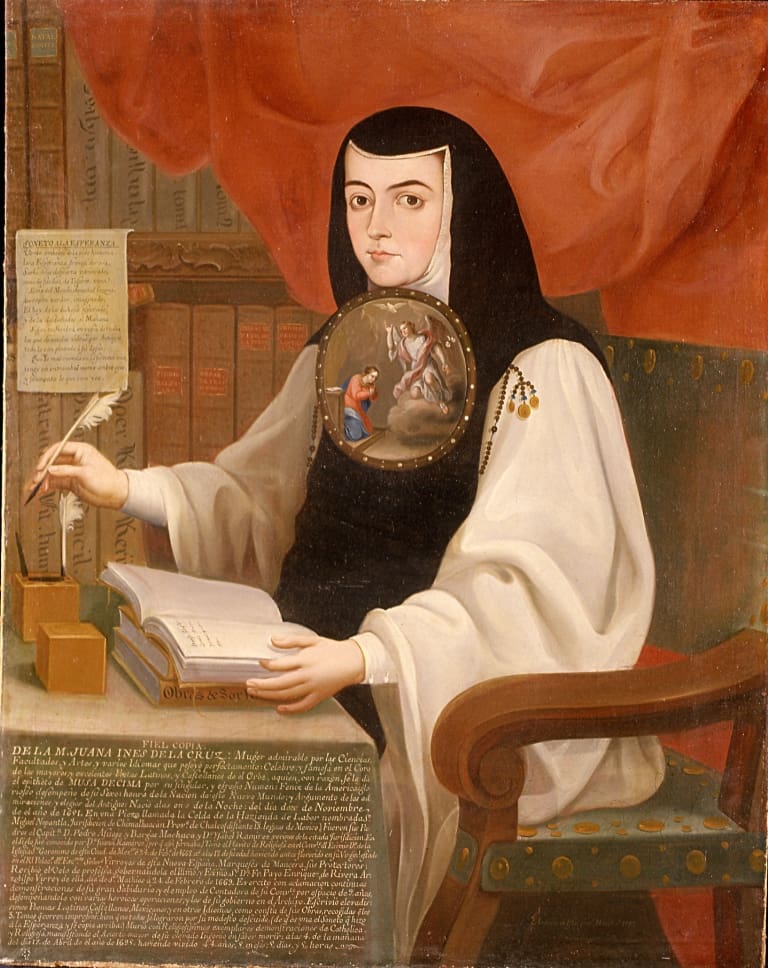
Fig. 1. Andrés de Islas, Portrait of Sor Juana Inés de la Cruz, 1772, oil on canvas (Museo de América, Madrid), Photo: AKG-images, Erich Lessing.
Along with her friend and fellow intellectual Carlos Sigüenza y Góngora, Sor Juana epitomized an American baroque that represented a nascent creole consciousness. This creolizing baroque differs from European notions of the epoch by being a form of proto-Enlightenment.[47] This American enlightened baroque took place during the seventeenth and eighteenth centuries, and, according to some, continued up until the end of the colonial period and even up until today.[48] As a cultural movement, it sought to challenge the European misconception of a lack of rationality beyond the “Old World” and asserted the intellectual validity of the “New World” and its peoples.[49]
While as a Novohispanic scholar Sor Juana constantly strove for recognition of her thought in theological and poetical discourses, she was also a “specialist in the manipulation of symbolic languages.”[50] Understood with Angel Rama, Sor Juana and other colonial intellectuals carried out a double ideological function between the dependence on and the mastery of the colonial network of signs: as a letrada, a lettered scholar, Sor Juana was a “servant of power” while at times also a “master of power,”[51] when, for example, she used her poetry to enter “the gap between [the] formal discourse and affective life” of the social and economic reality of Hispanicized Mexico.[52]
Sor Juana’s Corpus Christi plays from the late 1680s offer a unique dramatic personification of Idolatría, the allegorical figure symbolizing practices hegemonically attributed to any religion other than Christianity and its cult of images. In the following we will trace how Sor Juana’s Idolatría opens up a space of multiple didactics that allows for the simultaneous engagement of a heterogeneous audience in a creolizing colonial society.
Given the iconological nature of her works and the context of European-American cultural contact, it is no coincidence that Idolatría plays a central role in two of Sor Juana’s autos sacramentales. In these plays, Idolatría represents not only the complex interplay between Christian doctrines and Indigenous practices but also a strategic intervention in colonial memory to highlight a process of cultural negotiation between the “New” and “Old Worlds.”
Sor Juana’s Idolatría goes beyond mere theological discourse, instead extending to explore the tangible aspects of image practice. In early Spanish depictions, Idolatría primarily represents a grotesque embodiment of the religion of the Other, as portrayed in the Old Testament, emphasizing a crude and repellent understanding of non-Christian image worship. However, with the onset of the Spanish Conquista in 1492, the figure was adapted to a colonial ideology and given a new function: representing the subjugated idolatry of the Americas and the theme of human sacrifice.
Sor Juana engages with this iconographic canon but transforms Idolatría into a more profound and complex figure with quasi-auratic fascination—a presence figure. This translation can be interpreted as an attempt to mobilize the anthropological affordances of image veneration to facilitate Idolatría’s allegorical embodiment and to counter it with understandings of Indigenous image practice. In this sense, the personification of Idolatría can also be understood as the aspect of action or practice of a cultural allegory of image cults. Such a strategy allows for an intimate dialogue with divine absences iconically present in paintings and sculptures.[53] Christian image veneration implies visual contemplation and individual prayer in private and collective settings. And, indeed, Sor Juana stages Idolatría as a presence figure in the mode of the powerful image medievalism discussed earlier. In other words, Sor Juana’s religious drama re-enacts the religious culture of image veneration as a meta-commentary on the history of the Christian cult of images, mirrored through allusions to an Indigenous cult of images. To plastically exemplify the latent purposes of image cults, Sor Juana’s meta-commentary turns to a representation strategy of baroque theater: creating personifications that resemble images in their iconic rigidity. In essence, Krauss’s allegorical statues. In taking advantage of the affordance of static image veneration, Sor Juana superimposes the presence of divine figures atop her Idolatría character. Idolatría as a sculpted idea thus gains substance and authority through the gravity of material religion.
Rather than a demonic or apocalyptic image, Sor Juana’s Idolatría is reimagined as an Aztec-inspired ruler. This figure, adorned in an imperial costume reminiscent of the Mexica Empire’s traditions, was not meant to be condemned in the same way as earlier Idolatría figures. Instead, Sor Juana’s Idolatría is an abject symbol rich with ambivalent analogies between the Eucharistic theme of bodily incorporation and the accusations of cannibalism often leveled at Indigenous rituals. By evoking real instances of human sacrifice in the character’s speech, Sor Juana reconfigures Idolatría to explore the symmetries between the different orders of sacrifice, Indigenous and Christian both. This lens complicates colonial narratives and critiques the European gaze upon Indigenous customs and beliefs. Through such symbolic and visual transformation, Novohispanic sacramental theater not only served as a vehicle for Christian doctrines but also became a dynamic space for cultural negotiation, where colonial and Indigenous identities collided and hybridized. By shifting the focus onto complex, multifaceted allegories like Idolatría, liturgical drama offered audiences a way to confront and ponder the juxtaposition of European religious ideals and Indigenous cultural realities.
Particularly in Sor Juana’s plays, this figure challenged colonial constructions of Indigenous cultures and religions, reframing the image of Idolatría to create a new, critical perspective on colonial authority and the theological underpinnings of conquest. Through her allegorization of Idolatría, Sor Juana engages with the tensions between the Christianization of the Americas and the preservation of Indigenous memory and identity.
The Figure of Idolatría in Canonical Spanish Theater
It must be emphasized that Idolatría (Idolatry) was a frequently embodied figure in late medieval, Renaissance, and baroque liturgical drama. Idolatría was firmly established in the dramatis personae of early sacramental plays transitioning from the sixteenth to the seventeenth century, and appeared in various forms, including a monstrous female figure, as seen in Lope de Vega’s works (1562–1635). In some of his plays, Idolatría emerges apocalyptically from the belly of the Corpus Christi dragon, a massive serpent-like creature known as the Tarasca (Fig. 2), one of the primary props of Corpus Christi processions. Within these plays, Idolatría identifies herself as a basilisk, a chimera-like monster, in some interpretations symbolizing the destructive and heretical forces that Christianity sought to overcome.[54]
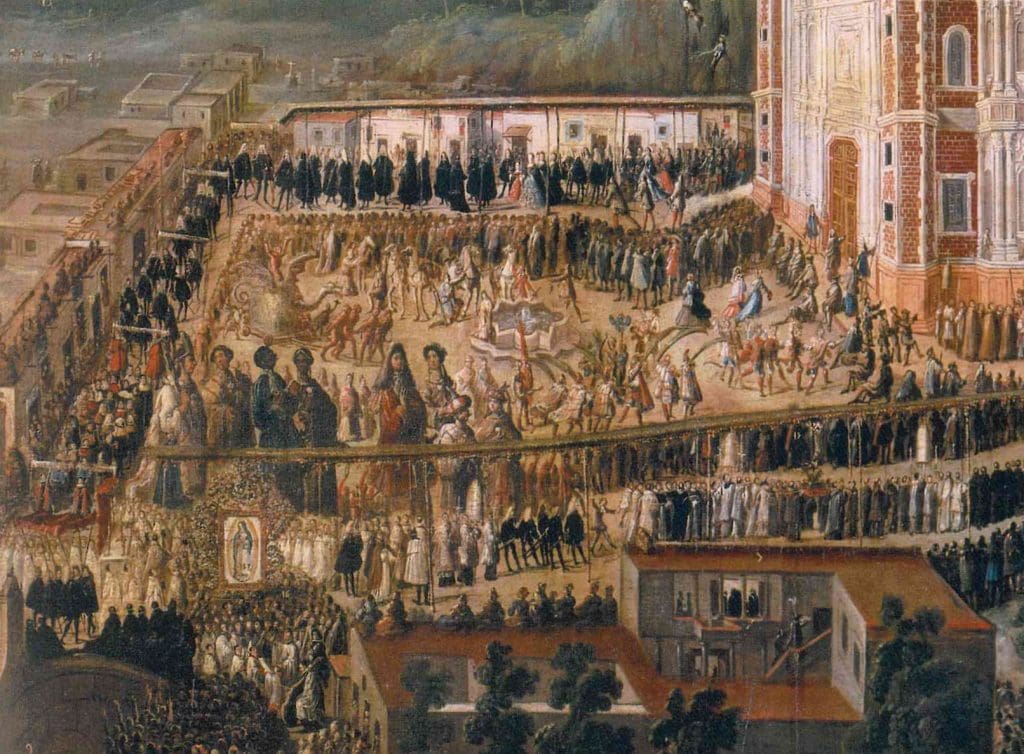
Fig. 2. Manuel de Arellano, Traslado de la imagen y estreno del santuario de Guadalupe (detail), 1709, oil on canvas, 176 x 260 cm. Private collection, Madrid.[55]
Traditionally, Idolatría was depicted as female, often appearing alongside a superior male allegorical figure such as Baal of the Old Testament or an ancient deity of the Greco-Roman world. Idolatría belongs to the negative character repertoire, representing sin, vice, and heresy—forces that must be subdued in the course of the play, typically culminating in the figure’s onstage death. Idolatría’s death symbolizes the triumph of Christianity and its rituals, with other forms of image practice being forcibly eradicated to make way for this new religious order.
Americanized representations of Idolatría often show her surrendering to the allegory of Faith, illustrating the colonial narrative of Christianity’s triumph over Indigenous “religions” and practices. Prominent examples of this newly globalized Idolatría are found in many plays of the Hispanic baroque, like Lope’s Famosa Comedia del Nuevo Mundo (1598–1603),[56] written about 100 years after the Spanish conquest, and his autos sacramentales, such as La Margarita Preciosa (1616), as well as Pedro Calderón de la Barca’s La Aurora de Copacabana (1664), a comedia de santos.[57]
Both authors’ works—but especially Calderón’s—are prime examples of baroque miracle theater, which addresses early Atlantic globalization from a Spanish colonial perspective. In the context of Calderón’s drama, which revolves around one of the first Amerindian miracle-working images of grace, the 1584 Virgin of Copacabana statue by Francisco Tito Yupanqui in Bolivia (Fig. 3), Idolatría becomes an active and resistant main character with a significant amount of stage time throughout the three acts. Despite her repeated defiance, Idolatría is eventually forced to kneel through the successive staging of five miracles. From Lope’s and Calderón’s American stagings of Idolatría, an intermedial iconography emerges that forms an important projection space for the figure of Idolatría in Sor Juana’s Novohispanic sacramental plays.
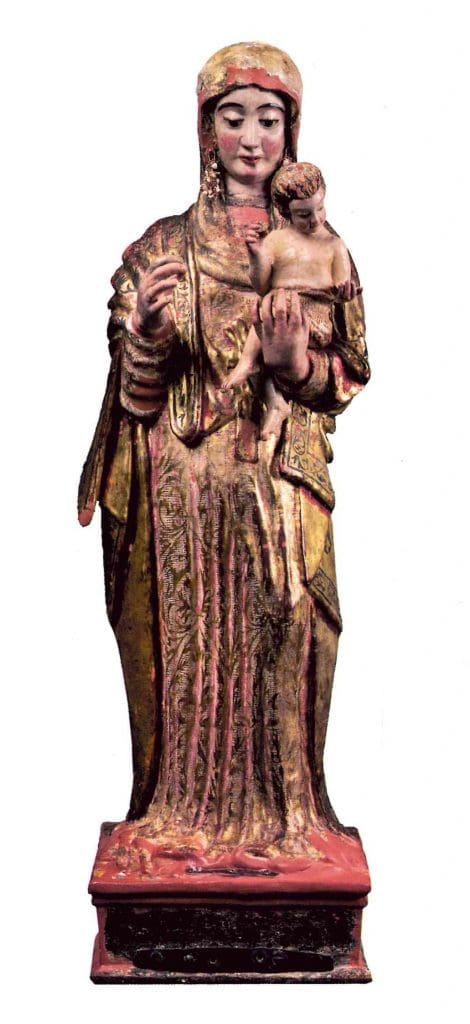
Fig. 3. Francisco Tito Yupanqui, Virgen de Copacabana, 1584, wood and maguey (agave), dimensions unknown, Santuario de Copacabana, Bolivia.[58]
Calderón’s stage directions model Idolatría in the old European fashion of Cesare Ripa’s Iconologia (1593).[59] Surprisingly, however, Calderón doesn’t use Ripa’s template for Idolatría but rather that of the warrior-like America (Fig. 4).[60] Calderón’s decision to not directly reference Ripa’s Idolatría—which the latter catalogs as “a blind, kneeling woman who incenses the statue of a bronze bull”[61]—might stem from Ripa’s interpretation of the figure’s blindness as representing misconception and error, but still as a full-fledged religion, one dedicated to the worship of a false god. Furthermore, Ripa’s choice of a kneeling position, conveying submission and humility, does not match the more aggressive and demonic characterization Calderón sought for his Amerindian Idolatría. He rather needed a figure that acted as an angry and vengeful Fury. Idolatría in Sor Juana’s plays also appears as an angry figure, but not as a demonically framed warrior; rather, she represents the pre-contact ruling dynasties as an Indigenous dignitary.
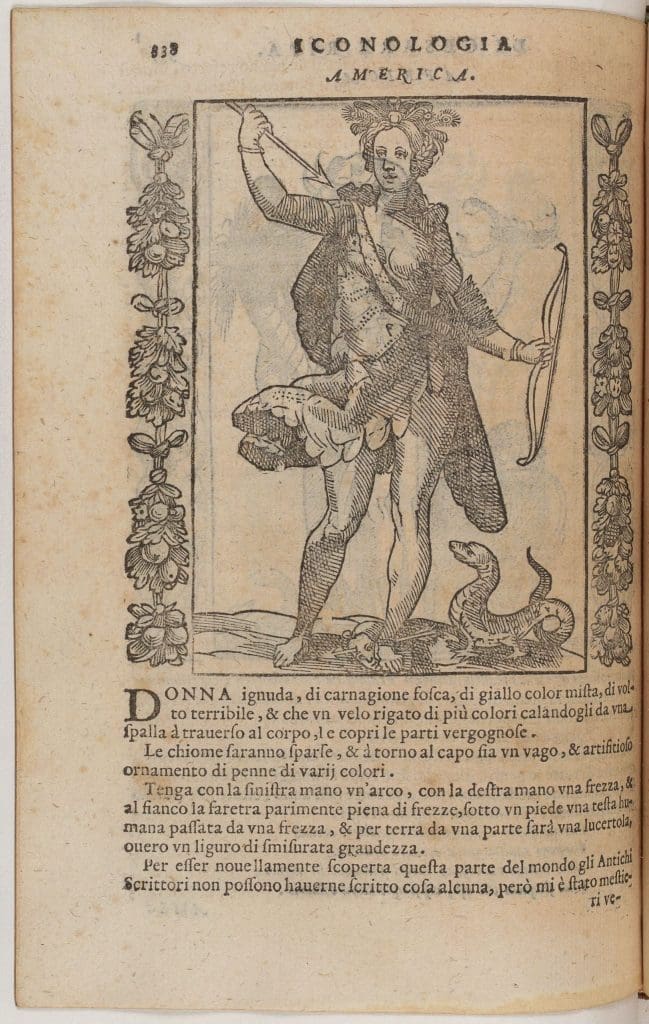
Fig. 4. Chevalier d’Arpin (Giuseppe Cesari), wood engraving. From Cesare Ripa: Iconologia, “Mondo, America,” Rome 1603, p. 338. Paris, Bibliothèque de l’Arsenal/ BNF.
The Representation of Idolatría as “India Bizarra”: An Amerindian translatio imperii
Sor Juana incorporates the canonical Spanish models into both of her autos containing the Idolatry character. She explains the allegorical meaning of the plays to the audience at the outset through a dialogue between several characters in the prologues (loas) of the auto sacramental genre, and here Idolatría herself is introduced as part of the audience of the performance. Sor Juana’s loas gain even more emphasis because they negotiate the geopolitical context of her liturgical dramas: Thus, through the participation of the character in the theatricality of the social environment, the effectiveness of the play’s didactic lesson must, in a way, be measured by Idolatría’s judgment. This moment, however, is left out of the action of the sacramental play. Instead, it converges with the experience of the spectators and their reactions to the play in the theatrical performance space.
To illuminate the aesthetic and social implications of Sor Juana’s Idolatría, I would first like to introduce the costumes from both prologues, before highlighting specific aspects of the character’s speech. In the later published of the two sacramental plays, El Cetro de Josef (1692), Idolatría’s first appearance is ethnically marked in a stereotypical way: “Sale la Idolatría de india” (“Enter Idolatry dressed as an Indigenous person of Central America”, v. 231). In El Divino Narciso (1689), however, the symbol of “india” is elaborated in great detail. In El Divino Narciso’s dramatis personae, the allegorical figure is named América, yet her adversary, Religión, clearly identifies her as Idolatría through her iconoclastic rhetoric: Religión describes América as “vain Blindness with superstitious practices”[62] who worships her idol “to the shame of the Christian religion.” This interaction indicates that Sor Juana must have been familiar with both of Ripa’s iconological figures of Idolatría and América.[63]
The stage directions for Divino Narciso’s loa describe Idolatría as an Amerindian noblewoman, accompanying the western continent Occidente—not Europe, but Central and South America:
Sale el Occidente, Indio galán, con corona, y la América, a su lado, de India bizarra: con mantas y cupiles, al modo que se canta el Tocotín. Siéntanse en dos sillas; y por una parte y otra bailan Indios e Indias, con plumas y sonajas en las manos, como se hace de ordinario esta Danza; y mientras bailan, canta la Música.[64]
In this scene, Occidente (the West) appears as a gallant Indigenous man with a crown and América stands by his side, dressed as an Indigenous noblewoman, wearing a manta (traditional cloak) and cupile (headpiece), in the style of the tocotín. The tocotín or mitote is a type of dance theater or choreographed mime, typically part of processions, weddings, and other ceremonies, that portrays the triumphal procession of the Aztec rulers, the Tlatoani. They sit on two thrones, and on both sides, Indigenous men and women dance with quetzal feathers and small rattles in their hands while music plays.
The india costume primarily emphasizes the baroque sense of the bizarre,[65] representing the Indigenous ruler as heroic, brave, and radiant—an allegorical statue imbued with the radiance of the powerful image. However, the cupiles (headpieces) and tocotín dances, originating from Mexica culture, starkly contrast the conventional portrayal of Idolatría, depicted as merely submissive. As revealed by the ongoing scholarly debate surrounding the recent critical editions of Sor Juana’s oeuvre, cupiles is often assumed to be a typographical error for the Nahua word huipil, a tunic-like garment, which was adopted in earlier Spanish editions and incorporated into the latest critical edition by Ignacio Arellano and Robin Ann Rice.[66] Yet, Mexican baroque scholars such as David Galicia argue that cupiles or copiles actually refer to an Indigenous headpiece resembling a tiara,[67] a pointed, triangular half-crown (Fig. 5).
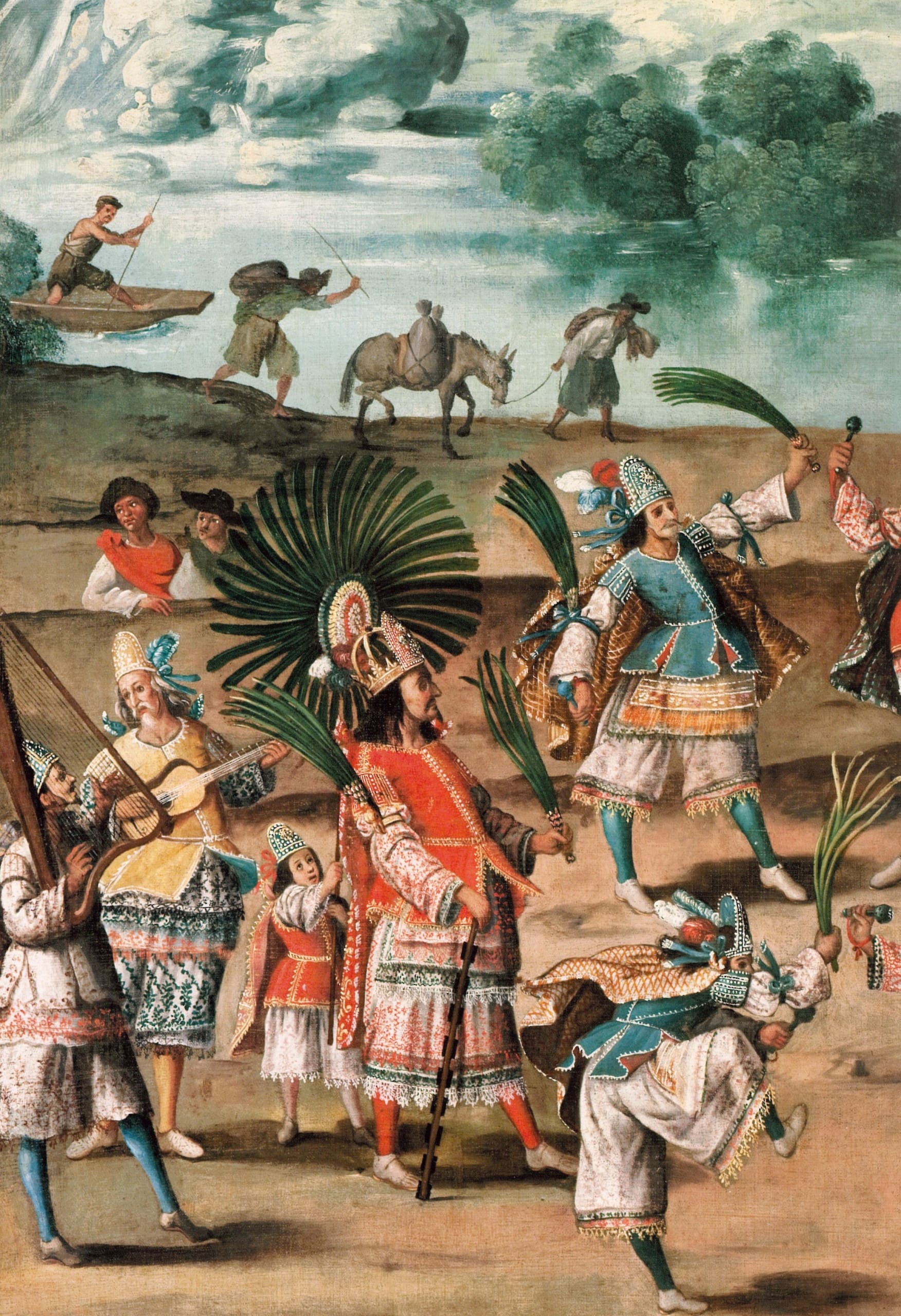
Fig. 5. Detail of folding screen: Biombo con deposorio indígena y palo volador, ca. 1690, oil on canvas, 167,6 x 304,8 cm, Los Angeles County Museum of Art.[68]
Whether a tunic or tiara, the disputes over the india bizarra costume—central to the identity of the Amerindian Idolatría—stress a deeper issue: Sor Juana’s refusal to relinquish the imperial aspirations of Novohispanic creole communities. In this context, creolized Mexicans are depicted as legitimate descendants of both the Mexica (or Aztec) dynasty and the Spanish conquistadors. Through this royal or noble costuming, Sor Juana emphasizes a legitimate power transition from one empire to the other, from the Tlatoani to the Spanish kings and their respective viceroys in New Spain, favoring ideas of Mexica imperialism and veiled sovereignty throughout Spanish colonialism.
To aestheticize this Amerindian traslatio imperii—the transfer of imperial authority—as the perpetuation of pre-colonial memory to Aztec civilization,[69] the copil (tiara) plays an important symbolic role. Galicia points out that the copil references the complex and contested historical identity of New Spain’s inhabitants.[70] Therefore, it is crucial to understand that Sor Juana presents the Indigenous figure of Idolatría not as an ordinary member of the general population but rather as a representative figure with the performative and captivating power to negotiate the terms of cultural transition.
In El Cetro de Josef—a less elaborate sacramental play compared to El Divino Narciso, which suggests it might have been an earlier one—Idolatría still carries strong echoes of the vengeful, demonic woman in Lope’s and Calderón’s works. In this possibly earlier play, she delivers an iconic speech against the forceful conversions of Spanish conquest:
Idolatría:
No mientras viva mi rabia,
Fe, consiguirás tu intento, […],
introdujiste tirana
tu dominio en mis imperios,
predicando la cristiana
ley, a cuyo fin te abrieron
violenta senda las armas, […],
y aunque casi todas ya
mis gentes, avasalladas
de tu activa persuasión,
todos tus dogmas abrazan,
con todo vuelvo a decir,
no ha de ser tu fuerza tanta,
que pueda de una vez sola
quitar las tan radicadas
reliquias de mis costumbres,
y así, aunque me ves postrada,
no tanto que no te impida
el que demuelas las aras
adonde los sacrificios
son las víctimas humanas.[71]
In this scene, Idolatría’s rhetoric does not merely critique Spain’s imposed religious practices but also powerfully represents Indigenous Peoples’ impulse to resistance, offering complex commentary on the colonial encounter. The theatrical representation of both military violence, for which Calderón’s La Aurora de Copacabana was nearly censored in 1664,[72] and the destruction of images, against which Idolatría vehemently protests, are addressed in the text. When, in response, the figure of Faith (Fe) asks who this blasphemous person is, Idolatría answers almost juridically and meta-theatrically, asserting that she is the defender of ancient rights, an allegorical idea, an abstract, collective concept that speaks as a plenipotentiary, a representative of all Indigenous people, against the use of violence and the destruction of statues used to suppress their cults:
Idolatría:
Soy, por más que tú me ultrajas,
la que sabrá defender
fueros de edades tan largas,
pues alegórica idea,
consideración abstracta
soy, que colectivamente
[…]
como plenipotenciaria
de todos los indios, vengo
a decirte que, aunque ufana
estés de que […]
no intentes con la violencia
inmutar la antigua usanza
que en sus sacrificios tienen, […].[73]
Of particular interest here is the insistent tone with which Idolatría argues that the highest sacrifices, after all, are those of human blood (vv. 287–88), and that it would be enough to acknowledge the one Christian God while continuing to offer the same highest sacrifices. A simple object exchange—el mudar el objeto—should suffice to restore peace between the various orders of sacrifice: “Pues el error fue el objeto./Mudar el objeto basta” (vv. 299–300; ‘For the error was the object./Changing the object is enough’).
As evidenced by the length of her dramatic speeches, Idolatría appears as if long deprived of articulation and has a lot to say, and at various points refers to herself both as a “barbarian” and as a “rebellious disobedient,” threatening to curse the land should human sacrifice be abolished there. Once the initial pathos of Idolatría is unleashed, in El Cetro de Josef the figure becomes more dialogical, engaging toward the end of the loa with Faith’s argument and agreeing to a teachable moment concerning the Eucharist parable. This agreement reached in the prologue is linked to the beginning of the impending sacramental play about Joseph (son of Jacob, Gen. 37), whose mythological vita is full of mysteries surrounding bread and grain. Again, in the loa’s final speech, Idolatría appears impatiently pragmatic, eager to finally witness the new human sacrifice, announced as the subject of the main play—a sacrifice that can be consumed, thus opening the sea of analogies between Mexica human sacrifice and consuming Christ’s body as a divine substitute for human sacrifice.
However, what is most important here is that, in Sor Juana’s Joseph play, Idolatría submits to neither the gestures nor the rhetoric of the Christian religion. Instead, the dramaturgist lets her merge with the actual audience of the performance, and it remains unclear in the dramatic text whether Idolatría eventually witnesses an equivalent sacrifice in the following auto sacramental and, if so, whether it provides her with satisfaction at the performance’s conclusion.
In Sor Juana’s more complex auto staging Idolatría, El Divino Narciso, not only the intermediary images of imminent human sacrifices but also the cultural analogies themselves are taken to the extreme. The Christian sacrificial order is also placed in an even more pointed symmetry with the Mexica one. In nearly as long a speech as in El Cetro de Josef, but more theological in its discourse on free will, América/Idolatría articulates her inner freedom to worship her own gods and venerate the God of Seeds:
y así, aunque cautivo gima,
¡no me podrás impedir
que acá, en mi corazón diga
que venero al gran Dios de las Semillas! (vv. 227–46)[74]
Even if América laments her captivity, Religion will not prevent her from declaring, in her heart, that she venerates a Mexica god. The God of Seeds, as Félix Duque has shown, refers to the deity Enoc, whom Sor Juana also mentions directly in her sacramental play, and nods to the practice of making human-shaped offerings from maize and blood.[75]
Parallel to the figure of Faith, Religion—in the costume of a Spanish lady—makes it her mission to subdue América/Idolatría not by force but through logical persuasion, offering her an equivalent sacrifice to the bloody seed sacrifice. This prompts in América a pragmatic curiosity about the Eucharist, which, in the play, is even mystified as “inspiración divina” (v. 396). The starkness of the character’s speech focuses closely on the topic of human sacrifice and also alludes to a re-embodiment of the Eucharistic transformation. Here, Sor Juana’s most scandalous version of Idolatría boldly inquires whether she can partake in the Christian sacrifice of grain and blood and touch it with her hands:
América:
Cuando eso así sea,
dime: ¿será tan propicia
esa Deidad, que se deje
tocar de mis manos mismas,
como el Ídolo que aquí
mis propias manos fabrican
de semillas y de sangre
inocente, que vertida
es sólo para este efecto? (vv. 321–329)[76]
Through this rhetorical invocation of the haptics of creating and personally touching the sacrificial offering, in which blood and grain merge, a reversal occurs in the sublimation of the Eucharistic sacrifice. What was once abstracted into the Real Presence of the resurrected body is now brought back to the level of bodily fluids and foodstuff. In Sor Juana’s liturgical drama, the fragility of the Christian sacrificial order lies in its operational proximity to anthropophagy and idolatry, from which it must constantly be safeguarded against regression and directed back into proper channels through the art of memory in liturgical drama.[77] However, within the intersection of these motifs, the literal human sacrifices imposed by the killings during the takeover of Christian colonial power can also be shifted back into the multilayered discourse of the play through the same significant proximity. In the loa of El Divino Narciso, Idolatría and Occidente (Central and South America), portrayed as a royal couple, are not subjected or forced to abandon their cosmological order. Instead, they are given the opportunity to convince themselves of the new sacrificial program. With the words “to see more/than to hear what you tell” (vv. 413–14), they too become alert skeptics within the sacramental play’s audience.
The figure of Religion—who is revealed as the author of the play, and thus congruent with the actual playwright, Sor Juana—explains her stage didacticism in an autoreferential manner. When asked about the title of the auto sacramental that she allegorizes, Religion, a.k.a. Sor Juana, responds:
Divino Narciso, porque
si aquesta infeliz tenía
un Ídolo que adoraba,
de tan extrañas divisas,
en quien pretendió el demonio,
de la Sacra Eucaristía
fingir el alto Misterio,
sepa que también había
entre otros Gentiles, señas
de tan alta Maravilla. (vv. 425-433)[78]
These otros Gentiles—a Spanish term indicating the aristocratic concept of noble people but also a synonym for “pagans” of other religions—refer to the prefiguration of Christian salvation history in the Narcissus myth of Classical mythology; however, at the same time, these cultural others allude to the Mexica dynasty and Indigenous America before Spanish colonization. With this comparison between communities of non-Christian religious practitioners, the theme of translatio imperii of the loa’s opening sequence is here taken up again, suggesting a comparability between cultural orders. This tactic seems to move the anthropophagic practices projected onto Otherness from their depths of abjection to the surface of anthropophagic Christianity. It must be emphasized once again that, rather than the subdued Idolatría of Calderón’s play on miracles in colonial Peru, Sor Juana’s Idolatría and Occident are depicted as self-determined actors up until the play’s end. They affirm themselves through Indigenous cultural practices such as the tocotín—the performance of dance, music, and play—and leave the stage in the traditional festive gesture: “Éntranse bailando y cantando.”[79] The action of the loa of Sor Juana’s most famous sacramental play, El Divino Narciso, ends with the speech acts of the Indigenous ruling couple, who rise from their chairs and then blend in with the musicians and spectators while performing the tocotín before the main play begins. This dance into the audience is a metalepsis, a leap between the media levels, in which the dramatic and the para-theatrical merge. With this ingenious dramaturgical leap, Sor Juana helps us grasp the interactive qualities across the media genres and their transgressive potential associated with the concept of social sculpture. This situates Beuys’ modernist approach in a long-term paradigm that can be transhistorically accessed.
Sor Juana’s Idolatría is ambiguous, simultaneously evoking both the cruel and repulsive colonial image of a cannibalistic idolatrer and the fascinating image of a cunning and eloquent Amerindian queen. This duality has led to euphoric appropriations of Sor Juana in postmodern, feminist, and post- and decolonial research, while also, still today, prompting conservative cultural assertions that she was an apologist for the Hispanic monarchy. Regarding the poet’s multifaceted openness to interpretation, Barbara Ventarola has coined the helpful term multididaxis—that is, multi-pronged learning—which occurs in the educative space of the auto sacramental and which simultaneously allows for diverse and heterological understandings.[80]
Through poetic reincarnation via the medium of allegorical personification, this multididaxis produces an affective imagery. In the actor’s embodied person, the meaning of words and their iconicity converge.[81] The rhetorical device of personification, therefore, requires revision as a living sculpture and powerful stage image. This device is still often taken for granted and quickly dismissed as an overly familiar trope of communication.[82] The allegorically personified Idolatría—as a living sculpture dancing into the play’s performative framework, that is, the Corpus Christi procession—connects to other performative genres that integrate the tocotín dances. In the terms of this essay’s argument, the tocotín serves as a link between the media levels of the powerful image and the procession as invisible social sculpture.
The procession is a means of communication with a performative function analogous to many theatrical forms of expression. Given that procession and stage drama draw upon each other and create an intermedial art form that sacralizes the urban performance space—by constantly reproducing the same symbols, iconicity, and sacra personae in the streets and squares as well as onstage—I have come to conceptualize both liturgical plays and processions as performative genres.
Such an understanding can prove useful when engaging with processions in the early modern period from the perspective of performative anthropology in a transhistorical and transcultural way. Religious processions can be understood as “genres of performance,” to borrow Victor Turner’s term for encompassing ritual and theater, alongside other Christian phenomena such as image devotion, pilgrimage, and ritual drama.[83] Turner defends “ritual in its performative plenitude” as a “matrix from which several other genres of cultural performance, including most of those we tend to think of as ‘aesthetic’ have been derived.”[84] In their interplay, all these genres of cultural performance create a total work of religious art. They form a cross-medial unit I refer to using the heuristic notion of processional theater.
Since the visible and invisible aspects of social sculpture interact to serve Sor Juana’s multididaxis, it is necessary to analyze the interaction between the different media inside and outside the procession. For this reason, and to further understand the interaction of the allegorical statues (visible social sculpture) with the transmedial and transtemporal performance space of the procession and dance (invisible social sculpture), another term alongside Turner’s becomes helpful: Elsje van Kessel’s “shared iconography.”[85] These analytical tools help illuminate why it is productive to apply the concept of social sculpture to the case study of Sor Juana’s autos sacramentales.
Kessel’s key study on seventeenth-century Corpus Christi processions as artwork provides an exemplary model to gain insight into how the inside and outside of processional theater merge. To justify her leaps between media levels—like banners, paintings, silver plates, and circular walking movements—Kessel sets the street as the framework for this ephemeral work of art with all its media arrangements. She argues that the people who contribute through devotional participation—such as the nuns responsible for weaving the hangings that decorate public space, for example—become part of the ephemeral display. Through an approach revolving around presence, Kessel traces “the interaction between object and recipient,” and between different artifacts, through their “shared iconographies.”[86]
Her idea of the “street as framing device” and the “inseparability of the object from its frame” gives the procession a “remarkable agency,”[87] and it seems to align with the tenets of social sculpture. However, the street as frame does not seem radical enough when it comes to the religious setting of sacralized urban space, which includes the open skies, thus reflecting the vertical cosmology of the Christian celestial beyond and the more-than-human actors between the heavenly and earthly realms. Kessel seems aware of this, when she organically includes the divine in her conclusion:
The music, banners, dances, figures of monsters, giants, serpents, saints, tableaux vivants, and hangings that, with human participants and the Holy Sacrament, made up the Lisbon Corpus Christi procession, produced presence: a heightened, physical sense of coming together that goes beyond meaning and that united participants with each other and the divine.[88]
Combining Kessel’s mediality shifts with Beuys’s concept of social sculpture broadens the framework of the street to include the interactive heavens as part of the urban sacred, encompassing the social organism in its totality. While the theater is one mode of presenting this social organism and the procession is another, in processional theater the two converge. Both for processions and sacramental plays, the frame is the whole community in the streets in symbiosis with the Real Presence of the divine. With this broadened framework, it is possible to show how Sor Juana’s creation of allegorical statues, and particularly her Idolatría, could have been nourished by Hispanic processional culture and its shared iconographies. Taking this framework as a departure point, the second part explores how Sor Juana’s Idolatría created a social sculpture that reflected and was reflected in Amerindian processions of the time.
2. Amerindian Processions as the Invisible Social Sculpture of Sor Juana’s Idolatría
To fully understand the dramatic embodiment of Idolatría and her hermeneutic openness in Sor Juana’s staging, it is necessary to consider other genres of performance that the poet drew on, mainly processions and dances. Sor Juana responded to the invisible social sculpture of processions and dance performances in her plays by hinting at an untapped poietic potential associated with the presence of Indigenous dignitaries in Amerindian processional theater.
To explain Idolatría’s staging as india (Amerindian), we have to more closely examine the aforementioned tocotín. These pantomimed choreographies referred to Aztec royalty and pre-colonial cultural tradition, and in Novohispanic festive culture they were performed, among other occasions, as part of any kind of religious procession or triumphal entry. The allegorical statue of Idolatría staged a la india and dancing the tocotín can be conceptualized as a sculpted idea in the Beuysian sense. Like a living image or a performer walking in a procession, she leads social interaction with the participating public and becomes transmedially activated as processional sculpture.
Curiously, the crucial information for deciphering the symbolic function of the theater allegory lies in the highly underestimated textual genre of festival books or celebration reports known as relaciones festivas or libros de fiestas. These festival books outline the various steps of baroque feasts, including the walking order and activities inside the display and at the margins of their processions. The Festivo aparato (1672),[89] which relays the 1672 canonization festival for Saint Francis Borgia in Mexico City, describes how the personifications of the Indigenous rulers and their Mexica courts opened the triumphal march, guiding the processional carts with statues of Jesuit saints and holy figures through the streets. In 1672 Mexico City, Idolatría did not walk in the celebration’s narrative sequence, but as metonymy she becomes present as the invisible partner to Moctezuma, the Indigenous emperor who iconologically is always accompanied by an Amerindian queen. We can see how only in its cultural framing and function as social sculpture does the ambiguous identity of Idolatría emanate in space to be recognized in her shared iconographies across genres.
In both Novohispanic and Spanish processional theater, a “transliminal aesthetic field”[90] unfolds and creates concrete situations of sacralized spatial communities. Perceiving them as traveling forms that can be transposed to other processional cultures, we can look at canonization festivities in Mexico City, Manila, or Madrid. The participatory observation of image processions, as transcribed in their festival books, makes them the perfect object of study for a comparative approach, which also allows us to highlight how they are each other’s invisible social sculptures. From this perspective, it is possible to map Roman Catholic processional theater across Jesuit festival reports of the transoceanic Americas to reveal how they nourish Sor Juana’s allegorical embodiment of Idolatría.
In this section, my primary focus is the Mexican book of Borgia’s canonization festival, which links the 1671 celebration in Madrid, to the 1672 one in Mexico City, to the 1673 one in Manila. The general structure of these canonization festivals—called solemnidades o octavarios—was their eight-day duration, including the vigils before and after the first and last Sunday. Popular festivals accompanied the ecclesiastical parts, most famous for their poetry contests, theater plays, and colorful street decorations. Church facades were transformed with hanging wax figurines and emblems called hieroglyphics—paintings with slogans and explanatory poems in Latin, Greek, and Spanish depicting and elaborating on, in this case, Borgia’s life and virtues. From this setting, we can already see how the community’s religious fervor was not only poured into an ostentatious synesthetic spectacle, overstimulating all the senses at once, but also expressed in a passionate poetic culture in which the written and spoken word occupied an equally animated and popular place as the spectacular elements. The climax of canonization festivals was the procession, often including long masquerades and allegorical pageantry, before, during, or after the passing of the processional carts, carrying the saints’ images.
Mexico City’s Festivo aparato (1672)
The Festivo aparato, published in Mexico City in 1672, is authored by an anonymous Jesuit writer. The highlight of Borgia’s triumphal march in Mexico was the opening procession, the so-called Máscara grave: an elevated and serious masquerade involving allegorical processional carts carrying the holy figures of various venerated saints. The Spanish peninsular custom was to separate the masquerade from the religious procession, but in Mexico they were merged from the beginning, arguably not to overload the ecclesiastical sequence of the eight days of sermons and poetry contests. The processional floats were embedded in the walking order of the three hundred main performers, accompanied by six hundred lacayos, or servants, each dressed according to their place in the social and clerical order (Fig. 6).
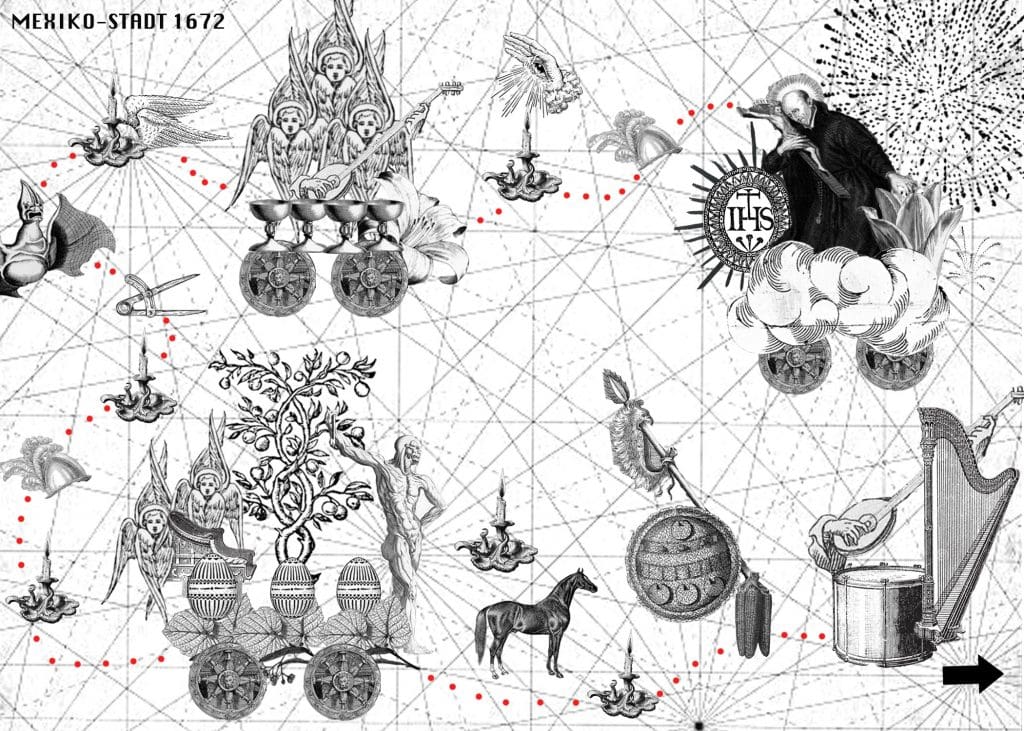
Fig. 6. Graphic by Miranda Martínez Bonfil and Johanna Abel, recreating the details of the order of procession of St. Francis Borgia’s canonization ceremony in Mexico City 1672.[91]
Most striking about the Mexican walking order is its first section, which opened the procession: it represented the Mexica court, symbolized by the Aztec ruler Moctezuma and his Indigenous royal court:
La primera festejaba como à primer Padre, y Fundador de esta Mexicana Provincia con setenta, y siete bellos Adonis, disfraçados con el siempre garboso trage Mexicano, de calçon ancho abierto, manta larga pendiente á los ombres, y coplile (que es una como medio Tiara) en la cabeça.[92]
One lead figure carried a huge coat of arms with the emblem of the Mexica dynasty, an eagle sitting on a nopal (prickly pear cactus). As part of this shield here finally appears the allegorical statue from Sor Juana’s plays, the iconic figure of América, transposed into a heraldic painting. The procession report describes it in almost exactly identical terms as Sor Juana’s stage directions for Idolatría as india bizarra:
El que capitaneaba à todos en un tan hermoso, quanto bien arrendado bruto, llevaba por delante cuatro pages, vestidos también a toda costa a la usanza Mexicana, con cavellera rendida en la espalda, carcaz de flechas al ombro, y arcos dorados en la mano: este empuñaba la Tarja que no desdezia un punto de la gala de su dueño. La pintura de ella entretenia con un crespo anchuroso mar, a cuya orilla esperaba la America en trage de India de be[.]ua planta, con las usuales insignias de Copile, naguas, yp giul, que es à modo de una sobrepelliz sin mangas; y a su ojal las Armas de este Mexicano Imperio, que son un Tunal, quien corona la Reina de las aves, como que destroza los círculos de una culebra con el pico. También se divisaba un Navio, que ya daba fondo con los primeros Padres de la Compañía, enarbolando uno de ellos la milagrosa Imagen de nuestra Señora del Populo, que venia por Fundatriz de esta Provincia, y en la popa un Buey, que le servía de remate: donde se traslucía el cortesano recibimiento, que hizo este Nuevo Mundo a los hijos, que embiaba San Francisco de Borja.[93]
This excerpt from the procession report is most revealing of what Solange Alberro, in her seminal work on another canonization festival, for Ignacio Loyola in Puebla, calls the Jesuit’s “skillful and subtle strategy of recovery, rehabilitation and resignification of Indigenous symbols for political purposes.”[94] But before we analyze the diverging meanings of this “Indigenous or Indigenist sequence” of the procession,[95] in Alberro’s term, I must first point out the significance of the emblem shield of the Mexica court: its description clearly offers a correction to the latest critical edition of El Divino Narciso and its silencing substitution of copil for huipil. The excerpt states these as precisely two different attributes of América’s Amerindian dress: “con las usuales insignias de Copile, naguas, yp giul [huipil], que es à modo de una sobrepelliz sin mangas” (emphases added).[96] Sor Juana’s text likewise clearly mentions the mantas (a.k.a. huipiles) first and then the copiles; undoubtedly, then, copiles can only refer to the tiara-like crowns, as David Galicia emphasizes and as was discussed above. This assertion further proves that the tocotín iconography remains an emblem of contested cultural agency up to this day.[97] If it still is contested today, in the twenty-first century, then how did the integration of the tocotín in mass media work in the colonial context of the seventeenth?
The excerpt from the procession report makes evident that the painted emblematics on the coat of arms, the allegorization of Idolatría in theater, and the re-enactment of Aztec dances all “partake in the same iconography,” as Elsje van Kessel formulates it,[98] to cross the various medial boundaries between artifacts and modes of presentation. Rather than as reflections of a given context, Kessel views baroque festivals with processions, such as that of Corpus Christi, as “material and social agent[s]” that could “intervene in political, economic, or social developments” with some “flexibility.”[99] While it is easy to get carried away by the seemingly positive implications of the Indigenous opening sequence of canonization festivals, Alberro dampens revindicating constructions of a flexible agency of the Mexican processions with strong counterarguments that show how these mediated events worked against integration and aesthetic equality.
While New Spain certainly presents itself as “plural and integrative by incorporating the Indigenous sequence,”[100] the república indígena is merely a generic formality dating back to the medieval Spanish peninsular tradition, whereby ethnic groups were integrated into processions as an appeal to regional or monarchic pride,[101] as was the case, for example, with Biscayan dances and reinos sequences (parading different nations and monarchs). In an apotropaic manner, processions often even included political enemies, such as the sultan of the Ottoman empire. And although the imposing image of the Aztec rulers was a form of revindication of their cultural legacy, it also had a neutralizing effect. Alberro describes the frequent representation of Mexica symbols in religious contexts as “exorcizing the symbolic power and ancient meanings they still conserved,” to be “replaced by new symbolic and emotional interpretations.”[102] As she further explains, the glorification of the surrendered Mexica Empire had, since Hernán Cortéz, served to demonstrate the superiority of the conquistadors’ military conquest, just as in the baroque period such glorification within Jesuit image programs demonstrated the superiority of Christian spiritual conquest by increasing the cultural value of the Indigenous world.[103] The parading of the tocotín and its costumes in processions thus remains a very simple form of reinforcing the Conquista’s founding myth of subjugation.[104] The only aspect Alberro leaves intact as one possibility of sovereign Indigenous agency is the glorification of the Mexica royal court on an aesthetic level. Its representation at the same level of aesthetic appreciation as the Christian orders and divine concepts cannot be fully contained in colonial image strategies:
It is also true that on an aesthetic level, and to the honour of both the procession as a religious and political manifestation, the indios could only be represented with the same richness and pomp as the other actors in the ceremony, since magnificence was consubstantial to the festivity, in each of its sequences and aspects.[105]
With this quality of “consubstantial magnificence” Alberro outlines the dimension of shared affordances inside and outside the procession as part of a devotional culture intended to create solemnity and awe. This reminds us also of Beuys’ approach to social architecture in artworks.
But while Kessel advocates shared iconographies to resolve the boundaries between artists and artworks on multiple medial levels, both her and Alberro’s approaches still lack one step to prove Indigenous agency as a real possibility in Sor Juana’s staging of Idolatría. This possibility is granted by the concept of social sculpture, for it incorporates spontaneous interaction or social intervention as a key factor in the performance. This key aspect is made explicit in another passage of the Festivo aparato, where it becomes clear that the presence effects provoked by the Indigenous walking sequence were prone to eliciting strong affects and interplay between the participants and the actors inside and outside the procession. While the shield carrier presented emblematic América in the opening sequence, the closing sequence included a child performer, un Cauarellito, impersonating Moctezuma:
Ultimo á todos en el puesto, y primero en la Majestad coronaba este tan lúcido, como vistoso acompañamiento un Cauallerito, que supo muy bien cumplir con la representación de el soberbio Monarca, y aclamado Emperador Moctezuma; conciliándose con las atenciones, los respectos de todos; por que todos sin hacer fuerza en la tela bien extraordinaria de el ropage, en la riqueza de el sceptro, que con ayroso ademan de Señor empuñaba, y en la pedrería de la Corona Imperial en quien hazia pie un tunal, y Aguila de plata (con ser así que sola esta pieza se tasaba en cinco mil pesos: llevando otras muchas de gran valor repartidas por el vestido,) solo les llevaba los ojos aquella gentil disposición, y gentileza de garbo, con que cristianaba en nuestros tiempos la primitiva grandeza, y Señorío de los Gentilicios.[106]
His performance is described as so immersive that “he alone stole away all the eyes with his gentle disposition, his graciousness and elegance, with which he christened in our times the archaic majesty and nobility of the pagans.” The Mexica sector then reached a station where the “acclaimed Emperor Moctezuma” recited his loa, a small theatrical scene in which he enacted an imaginary dialogue with the sun. The allegorical background was a combined double image of the sun and Jesuit Saint Borgia, symbolizing the new sun that “runs farther” than the subjugated old sun in the “surrendered hearts” of the Mexicans.[107]
As we have seen above, what happened in the surrendered heart of Sor Juana’s Idolatría was definitely something else.
Conclusion
The idea of social sculpture as voiced by Joseph Beuys can be read as a Christian method building on incarnation techniques and Spiritual Exercises to activate a process of social architecture of both visible and invisible forms. These latencies position Beuys’s approach as a manifestation of medieval afterlives.
Through Sor Juana’s re-embodiment of Idolatría as an allegorical statue, which provokes participation through its ambiguous actions, Beuys’s method can be reciprocally expanded. Her staging theory serves as a communicating vessel for the medievalisms likewise contained in both 17th-century and 20th-century action art. By incorporating the invisible social sculpture of Indigenous re-enactment and the dance sequences of processional theater into the staging strategy for her autos sacramentales, Sor Juana completed her visible social sculpture as a calculated social plastic to provoke changes in the creole consciousness of the Viceroyalty of New Spain.
Did Sor Juana create social sculptures through her religious plays that challenge colonial and Spanish Christian paradigms? Yes, if we perceive her allegorized figures such as Idolatría as contested presence figures, which create an atmosphere of social reorganization from within. The evidence from festival culture can prove that Sor Juana’s allegorical intentions reflect a shared iconography by including Indigenous dances as part of her processional theater. Lending her the opportunity to benefit from different medial representations of the social organism, the procession provided the socially mobile complement to the more static side of her plays, together producing her encompassing social sculpture. Sor Juana’s allegorical statues share affordances with the powerful images of the Middle Ages, still alive in the iconic presence they convey onstage. On the other hand, the shared affordance of social interplay between artwork and participants renders the ends of her sacramental plays as immersive and anarchic as that of processions. The translation between the different media of her social sculpture and the transmission between the inside and outside of her artwork only gain relevance in the gap between formal discourse and poetic alternatives. Access to this gap can be envisioned if invisible and visible sculpture come together through cross-theatrical rereadings.
References
| ↑1 | Martina Münkler: Anbruch der Neuen Zeit. Das dramatische 16. Jahrhundert. Berlin 2024. |
|---|---|
| ↑2 | I am more aware than ever of the power dynamics implicated in approaching the poetic works of a queer, Novohispanic, female intellectual from the seventeenth century – often referred to as the “first feminist of Latin America,” – through the theoretical lens of a white, European, male artist of the twentieth century such as Beuys, highly contested for his fictitious shamanic self-fashioning and for his ideological origins and uncritical continuation of Germanic mythologies. The asymmetric relation that arises between Beuys’s fantasy of Indigenous spirituality and Sor Juana’s voicing of Indigenous reason and irreverence has been completely coincidental for my text. As a German literary researcher, I must admit that I first learned about Beuys’s notion of social sculpture through the call for papers for this special issue while already working on Sor Juana’s processional theater. Whereas, upon seeking advice, my critically concerned German colleagues insisted I shy away from Beuys due to his preoccupation with völkisch (i.e., ethnic) thought, my Central and Eastern European colleagues, dismissed this stance as being overly biased, in a typically German way regarding memory politics, and as unnecessarily silencing the artist’s more relational thoughts on the transformative potential of communitarian artworks. An alternate way of transculturally engaging with Beuys can be found in the feminist and decolonial perspective of Delcy Morelos, a contemporary artist from Colombia. Her immersive installation Madre (2025), exhibited at Berlin’s Hamburger Bahnhof –Museum of Contemporary Art at the time of writing this text, offers auto-reference to the concept of social sculpture (see https://www.smb.museum/en/exhibitions/detail/delcy-morelos/ (06.11.2025). |
| ↑3 | Peter Schata, “Das Oevre des Joseph Beuys. Ein individueller Ansatz zu universeller Neugestaltung,” in Volker Harlan, Rainer Rappmann, Peter Schata, Soziale Plastik. Materialien zu Joseph Beuys (Achberg, 1984), 121. |
| ↑4 | Rainer Rappmann, “Der Soziale Organismus – ein Kunstwerk,” in Volker Harlan, Rainer Rappmann, Peter Schata, Soziale Plastik. Materialien zu Joseph Beuys (Achberg, 1984), 9-74, here 23. |
| ↑5 | Rappmann, “Der Soziale Organismus,” 20. |
| ↑6 | On Beuys’s Wärmeplastik (plastic of warmth), social warmth and character of warmth see Rappmann, “Der Soziale Organismus,” 20. |
| ↑7 | Rappmann, “Der Soziale Organismus,” 16-17. |
| ↑8 | See for example Ignacio Arellano and Robin Ann Rice, “Introducción,” in Sor Juana Inés de la Cruz, El Mártir del Sacramento, San Hermenegildo , eds. Ignacio Arellano, Robin Ann Rice (Madrid, Frankfurt,2019), 7-61, here 21-27. |
| ↑9 | See Joachim Küpper, Leonie Pawlita (eds.), Theatre Cultures within Globalising Empires. Looking at Early Modern England and Spain (Berlin, Boston 2018). |
| ↑10 | Joachim Küpper, Discoursive Renovatio in Lope de Vega and Calderón. Studies on Spanish Baroque Drama. With excursus on the evolution of discourse in the Middle Ages, the Renaissance, and mannerism (Berlin, Boston 2017); idem, Diskurs-Renovatio bei Lope de Vega und Calderón. Untersuchungen zum spanischen Barockdrama. Mit einer Skizze zur Evolution der Diskurse in Mittelalter, Renaissance und Maniersimus (Tübingen 1990); Ulrike Sprenger, Stehen und Gehen. Prozessionskultur und narrative Performanz im Sevilla des Siglo de Oro (Konstanz 2013); Gerhard Poppenberg, “Neuzeit oder Renovatio? Überlegungen beim Lesen von Joachim Küppers Diskursrenovatio,” Germanisch-romanische Monatsschrift 41/1(1991), 443-456. Hanno Ehrlicher, Zwischen Karneval und Konversion. Pilger und Pícaros in der spanischen Literatur der Frühen Neuzeit (München 2010), 12. |
| ↑11 | See Thomas Crow in Elsje van Kessel, “The Street as Frame: Corpus Christi Processions in Lisbon Prior to João V,” in The Agency of Display. Objects, Framings, Parerga, ed. Johannes Grave et.al. (Dresden 2018), 45-61, here 45; Thomas Crow, Painters and Public Life in Eighteenth Century Paris (New Haven 1985), 82. |
| ↑12 | Kessel, “The Street as Frame,” 45. |
| ↑13 | Martin Treml, “Zwischen Transsubstantiation und Tropus. Berengar von Tours und sein Leser Lessing,” in Figuren des Europäischen. Kulturgeschichtliche Perspektiven, ed. Daniel Weidner (Paderborn, München, 2006), 129-147; Stefanie Ertz, Heike Schlie, Daniel Weidner (eds.), Sakramentale Repräsentation. Substanz, Zeichen und Präsenz in der Frühen Neuzeit (München, 2012). |
| ↑14 | For coding machines, see Sprenger, Stehen und Gehen, 99. |
| ↑15 | Angel Rama, The Lettered City (Durham, London 1996), 24. |
| ↑16 | My use of creole instead of mestiza/mestizo for the process of colonial transculturation comes from my indebtedness to Caribbean cultural theory, where my original focus as a Hispanist or Romance philologist lies. With Antonio Benítez-Rojo and Sibylle Fischer, I perceive the Caribbean as the epicenter of modernity, and Central America as part of a trans-archipelagic Caribbean. Even if in the Mexican and/or Latin American cultural context in general the preference is for the term mestizaje, in reference to Édouard Glissant’s theory of creolization and his book Poetics of Relation, I prefer the term creole, as it includes a much more complex outcome of forced cultural contact, and includes African, Asian, and several other normally overlooked diasporas in the Americas. I am conscious of the sociohistorical fact that creole in the context of Latin American independences of the nineteenth century usually refers to the white Euro-American republican elites, invisibilizing Black and Indigenous creolization, which is why my use of creole puts forward a semantic shift to include their presence in the concept. The term mestizaje usually refers only to Amerindian and European cultural contact and is thus a narrower term to describe transculturation. Especially in the case of Sor Juana’s creole consciousness, using the term creole makes even more sense, as recent scholarly inquiry includes her writing in the paradigm of the Black Atlantic. See Nicholas R. Jones, “Sor Juana’s Black Atlantic: Colonial Blackness and the Poetic Subversions of Habla de negros,” Hispanic Review (2018) 6, no. 3: 265–85. |
| ↑17 | See Küpper, Discoursive Renovatio in Lope de Vega and Calderón (2017). https://doi.org/10.1515/9783110556094. |
| ↑18 | Hans Belting, Likeness and Presence. A History of the Image before the Era of Art (Chicago, 1994). |
| ↑19 | Sigrid Weigel, Grammatology of Images. A History of the A-Visible (New York 2022) https://doi.org/10.5422/fordham/9781531500153.001.0001; idem., Grammatologie der Bilder (Berlin, 2015), 218. |
| ↑20 | On the topoi of the empty grave, absent body and the desire for images see Weigel, Grammatology of Images. |
| ↑21 | Werner Krauss, “Calderón als religiöser Dichter,” in Spanische, italienische und französische Literatur im Zeitalter des Absolutismus, ed. Peter Jehle (Berlin, New York, 1997), 237-249, here 238. https://doi.org/10.1515/9783110807295.237. |
| ↑22 | Erich Auerbach, “Adam und Eva,” in Mimesis. Dargestellte Wirklichkeit in der abendländischen Literatur (Tübingen, 2015), 150. |
| ↑23 | Friedhelm Menneke, Joseph Beuys Manresa. Eine Aktion als geistliche Übung zu Ignatius von Loyola (Frankfurt, Leipzig 1992). |
| ↑24 | Rappmann, “Der Soziale Organismus,” 61. |
| ↑25 | Friedhelm Menneke, Joseph Beuys Manresa. |
| ↑26 | For compositio loci see Pierre-Antoine Fabre, Ignacio de Loyola: el lugar de la imagen : el problema de la composición de lugar en las prácticas espirituales y artísticas jesuitas en la segunda mitad del siglo XVI, tr. Isabel Almada Calvo (Mexico City, 2013). |
| ↑27 | Schata, “Das Oevre des Joseph Beuys”: “[…] wenn nicht die Revolution zuerst im Menschen geschieht, scheitert jede äußere Revolution. Der Mensch muß den Innenraum erobern,” 102. |
| ↑28 | Schata, “Das Oevre des Joseph Beuys,” 100. |
| ↑29 | Schata, “Das Oevre des Joseph Beuys,” 100. |
| ↑30 | Solange Alberro, “Las fiestas de canonización de San Ignacio de Loyola y San Francisco Xavier en Puebla, 1623. Universalismo y didáctica jesuita,” in Rafael Castañeda García, Rosa Alicia Pérez Luque (eds.), Entre la solemnidad y el regocijo. Fiestas, devociones y religiosidad en Nueva España y el Mundo Hispánico (Zamora, Mexico City 2015, 325-343. |
| ↑31 | Sprenger, Stehen und Gehen, 107, 114. |
| ↑32 | Victor Turner, From Ritual to Theatre. The Human Seriousness of Play (Baltimore 1982), chapt. 2, “Social Drama and Stories about them”; 3, “Dramatic Ritual/Ritual Drama”; Victor Turner/Edith Turner, Images and Pilgrimage in Christian Culture. Anthropological Perspectives (New York 1978). |
| ↑33 | Xavier Bray, “The Sacred Made Real. Spanish Painting and Sculpture 1600-1700,” in The Sacred Made Real, eds. Xavier Bray, Alfonso Rodríguez G. de Ceballos, Daphne Barbour, Judy Ozone (London, Yale, 2010), 40. |
| ↑34 | Pedro Calderón de la Barca, “Tratado defendiendo la nobleza de la pintura” (Madrid, 1677), as referenced in Ernst Robert Curtius, “Calderón und die Malerei,” in Romanische Forschungen 50, 2 (January, 1936), 89-136, here 89. |
| ↑35 | See for sacramental gaze in the Spanish context, Felipe Pereda (mirada sacramental), in Las imágenes de la discordia. Política y poética de la imagen sagrada en la España del cuatrocientos (Madrid, 2007), 122; Thomas Lentes, “‘As far as the eye can see …’: Rituals of Gazing in the Late Middle Ages,” in The Mind’s Eye: Art and Theological Argument in the Middle Ages, eds. Jeffrey F. Hamburger and Anne-Marie Bouché (Princeton, 2006), 360-373. |
| ↑36 | Peter B. Bräunlein, “Ikonische Repräsentation von Religion,” in Europäische Religionsgeschichte. Ein mehrfacher Pluralismus, ed. Hans Kippenberg (Göttingen, 2009), 771– 810; for “prolonged processional gaze” see page 798. Bräunlein refers to the concept of “Blickverlängerung” in Christina Leuchtermann, “Nebenwirkungen. Blick-Bewegungen vor der Perspektive,” in Wissen und neue Medien Bilder und Zeichen von 800 und 2000, ed. Ulrich Schmitz (Berlin 2003), 93–112. |
| ↑37 | Frank Meyer, “Sichtbare Skulptur – Unsichtbare Skulptur. Der Energieplan von Joseph Beuys,” in Die unsichtbare Skulptur, ed. Free International University Kassel (Stuttgart 1989), 91-104. |
| ↑38 | Serge Gruzinski, La guerre des images: de Christophe Colomb à “Blade runner,” 1492-2019 (Paris, 1990); idem., Images at war. Mexico from Columbus to Blade Runner (1492-2019) (Durham 2001). |
| ↑39 | Florian Nelle, Künstliche Paradiese. Vom Barocktheater zum Filmpalast (Würzburg, 2005), 68. |
| ↑40 | Nelle, Künstliche Paradiese, 56. |
| ↑41 | Nelle, Künstliche Paradiese, 57. |
| ↑42 | Nelle, Künstliche Paradiese, 57. |
| ↑43 | Nelle, Künstliche Paradiese, 68-69. |
| ↑44 | Nelle, Künstliche Paradiese, 70. |
| ↑45 | Nelle, Künstliche Paradiese, 70. |
| ↑46 | I use the term Novohispanic to describe cultural historical phenomena from the 1500s to the 1700s. Others use the terms viceregal, Spanish colonial, or New Spanish. My use of Novohispanic is a learned adoption of the Spanish term novohispano, borrowed from early modern theater studies as practiced at, for example, the Jornadas Internacionales de Teatro del Siglo de Oro Español y Novohispano. Dramaturgia y teatralidad [International Conference on Theatre of the Spanish and New Spanish Golden Age. Dramaturgy and Theatricality], held at the Universidad Iberoamericana, Mexico City, in 2024. In this usage, the term connotes not a neocolonial dependence on Spanish models but a differentiated and critical historical understanding of colonial literature as part of an appropriated canon in which Spanish peninsular works are considered part of the Mexican legacy. This canon begins with the early modern dynastic transfer of power from Mexica (Indigenous) to Castilian (Spanish) rule. My use of phrases like Hispanic world and Hispanicized all imply the same understanding of creolization or reciprocal transculturation that changed the Spanish world into the Hispanic world, a process that started with the first transoceanic encounters, while fully acknowledging its coloniality of knowledge as the darker side of the Renaissance. |
| ↑47 | Proto-Enlightenment comes from José Lezama Lima’s La expresión americana (1957) and describes how the American baroque, as it expresses itself in Sor Juana’s thinking, defies later Eurocentric periodizations of aesthetic regimes. The term synthesizes a baroque aesthetics with nascent Enlightenment ideas and a sensualismo avant la lettre. See José Lezama Lima, “Die Barocke Neugier,” in Die amerikanische Ausdruckswelt (Berlin 1992), 45-74, here 45. |
| ↑48 | Lezama Lima, “Die Barocke Neugier,” 46, 73; Bolívar Echeverría, La Modernidad de lo Barocco (México D.F. 1998). |
| ↑49 | See Judith Farré, “A propósito del Tocotín y el Mitote en la Dramaturgia Novohispana. Algunos Apuntes sobre Criollismo y la Presencia de Sor Juana en el Festín,” in Festín Plausible con el que el convento de Santa Clara celebró su felice entrada a la Ex. Ma. D. María Luisa, Condesa de Paredes, Marquesa de la Laguna y Virreina de esta Nueva España, ed. Judith Farré (México D.F. 2009), 17-21, here 18. |
| ↑50 | See Rama, The Lettered City, 22. |
| ↑51 | Rama, The Lettered City, 22. |
| ↑52 | Rama, The Lettered City, 25. |
| ↑53 | Birgit Meyer, Mediation and the Genesis of Presence. Towards a Material Approach to Religion (Utrecht, 2012), 23-25. |
| ↑54 | Cf. Antoinette Molinié (ed.), Celebrando el cuerpo de Dios (Lima 1999); Norman D. Shergold: A history of the Spanish stage: From Medieval Times to the end of the Seventeenth Century (Oxford 1967). |
| ↑55 | Image from: Ilona Katzew, “Remedo de la ya muerta América: La Construcción de los Ritos Festivos en la Nueva España,” in Miradas Comparadas en los Virreinatos de América, Exhibition catalogue Los Angeles County Museum of Art; Instituto Nacional de Antropología e Historia, Mexico City 2012, 150–175, p. 175. |
| ↑56 | Lope de Vega, “La Famosa Comedia del Nuevo Mundo descubierto por Cristóbal Colón,” ed./transl. Kenneth A. Stackhouse, Translations of the American Plays of Lope de Vega (Lewiston 2003), 1-160. |
| ↑57 | Pedro Calderón de la Barca, La Aurora en Copacabana (una comedia sobre el Perú), ed. José Elías Gutiérrez de Meza (Madrid, Frankfurt 2018). |
| ↑58 | Image from: Luis Eduardo Wuffarden, “De aprendices a ‘famosos pinceles’: Artífices indígenas en el virreinato del Perú,” in Miradas Comparadas en los Virreinatos de América, 250-273, p. 255. |
| ↑59 | Cesare Ripa, Iconologia (Rome, 1603). |
| ↑60 | Ripa, Iconologia, 338. |
| ↑61 | Ripa, Iconologia, 219. |
| ↑62 | Sor Juana Inés de la Cruz, El Divino Narciso/The Divine Narcissus [1689], ed. a. transl., Patrcia A. Peters, Renée Domeier (Albuquerque, 1998), 22, v. 295. |
| ↑63 | See Ripa, Iconologia, 219, 338. |
| ↑64 | Sor Juana 1689, El Divino Narciso, 2, v.1.: “The West comes out, a gallant Amerindian, with a crown, and America, at his side, as a bizarre Amerindian: with blankets and cupiles, in the manner in which the Tocotín is sung. They sit on two chairs; and on either side, Amerindian men and women dance, with feathers and rattles in their hands, as this dance is usually done; and while they dance, the Music sings.” My translation, as are all the following quotations unless otherwise marked. |
| ↑65 | Real Academia Española: Diccionario de la lengua española (2014), Online-Version 23.7, https://dle.rae.es/?w=bizarro (25.11.2025). |
| ↑66 | Sor Juana Inés de la Cruz, Auto historial alegórico El Cetro de Josef, ed. Ignacio Arellano, Robin Ann Rice (Madrid, Frankfurt, 2020). https://doi.org/10.31819/9783964569806. |
| ↑67 | David Galicia Lechuga, “Los cupiles en la loa de El divino Narciso de Sor Juana Inés de la Cruz como signo escénico,” in Melanie Werder Avilés, Elena María Moncayola Santos (eds.), El tinglado de la antigua farsa: corrientes actuales de estudio del teatro clásico hispano (Madrid 2021), 141-156. |
| ↑68 | Image from Ilona Katzew, “Remedo de la ya muerta América,” p. 153. |
| ↑69 | From a contemporary perspective sensitized to decolonial thought, this may sound counterintuitive, as it challenges the myth of total erasure. This myth is based on the opposite assumption, namely that the Spanish takeover of power would also erase pre-colonial memory. While her strategic move to stage imperial continuity between the ruling authorities facilitates framing Sor Juana as a colonialist thinker, it also reflects the possibility of historical differentiation, in line with recent post-postcolonial approaches that seek to demystify the “myth of the myth” as a colonial projection of unidirectional hegemony that does not allow other historical patterns or forms of synthetic relationality to be perceived. Cf. David Graeber, David Wengrow, The Dawn of Everything. A New History of Humanity (London, 2021). |
| ↑70 | Galicia, “Los cupiles en la loa de El divino Narciso,” 146. |
| ↑71 | Sor Juana 1692, El Cetro de Josef, vv. 232-300: “Not as long as my rage lives,/Faith, you will achieve your intent, […],/you introduced tyrannically/your dominion in my empires,/preaching the Christian/ law, to which end your weapons opened/ the violent path, […]/and although almost all/ my people overwhelmed/by your active persuasion,/all your dogmas embrace,/yet I say again,/ your strength will not be as much/, as to all at once/remove the so deeply rooted/relics of my customs,/and so, although you see me prostrate,/not as much as not to prevent you/from demolishing the altars/where the sacrifices/are human victims.” |
| ↑72 | José Elías Gutiérrez Meza, “Review of Moisés R. Castillo, Indios en escena. La representación del amerindio en el teatro del Siglo de Oro (West Lafayette, IN, 2009),” Anuario Calderioniano 5 (2012), 275-279. https://doi.org/10.31819/9783865279880-016. |
| ↑73 | Sor Juana 1692, El Cetro de Josef, vv. 232-300: “I am, no matter how much you outrage me,/the one who will know how to defend/the lawful rights of such long ages,/therefore allegorical idea,/abstract consideration/I am, that collectively […]/as plenipotentiary/ of all the Indians, I come/ to tell you that, even if/ you’re proud […]/do not try with violence/to disturb the ancient usage/that in their sacrifices they have, […].” |
| ↑74 | “Although in grief, I now lament,/a prisoner, your cruel might/has limits. You cannot prevent/my saying here within my heart/I worship the great God of Seeds!” Sor Juana 1689, El Divino Narciso, 21. |
| ↑75 | Félix Duque, “La híbridación de las culturas en El divino Narciso,” in Zwischen dem Heiligen und dem Profanen. Religion, Mythologie, Weltlichkeit in der spanischen Literatur und Kultur der Frühen Neuzeit, eds. Bernhard Teuber and Wolfram Nitsch (München, 2008), 311-328. https://doi.org/10.30965/9783846746165_017. |
| ↑76 | “That might be so;/then tell me, is this God so kind –/this deity whom you describe –/that I might touch him with my hands./these very hands that carefully/create the idol, here before you,/an image made from seeds of earth/and innocent, pure human blood/shed only for this sacred rite?” Sor Juana 1689, El Divino Narciso, 25. |
| ↑77 | Stephanie Beréiziat-Lang, (ed.), Kannibalismus und Eucharistie. Frühneuzeitliche Figurationen des Einverleibens in den romanischen Literaturen (Berlin, Boston 2024). https://doi.org/10.1515/9783111323947. |
| ↑78 | Sor Juana 1689, El Divino Narciso, vv. 425-433: “Divino Narciso,/ for if this unfortunate figure/had an idol that she worshipped,/in which the demon tried to simulate/the mystery of the Holy Eucharist,/everyone should know/ that also among other Pagans/ signs of this great Wonder existed.” |
| ↑79 | Sor Juana 1689, El Divino Narciso, v. 500. |
| ↑80 | Barbara Ventarola, “Multi-Didaxis in the Drama of Lope de Vega and Sor Juana Inés de la Cruz,” in Theater Cultures within Globalising Empires. Looking at Early Modern England and Spain, eds. Joachim Küpper and Leonie Pawlita (Berlin, 2018), 163-187, here 186. https://doi.org/10.1515/9783110536881-009. |
| ↑81 | Hans Belting, Bild-Anthropologie. Entwürfe für eine Bildwissenschaft (München, 2001), 179. https://doi.org/10.30965/9783846752210. |
| ↑82 | Walter S. Melion and Bart Ramakers, “Personification: An Introduction,” in idem. (eds.), Personification: Embodying Meaning and Emotion (Leiden, Boston, 2016). https://doi.org/10.1163/9789004310438. |
| ↑83 | Turner, From Ritual to Theatre, 90. |
| ↑84 | Turner, From Ritual to Theatre, 81. |
| ↑85 | Kessel, “The Street as Frame,” 51. |
| ↑86 | Kessel, “The Street as Frame,” 51. |
| ↑87 | Kessel, “The Street as Frame,” 51. |
| ↑88 | Kessel, “The Street as Frame,” 59. |
| ↑89 | Anonymous, Festivo Aparato con que la Mexicana Provincia de la Compañía de Jesús celebró en esta Imperial Corte de la América septentrional […] los lauros y glorias inmortales de S. Francisco de Borja (Mexico City, Imprenta de Ivan Ruyz, 1672). |
| ↑90 | Cf. Benítez Rojo’s concept of procession in Antonio Benítez Rojo, The Repeating Island (Durham, 1996), 21, 29. https://doi.org/10.1215/9780822382058. |
| ↑91 | From the written source: Anonymous, Festivo Aparato con que la Mexicana Provincia de la Compañía de Jesús celebró en esta Imperial Corte de la América septentrional […] los lauros y glorias inmortales de S. Francisco de Borja (Mexico City, Imprenta de Ivan Ruyz, 1672). |
| ↑92 | Festivo Aparato, 10: “The first celebrated [Moctezuma] as the first Father and Founder of this Mexican Province with seventy-seven beautiful Adonis, dressed in the always graceful Mexican costume, with wide open trousers, long blanket hanging from the shoulders, and a copile (which is a half tiara) on the head.” |
| ↑93 | “The one who captained them all on such a beautiful, well-leased brute, had four pages in front of him, also dressed at all costs in the Mexican fashion, with their long hair slung over their backs, arrow quivers over the shoulders, and golden bows in their hands: this first one wielded the emblem shield, which did not detract one iota from its owner’s pageantry. The painting of it entertained with a crested wide sea, on the shore of which America was waiting in the costume of an India of firm stand, with the usual insignia of Copile, naguas, yp giul, which is in the manner of a sleeveless surplice; and at its center the Arms of this Mexican Empire, which are a tunal cactus, crowned by the Queen of the birds, as she shatters the circles of a snake with her beak. A ship could also be seen, which had already anchored with the first Fathers of the Company, one of them hoisting the miraculous image of Our Lady of the People, who came as the Foundress of this Province, and in the stern an ox, which served as a finial: where one could see the courteous welcome that this New World gave to the sons that Saint Francis Borgia was sending.” Festivo Aparato: 10, 1-2. |
| ↑94 | Alberro, “Las fiestas de canonización,” 341, fn. 25. |
| ↑95 | Alberro, “Las fiestas de canonización,” 329. |
| ↑96 | Festivo Aparato, 10, 1. |
| ↑97 | Lindsey Drury, “The transhistorical, transcultural life of sausages: From medieval morescas to New Mexican Matachines with Aby Warburg,” in Post-Medieval: A Journal of Medieval Cultural Studies, 14, 2-3 (2023), 513-541. https://doi.org/10.1057/s41280-023-00275-1. |
| ↑98 | Kessel, “The Street as Frame,” 47, 51. |
| ↑99 | Kessel, “The Street as Frame,” 52. |
| ↑100 | Alberro, “Las fiestas de canonización,” 330. |
| ↑101 | Alberro, “Las fiestas de canonización,” 329, fn. 7. |
| ↑102 | Alberro, “Las fiestas de canonización,” 341-342. |
| ↑103 | Cf. Alberro, “Las fiestas de canonización,” 336. |
| ↑104 | Cf. Alberro, “Las fiestas de canonización,” 341. |
| ↑105 | Alberro, “Las fiestas de canonización,” 341. |
| ↑106 | Festivo Aparato, 12,1: “Last to all in position, and first in majesty a little gentleman crowned this so lucid as showy accompaniment, who knew very well to fulfill the representation of the superb Monarch, and acclaimed Emperor Moctezuma; getting with his attentions the respect of all; without emphasizing the very extraordinary fabric of the robes, or the richness of the scepter, that he wielded with the dashing triumph of a Lord, nor on the jewelry of his Imperial Crown on which a cactus and eagle of silver made foot (made in a fashion that this piece alone was priced at five thousand pesos: with many others of great value spread over the dress), for he alone stole away all the eyes with his gentle disposition, his graciousness and elegance, with which he christened in our times the archaic majesty and nobility of the pagans.” |
| ↑107 | Festivo Aparato, 15. |