Sophie Durbin • UHI Orkney
Recommended citation: Sophie Durbin, “Choreographing Around Earth and Stone: The Prehistoric/Medieval Dynamic in Orkney, Scotland,” Different Visions: New Perspectives on Medieval Art 13 (2026). https://doi.org/10.61302/TVII8951.
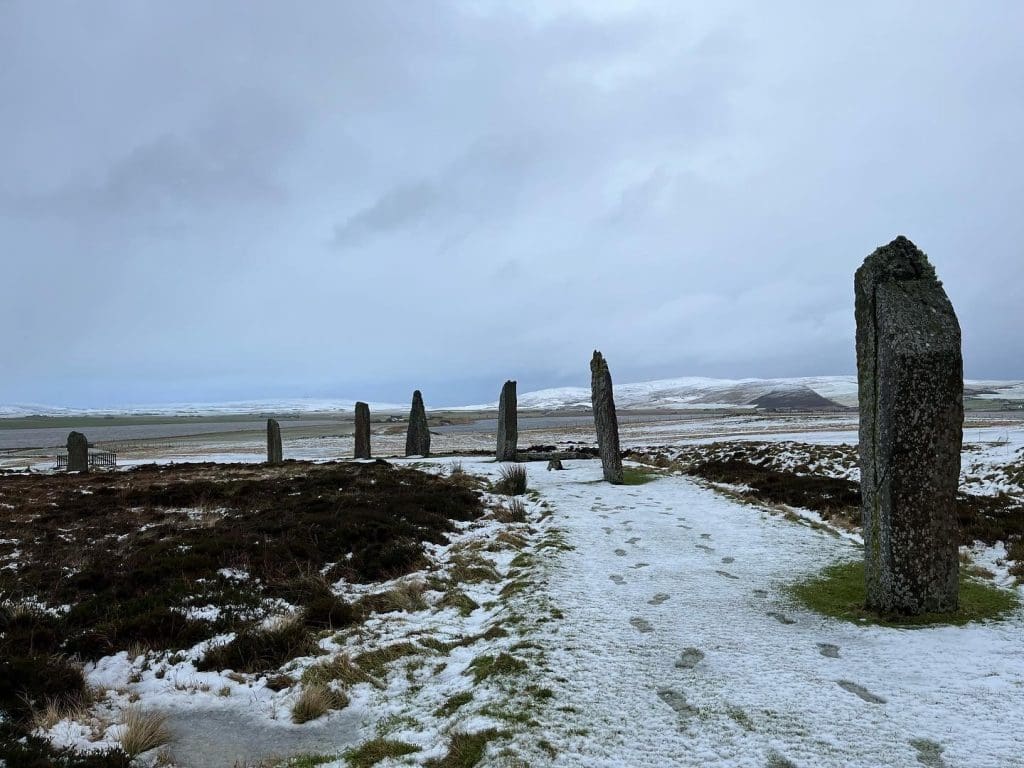
Fig. 1. Footprints at the Ring of Brodgar[1]
The Orkney Islands, an archipelago north of mainland Scotland known colloquially as Orkney, are rich in significant archaeological sites dating from prehistory through the Second World War. Neolithic standing stones are juxtaposed with Iron Age brochs, ruined medieval churches, eighteenth-century kelp processing pits, and wartime shipwrecks. Gentle rolling hills are dotted with grassy mounds, a reminder that much remains underground. The density and visibility of Orkney’s archaeological monuments within its limited land mass causes them to be in constant visual conversation with each other. Throughout Orkney’s history, humans have participated in this dialogue, moving through and building upon the pre-existing monuments. Within the Neolithic period itself, which is characterized by the spread of agriculture and in Orkney spans 4000 – 2500 BC, people built upon and modified existing structures. Bronze and Iron age additions within the Orkney landscape made way for interventions by the Pictish population, who were then displaced or absorbed by medieval settlers arriving from Scandinavia in the ninth century.[2] These Norse settlers were among the post-Neolithic people who encountered a tangible Orcadian prehistory which they used, re-shaped, and reused. They buried their dead in furnished graves, often near prehistoric monuments,[3][4] a practice they carried from their ancestral burial traditions in Viking Age Scandinavia.[5] They built churches, castles, farms, and drinking halls, often also in tight proximity to preexisting Neolithic and Iron Age structures. Norse citation of prehistoric monuments in Orkney may have been a deliberate activity associated with movement toward and through places already marked in the landscape as part of a visible, ritually important past. This leaves an opportunity for a holistic consideration of medieval Norse activity associated with these prehistoric sites inclusive of all kinds of physical movement. With limited primary sources and a complex variety of sites to consider, what metaphors may help us conceptualize the physical processes of Norse movement through the prehistoric archaeology of Orkney?
In this article, I will argue that Norse usage of the prehistoric monuments is an example of Joseph Beuys’s theory of social sculpture: an artwork that “can include the entire process of living.”[6][7] The land artist and sculptor Richard Long, whose artwork often consists of documented walks, signalled a need for deeper exploration of this concept in Orkney in his 1994 walk/sculpture titled “Birsay Circle” which can be seen photographed in Figure 2.[8] The walk was conducted at Orkney’s Brough of Birsay, a tidal island off of Mainland, Orkney’s largest island. In “Birsay Circle,” Long trod a massive circle into the landscape foregrounding the Brough, which he then photographed. Embedding himself in the contemporary landscape of Birsay, he implicitly also stirred multiple other chronologies that overlap at the site, as Birsay is an example of the palimpsest of Orkney’s archaeology in miniature. A Neolithic mace head found there suggests a human prehistoric presence, while a Pictish slab and evidence of a Norse settlement indicate that both Picts and Norse settlers later occupied it, with Birsay serving as a Norse seat of power in the 11th century.[9] Here, when Long drew a circle in the ground at Birsay with his body and documented it, he acknowledged the site as a center of these intertwined performances, and made his own contribution to the social sculpture of Birsay. Notably, in the photograph Long’s physical movements are absent, but the circle is made up of their traces. Long may have been acting upon an “object fantasy,” a way of making tangible the motion he saw within the site.[10] The viewer is then asked to imagine the artist’s body in the process of walking the circle. His absence becomes a key component of the artwork. This paradoxical absence is echoed across the Norse interventions into Orkney archaeology, as I will later illustrate.
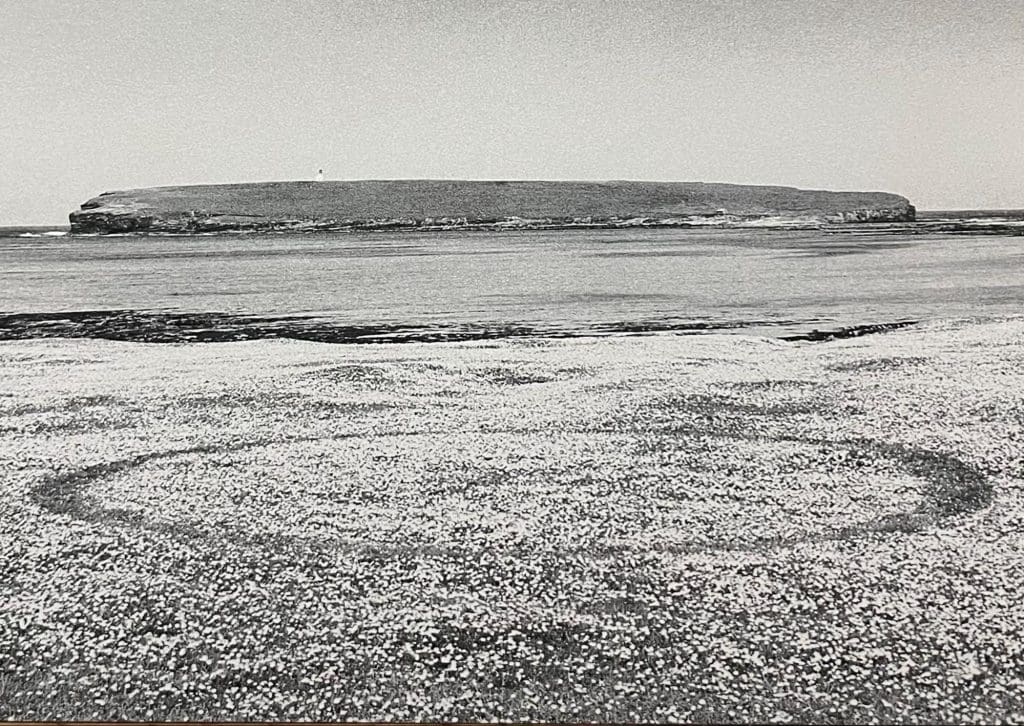
Fig. 2. Brough of Birsay Circle, Richard Long, 1994
Richard Long began taking his walks in the 1960s at the same time that Beuys’ concept of social sculpture emerged. Another mid-century artistic development, postmodern dance, spearheaded by Yvonne Rainer and peers like Simone Forti, is another useful reference as we attempt to understand the layered human movements that impacted Orkney’s archaeology.[11] In her landmark survey of postmodern choreography Terpsichore in Sneakers, Sally Banes identifies a key shift in the conception of dance as an art form in the 1960s, aligning with the art world that produced Beuys’s theory: dance became classified as “dance” based on its context, not its content.[12] Within this new model, one simply needs to cognitively frame movement as “dance” for it to become so. Is it worthwhile to consider the movement through Orcadian archaeological monuments as dance? What might this metaphor do to help us better understand these sites, and what can the postmodern choreographers teach us?
Fluxus choreographer Simone Forti focused her performance practice on conceiving of dance as sculpture. She referred to her dances as “dance constructions,” a terminology which solidifies the ephemeral moments that make up a dance – much like Richard Long named his walks. In one instance, Forti positioned dances throughout an evening at Yoko Ono’s New York loft space in a timed sequence meant for audiences to encounter as they might circumnavigate sculptures in a museum.[13] For Forti, a dance could be a concrete and temporarily fixed artifact as well as a time-based, ephemeral medium. Her dances lacked a set narrative, focusing on task-based movements in which dancers integrated their bodies into a briefly cohesive structural whole. Forti’s point of view sharpens the linkage between the physical processes that occur around an archaeological site during its construction and afterward. Her example can also serve as a metaphor for journeying through the Orkney landscape, in which each archaeological site is a construction for visitors to participate in and investigate. With each instance of interaction with the archaeological site, the visitor momentarily modifies the sculpture with their own body, gestures, and presence. These sites are ever-shifting according to the visitors within and around them, and therefore can be understood as temporary constructions – as dances. The traces that remain, while often scant, gesture at the human movements that built these constructions.
Therefore, postmodern choreography offers a useful, if unexpected, lens that I will use to understand human physical processes in relation to Orkney archaeology. Using Beuys’ theory as permission and postmodern dance as a guiding metaphor, in this article I examine Norse settler movement within the context of Orcadian archaeology as examples of a collectively built, choreographic social sculpture. I will investigate three sites representative of prehistoric and medieval Norse intervention as dance constructions: Maeshowe, a Neolithic tomb inscribed during the medieval period with Scandinavian runes; the Ring of Brodgar, a henge also from the Neolithic era also marked with runes that may or may not date from the Norse settlement period; and Orphir Round Kirk, a 12th century church that is part of a larger complex which contained reused stone from the Neolithic and Pictish eras.[14] Within each variation of this long-form performance, object fantasies remind us of the kinesis that shaped and which continues to shape the sites. I conclude my journey through this metaphor as I conduct and document a solo dance construction of my own at the Orphir Round Kirk, informed in part by my personal object fantasy of the church as well as the choreography I have perceived across this unique network of monuments in Orkney.
Overture: Prehistoric and Early Medieval Orkney Archaeology as a Stage
The Heart of Neolithic Orkney is the UNESCO title used to officially refer to the major Neolithic monuments clustered in the center of Mainland, Orkney’s largest island, all built around 5,000 years ago and situated within a “natural amphitheatre of hills.”[15] The key monuments of the complex are Maeshowe Chambered Cairn, Skara Brae Neolithic Village, the Stones of Stenness, and the Ring of Brodgar. Other Neolithic sites are found throughout Orkney outside of the UNESCO-designated area, and should always be considered in the grander Neolithic context of Orkney; within these monument clusters thousands of years are represented and they all would have been erected at slightly different times, the sites evolving in relation to each other over centuries. While these monuments appear to share a strong ritual significance, it is necessary to remember the false dichotomy between ritual and domestic spaces within Neolithic archaeology.[16] Within the megalithic monuments as well as the Iron Age brochs, the prehistoric builders of these sites may have envisioned long periods of use, quarrying stone from sites as far as Vestrafiold, a 2.5 hour walk from the Ring of Brodgar.[17] Creating these sites was an inherently laborious act, which may have inspired awe through the construction process alone. Visitors today may wonder if the original builders used stone to aim for permanence. In Jonathan Marshall’s performance analysis of the mise en scene of the Heart of Neolithic Orkney, these monuments can be considered a stage upon which future performances have played out.[18] Jeffrey Jerome Cohen extends this metaphor further to consider how stone itself takes part in this geochoreography;[19] discussing Stonehenge, he notices “an aeonic collaboration among disparate artists, including stone itself.”[20] Notably, Cohen cautions against considering stone merely as “a blank slate for human stories,” despite the tendency for humans to build in stone to signify permanence or monumentality.[21] While stone may signify longevity to a builder or a later visitor, the material itself evolves and changes over time, albeit much deeper time than humans can conceive of within their lifespans. The stones at the Ring of Brodgar today are participants in their own choreography, an important conduit for “the linguistically insurmountable gap that separates prehistory from us.”[22]
Orkney is also rich in Iron Age brochs, cylindrical hollow-walled stone structures unique to Scotland including its Northern Isles of Orkney and Shetland.[23] Often located on coastlines, brochs were also apparently built for their permanence and fortitude. Their long periods of use suggest that these sites were made and remade over centuries, and they bear the marks of deep time in the slow shifts in their stony materiality. While the brochs may at first glance have served a functional role, the visuality of brochs appears to have influenced pagan burial sites dating from the earliest Norse settlement of Orkney. For instance, the Westness cemetery on Rousay contains graves of Pictish[24] and Norse types, including the most richly appointed female pagan burial found to date in Scotland.[25] The cemetery is located in close proximity to the Iron Age Midhowe Broch and Neolithic Midhowe Chambered Cairn, both of which may have simply been visible as mounds in the landscape at the time of the Westness burials; even so, these mounds may have signified specialness within the landscape to Norse settlers. All along the south end of the isle of Rousay, the overlapping daily practices, cosmologies, and architectural styles of multiple groups of people are visible within this cluster of monuments. The scene depicted is one of movement: of kinetic processes, both earthly and in the afterlife. In his study of monumentality within the Heart of Neolithic Orkney, Colin Richards reminds us that prehistoric architecture is situated across space and time, embedded with the social practices of both its builders and later visitors.[26] At the time that a monument is built, its features may reflect the spatial needs required of the cosmological beliefs and rituals of its builders,[27] but subsequent generations will infuse the space with their own spiritual practices, through physical intervention as well as the ephemeral movement of their bodies. These intermingling performance practices are never neatly distributed. Shanks and Pearson describe the structure of performance to be a “stratigraphy of layers,” which “from moment to moment […] may have different relative thicknesses or dramatic significance.”[28] In this stratigraphy, a multitemporal lens is a given: different performance cultures whirl through the site over time, leaving traces that will be arbitrarily buried or exposed.
The Norse brought their own distinctive performance culture with them to Orkney when they first established settlements in the mid-ninth century. The first generation of Norse in Orkney, like the rest of the Viking Diaspora,[29] would have been familiar with the oral recitation of sagas and poetry, the stylized weapon dances of wartime,[30] sorcery,[31] rune-carving, and the mortuary drama of burial.[32] These generative acts were situated within constant navigation of the islands and beyond by land and sea. While Viking age boats have been studied extensively, the literal maritime movement that they were used for has recently been re-evaluated by Sanmark and McLeod, which invites further interpretation of the physical processes of travel within a cognitive context.[33] As a narrative device within the stories that Norse settlers told about themselves, travel – particularly by sea – cannot be underestimated in its importance.[34] The Orkneyinga Saga, the most comprehensive literary source for medieval Orkney, devotes a significant portion of its terse prose to descriptions of travel from Orkney to Shetland to Constantinople and Jerusalem. In the saga, travel is performative: it is a ritual element of the making and breaking of power within the Norse earldom that ruled the islands for several centuries. At the very least, the narrative technique that insists upon a constant return to travel and transit indicates that travel was part of how the Orkneyinga Saga’s authors conceptualized narrative when they told the stories of its broader diaspora. Movement within Orkney and externally, both as a means to settle the land and to carry out performative traditions, were inextricable from the Norse settlement of the islands, as well as the stories they collected. In the introduction to their 1978 translation, Palsson and Edwards note that “the comings and goings of the frequently warring power groups […] might superficially seem repetitive, but they create a narrative rhythm which could be considered one of the sustaining features of the story.”[35] This narrative rhythm is cyclical, a constant reinterpretation of the saga’s opening theme in which the mythical, pagan origin story of Norway precedes the first emigration to Orkney and the original struggles for control of its islands. The Norse interaction with Orkney archaeology follows a similar pattern: the pagan past, tangible at sites like the Ring of Brodgar and Maeshowe, is re-encountered and commented upon in the firmly Christianized medieval period. Like the Orkneyinga Saga itself, the actions of the Norse settlers are a constant physical reinterpretation of a primordial past: a long-form performance over centuries.
Shifting belief systems, patterns in trade, and the slow, perhaps violent, process of assimilation into Orkney weave in and out of each period of settlement, never quite all evolving at once. At Westness, Norse settlers whose ancestors worshiped Odin mingle in death with Christian Picts, within sight of where Neolithic people buried their dead at the Midhowe cairn. In the richly appointed female burial at Westness, the grave goods include a bronze plaque which was originally part of an insular book cover or shrine, broken from its original context and fashioned into a brooch – an example of Norse breaking and remaking of local traditions.[36] The visitor to Orkney will become immersed in the traces of all of these systems of belief at once, but may not know how to make sense of their intersecting presences. If we return again to our postmodern dance metaphor, some examples emerge to help parse out the layered chronologies within these Orkney sites.
While choreographers like Forti and Rainer often chose to turn from the reference point of classical ballet, they nevertheless remained in conversation with the dance forms that came before them, even (or especially) when they were subverting them. The absence of the traditional dance forms bring these very forms to mind; the contrasts to the classical steps draw attention to the classicism that postmodern dance is thwarting. When George Maciunas placed Fluxus at the culmination of all of art history in his ambitious and unfinished chart titled Diagram of Historical Development of Fluxus and Other 4 Dimentional [sic], Aural, Optic, Olfactory, Epithelial and Tactile Art Forms, he explicitly cited work by choreographers like Rainer to illustrate his point.[37] In his history, Maciunas acknowledges art forms as distinctive as church processions, medieval fairs, and the Roman circus as part of the constellation of media from which Fluxus emerged. The chart lacks linear or chronological cohesion, suggesting that Maciunas thought Fluxus and its associated personnel did not eclipse but continued to coexist with the art forms that preceded it. In this model of dance history, every layer of human movement continues to coexist in conversation with the movement before it. In the following variations on this overture, I will illustrate how this is also true in the Neolithic/medieval Norse context of Orkney archaeology.
Dance Construction No. 1: The Rune Carvers of Maeshowe
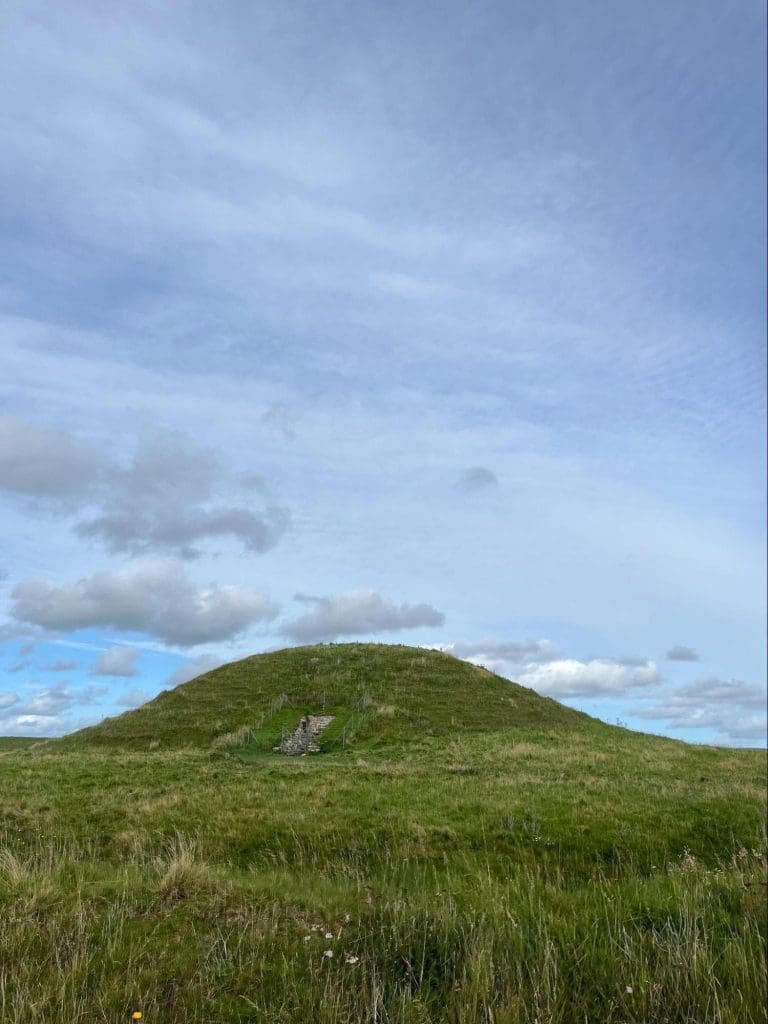
Fig. 3. Entrance to Maeshowe Chambered Cairn
Earl Harald set out for Orkney at Christmas with four ships and a hundred men. He lay for two days off Graemsay, then put in at Hamna Voe on Mainland, and on the thirteenth day of Christmas they travelled on foot over to Firth. During a snowstorm they took shelter in Maeshowe and there two of them went insane, which slowed them down badly, so that by the time they reached Firth it was night-time.[38]
Maeshowe Chambered Cairn, seen in Figure 3,[39] is a massive passage grave capped by a grassy mound that sits slightly inland from the near-confluence of the Loch of Harray and the Loch of Stenness.[40] The entrance is within direct view of the Stones of Stenness, the Ring of Brodgar, and the isthmus known as the Ness of Brodgar, and aligns with the twin hills of the nearby island of Hoy. The landscape and building locations appear to have been selected for a perfect view of the midwinter sun after it sets between the Hoy hills,[41] a feature that suggests its builders thought of the winter solstice as a process of ritual significance.[42] The builders may have also been conscious of their own past: a stone drain structure found outside the entrance suggests that it stands upon the site of a former house, once again complicating the relationship between ritual and domestic spaces within Orkney’s Neolithic sites.[43] Maeshowe’s central chamber, which is flanked by small cells along its sides, is entered through a long, low, hallway-like entrance. The entrance, as well as the side chambers, are flecked with carvings and peck-marks etched into the walls, which are reminiscent of similar marks within the monuments nearby.[44] When the cairn was excavated by antiquarian James Farrer in 1861, over 30 runic inscriptions were found, most likely carved by Norse settlers who had taken shelter in the tomb on at least two occasions.[45][46] In the runic graffiti, the Norse travelers etched their names and stories into the walls, referencing faraway lands and mythical creatures. Thanks to this collection of runes, of all the archeological sites in Orkney, Maeshowe offers the most cohesive collection of material traces illustrative of how medieval Norse Orcadians moved through the prehistoric monuments in their landscape.
In his examination of Maeshowe’s original construction, Richards draws attention to the small dimensions of the passage leading to the center of the tomb, which “restrict bodily movement into and out of the central chamber; it is, in fact, very difficult to move along the passageway except upon hands and knees”.[47] This difficulty could have been by design, intentionally shifting the posture of the person entering to signify entry into a deferential stance. Richards elaborates that the journey through this passage, which takes the visitor from the realm of the living to the realm of the dead, denies the visitor any visibility into what may be occurring at the central core; instead, visitors would have relied on sound and the heightened acoustics to suppose what might be happening there.[48] Upon entering the central chamber, the visitor is able to finally stand within an impressively spacious area. Once the visitor’s eyes adjust to the dim light inside the tomb, vision is added to the senses available to comprehend the space. The visitors’ eyes will likely catch on the runes, which appear in all directions and angles. Given the purity of the sonic environment within Maeshowe, one can imagine the sound of the rune carvers’ tools on stone and their voices in conversation. This is a reminder that movement is never sensorially isolated, and was accompanied both in Neolithic and medieval times by sound: singing, chatter, tools scratching and pounding on stone. These sounds would have – and continue – to have acoustic qualities that may have made sound within the chamber strange and special.[49] Maeshowe was designed to capture the imagination and to stimulate multiple senses, privileging different sensory processes depending upon the spatial location of the visitor. When exiting through the central passage, the crouching visitor finally straightens their body outdoors and immediately meets the hills of Hoy, which center the setting sun, as well as the Stones of Stenness, Barnhouse village, and Ring of Brodgar in the distance. Together, these sites comprise the external sacred landscape of which Maeshowe is a part. The visitor is rewarded with a panoramic reminder of the ritual landscape upon leaving. The physical processes of entering and exiting the structure each begin with the deprivation of sight and end with a spectacular feast of visuality, suggesting that the choreographic script of entering and leaving the space was meant to prime the visual sense by first provoking the sonic and tactile senses during the sequences of entering and exiting.
When the Norse visitors arrived at Maeshowe, they deviated from the choreography that the Neolithic builders prescribed by building the cramped entrance: they broke into the tomb from the top. Based on the height of one runic inscription near the ceiling in the central chamber, which could only have been reached by standing on rubble fallen from a disrupted roof, it is likely that the visitors entered through through the roof of the tomb, which is also how antiquarians later entered the space in 1861.[50] Here, it is important to consider not just the end result of the runes and their possible interpretations but also the process that created them. In rune-carving as in other forms of crafting, meaning is constructed not just as an end result of making but is produced through the continuous act of creation.[51] The height of the runes conjures lively scenes: intruders entering the tomb from above, piling up detritus, and, possibly as a cure for boredom, hoisting themselves up to carve the inscriptions. Many of the runes simply consist of a personal name, usually of the carver (see: “Vémundr carved” for a typical model).[52] Some of the inscriptions are humorous or even crude: see “A þorny sarþ. hælhe ræist” for a dramatic example, which in English Michael Barnes has translated to “Þorny fucked. Helgi carved.”[53] There are additional glimpses of Norse locker room talk: “Ingibjǫrg, hin fagra ekkja. Mǫrg kona hefir farit lút inn hér. Mikill ofláti. Erlingr”(Ingibjǫrg, the fair widow. Many a wife has travelled stooping in here. A great show-off. Erlingr.)”[54] Erlingr, presumably the carver, makes sure to sign off on this lewd gossip about Ingibjǫrg, listing himself as a primary source. The rune-carving may have manifested as social performance for each other, accompanied by impressions of the characters named within the carvings, or recitations made to keep themselves entertained while sheltering from the December weather, which in Orkney is unpredictable, windy, and bone-chillingly damp.
The evocative image of an intruder rising from the social scene to then climb on top of the rocks to carve a rune can be compared with Simone Forti’s 1961 dance Huddle. Huddle contains no concrete sequence of steps, and instead follows a series of tasks that must be accomplished. Dancers are instructed to stand close together in a “huddle.” Eventually, one dancer uses the other dancers’ bodies to hoist themselves over the top of the huddle, ending by crawling through and re-entering the group. The process is then repeated, and can go on indefinitely. The title of the dance is evocative: a “huddle” can suggest a conversation, usually private, in which two or more parties briefly come to a consensus (consider the “huddle” as a fixture in American football). In a conversation with Yvonne Rainer for a retrospective on the Judson Dance Theater movement at the Museum of Modern Art in New York, Forti asserts the dual nature of the dance: “it’s a physical action and it’s a sculpture.”[55] Never fully separated from the group, the rise and fall of each rune-carver gave way to another participant mirroring the same sequence of actions. The dance is a discrete object that can be observed by viewers; it is partially preserved, but not entirely, within the runes themselves. Again, as in Richard Long’s photograph of his Brough of Birsay walking circle, the absence of the movement itself in the final outcome of the creative process draws attention back to its importance.
The crass tone of these graffiti suggests a lightheartedness to the visit that contrasts with the supposed solemnity of the Neolithic ritual surrounding it. It also contrasts with the foreboding passage of the Orkneyinga Saga which names Maeshowe. In the Orkneyinga Saga, Maeshowe is the only prehistoric structure mentioned by name aside from the Broch of Mousa in Shetland, which is listed in the same chapter.[56] Both sites are cited as places of refuge, though for different reasons: Maeshowe is used for shelter presumably from the weather in the winter by Earl Harald’s men, and Harald’s mother Margaret escapes to Mousa with her betrothed, Erlend, whom Harald previously rejected in his request for his mothers’ hand in marriage.[57] The couple at Mousa eventually win Harald’s favor and strengthen his case to “recover his realm,” but it is unclear if the men who “go insane” at Maeshowe recover.[58] This passage may suggest a supernatural or malevolent presence within Maeshowe, possibly influenced by the pagan context within which it was built or Earl Harald’s previous wrongdoings. This evil presence may have been aggravated when the Norse broke the contract between the living and the dead, entering a space which they were not meant to enter through an opening that was not meant to be an entrance. In their object fantasies of Maeshowe, what properties did the Norse visitors perceive within the space and were the runes a method of responding to these fantasies? Several runes are explicitly Christian in nature, deviating sharply from the comical and secular carvings previously listed (see: “Benedikt gerði kross þenna/Benedikt made this cross”).[59] Here, inscribing runes within the Maeshowe walls may have been an apotropaic response or an attempt to Christianize a space that was seen as a living container for pagan practices. The rune assemblage is a social sculpture embedded with the material traces of carving movements conducted in the service of religious belief.
There is another object fantasy which may help shed light on the rune-carving choreography at Maeshowe: perhaps the Norse saw within the mound a reminder of their own history, an animate manifestation of their past which was meant to be interacted with accordingly. The drama associated with saga storytelling was part of a larger array of performance practices within the Viking world, such as the performative ritual of burial.[60] References to burial practices are implicit in the act of breaking into Maeshowe in and of itself. Tombs would on occasion be intentionally broken into or re-opened within Norse burial contexts in the Scandinavian homelands to remove or interact with the grave goods, which Klevnäs has interpreted as an action representing memorialization rather than simply destruction.[61] Several of the runic inscriptions point to the idea that the visitors broke into Maeshowe because they understood it to be the burial place of the mythical original earl of Orkney, an object fantasy that has a precedent in the Scandinavian homelands, where some mounds were thought to contain the legendary original kings of Norway and Denmark.[62] This belief may have given the original Maeshowe visitors cause to break open the tomb, possibly to search for ancestral treasure. It would have made sense for the Norse in Orkney to appropriate the prehistoric landscape to strengthen their claim to the land by both opening it and marking it in ways distinctive to their own diasporic performance culture. In Sarah Randles’ consideration of the Norse perception of the Neolithic archaeology of Orkney, she argues that Norse settlers inscribed the monuments they encountered with markings that reoriented them to fit within the traditions that they brought from their Scandinavian homeland.[63] Breaking into the tomb possibly hoping to find treasure, the visitors then endowed the empty tomb with meaning through the runes.
Like the Neolithic people who built Maeshowe, the Norse visitors – intentionally or not – invited future travelers to add to their graffiti or, as we will see in the next section, mimic it elsewhere. By making their mark with runic inscriptions, the Norse created a template for engaging with the object fantasies of Maeshowe, and ensured that future visitors would see their influence on the space, perhaps even taking up their own carving tools to contribute. Certain runes, such as “Jerusalem men broke this mound,”[64] situate the graffiti within the context of the Crusades.[65] Here, the theme of travel so often seen in the sagas is brought into the archaeological record of Norse kinetic activity. These references to Christian conquest would become inextricably linked with the practice of rune carving in Orkney, and therefore can be compared alongside the other examples of rune-carving as a deliberate Christian performance which will be considered next.
Dance Construction No. 2: The Ring of Brodgar and Runes as Nation-Building Tools
Maeshowe neighbors The Ring of Brodgar, a Neolithic henge surrounded by a rock-cut ditch built around 2600 – 2000 BC. It also contains a stone circle consisting originally of 60 standing stones, 21 of which remain upright in the ground today.[66] Also part of the Heart of Neolithic Orkney, the Ring of Brodgar is located in the line of sight of Maeshowe and the Stones of Stenness, as well as other notable Neolithic sites Unstan Chambered Cairn and Barnhouse Village. The Ring of Brodgar’s dramatic, mysterious presence has captivated Orcadians since the time it was built, and has become a beloved part of local folklore. Marshall writes of the Ring of Brodgar’s “hauntological” unknowability: “Brodgar is […] hauntological because its original form and purpose – the referents which lie behind the signs left at the site today – remain unknown and unknowable.”[67][68] We have seen this “hauntological” absence, which draws attention to its makers’ movements precisely because they remain hidden, previously in Richard Long’s Brough of Birsay walk and the runes left behind by the Norse in Maeshowe, and now in a most dramatic form at the Ring of Brodgar. The site’s unknowability has inspired numerous object fantasies over time that have animated and anthropomorphized the stones, such as an antiquarian observation that they resembled a group of ancient druids.[69][70] The Ring of Brodgar’s “unknowability” is further enhanced by a cluster of runic inscriptions in its midst, some of which are of questionable date. Here, I will consider the runic inscriptions at the Ring of Brodgar as part of its construction as a social sculpture, shaped over millenia through the physical processes of its visitors. Like Maeshowe, visitors clearly left runes behind in an attempt to make their own mark on these sculptures. But the impact of rune-carving in the instance of the Ring of Brodgar is more ambiguous, and was possibly part of a project in which rune carvers attempted to cast a uniquely Norse Christian past onto a visibly pagan monument.
One of the runic inscriptions found carved on a standing stone at the Ring of Brodgar is of the name lngibjorg. An inscription of the same name is also found at Cuween Chambered Cairn. These have both been identified as modern carvings, likely created in reference to the set of runes spelling the same name at Maeshowe (readers of the present article will recall the aforementioned “fair widow”).[71] Also at the Ring of Brodgar, a set of twig runes paired with a cross were found in 1906 on one of its standing stones reading either “NROUN” or “BJORN”, marked below by a simple cross.[72] The dating of the NROUN runes has been disputed. Freund and Ragnhild accept a possible medieval origin for them, while Barnes identifies the runes as, like the Ingibjorg carvings, potentially modern inscriptions inspired by Maeshowe, which by the turn of the twentieth century had become a popular symbol of Orkney’s “Viking past.”[73][74] In the case of the cross that accompanies the “BJORN” runes, the rune carver does their part to Christianize a pagan site, possibly in an attempt to “purify” the space.The carver may have had similar intentions to an early medieval Christian person facing a spiritual obligation to bring sanctity to an obviously pagan landscape.[75] Using a runic strategy to Christianize the Ring of Brodgar also suggests that the rune carver cared to mark the Ring with a profoundly Norse medieval Christianity, reminding visitors of Orkney’s position within the Norwegian earldom until 1472 and establishing legitimacy through a sense of antiquity. Regardless of their dating, these runes help us to access a uniquely Orcadian practice of rune-carving that may be best understood as a series of dance constructions: some medieval, some modern, but all coexisting within the Neolithic landscape and navigable by future visitors. At all points on the continuum of the rune-carving tradition in Orkney, runes become an important tool for building and supplementing a Scandinavian and Christian past within a landscape marked by pagan cosmology.
A cross-Atlantic parallel may help us further understand the modern performance of rune-carving at the Ring of Brodgar. In 1898, a Swedish immigrant farmer named Olof Ohman dug up a stone covered in runes near in rural Minnesota, bearing the following inscription:
8 Swedes and 22 Norwegians on an exploration journey from Vinland westward. We had our camp by two rocky islets one day’s journey north of this stone. We were out fishing one day. When we came home we found 10 men red with blood and dead. AVM, save us from evil. We have 10 men by the sea to look after our ships, 14 days’ journey from the island. Year: 1362.[76]
The stone, now called the Kensington Runestone, was touted as proof of a Scandinavian expedition to the middle of the country, predating Columbus’s journey and Christianizing the now-United States in the Middle Ages.[77] When entering the town of Alexandria, tourists are greeted by a giant Viking statue wearing a shield that reads “ALEXANDRIA/BIRTHPLACE OF AMERICA.” The artifact offers a counter-historical narrative for Minnesotans who prefer to believe that Christianity first arrived in America in their own backyard. Because of notable irregularities and errors in the runic text and with the general historical implausibility of the stone’s claims, the Kensington Runestone is not considered an authentic artifact by period specialists.[78] Still, the runestone still remains an important symbol of late 19th-century American anxieties about the United States’ perceived lack of a premodern Christian past. In Minnesota, these anxieties were juxtaposed with the settlement of the area by Scandinavian immigrants who wished to see their own past reflected in their new environment.[79] Intriguingly, the pseudo-archaeological artifact obscured the ample, compelling evidence of the ancient past left behind by early inhabitants of Minnesota such as the Jeffers Petroglyphs or the sacred burial mounds located at Indian Mounds Regional Park.[80][81] Direct references to Minnesota’s indigenous population are absent within the runestone, but their presence within the landscape is indicated in the text, which seems to implicate them in its description of “ten men red with blood and dead.” Once more we are met with the suggestive “unknowability” seen at the Ring of Brodgar, in which the presence of the original inhabitants of a landscape is made ironically palpable by their absence from the narrative. The Kensington Runestone is the result of an object fantasy in reverse: perceiving a lack of material Christian traces within their surrounding environment, Swedish immigrants created their own.
Both the Alexandria and Ring of Brodgar inscriptions signify a preoccupation with the Scandinavian medieval past, as well as a desire to mark a visibly “pagan” landscape with a Christian symbol. Here, like the Neolithic builders and the Norse intruders at Maeshowe, the rune-carver abandons a fixed audience restricted to one moment in time for an eternally growing audience of tourists, archaeologists, and other passers-by, all of which will not see the actual performance of rune carving but will be reminded of its process every time they see the resulting marks. More importantly for the rune-carver, the future audience will identify the object with Christianity. The movements of carving in stone maintain certain essential qualities over time such as the pressure required to etch into stone and the skill required to carve a coherent shape. These movements are acquired through practice and skill. Reenacting the process connects the contemporary graffitist with the medieval carvers with whom they may feel kinship.
In the United States, the carver of the Kensington Rune Stone channeled their own version of the intense desire for an early Christian past that was rippling through the country. Etching runes into stone, burying it, and unearthing the object constituted the choreographed steps that a Swedish immigrant family took, hoping to participate in a nation-building narrative that shifted the origins of the United States to a familiar homeland and helped them partake in the construction of Nordic whiteness as an ideal. Its discovery was a performance, in which an impoverished Scandinavian immigrant population attempted to connect with its actual diaspora – which did indeed leave runestones far and wide – and its imagined one, which did not successfully penetrate North America despite arriving at L’anse aux meadows over four hundred years prior to Columbus’s first voyage to North America.[82][83] The importance of the Viking imagery to Orkney identity today is built upon a thousand-year legacy of local storytelling, grounded in reality but filtered through a contemporary desire to attract tourists and position Orkney as a dual hub for the Viking and Christian past. In both instances, the traces of prehistory are used as the stage for a dance construction in which the performer tells a new tale to seed the land with perpetual Christian, Scandinavian character.
At the Ring of Brodgar and on the Kensington Runestone, the runes are examples of backwards object fantasies, of intangible beliefs made tangible: “sensory perceptions of object properties that have been cognitively interpreted and artistically recombined into new objects; material creations that refer to a range of experiences and perceptions as well as images and meanings, and in turn produce new connections between them.”[84] In the next and final case study, I will consider an explicitly Christian location as a dance construction which I then elaborate on through my original choreography in the present day.
Dance Construction No. 3: Orphir Round Kirk and the Performance of Liturgy
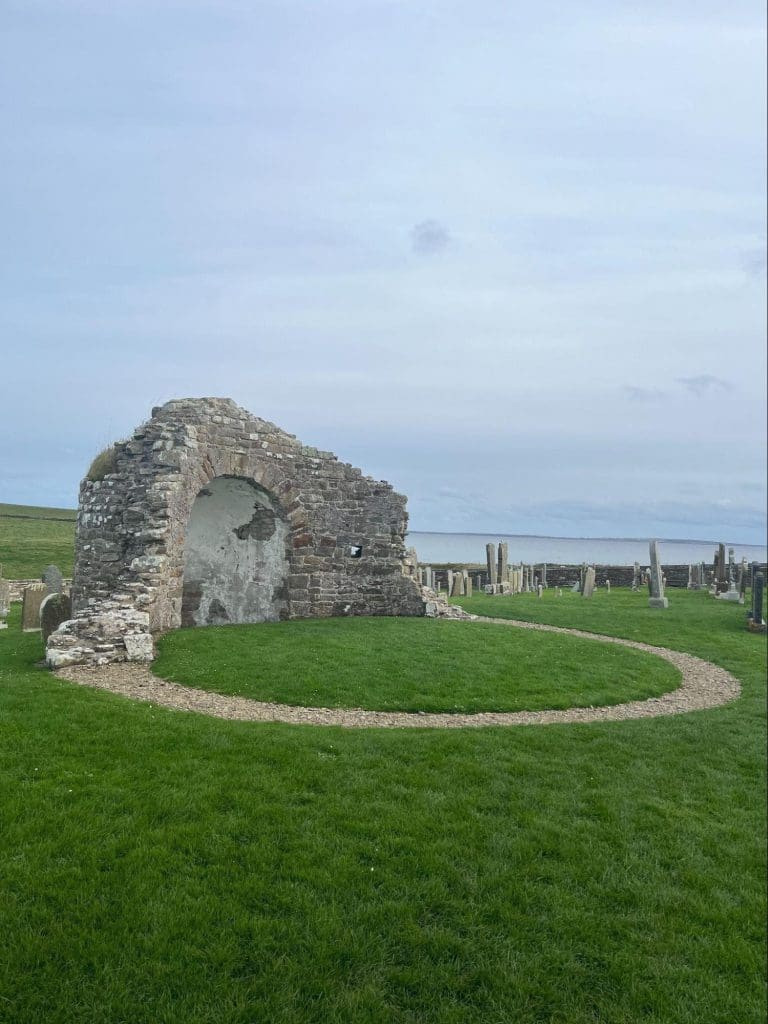
Fig. 4. Ruins of Orphir Round Kirk
The ruins of a small twelfth-century round church dedicated to St. Nicholas, now known as Orphir Round Kirk and shown in Figure 4,[85] are located in the cemetery at the coastal site of Earl’s Bu in Orphir, Mainland.[86] The Earl’s Bu complex is generally recognized as Earl Haakon Paulsson’s residence described in the Orkneyinga Saga.[87] The Round Kirk is clearly part of the grander scheme of Norse building and rebuilding that placed sites of worship and power near the sea; both Orkney’s prehistoric monuments and its Norse burials were often placed on the fringes of settlement or on coastlines with the likely aim of being seen from the sea.[88] Diagonally across the bay from Orphir Round Kirk are the ruins of the Broch of Ayre, adding an additional archaeological layer to its coastal relationships to other sites.[89] The site is located outside of the bounds of the Heart of Neolithic Orkney, but prehistoric and early medieval builders are still implicated in its construction, as the 1938 excavation revealed both a Pictish symbol stone and Neolithic pecked stone within the structure of the Bu.[90][91] While these finds confirm that the medieval builders reused locally available stone during construction, they also suggest that they may have identified these stones as special and used them purposefully. Today, the Round Kirk is also the site of the Orkneyinga Saga Centre, where visitors can learn more about the saga’s importance and view a short film in which various dramatic and violent episodes from the text are shared and reenacted. Like the Heart of Neolithic Orkney, Orphir Round Kirk serves as a stage. Here, the dramatic events referenced in the saga literature play out repeatedly over time as they are imagined by visitors who encounter the space. The Round Kirk remains a functioning place of worship: the Orkney Communities website reports that the ruins of the Round Kirk are also still used for an “open air service on Easter morning (in all weathers!)”.[92] Worshipping at this medieval site, visitors participate in adding to Orphir Round Kirk as a dance construction: a site of multilayered moments of creation and destruction, essential to Orkney’s perception of its own Norse past.
It is important to consider the Round Kirk first in the context of Christian belief, which likely informed its design and the subsequent choreographies that played out at the site. Like other round medieval churches, Orphir Round Kirk’s circular plan may be a reference to the Church of the Holy Sepulchre. The influence of the Holy Sepulchre round plan at Orphir is disputed,[93] and may more plausibly be a result of Orkney’s medieval connection to central European contexts where round churches were more common.[94] However, the possibility of the Holy Sepulchre’s influence is strengthened by Earl Haakon’s visit to Jerusalem which would have occurred before he had the church built.[95] Regardless of the original explanation for the church’s roundness, irregular in Orkney at the time, worshipers at Orphir certainly would have had access to hearsay about Christian pilgrimage to the Holy Land. These stories were transmitted by travelers to scribes and eventually visible within the regional imagination (for example, the earlier examples of graffiti depicting the Crusades at Maeshowe.)[96][97] Whether or not the church was built to intentionally echo the Jerusalem church, the two buildings are entangled within the Orcadian consciousness. Tourist guides and promotional materials about the site now perpetuate the Holy Sepulchre comparison as a fact. As no other round churches have been found in Orkney, medieval worshipers at Orphir would have noticed the atypical round plan and modified their movements during worship accordingly. This modification may have been intentional or subconscious, but may have been informed by their awareness of the influence of pilgrimage on the round design. Could this have made their actions feel more deliberate, more holy, even somehow transporting? Because worshipers at Orphir would likely have been associated with the Orkney earldom, a higher percentage of them may have had access to travel to the Holy Land (either for crusading or pilgrimage) or Rome. The round plan may have reminded them of round churches encountered at any of these sites, making the church at Orphir even holier or more special. By worshiping within the round church, worshipers had the opportunity to encounter evidence of pilgrimage: the round plan itself allowed for kinetic mechanisms that could be enacted to activate, and disperse the memory of a sacred geography.
The church’s intimate scale would have also augmented the literal flow of worship. Walking through a circular sacred space is different from processing through a cruciform-plan church. Just as the visitor to the Ring of Brodgar is aware of the missing standing stones within the circle, the visitor to Orphir imagines the missing ceiling and walls as they navigate the round church. The round forms that both the Ring of Brodgar and the round church take encourage a nonlinear, cyclical pattern of walking through the space. There is not a clear beginning and end point. While there is no way to know if the Ring of Brodgar or other Orcadian henges such as the Ring of Bookan were an influence on Orphir Round Kirk, its roundness distinctively places it in the landscape alongside similarly round prehistoric monuments. The site inspires an object fantasy rich with circular movement, a method of propelling bodies through space relevant inside the church, where the round plan would have demanded it, and the church’s external environment, which was and remains studded with circular prehistoric sites that encourage the same ambulatory methods.
The physical actions of liturgical ritual itself would have been constrained inside of the round church. As it is now, movement through the church ruin is possible, but one is always aware of the small circumference of the structure and the precarious sensation of attempting to stay within the circle. This is reminiscent of the cramped movements that would have been necessary to enter Maeshowe’s impossibly low doorway. Within the church, movements may have included kneeling, a sort of vertical crawl – in both instances the limbs are hunched in order to submit to a higher power: entering Maeshowe on one’s hands and knees to greet the fading light of the winter solstice is not dissimilar to kneeling in the Orphir chapel to pray to God. In both cases, bent knees are the physical mechanism that allow the visitor to enter the chosen sacred realm; the ritual space has been designed to generate or force this particular kind of movement. Both the space and the movement are part of the essential physical infrastructure for the kinetic embodiment of belief. The round plans of the Ring of Brodgar and the round church, without obvious beginning/middle/end points for the visitor to move, echo each other, offering a coexisting choreography within the Orkney landscape that is now an useful laboratory for the application of the postmodern dance metaphor.
Finale: A Contemporary Addition to the Dance Construction at Orphir
On a previous visit to Orkney in 2023, I had conducted a few choreographic experiments at the Ring of Brodgar, indulging in movement-based realizations of object fantasies inspired by the “animate” quality of the stones (see Figures 5 and 6).[98][99] While conducting field research for this article in September 2024, I endeavored to build on these experiments at Orphir. I wanted to find out if adding my own contribution to the Round Kirk would help me to understand it better as a dance construction. I placed myself in the shoes of the medieval Norse settlers who had built the space, reusing stones crafted by their Neolithic and Pictish predecessors. By participating in the dance construction at Orphir, I activated a new object fantasy: my dance made concrete the historic kinesis that I perceived within the crumbling walls of the Round Kirk. At the time, I thought that my dance was unique; as I worked through the peer review process of this publication, I was made aware of Claire Pençak’s collaborations with artists/archaeologists in Orkney, whose work precedes mine by over a decade. I was pleased to be part of a movement-based body of knowledge, a living archive, a catalogue of object fantasies flowing through the space for millenia.[100]
If Forti’s Huddle offers a flexible blueprint that can be used to understand movement within Maeshowe as a choreographic social sculpture, it can also be considered in the context of liturgical ritual. During a mass, the congregation is a whole – but each worshiper maintains their own personal relationship with God through individual, even private movements. During the ritual of the Eucharist, the worshipers rise to take the host and then return to the whole, just as dancers exit and then re-enter the huddle in Huddle. Yvonne Rainer’s dance Trio A offers a radical rethinking of the narrative of ritual which can then illuminate how liturgical movement at the round church may have echoed the movement associated with prehistoric sites such as the Ring of Brodgar. First performed in 1966, in Trio A a solo dancer completes a continuous flow of movement that entirely thwarts the traditional beginning-middle-climax-end template that most Western dances conformed to before the postmodern dance movement.[101] In her No Manifesto, Rainer explicitly names “virtuosity” and “spectacle” as values that were no longer the measuring stick for the success of a performance.[102] This is visible in the steps she chose to include in Trio A. Many of the choreographed phrases are simply pedestrian movements: shuffling, walking, rolling the head from side to side. The impact is a phrase that looks casual despite being tightly controlled by the dancer and strictly choreographed by Rainer. The body is in constant rotation, as is the dancer’s gaze, rejecting the notion that the audience can observe the entire dance from a fixed point, or that the dancer is indeed performing at all. The dancer’s sphere of influence on the stage becomes circular instead of linear. The dancer moves within their own bubble, without the typical dancer-stage/audience/seats dichotomies. While Trio A has been performed within a typical theatrical stage context, it almost appears as a coincidence when it is – like the audience happened upon someone marking a dance in private. Using what I consider the essential ingredients of both Huddle (exiting and re-entering a whole, organic and improvised shapes, dance as sculpture) and Trio A (pedestrian movement, rotating sphere of influence, lack of cohesive beginning/middle/end narrative), I developed several short dance constructions which I tested and documented at Orphir Round Kirk.
The dance began as improvised movements, and developed into a brief phrase in which I crouched down, folding myself into my knees, and then rolled up slowly. This small phrase was influenced by the entrance into Maeshowe, which requires a careful crouching movement followed by an upward unraveling of the spine. After completing this phrase, I then walked to a different part of the circular floor plan to complete the same movement. In one iteration of the combination, I sat and then hopped down into the lower level of the apse, then hoisting myself back up onto the grassy circle, referencing the hoisting movement possibly required at Maeshowe to carve runes near its ceiling. In the final dance construction, I experimented with grand battement movements (the foot making contact with the grass and then extending off the ground), which finally led into two brief cycles of running across the grass. The grand battements were a subversion of a step normally used to display virtuosity; in classical ballet, the typically tall, slender ballerina with hyperextended limbs and 180-degree turnout will complete a grand battement to showcase her superhuman athleticism and physique. In the video, it is clear that my center of balance is not “square” as required in a typical ballet setting. The battements lead to immediate gravitational shifts that propel me across the grass in a purposefully unskilled, unpracticed way. The grass was a precarious surface for dance, as it was made damp by the spray of the sea and the unpredictable Orcadian rain showers that occur almost daily. Here, my attempt was to play on the postmodern dance tendency to include movements from ballet that are then taken in an unexpected, unorthodox, or otherwise new direction. The absence of classical ballet technique, which may be perceived by audiences as a lack of skill or awkwardness of motion, draws attention to its influence and its lingering presence within the postmodern style. The movements only appear awkward because of the spectre of ballet itself. The dances were filmed from two different angles: one viewing the church ruin against the sea, and another peeking through the small window of the apse, which mirrored the voyeuristic mode the audience might take on when watching Trio A.
While dancing, my environmental awareness immediately took over any intellectualizing I’d done in preparation for the dance. I was keenly aware of how chilly I was, and braced myself against possible surprise precipitation, a possibility at any moment in Orkney. This is visible in my body language within the videos, where my shoulders are tense and I hold my arms close to my body. During one round of filming, a brief, blustery rain began to fall, which caused my movements to speed up as I looked forward to getting out of the cold. This reminded me that while the walls of the church are thick and therefore would have been somewhat insulated, visitors would have also been aware of the ever-changing Orkney weather even as they prayed inside. In each of the dance constructions, the landscape and physical context of the space is a character in its own right. Seen through the apse window, the dance is set against a dramatic backdrop of farmland hills; seen from the other side of the church ruin, the viewer is reminded that the dance construction is a sculpture within the graveyard, with Orphir Bay in the background. My audience was entirely incidental, consisting of people who wandered through the surrounding cemetery on their daily walk or tourists who were visiting the Round Kirk or Bu. Using creative dance practice as research, I was led back to a simple discovery: these social sculptures are always collaboratively created by the builders of monuments as well as those who move through them today, together or apart.
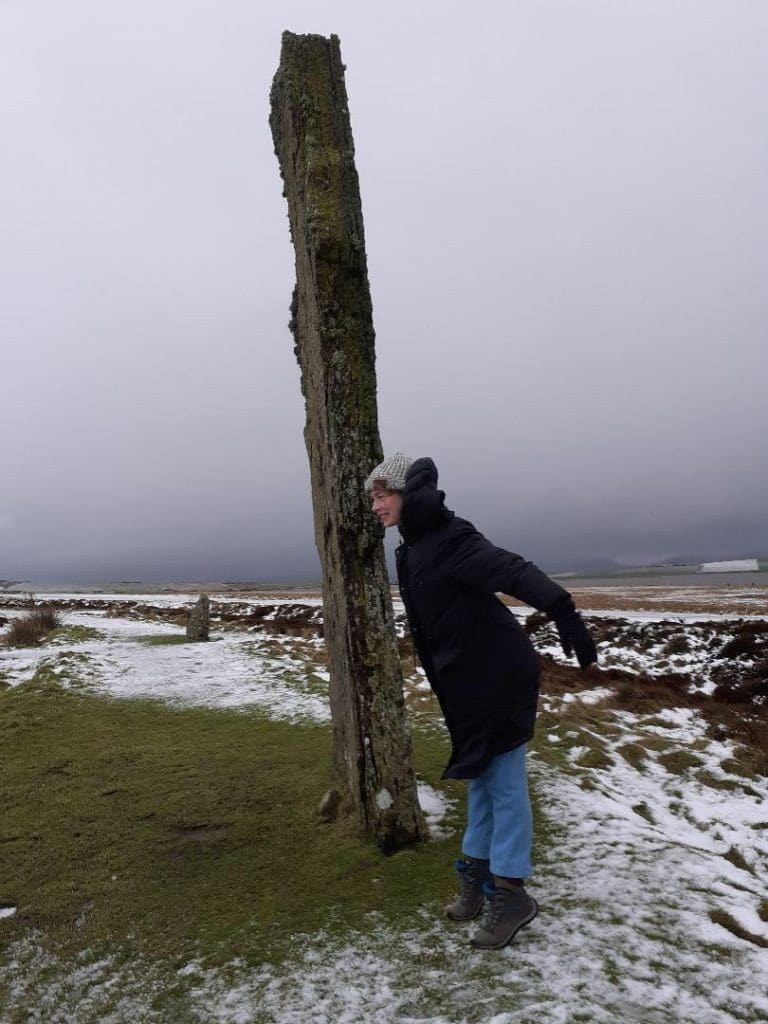
Fig. 5. Leaning towards the wind in the style of a standing stone at the Ring of Brodgar
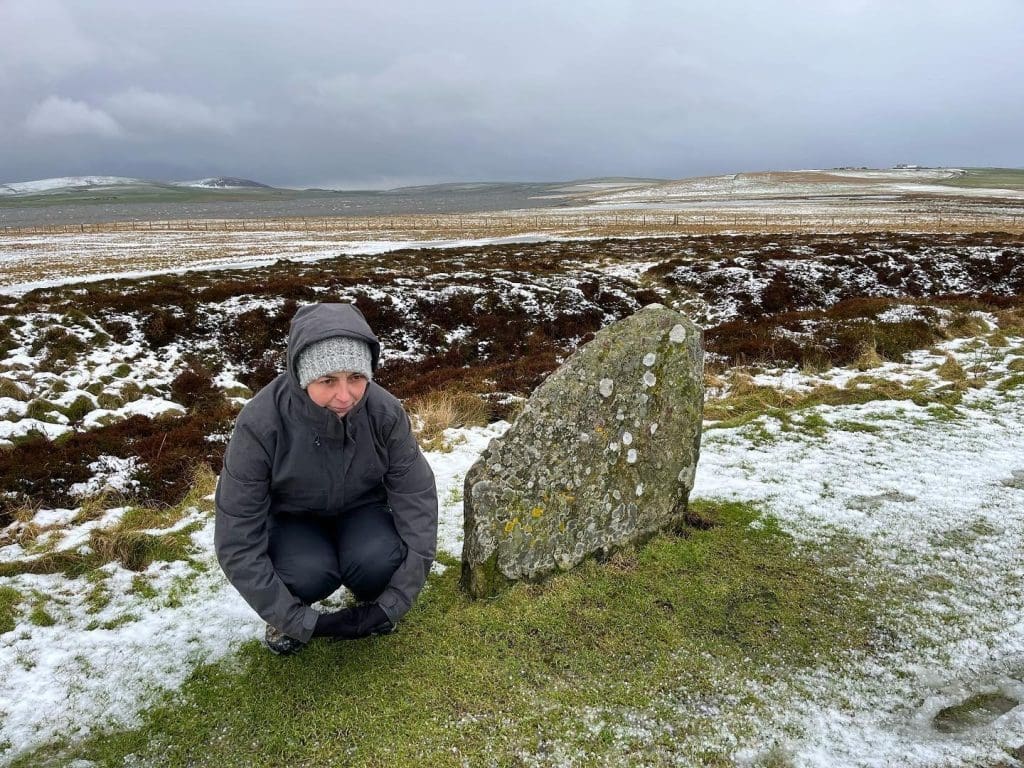
Fig. 6. Crouching by a neolithic stump, Ring of Brodgar
Postlude: Future Possibilities
In this work I came to understand the ways that these monuments are activated through movement over time, working within the metaphor of postmodern dance. Future elaborations on this research may include a study that incorporates the full scope of Orcadian folklore that shrouded these sites for centuries after the Norse arrived and which continues to live on today. Another opportunity exists to build on the social sculpture analysis with a fuller analysis of the Norse interaction with Pictish archaeology, a controversial topic that I could not do justice within the scope of this paper. Finally, while I did my best to use a multisensory lens throughout this article, future work may further dive into the sonic, haptic, and olfactory components of human movement within these spaces. By continuing to acknowledge the physical processes that linger within the archaeology of Orkney, we can then better understand how the movement of contemporary visitors continues to embed performances within these sites.
Using three sites with varying layers of Neolithic and medieval significance, I have argued that the archaeological landscape of Orkney constitutes a unique system of social sculpture shaped by human movement. Over time, inhabitants and visitors of Orkney have used the physical processes of living to endow these sites with their performance traditions. The physical processes have included the actual work of building and architecting; rune-carving and mark-making; ceremonial movements for ritual or liturgical purposes, pedestrian movement, and contemporary choreography. These physical processes are linked to systems of belief which continue to intermingle with each other. Activated through the movement of tourists and locals, the multilayered cognitive systems that have populated the Orcadian landscape remain palpable. Through onsite experiments in dance and video, additional layers of meaning may eventually make themselves known. Dickason tells us how the medieval period can serve as a laboratory to consider the “many afterlives of dance,” and in this instance I am examining the intertwined choreographic afterlives of prehistoric and medieval Orkney.[103] The resulting postmortem report shows that the afterlives of prehistoric and medieval movement continue longitudinally across time, troubling the idea of an afterlife as a final and static state and showing that today in Orkney, prehistory and the medieval period continue to mingle in an eternal, evolving, kinetic social sculpture.
References
| ↑1 | Sophie Durbin, Footprints at the Ring of Brodgar, 2023, Stenness, Orkney, Scotland. |
|---|---|
| ↑2 | James Barrett, “The Norse in Scotland,” in The Viking World, ed. Stefan Brink and Neil Price (Routledge, 2008), 419. |
| ↑3 | Shane McLeod, “Legitimation through Association? Scandinavian Burials and Prehistoric Monuments in Orkney,” Journal of the North Atlantic 28 (2015): 1. https://doi.org/10.3721/037.006.2801. |
| ↑4 | Charlotta Hillderdahl, “Negotiating narrative – an emic perspective on Norse reuse of ancient monuments on the Northern isles of Scotland,” in Re-imagining Periphery: Archaeology and Text in Northern Europe from Iron Age to Viking and Early Medieval Periods, ed. Charlotta Hillerdahl and Kristin Ilves (Oxbow Books, 2020), 157 – 168. https://doi.org/10.2307/j.ctv138wt08.18. |
| ↑5 | Eva S. Thäte, Monuments and minds: monument re-use in Scandinavia in the second half of the first millennium AD (Acta Archaeologica Lundensia Series in quarto 27, 2007.) |
| ↑6 | Cara Jordan, “Joseph Beuys and Social Sculpture in the United States” (PhD thesis, City University of New York, 2017), 2. https://academicworks.cuny.edu/gc_etds/1731/. |
| ↑7 | Caroline Tisdall, Joseph Beuys (Solomon R. Guggenheim Museum, 1979), 6. |
| ↑8 | Richard Long, Brough of Birsay Circle, Pier Arts Centre, 1994, Stromness, Orkney, Scotland. |
| ↑9 | Historic Environment Scotland, “Brough of Birsay Statement of Significance” (Historic Environment Scotland, 2017), 1. |
| ↑10 | Phillipe Cordez, Romana Kaske, Julia Savello, Susanne Thüringen, “The Properties of Objects: Walt Disney’s Fantasia,” in Object Fantasies: Experience and Creation (De Gruyter, 2018), 15. https://doi.org/10.1515/9783110598803. |
| ↑11 | Sally Banes, Terpsichore in Sneakers (Wesleyan University Press, 1987), xix. |
| ↑12 | Banes, Terpsichore in Sneakers, xix. |
| ↑13 | Virginia B. Spivey, “The Minimal Presence of Simone Forti,” Women’s Art Journal 30, no. 1 (2009): 15. https://www.jstor.org/stable/40605219. |
| ↑14 | Historic Environment Scotland, “Earl’s Bu and St. Nicholas Church, Orphir Statement of Significance” (Historic Environment Scotland, 2017), 12. |
| ↑15 | Pickering and Foster, Maeshowe and the Heart of Neolithic Orkney (Historic Environment Scotland, 2023), 4. |
| ↑16 | Antonia Thomas, Art and Architecture in Neolithic Orkney: Process, Temporality and Context (Archaeopress Publishing Ltd, 2016), X. https://doi.org/10.2307/j.ctvxrq0z3. |
| ↑17 | Colin Richards, John Brown, Siân Jones, Allan Hall, and Tom Muir, “Monumental Risk: megalithic quarrying at Staneyhill and Vestra Fiold, Mainland, Orkney,” in Building the Great Stone Circles of the North, ed. Colin Richards (Oxbow: 2013), 119-148. https://doi.org/10.2307/j.ctv13gvfvx.10. |
| ↑18 | Jonathan Marshall, “Absence, Presence, Indexicality: The Mise en Scene of ‘the Heart of Neolithic Orkney’,” Theatre Research International 42 no. 1 (2017): 72 – 90. https://doi.org/10.1017/S0307883317000074. |
| ↑19 | Jeffrey Jerome Cohen, “Stories of Stone,” in Postmedieval: A Journal of Medieval Cultural Studies 1 (February 9, 2010): 56–63. https://doi.org/doi:10.1057/pmed.2009.1. |
| ↑20 | Jeffrey Jerome Cohen, Stone: An Ecology of the Inhuman (University of Minnesota Press, 2015), 13. |
| ↑21 | Cohen, Stone: An Ecology of the Inhuman, 33, 54. |
| ↑22 | Cohen, Stone: An Ecology of the Inhuman, 5. |
| ↑23 | Euan W. MacKie, “Aspects of the Origin of the Brochs of Atlantic Scotland,” in Peoples & Settlement in North-west Ross, ed. John R. Baldwin (Scottish Society for Northern Studies, 1994), 15 – 42. |
| ↑24 | Any area specialist will notice the general absence of the Picts in this article. The Picts were active in Orkney when the Norse settlers arrived, and the nature of their interaction with Norse is still debated: did the settlers annihilate the local population, or did they coexist with and eventually absorb them? While the “Pictish period” will always be an implied layer of intervention in the Orkney prehistoric landscape, their impact is often ambiguous or obscured. |
| ↑25 | Sigrid Kaland, “Westnessutgravningene pa Rousay, Orknoyene,” Viking 37 (1973), 77 – 102. https://www.duo.uio.no/handle/10852/37599?show=full. |
| ↑26 | Colin Richards, “An Archaeological Study of Neolithic Orkney: Architecture, Order and Social Classification” (PhD thesis, University of Glasgow, 1993), 286. |
| ↑27 | Richards, “An Archaeological Study of Neolithic Orkney: Architecture, Order and Social Classification,” 287. |
| ↑28 | Michael Pearson and Michael Shanks, Theatre/Archaeology (Routledge, 2001), 24. |
| ↑29 | Judith Jesch, “Myth and Cultural Memory in the Viking Diaspora,” Viking and Medieval Scandinavia 4 (2008), 221. https://doi.org/10.1484/J.VMS.1.100312. |
| ↑30 | Neil Price, The Viking Way: Magic and Mind in Late Iron Age Scandinavia (Oxbow Books, 2019), 308. https://doi.org/10.2307/j.ctvhhhgz3. |
| ↑31 | Price, 2019 in its entirety deals with the complexities of Viking sorcery. |
| ↑32 | Neil Price, “Passing into Poetry: Viking-Age Mortuary Drama and the Origins of Norse Mythology,” Medieval Archaeology 54 (2010), 123 – 156. https://doi.org/10.1179/174581710X12790370815779. |
| ↑33 | Alex Sanmark and Shane McLeod, “Norse Navigation in the Northern Isles,” Journal of the North Atlantic 13, no. 44 (2024). https://doi.org/10.3721/037.006.4403. |
| ↑34 | Kristel Zilmer, “Scenes of Island Encounters in Icelandic Sagas: Reflections of Cultural Memory,” Viking and Medieval Scandinavia 4 (2008), 227. https://doi.org/10.1484/J.VMS.1.100313. |
| ↑35 | Herman Palsson and Paul Edwards, trans., Orkneyinga Saga (Penguin Books, 1978), 15 – 16. |
| ↑36 | Adrian Maldonado, Crucible of Nations: Scotland from Viking Age to Medieval Kingdom (National Museums Scotland, 2021), 63. |
| ↑37 | George Maciunas, Diagram of Historical Development of Fluxus and Other 4 Dimentional [sic], Aural, Optic, Olfactory, Epithelial and Tactile Art Forms, 1979, Museum of Modern Art, New York. |
| ↑38 | Palsson and Edwards, Orkneyinga Saga, 188. |
| ↑39 | Sophie Durbin, Maeshowe, 2024, Stenness, Orkney, Scotland. |
| ↑40 | For a comprehensive digital experience of Maeshowe, see Julie Mell and Shaun Bennett, “Digital Field Trips,” Out of the Archives: Digital Projects as Early Modern Research Objects, February 21, 2022. https://out-of-the-archives.pubpub.org/pub/mtocq3a6/release/2. |
| ↑41 | “The centre of their world – a place where heaven, earth and people met,” Sigurd Towrie, December 20, 2024, https://www.nessofbrodgar.co.uk/importance-of-place/. |
| ↑42 | Colin Richards, “Monuments as Landscape: Creating the Centre of the World in Late Neolithic Orkney,” World Archaeology 28 no. 2 (1996), 202. https://doi.org/10.1080/00438243.1996.9980340. |
| ↑43 | Rachel Pickering and Sally Foster, Maeshowe and the Heart of Neolithic Orkney (Historic Environment Scotland, 2017), 11. |
| ↑44 | Pickering and Foster, Maeshowe and the Heart of Neolithic Orkney, 13. |
| ↑45 | Pickering and Foster, Maeshowe and the Heart of Neolithic Orkney, 18. |
| ↑46 | John Stuart, “Notice of Excavations in the Chambered Mound of Maeshowe, in Orkney, and of the Runic Inscriptions on the Walls of its central Chamber,” Proceedings of the Society of Antiquaries of Scotland 5 (1865), 249. https://doi.org/10.9750/PSAS.005.247.279. |
| ↑47 | Richards, “An Archaeological Study of Neolithic Orkney: Architecture, Order and Social Classification,” 290. |
| ↑48 | Richards, “An Archaeological Study of Neolithic Orkney: Architecture, Order and Social Classification,” 291. |
| ↑49 | For a thorough discussion of archaeoacoustic experiments at Maeshowe, see “Acoustics at Maeshowe,” Aaron Watson, 2025. https://www.aaronwatson.co.uk/stones-of-stenness-1. |
| ↑50 | “Maeshowe,” Sigurd Towrie, November 23, 2020. https://www.nessofbrodgar.co.uk/maeshowe/. |
| ↑51 | Tim Ingold, Being Alive: Essays on Movement, Knowledge and Description (Taylor & Francis, 2011), 210 – 219. |
| ↑52 | Or Barnes 5, 1133 – 1166, Scandinavian Runic Text Database. https://app.raa.se/open/runor/inscription?id=c49d7ae4-5318-4ee4-a6ed-023edea3ab61. |
| ↑53 | Or Barnes 10, 1133 – 1166, Scandinavian Runic Text Database. http://kulturarvsdata.se/uu/srdb/2f24c3b7-59c8-4328-b9ab-6bbadff98dc2. |
| ↑54 | Or Barnes 9, 1133 – 1166, Scandinavian Runic Text Database. http://kulturarvsdata.se/uu/srdb/684cbcf0-1b76-4ce2-91ec-f12fcc7b1737. |
| ↑55 | Simone Forti and Uvonne Rainer, Slant Board/Huddle. 1961 (Museum of Modern Art, 2018) https://www.moma.org/audio/playlist/53/775. |
| ↑56 | Palsson and Edwards, Orkneyinga Saga, 190. |
| ↑57 | Palsson and Edwards, Orkneyinga Saga, 190. |
| ↑58 | Palsson and Edwards, Orkneyinga Saga, 190. |
| ↑59 | Or Barnes 22, 1133 – 1166, Scandinavian Runic Text Database. http://kulturarvsdata.se/uu/srdb/00027eda-a0e3-496a-9fb9-38785fd90928. |
| ↑60 | Terry Gunnell, The Origins of Drama in Scandinavia (D.S. Brewer, 1995). |
| ↑61 | Alison Margaret Klevnäs, “‘Imbued with the Essence of the Owner’: Personhood and Possessions in the Reopening and Reworking of Viking-Age Burials,” European Journal of Archaeology 19 no. 3 (2016), 456 – 476. https://doi.org/10.1080/14619571.2016.1190202. |
| ↑62 | Ragnhild Ljosland, “Maeshowe, Orkahaugr – The names of Orkney’s great burial mound as nodes in a heteroglossic web of meaning-making,” in What is North? Imagining the North from Ancient Times to the Present Day, ed. Oisín Plumb, Alexandra Sanmark, Donna Heddle (Brepols, 2018), 201-203. |
| ↑63 | Sarah Randles, “Carved in stone: Engaging with the past in Medieval Orkney,” in Historicising Heritage and Emotions: The Affective Histories of Blood, Stones, and Land, ed. Alicia Marchant (Routledge, 2019), 19 – 33. https://doi.org/10.4324/9781315472898-2. |
| ↑64 | Or Barnes 14, 1133 – 1166, Scandinavian Runic Text Database. http://kulturarvsdata.se/uu/srdb/0608fcd0-1c9f-43da-91b1-291a4443ec8c. |
| ↑65 | Randles, “Carved in stone: Engaging with the past in Medieval Orkney,” 26. |
| ↑66 | Historic Environment Scotland, “Ring of Brodgar Statement of Significance” (Historic Environment Scotland, 2018), 3. |
| ↑67 | Marshall, “Absence, Presence, Indexicality: The Mise en Scene of ‘the Heart of Neolithic Orkney’,” 86. |
| ↑68 | The concept of hauntology is taken from Jacques Derrida, Specters of Marx: The State of the Debt, the Work of Mourning, and the New International (Rouledge, 1994). |
| ↑69 | Cordez, Kaske, Savello, Thüringen, “The Properties of Objects: Walt Disney’s Fantasia,” 15. |
| ↑70 | Hugh Miller, Scottish geologist, remarked in 1846 that the stones “look like an assemblage of ancient druids, mysteriously stern and invincibly silent and shaggy.” Cited at “Ring of Brodgar,” Historic Environment Scotland, accessed February 9, 2025. https://www.historicenvironment.scot/visit-a-place/places/ring-of-brodgar-stone-circle-and-henge/. |
| ↑71 | Michael Barnes, “Runic tradition in Orkney: From Orphir to the Belsair Guest House,” in The Faces of Orkney: Stones, Skalds and Saints, ed. Doreen J. Waugh (Scottish Society for Northern Studies, 2003), 5. |
| ↑72 | Barnes, “Runic tradition in Orkney: From Orphir to the Belsair Guest House,” 8. |
| ↑73 | Andrea Freund and Ragnhild Ljosland, “Modern Rune Carving in Northern Scotland,” Futhark: International Journal of Runic Studies 8 (2017), 131. https://doi.org/10.33063/diva-385073. |
| ↑74 | Barnes, “Runic tradition in Orkney: From Orphir to the Belsair Guest House,” 6. |
| ↑75 | Alexandra Walsham, The Reformation of Landscape: Religion, Identity, and Memory in Early Modern Britain and Ireland (Oxford, 2011), 30. |
| ↑76 | Translation of Kensington Runestone by Erik Wahlgren, 1958, cited in David Krueger, Myths of the Rune Stone: Viking Martyrs and the Birthplace of America (University of Minnesota Press, 2015), 2. |
| ↑77 | Krueger, Myths of the Rune Stone: Viking Martyrs and the Birthplace of America, 2. |
| ↑78 | Krueger, Myths of the Rune Stone: Viking Martyrs and the Birthplace of America, 36-39. See Krueger’s entire volume for elaborations on this theme. |
| ↑79 | Henrik Williams, “The Kensington Runestone: Fact and Fiction,” The Swedish-American Historical Quarterly LXIII no. 1 (2012), 8. https://doi.org/10.1353/swe.2012.a939408. |
| ↑80 | “Jeffers Petroglyphs,” Minnesota Historical Society, 2024. https://www.mnhs.org/jefferspetroglyphs. |
| ↑81 | “Indian Mounds Regional Park,” Saint Paul Minnesota. https://www.stpaul.gov/facilities/indian-mounds-regional-park. |
| ↑82 | Brigitta Wallace, “L’Anse aux Meadows, Leif Eriksson’s Home in Vinland,” Journal of the North Atlantic, Special Volume 2: Norse Greenland – Selected Papers from the Hvalsey Conference 2008 (2009), 114-125. https://doi.org/10.3721/037.002.s212. |
| ↑83 | Brigitta Wallace, “The Norse in Newfoundland: L’Anse aux Meadows and Vinland,” Newfoundland and Labrador Studies 19 no. 1 (2003), 5 – 43. https://id.erudit.org/iderudit/nflds19_1art02. |
| ↑84 | Phillipe Cordez, “Object Studies in Art History,” in Object Fantasies: Experience & Creation (De Gruyter, 2018), 30. https://doi.org/10.1515/9783110598803-002. |
| ↑85 | Sophie Durbin, Ruins of Orphir Round Kirk, 2024, Orphir, Orkney, Scotland. |
| ↑86 | Paul Johnson and Colleen Batey, “Survey at the Earl’s Bu, Orphir, Orkney 1989–91: Geophysical work on a Late Norse Estate Complex,” Scottish Archaeological Internet Report 4 (2003), 5. https://doi.org/10.9750/issn.1473-3803.2003.04. |
| ↑87 | A.W. Johnston, “The Round Church of Orphir: Or, the Earl’s Bu and Kirk in Or-fjara,” Saga Book 3 (1901), 174. https://www.jstor.org/stable/48612837. |
| ↑88 | Tim Phillips, “Seascapes and Landscapes in Orkney and Northern Scotland,” World Archaeology 35, no. 3 (2003), 371–84. https://doi.org/10.1080/0043824042000185775. |
| ↑89 | A. Sutherland Graeme, “An Account of the Excavation of the Broch of Ayre, St Mary’s Holm, Orkney,” Proceedings of the Society of Antiquaries of Scotland 48 (1914), 31-51. https://doi.org/10.9750/PSAS.048.31.51. |
| ↑90 | Historic Environment Scotland, “Earl’s Bu and St Nicholas Church, Orphir Statement of Significance” (Historic Environment Scotland, 2017), 12. |
| ↑91 | Colleen Batey, “Excavations at the Earl’s Bu, Orphir, Orkney, c. 1859-1939,” New Orkney Antiquarian Journal 3 (2003), 49. |
| ↑92 | “Orphir,” Orkney Communities, accessed February 9, 2025. https://www.orkneycommunities.co.uk/orphirandstenness/index.asp?pageid=593843. |
| ↑93 | Alan Borg, “The Military Orders and the Idea of the Holy Sepulchre,” in Tomb and Temple: Re-Imagining the Sacred Buildings of Jerusalem, ed. Robin Griffith-Jones and Eric, Fernie (Boydell & Brewer, 2018), 348. https://doi.org/10.1017/9781787442115.023. |
| ↑94 | Eric Fernie, “Representations of the Holy Sepulchre,” in Tomb and Temple: Re-Imagining the Sacred Buildings of Jerusalem, ed. Robin Griffith-Jones and Eric Fernie (Boydell & Brewer 2018), 336-337. https://doi.org/10.1017/9781787442115.022. |
| ↑95 | Johnston, “The Round Church of Orphir: Or, the Earl’s Bu and Kirk in Or-fjara,” 210 – 211. |
| ↑96 | Borg, “The Military Orders and the Idea of the Holy Sepulchre,” 349. |
| ↑97 | Ewan Campbell and Adrián Maldonado, “A New Jerusalem ‘At the Ends of the Earth’: Interpreting Charles Thomas’s Excavations at Iona Abbey 1956-63,” The Antiquaries Journal 100 (2020), 33 – 85. https://doi.org/10.1017/S0003581520000128. |
| ↑98 | Sophie Durbin, Leaning towards the wind in the style of a standing stone at the Ring of Brodgar, 2023, Stenness, Orkney, Scotland. |
| ↑99 | Sophie Durbin, Crouching by a Neolithic stump, Ring of Brodgar, 2023, Stenness, Orkney, Scotland. |
| ↑100 | Antonia Thomas, “Creating Contexts: Between the Archaeological Site and Art Gallery.” In Art and Archaeology: Collaborations, Conversations, Criticisms, edited by A Cochrane and I.A. Russell, 141–55. https://doi.org/10.1007/978-1-4614-8990-0_11. Springer-Kluwer, 2013. |
| ↑101 | Yvonne Rainer, No Manifesto, 1965. https://conversations.e-flux.com/t/yvonne-rainer-no-manifesto/1454. |
| ↑102 | Rainer, No Manifesto, 1965. |
| ↑103 | Kathryn Dickason, “King David in the Medieval Archives: Toward an Archaic Future for Dance Studies,” in Futures of Dance Studies (University of Wisconsin Press, 2020), 50. https://doi.org/10.2307/j.ctvvh86kr.8. |