
Holly R. Silvers • Independent Scholar
Recommended citation: Holly R. Silvers, “Anti-Social Sculpture: Sonic Assault and Synaesthetic Disharmony in the Imagined Performances of Corbel Musicians in Romanesque Saintonge,” Different Visions: New Perspectives on Medieval Art 13 (2026). https://doi.org/10.61302/UWQM5399.
It was an unpleasant surprise when the laundromat across the street from one of the best regional live music clubs in the midwest began blaring classical music as a post-show loitering deterrent. As hundreds of alternative music fans flowed out of the venue, symphonic strains of Beethoven filled the street and assaulted our ringing ears. There would be no hanging around by the laundromat’s sidewalk bench to smoke clove cigarettes and talk about the show that night. In the following years, the laundromat experimented with a couple of different genres, finding country to be a little less repellent because many of us were already Johnny Cash fans and not disinclined to listen to the classic country of our grandparents’ era. This was back in the ‘80s, when weaponizing music was a novel way to keep riff raff like myself from loitering in public spaces.[1]
During this era, music was used as a deterrent and a form of “no-touch torture” in both social and political contexts.[2] Music is still used to discourage unhoused individuals from lingering in one place and to deter crime in public spaces. Lily E. Hirsch explains that blasting music, especially classical music, isn’t necessarily all about the music itself, but what it signifies and to whom. Classical music is traditionally the domain of the educated and the moneyed, and its presence in a public space can define who feels welcome and who does not. Hirsch claims that this use of classical tunes creates cultural hierarchies by using sound to reinforce the idea that an area belongs to certain privileged groups.[3] In the case of my cohort, even if we had liked the music it would have been uncool to admit it, so we fell into our prescribed demographic behavior and moved on. But even the physical movements of people who are fans of classical music are being manipulated by the use of classically styled compositions.
For example, the Los Angeles Metro has chosen to broadcast classical music in its stations, including a loop of a composition called “Immaterial” by contemporary composer Adrián Berenguer, played between 83-90 dB.[4] As a result, crime, vandalism, and calls to emergency services along the Metro line dropped significantly. Why? Because the song is uncomfortable to listen to and at that volume, it is almost unbearable. It is written in the style of Vivaldi but there is no real progression to the song. It is repetitively frantic and stressful in its pace, the staccato violins are shrill, and quickly hurt the ears when played loudly. Even a passerby who enjoys classical music would find this eternal loop of stressors uncomfortable to hear after a few minutes. It is an auditory wolf in sheep’s clothing: something that appears harmless and familiar that actually subverts expectations and scatters the herd towards their destination away from this soundscape. The piece is not without merit, however it is not a welcoming soundtrack when blasted infinitely and loudly in a public space.[5]
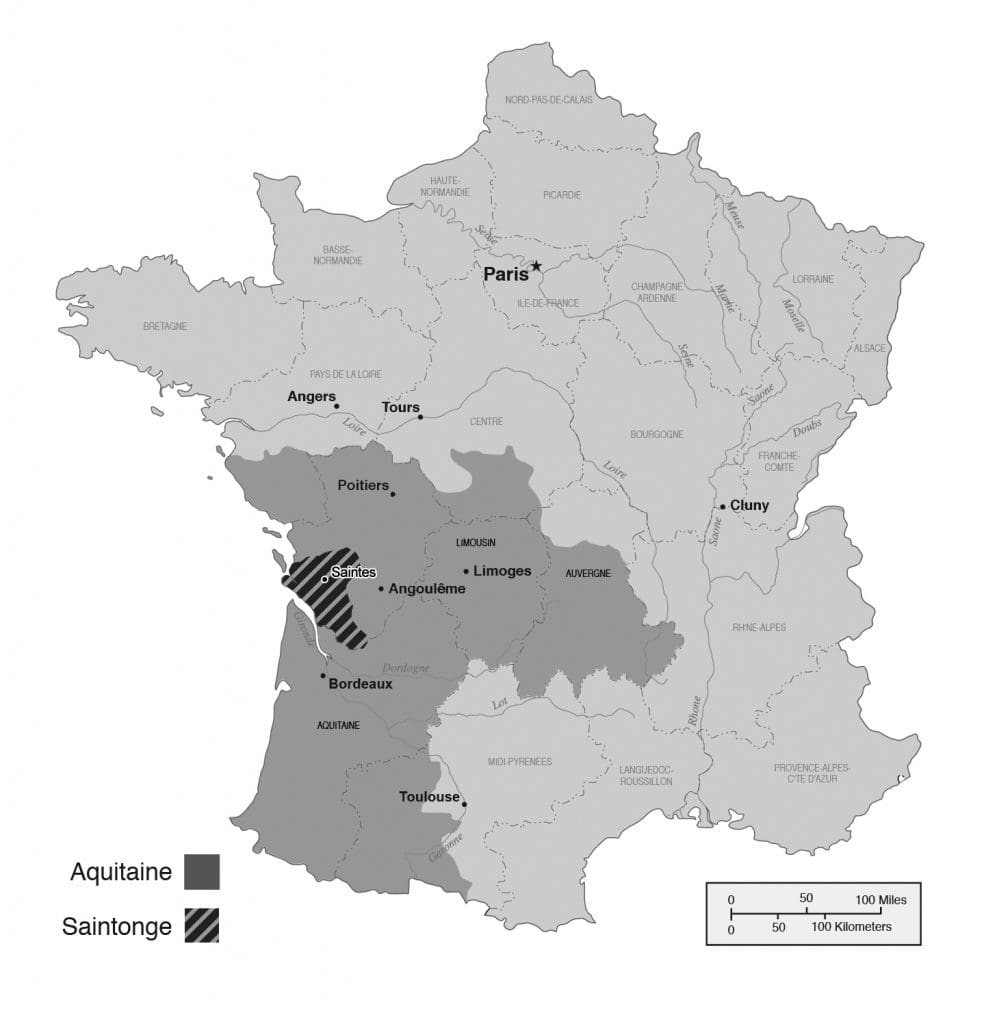
Map 1. of Saintonge within the larger context of Aquitaine.
But what does all of this talk of music as a deterrent have to do with medieval sculpture? As early as the twelfth century, the tactic of weaponized sound was hidden in plain sight on the corbel tables of several Romanesque village churches in Saintonge, an old Aquitanian county in southwestern France (Map 1) in the modern department of Charente-Maritime. Saintonge contains around 150 surviving village churches from the Romanesque era and a wealth of original corbels, which are often the main or most frequent form of decoration on small village churches, most dating to the second quarter of the twelfth century.[6] In these cases, corbels provided visual cues that triggered a multi-sensory response resulting in an unpleasant imagined soundtrack that encouraged engaged viewers to move along.
While corbel musicians exist pretty much anywhere there are corbels, the musicians of Saintonge are set apart because they are usually located in the midst of wholly vulgar characters, poised in an imagined performance the song of which is somehow more difficult to imagine than the heavenly music of the portal.[7] Although some excellent examples of overt visual profanity on corbels are found scattered in parts of France, Spain, and England, Saintonge boasts the highest concentration of this genre of figure.[8] While not graphically profane like some of their corbel neighbors, these fiddlers under the roof and their musical cohort should be read as the end products of a visual and compositional vernacular directed at a specific audience in twelfth-century Saintonge and as such, are extremely difficult to interpret with any semiotic depth today. One reason for this pertains to how their original audience learned to “read” and access different types of sculpture.
Moving forward, I will use a phenomenological approach to explore how specific medieval communities in Saintonge interacted with and received the imagined weaponized performances of corbel musicians and the localized influences that informed these visual cues. This phenomenological approach acknowledges that viewing, for medieval Saintongeais villagers, was an active, multi-sensory endeavor[9] that included iconographic interpretations incorporating aspects of popular trends in song and narrative, an important regional distinction. Although traditional scholarly discourse tends to dismiss corbels as merely decorative elements, these figures filled the marginal spaces around the church exterior with visual cues that worked at a multi-sensory level to guide people around the church exterior much as modern use of loud music is used to disperse and move citizens through public spaces. While the modern form of weaponized music is controlled via technological automation, the medieval version was effective due to a variety of complex learned associations.
Sacred or Profane: Location and Learned Associations
The first learned association establishes a hierarchy of image due to location. The soundtrack of Saintongeais corbel tables was purposefully constructed as a profane cacophony inflected with vulgar metaphorical and hermeneutical associations drawn from the content and structure of popular narrative and song. But generations of art historians have missed this cue, because we learned to listen to the music at selected portals instead. Traditional discourse pertaining to medieval sculpted musicians tended to focus on the Burgundian-style portals along the pilgrimage roads in France and Spain that depict easily recognizable religious figures like Christ, choirs of angels, or the Elders of the Apocalypse with phials and instruments in hand awaiting the Second Coming of Christ. Such figures inhabit primary areas of sculpture on these churches, namely the tympanum and other elements of the portal, which have been likened to a marquee that uses the sights and sounds of salvation to draw people into the church.[10]
And while I believe primary sculpture was intended to function in this way, tradition also facilitates a glaring omission in dismissing the façades of Aquitaine,[11] which do not feature tympana but host complex iconography in several locations on the façade and often other areas of the church.[12] Most commonly, the archivolts feature Apocalyptic or Christological iconography, but sometimes the entire façade is populated with identifiable Christian forms (Figs. 1 and 2). Linda Seidel notes that the arcades and lantern towers of the Aquitanian church structure itself imitated liturgical forms representing triumph over death, forms that would have been easily recognized in the region.[13] So not only are we underinformed in the ways corbels were received by their original audience, canonical works by the likes of Focillon and Mâle have deprived us of fully appreciating the intelligent complexity and iconographic strategy of the Aquitaine façade as well.
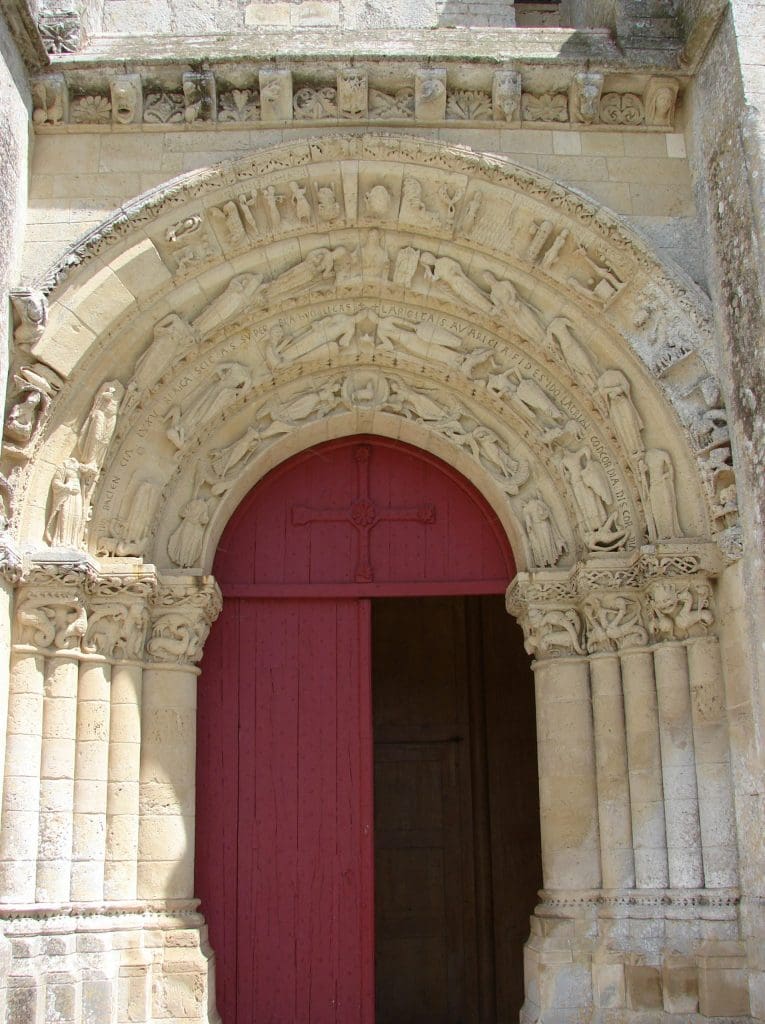
Fig. 1. Western portal of St.-Pierre-de-la-Tour, Aulnay de Saintonge. This portal displays the majority of its religious iconography in the archivolts in the form of the so-called Saintonge-Sermon and theophany.
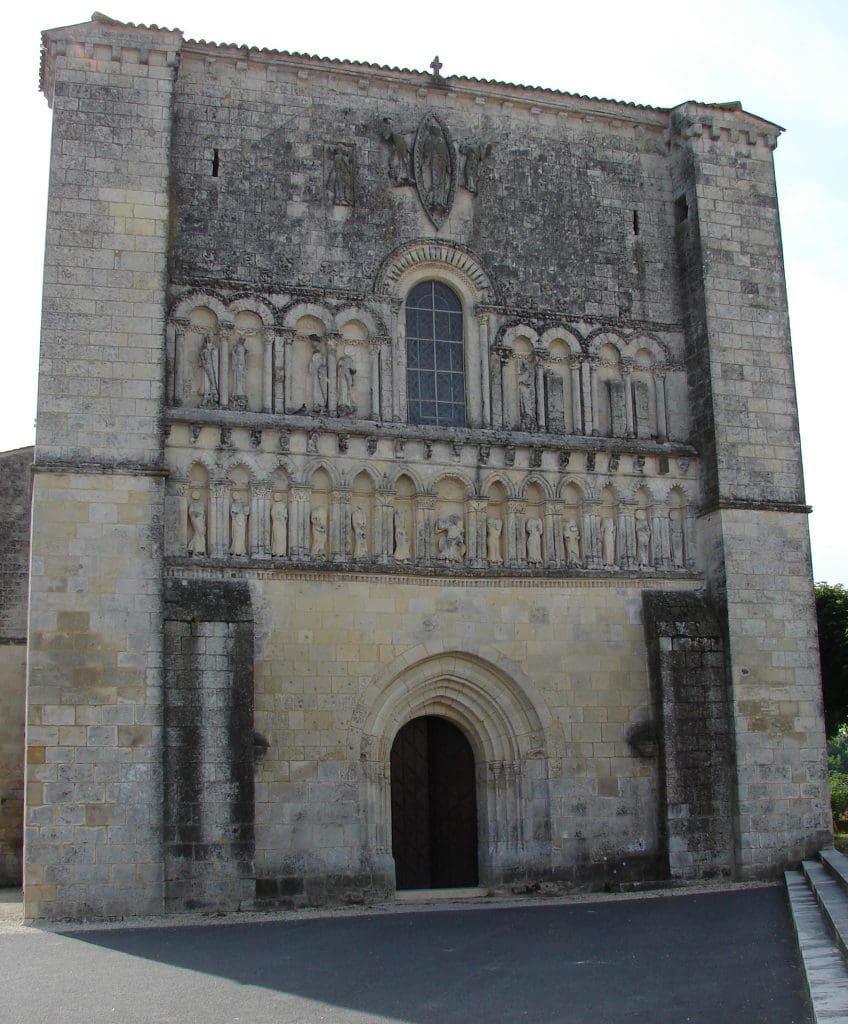
Fig. 2. St.-Pierre at Pérignac displays religious iconography throughout its façade with an entire register devoted to the Virtues and Vices of the Saintonge Sermon flanking the central window, with the theophany at the top of the façade. Both this arrangement and that of Aulnay represent two popular styles of Aquitaine façade.
As far as learned associations are concerned, the Apocalyptic and Christological scenes that dressed the portals and façades of major Romanesque churches became a genre of medieval popular culture broadcast by a form of visual mass media, a common text that was disseminated widely, the iconography of which was understood by all those who saw it, and whose “publisher” was the Church.[14] The literature from which these images were conceived was biblical and the iconography was delivered in the form of relatively straightforward narratives that were also implicitly moralizing. In this way, the portal served as a dogmatic advertisement that reinforced the Church’s interests and goals regardless of geographic location and local audience.[15] This type of narrative sculpture was designed to be mentally masticated and easily digested by the masses on a fundamental level, with deeper levels of symbolism for the more educated. In fact, sculpture in this period was the most accessible form of iconographic communication available to the general public,[16] so this type of primary sculpture was exceptionally well-understood by design. Even so, such active viewing and linking of image to text required an engaged and informed viewer, the degree of which may be affected by geographical location.[17]
The overall accessibility of the iconography and textual narrative sources of primary sculptural programs is one reason why we can identify the iconography with relative ease today. The amount of research devoted to those sculptural programs is another. The lack of both regarding secondary sculpture leads to frustrating attempts to parse the seemingly random assortment of performers, monsters, and myriad other motifs that are not defined or unified to adjacent corbels by a recognizable source. The individual elements of secondary sculpture, like those comprising the corbel table, have been slow to find their way into the scholarly discourse as a meaningful whole since we modern viewers are not the localized audience for whom these enigmatic figures were intended and, perhaps more importantly, our viewing experience today is more passive than in the twelfth century.
Despite the daunting task of interpreting the visual language of secondary sculpture, corbels and capitals are being represented by substantial recent work that highlights the complexity of these carvings. The most important inroad leading to meaningful contextual approaches for interpreting secondary sculpture has been the realization and that corbels and capitals were not meant to be (and, in fact, cannot be) read as parts of a linear visual scheme or overarching narrative structure as is standard practice in areas of primary sculptural decoration. Secondary sculpture was simply not devised to function in such a role.[18] Instead, as Kirk Ambrose has argued, these carvings were individual visual signs and symbols intended for a particular audience. The images carried deep and specific meanings that have long been iconographically simplified by the “dictionary fallacy” in which certain images are defined at face value without consideration given to the implications of gesture, expression, or context relating to said image.[19] Imagery that has fallen victim to this simplification has had its nuances and semiotic multivalence subverted through time, as is the case with corbel sculpture.
The challenge of interpreting secondary sculpture is exacerbated by its individuality and its localization. Unbound by unified themes or recognizable narratives, secondary sculpture’s broad distribution leaves interpretation wide open. Anthony Weir and James Jerman[20] have identified profane figures somewhat simplistically as admonitions against lustful behavior, while Nurith Kenaan-Kedar’s[21] work focuses on corbels as representations of the people at the margins of society. Marian Bleeke[22] interprets corbels at Kilpeck as an invitation to dance with the church’s approval, and Barry Magrill[23] views certain English corbels as indicative of donor status. Corbel tables are full of meaning and nuance all meant for unique audiences. The corbels at Kilpeck do not carry the same message as those in Champagnolles or Marignac, nor does the sculpture of large pilgrimage churches align in parity with that of village churches . They are speaking different languages to different audiences.
With this in mind, our phenomenological approach has two prongs. One is heuristic and it helps to identify visual phrases and architectural elements that mimic grammatical structure or relationships between corbels. The other prong is hermeneutic and it attempts to unpack the meaning of individual motifs. While it is tempting to jump right to the hermeneutic prong we must first consider the arrangement of secondary sculptural elements before attempting to excavate meaning from their individual forms, because while it is possible to find one layer of meaning in a narrative scene on a capital, corbels exist solely as individual symbols. Therefore, our interpretation of corbel figures often relies as much on heuristic examination of their arrangement and placement as it does on the hermeneutic and semiotic interpretation of their physical forms. A corbel in a museum or one in situ surrounded by replacement blocks has had its context removed and its voice silenced.
Heuristic Analysis, Location, and Structural Mimicry
Corbel arrangement frequently imitates textual practices and musical compositional structure of the twelfth century. Often, corbel arrangement creates visual phrases that assist in promoting a particular interpretation of a specific motif depending on its proximity to other figures. As is the case with words in textual sources, the context in which a motif or image appears affects the image’s facets of meaning.[24] For example, musicians at the portal can be understood to be players of sanctioned music that the Church had approved. They herald the threshold of salvation and entice the viewer to enter the sanctuary.
Conversely, corbels are outside of that sanctioned space. On the Saintongeais village churches, they are usually found on the sides and backs of the church, in the shadowy nooks and crannies where loitering is likely to occur or next to the street where it is dirty and loud, so the objective would have been to move people towards the door or at least out of the way of temptation. In some cases, there are no sanctioned musicians at the portal and some very small churches only have corbels figures on the façade, and the rest of the structure only uses plain or geometric corbels (Fig. 3). The screen façade of St.-Quantin-de-Rançanne has obviously seen some reconstruction, but we can observe that at one time there was a theophanic arrangement at the top of the structure and saints or virtues were housed in the now empty niches as at Pérignac (Fig. 2). The small size of the archivolts and the presence of this style of façade indicates a relatively simple portal scheme. In this case, there is a lack of positive musical reinforcement and the corbels act as an impetus to hurry the parishioner inside to escape whatever unpleasant effects the corbels emit, despite their placement between religious iconography. Note the anal exhibitor (Figs. 4 and 5) directly above the door at St.-Quantin-de-Rançanne, which would not only have been offensive to the eye but also, on a multi-sensory level, to the ears and nose as well.
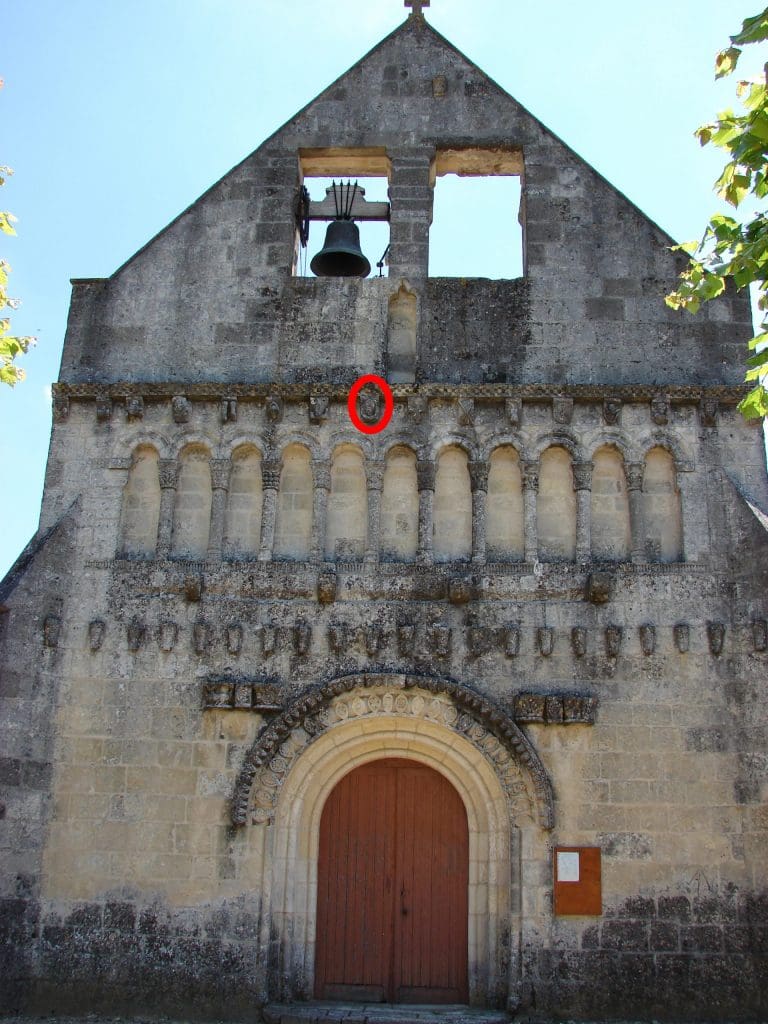
Fig. 3. St.-Quantin-de-Rançanne. This was similar in iconographical scheme to Pérignac. Note empty niches for saints or Virtues and the space for the theophany above. Anal exhibitor noted with circle.
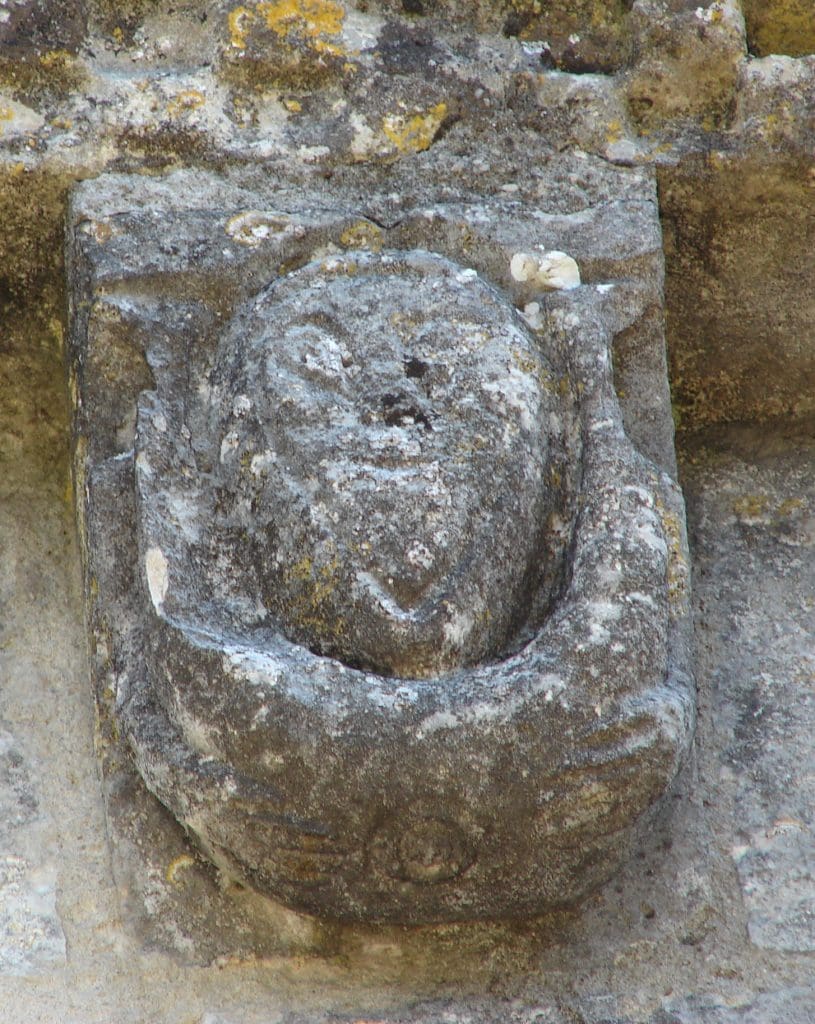
Fig. 4. Detail of anal exhibitor directly above the door of St.-Quantin-de-Rançanne.
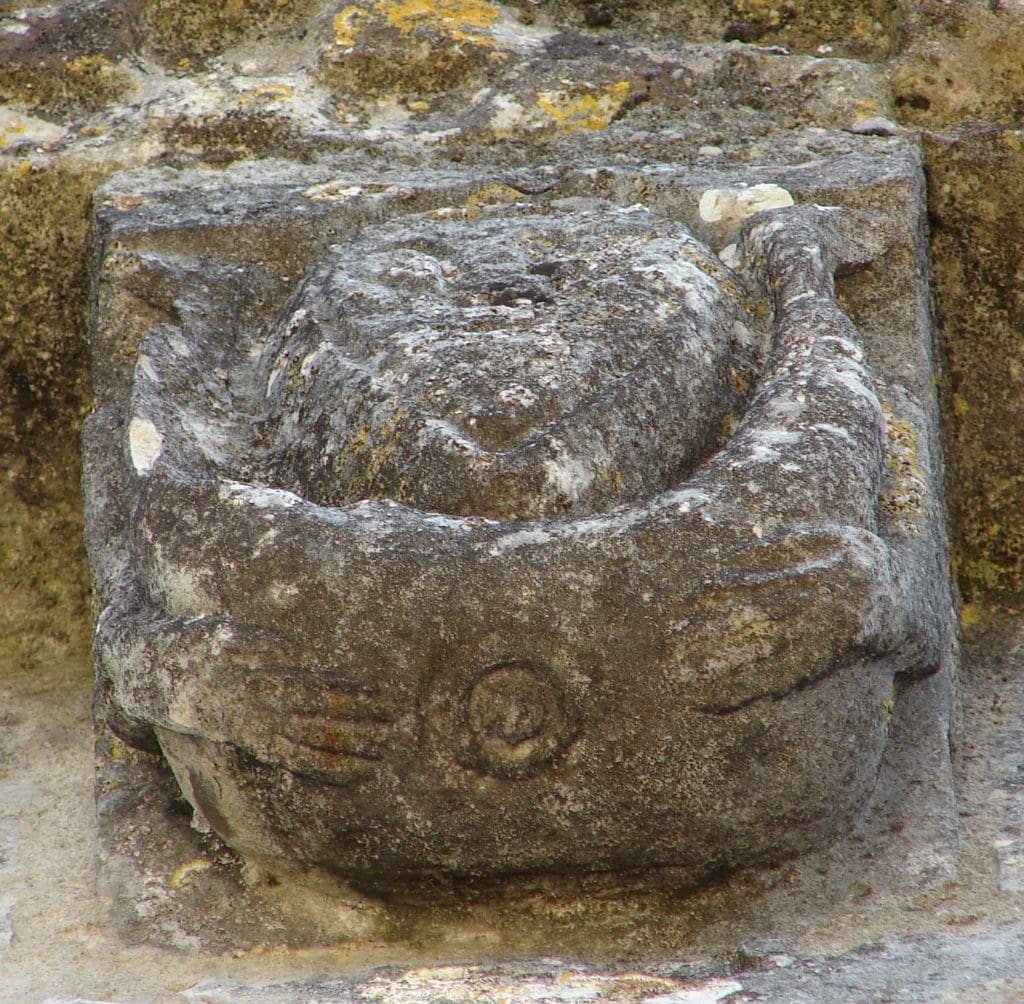
Fig. 5. Detail of anal exhibitor directly above the door of St.-Quantin-de-Rançanne.
Location is the first factor that determines how viewers received the imagined music being played. Certainly, a harp, a horn, a vielle are the same instrument no matter where they are depicted. And in reality, the same musicians played both sanctioned and unsanctioned music depending on the reason for the performance.[25] The difference between sanctioned and unsanctioned musicians in sculpture is reliant on the company they keep as well as their location. Portal musicians form ensembles in the presence of sacred figures like Christ, Elders of the Apocalypse, angels, and labors of the month. Unique to Saintonge, figures of Virtues conquering Vices from Prudentius’ Psychomachia form a regional moralizing theme known as the Saintonge Sermon (Figs. 1 and 2).[26] The placement of music makers at the portal and among revered figures created harmonious sounds that helped mold the soul accordingly.[27] Conversely, corbel musicians hold court among beasts, monsters, and other undesirable characters. Instead of a heavenly serenade, these musicians play profane, discordant sounds, unsanctioned music. And because of their neighbors on the corbel table, this music is lustful, dissonant, and unpleasant. And remember that the synaesthetic aspects of viewing meant that these musicians and those around them would have been heard and smelled as well.
With the importance of location in mind, we can begin to construct the larger soundscape on the corbel table and determine why the presence of neighboring motifs matters. The influence of the corbels surrounding our musicians is connected to grammatical concepts contemporary to the construction era of these churches. To illustrate, in the first quarter of the twelfth century, Bernard of Chartres used the example of the word albedo (“whiteness”) to represent the virgin form of a word that has not been sullied by conjugation or secondary meanings.[28] Once the word is placed in a grammatical context, however, it must be manipulated or corrupted in form and meaning to fit its syntactical role. Such lexical metamorphosis is determined by other words or signifiers within the sententia that require the implementation of such conjugation.[29] This phenomenon of cosignification, or multivalent meanings or purposes of a word or thing, is an important link to written convention and the manipulation of a word’s meaning due to its relative location to other words in a particular phrase or sentence translates to the corbel table, as we will see.
In addition to the cosignification of individual corbels, their arrangement can imitate syntactical or compositional structure. A relatively intact corbel table, with its original sculptural components uninterrupted by reconstructed motifs or blank replacements, displays characteristics seen in the compositional structure of popular music and poetry that was developing or flourishing in twelfth-century Saintonge and throughout Aquitaine. These structural patterns on the corbel table are often enhanced by the architectural rhythm of the church itself. In addition to other carvings like metopes or capitals that may occupy the corbel table, architectural features such as buttresses, pilasters, and windows, served to break the corbel table into visual phrases or units of mental text (Fig. 7). This division of the corbel table mimics the development of silent reading and the textual divisio, or aeration,[30] required to accommodate techniques of rapid scanning that were in wide use by the twelfth century.[31] These visual phrases also emulate segments of word clusters that aided in the oral performance or recitation of a written text,[32] which made textual developments accessible to those who were unable to read the written word.
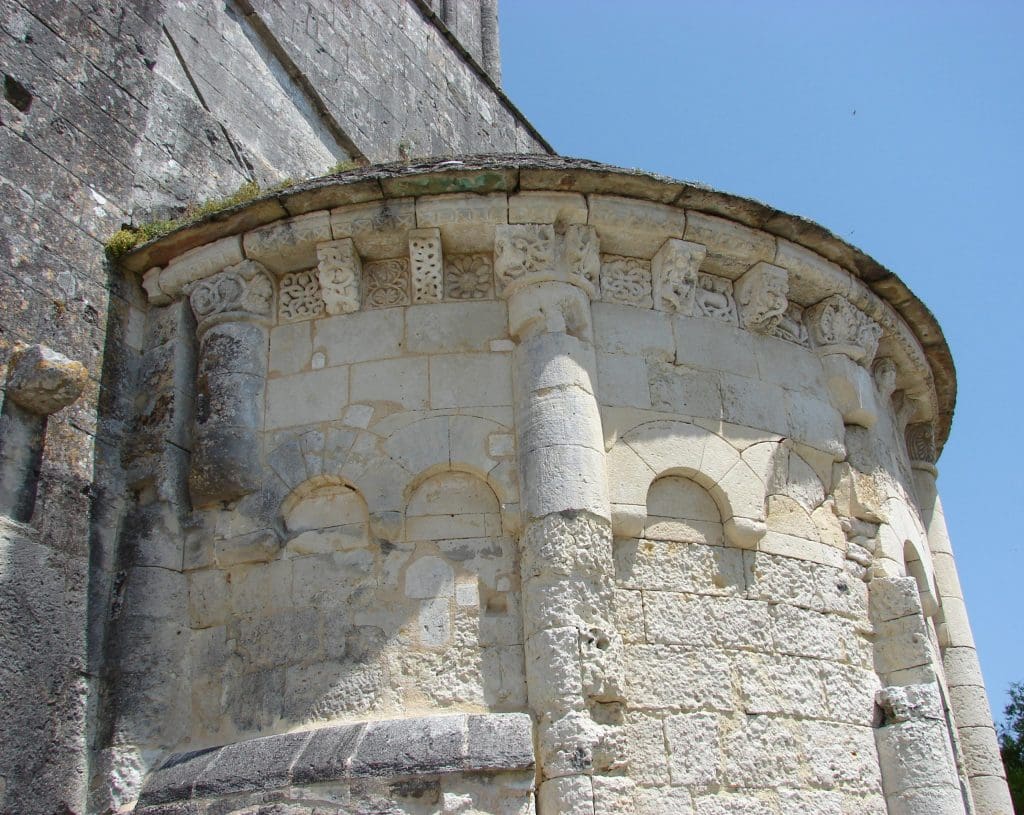
Fig. 6. The tri-lobed chevet at St.-Sulpicein Marignac uses architectural elements in addition to sculpture to create visual rhythms and phrases.
While architectural elements within the visual structure of a corbel table act as hard breaks in the phrasing and help form a rhythmic architectural and visual cadence, non-figural sculptural motifs like stars, checkerboards, and foliage appear to act in the manner of textual punctuation or directional marks (Fig. 7). Symbols borrowed from text like the diple or the hedera (itself a foliate motif) were meant to emphasize a particular word or concept,[33] and separate it from the rest of the concepts on the table, although in very non-standardized ways, depending on when and where they were used and by whom.[34] Non-figural motifs are frequently repeated on a single corbel table and occur throughout a wide geographic span. The placement and repetition of such motifs also calls to mind the use of refrains in the composition of the “new song” and the written monastic versus that blossomed in tandem with the flourishing troubadour culture in twelfth-century Saintonge.[35] These directional motifs guide the viewer’s attention to a specific image or, through repetition, link visually disparate corbels to one another, like one verse in a song is linked to another by a musical refrain. At Marignac, profane corbels (including musicians) all sit next to a quatrefoil motif in the metopes, linking them together regardless of their location on the large tri-lobed chevet (Figs. 8 and 9).
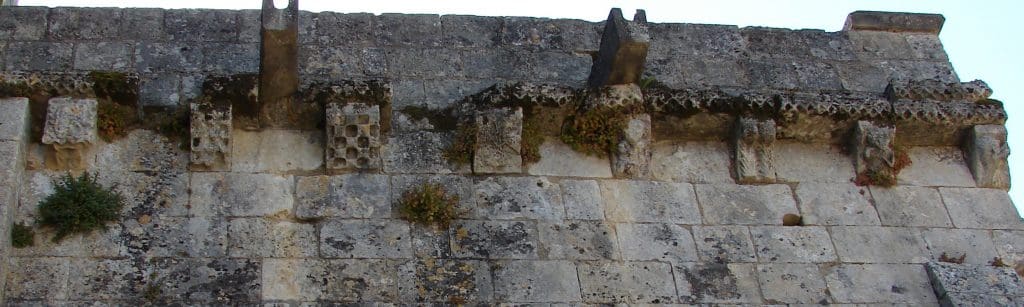
Fig. 7. The north transept at St.-Pierre, Champagnolles, with a variety of geometric or directional corbel motifs, most borrowed from written texts.
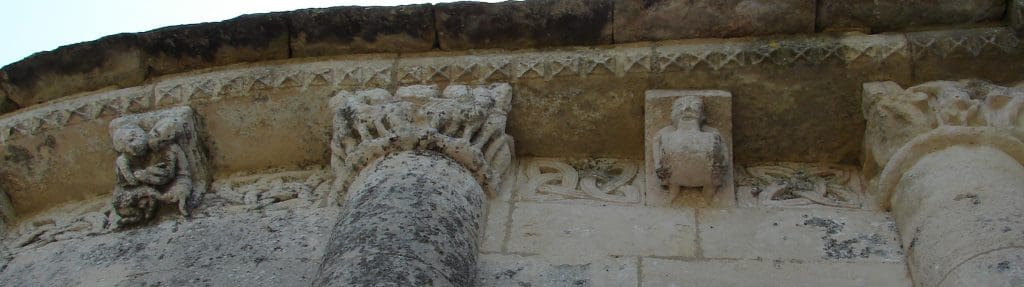
Fig. 8. Vulgar figures at St.-Sulpice, Marignac, are linked via quatrefoil motifs in the metopes, regardless of whether they are direct neighbors on the corbel table or residing on a completely different part of the chevet.
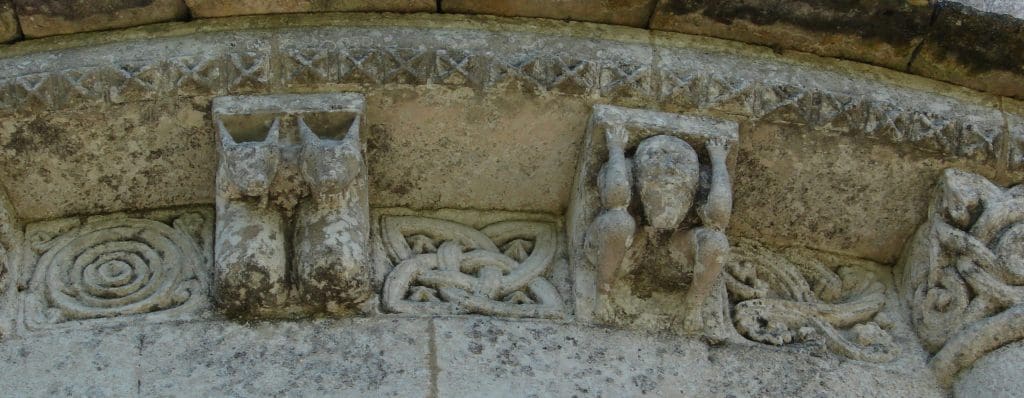
Fig. 9. Vulgar figures at St.-Sulpice, Marignac, are linked via quatrefoil motifs in the metopes, regardless of whether they are direct neighbors on the corbel table or residing on a completely different part of the chevet.
The use of non-figural motifs as punctuation or refrain is one way in which the corbel table itself conveys a sense of rhythm and song. When observing a corbel table from a short distance away,[36] the viewer can distinguish the individual shapes of corbel motifs as well as the visual rhythms of its arrangement due to the use of architectural elements and repeated motifs that help define visual phrases. The manner in which this rhythm is constructed recalls the repetitive structures of rhyme schemes present in twelfth-century song.[37] In the case of corbel tables, specific motifs or shapes are associated with isomorphically similar motifs in order to form visually rhyming patterns within structured, rhythmic phrases comprised of other sculptural and architectural elements (Figs. 10 and 11).
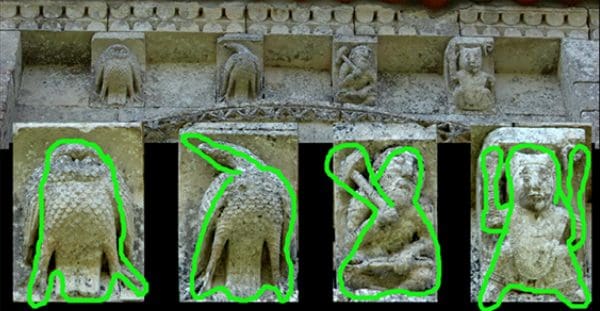
Fig. 10. Isomorphic correspondence within visual phrases on St.-Léger-en-Pons. Figure 10 has an isomorphic rhyme of ABBA.
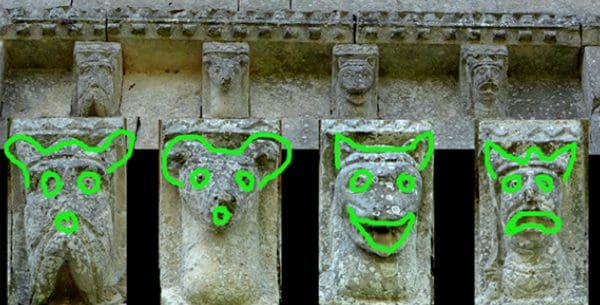
Fig. 11. Isomorphic correspondence within visual phrases on St.-Léger-en-Pons. Figure 11 rhymes AABB.
The arrangement and use of architectural elements to create visual rhyme and phrasing provides the heuristic guidelines for reading segments of the corbel table, and augments the overall performative element of the musicians on the corbel table. While the original beholders of these corbels almost certainly would not have had understood grammatical concepts on a written page, they absolutely would have heard spoken or sung verse and understood the inherent rhythm in that delivery. Having outlined the heuristic prong of our analysis, we can now move on to corbels’ hermeneutic potential.
Hermeneutic Analysis and The Role of Popular Narrative
Interpreting the semiotic meaning of corbels is a hard nut to crack because these motifs do not figure into the core of our current visual vocabulary beyond how we interpret them at face value. However, our agrarian Saintongeais villagers were dependant on oral tradition and would be considered textual communities, either independently or as part of a larger network of villages, whereby certain orally transmitted texts are so well-known by members of a group, that the actual written text and the ability to read it are unnecessary details.[38] As a member of a textual community, the visually literate medieval villager would not only have been able to distinguish the hierarchical status of various sculptural forms, they would also have been able to recall the hermeneutics of each shape or figure. Such associations were made through what Howard Bloch calls “medieval sign theory,¨[39] whereby the beholder used knowledge of the context in which these figures occur, as Augustine proposed,[40] or as Thomas Aquinas recognized, understanding that a word is not solely the thing it signifies, but also incorporates elements of other words (and thus things) upon which the word is imposed,[41] not unlike Bernard of Chartres’ exploration of the corruption of word forms. The motifs also acted as pictorial memory tropes or “narrative hooks” of memory, mnemonic devices used in recalling orally transmitted narratives or lessons.[42]
These narratives of primary sculpture were (and still are) accessible enough that just about anyone passing by one of our little churches would have understood, at a rudimentary level, exactly what story was being depicted in the stones of the portal or the façade. The iconography of this sculpture– the marquee advertising salvation or a sort of visual Muzak offering comforting and familiar material– is the stuff of fundamental instruction in the literature of the Church. It is broadly understood at a basic level, even if the average villager did not have the opportunity, education, or desire to draw from the deep well of exegetical writings that added layers of nuance to portal sculpture. Conversely, the strange and bawdy imagery of the corbels that mirrored themes in secular lyric and narrative[43] appealed to a demographic who no doubt attended church, but also participated in a secular culture of popular linguistic, musical, and narrative tradition that developed outside ecclesiastical boundaries and flourished alongside the high language of clerical writings and chant. It is through the secular aspect of daily life and popular culture that our corbel musicians and their profane neighbors come to life.
The dual flourishing of ecclesiastical and secular language and music in both oral and written forms is a hallmark of the twelfth century, a time of change and liminality. Language was straddling the line between orality and codification, Latin co-existed with vernacular tongues in both secular and ecclesiastical matters,[44] and ecclesiastical texts found competition with the rise of oral popular narrative, which eventually blossomed into a body of codified text in the thirteenth century, a good portion of which survives today.[45] The development of these secular narratives is particularly relevant for our Saintongeais villagers due to the presence of high-profile, well-traveled poets and jongleurs in the region. The tradition of popular narrative transmitted through song and oral spoken performance exploded in twelfth-century Aquitaine, which I will discuss in more detail below, in some cases borrowing structure from Arabic strophic poetry.[46] This literary mimicry coincided with the adaptation and adoption of elements of visual art and architecture from Muslim Spain[47] that helped define the Romanesque style, particularly in southern France.
The Fabliaux and Erotization of Music
I will note here that any lack of written examples of popular narrative and lyric from the twelfth century does not indicate that those narratives were absent altogether prior to extant codified examples from the thirteenth century. Although the term “fabliaux” is commonly used to refer to Old French tales from northern France, Peter Dronke has argued for the use of that term as a generic reference to “amusing stories of deception and outwitting, especially of a sexual kind.”[48] The generic version of fabliaux is to be differentiated from the more formal designation of Old French fabliaux, which flourished in the thirteenth century and survive in small numbers in written form today.[49] It is the generic form of the term to which I refer hereafter.
Some of the codified fabliaux took their narratives from lewd anecdotes and bawdy jokes that survived in oral incarnations for long periods of time prior to the twelfth century and may never actually have been textual entities in the Middle Ages.[50] In fact, the themes and humor of fabliaux are reflected in the narrative tradition of Antiquity and the early Middle Ages.[51] Dronke notes the similarities between the tale of the widow of Ephesus as relayed by Petronius and Pahedrus, and the Old French fabliau “De celle qui se fist foutre sur la fosse de son mari.”[52] Additionally, a variety of Antique narratives revolving around cheating wives with their lovers all but hidden in plain sight are typologically recognizable in fabliaux.[53]
Even with the dearth of written examples of bawdy popular narrative from the twelfth century, ample evidence illustrates that the fabliau genre was the progeny of surviving Antique tales and had been normalized through oral transmission and performance, merging with the blossoming music scene in medieval Aquitaine. The raunchy temperament of these tales flavors the vulgar corbels of Saintonge. The original audience for these sculptures would have experienced such coarse narratives through oral transmission, which was critical for the survival of song and narrative.[54] In fact, song itself in the 12th century was a somewhat imagined performance. We do not know what the original version of Bernart de Ventador’s songs sounded like, for instance, because songbooks containing notation were not yet in use.[55] His contemporary, Jaufré Rudel, claimed that songs consisted of two parts: the performance and its material incarnation.[56] The corbel table gives us both parts via the imagined soundscape and corbels that provide it. Our Saintongeais villagers witnessed the development of music and poetry in ways that reflected a shift from the sacred towards the secular, from the familiar to the foreign. In the end, the general public of twelfth-century Saintonge was perfectly comfortable with profanity and vulgarity in daily secular life and the Church knew it.
But the Church had worries about uncontrolled profanity in its own house, as vulgarity had also found its way into the changing form of sacred song. In the twelfth century, the eroticization of music[57] was an institutional concern following the introduction of polyphony, which was described in erotically anthropomorphic terms whereby polyphonic counterpoint actively performed such corporeally sensual actions as kissing, adulating, and embracing.[58] These musical feats were objectionable partly because they broke from the relatively musically chaste forms of psalmody that comprised a fundamental requirement for clerics and which contributed to the intellectual development of the singer’s whole being.[59] Thus, music under the influence of polyphony was threatening to become less about intellectual rumination and more about visceral performance. In fact, recent sound studies have shown that troubadour songs borrowed from chant a number of critical features like pitch, repetition, and notation.[60]
Even the notation of polyphony created a visual outline of the music that caused consternation among its critics, one of whom ranted that “visual beauty of the noted page has itself served as a provocation to ‘unnatural’ performance.”[61] This perceived lewdness was, in fact, a valuable memory aid, since medieval mnemonics were best served by “useful sex and violence”[62] and a pictographic vocabulary including these sorts of traits was a successful memory aid for clerics who preached or performed in an unfamiliar vernacular[63] or for those members of society who were unable to read words, yet were able to learn them from oral transmission. Thus, despite the potential to invoke temptation, the suggestive mingling and intertwining of polyphonic notation would have worked in favor of memorization for performance and it served a mnemonic and intellectual purpose, rather than simply existing as an edifice of venal excess through music. In other words, the Church found a use for vulgarity.
In important parity with the sensory effects of polyphony and its notation on the medieval imagination and memory, the manner in which people observed and interacted with text and image was equally complex. I return here to the phenomenon of word and image eliciting a synaesthetic experience for the viewer. For example, in a modern framework, a still image of Janet Leigh in the shower triggers the mental sound of screeching strings and a feeling of horror rather than lust in those who have seen the film Psycho. In a similar vein, to the medieval beholder words as well as images engaged multiple senses by triggering switches of memory, whereby the visual form causes the imagination to call up a sound or scent association for that image and vice versa,[64] what Mary Carruthers calls an “aural gateway.”[65] Similarly, in written medieval texts, the voice of the scribe was audible in the silent reader’s imagination and the textual suggestion of song carried a melody or tone.[66] Because of this blending of senses the mere sight of a musician on a corbel brought with it an imagined performance with sonic inflection flavored by narrative associations and popular language trends, as well as any cosignification inherent in its placement on the corbel table. This multisensory experience is an essential part of the hermeneutic analysis of the corbel table.
Strong Language in Saintongeais Popular Media
In addition to similarities to the musical structure of song, corbel tables also exhibit multivalent hermeneutic associations that evoke the vernacular language and mood used in popular song and narrative that flowered in twelfth-century Aquitaine. Troubadour and jongleur poetry and song were increasingly popular in Saintonge and by the middle of the twelfth century, the lexicon of popular song and poetry had saturated the region. In the first quarter of the twelfth century, William IX, Duke of Aquitaine, called “the Troubadour,” frequently made the journey from his palace in Poitiers to Saintonge for business as well as pleasure.[67] At the southernmost edge of Saintonge, the lord of Blaye, Jaufré Rudel, was an active and famed early troubadour who was active between 1125 and 1148.[68] Although Jaufré was a lord of some importance,[69] scarcely any information about him survives with the exception of his songs and poetry.[70]
The influence on secular entertainment by the simultaneous presence in Saintonge of these two very famous early amateur poet-composers cannot be overstated and the survival of their songs offer a profile of the county as a largely rural area that was also a fertile environment for the development of complex language in a linguistically transitory period. The linguistic tapestry of intricate syntactic structure, music, and crude, hard words was also accentuated with delicate language.[71] This latter component may well have been inspired by Arabic poetry that the duke would have encountered on his visits to his Castilian and Arangonese relatives and through the Arabic influences coming into Aquitaine via pilgrims and knights returning from battles of reconquest in Muslim Spain.[72] This patois is reflected in the concentration of especially vulgar corbel figures in Saintonge that color the interpretation of their musical neighbors.
William IX, as the earliest known troubadour whose work survives, wrote in the southern vernacular Occitan dialect[73] and set the rhetorical tone for troubadour song, further eroticizing music, and creating a multifarious language of tropes that covered the lexicons of feudalism, love, and religion.[74] Additionally, his love of pun and metaphor allowed for liberal use of these devices to describe sexual situations. For example, ladies were alluded to as horses and castles, while cats, sacks, and dice stood in as sexual parts.[75] All of these appear on Saintongeais corbels (with the exception, perhaps, of castles). Use of pun and metaphor became the standard for the duke’s successors, and as the corpus of extant popular narrative form the twelfth and thirteenth centuries illustrates, both songs and folk tales are rife with metaphor and euphemism that reinforce the concept of fluidity and the multifaceted nature of language in twelfth-century Aquitaine. At the same time, these examples do not shy from the “hard words”[76] and themes that frequently cause pearl clutching and censure in our modern lexicon. Predictably, a high concentration of sexual profanity, puns, and euphemism is represented in the visual language of Saintongeais corbels. These references, considered “obscene” by modern standards, would have been accepted with different nuances than they carry today, and surprisingly, these nuances were defined but not necessarily condemned by the Church.
Nuances of the Profane Visual Vocabulary
To label lewd corbels obscene is problematic because the term has been over-simplified and lacks the nuances that it carried in the twelfth century. The modern interpretation of the word “obscene” holds inherently sexual connotations: perverted, pornographic, impure. The Latin obscena and obscenus, however, embrace a larger semantic range that indicates a low or undesirable, but not perverted, nature. Obscena concerns urine, excrement, genitalia, while obscenus implies lewdness, inauspiciousness, ominousness.[77] Obscenus and its variations did not denote a category or genre,[78] but functioned as a rhetorical tool used to add a bit of drama or irreverence to a narrative, which resulted in pleasure derived from the refusal of “the proper.”[79] It created themes that were admonitory or irreverent but never purposefully forbidden.
Furthermore, the common and intentional employ of obscena in twelfth-century narrative created a vernacular literary culture relatively free of linguistic taboos,[80] a phenomenon that is manifested in Saintongeais corbels, and one that exists in direct contrast to the care taken by the Church to avoid ecclesiastical word forms that would unintentionally create a dirty word or inappropriate pun in Latin.[81] The Church’s complicated dichotomy regarding the profane extends to incorporate the binarism of the unclothed human body. Under this umbrella, the naked bodies of Christ and saints, which represent virtue and sacrifice,[82] coexist alongside the profane nudity of secular or classically inspired figures, implicating this latter kind of nude body as representative of the nudity of the soul, which is bereft of virtue, as well as a potential object of desire.[83] Figures of allegorical Lust, classical motifs like Atlantes, and all manner of humans and beasts displaying varying levels of nudity were widely employed in the service of secondary sculpture in Romanesque Saintonge. There was an objective behind the Church’s use of profane motifs on their structures, and none of which are there by chance. On the contrary, the Church was speaking to a specific audience in a popular, localized language that they understand. The Church’s use of the profane was a strategy, not an oversight.[84]
Therefore, the corbel table exhibiting the liberal use of euphemism and metaphor is not riddled with vagaries, but is instead populated with deliberate signifiers and meaning for a localized demographic who would have understood the nuances of the imagery in a way that someone outside a particular textual community cannot. For example, the majority of profane human corbel figures in Saintonge, with and without obvious elements of obscena, are male. The masculine features of these figures appear in both graphic obviousness, and for most modern beholders, this is where hermeneutic inquiry or curiosity stops. However, these figures are usually in the guise of visual metaphor or pun, several of which come from the body of comic folk tales or generic fabliaux and popular songs circulating at the time. Certain popular works were circulated by and addressed a specifically male audience[85] within their texts, especially those of a particularly violent or anti-feminist nature.[86] The masculine language and anti-female humor of those narratives manifest in the images of maleness on the corbel table.
The metaphorical penis of popular narrative comes from a rich euphemistic tradition that, from the twelfth century on, eventually culminated in popular narrative and troubadour songs. The long list of euphemisms for genitalia includes mundane terms that fit with easy slyness into narrative form. In these narratives, the penis took the form of sausage, a door knocker, a ladle, and a battering ram, among other objects, while testicles were alluded to as a purse, a harness, eggs, and guards.[87] Misers are frequently shown with their money bags hanging suggestively between their legs, as illustrated by this figure at Champagnolles (Fig. 12). Wind instruments, which appear frequently on corbels, were also common euphemisms for the male member. While corbel musicians might appear to be simply making music, contextual hermeneutic analysis reveals the multivalence of the imagined performance and affirms the synaesthetic experience of the Saintongeais viewer.
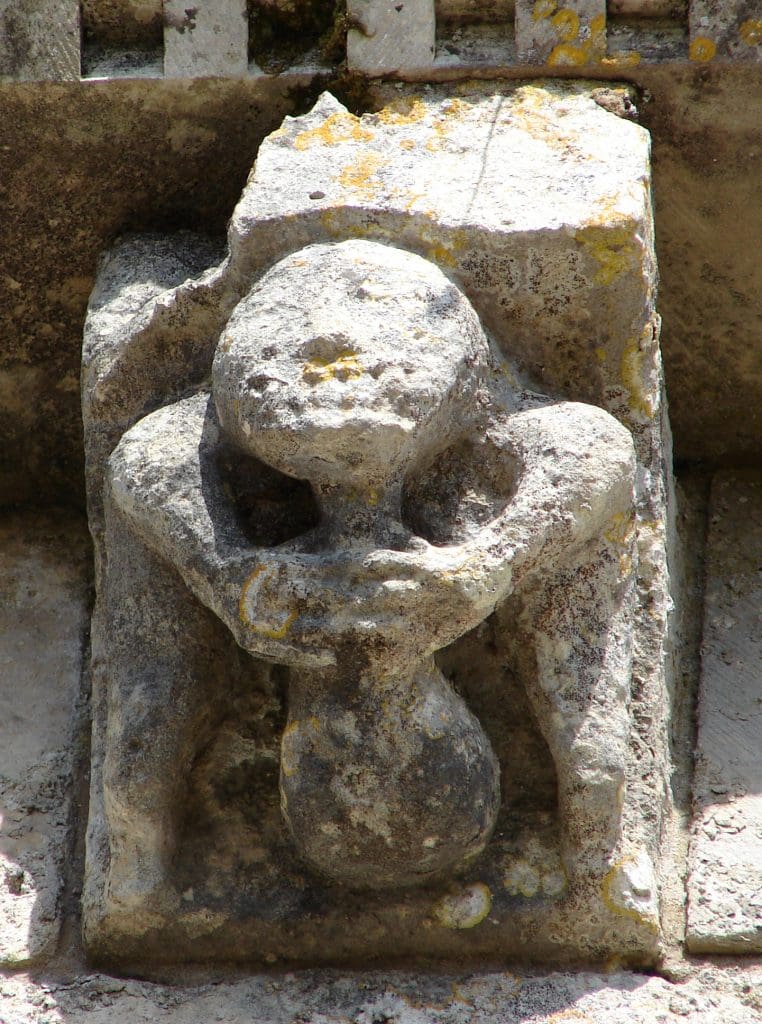
Fig. 12. Miser clutching his money bag at Champagnolles.
For example, the euphemistic use of musical instruments to represent the penis stems partially from the comedic “riddling tradition” of folk tales and fabliaux, which creates a pronounced innuendo in which one interpretation of the resulting pun or euphemism is relatively straightforward and innocent, while another equates to vernacular raunch.[88] So what happens when the familiar and beloved tropes of fabliaux are placed in the profane context of beasts and other profane corbel figures? The music of the corbel table would have been unrefined and chaotic to the engaged Saintongeais viewer whose imagination, stimulated by the visual cues of the carvings, would have provided a discordant mental noisescape with horns blaring, harps twanging, and flutes tooting to create a fine line between the signified and the signifier,[89] between real and imagined. The visual and aural qualities of such imagery are linked inextricably to each other through placement, cosignification, and to whatever hermeneutic meaning the viewer had assigned to each signifier.
In addition to the realistic imagined sound created from corbel musicians, certain instruments also carried a sonic profanity due to their suggestive natures in popular medieval parlance: horns and flutes were notorious euphemisms for the penis, and both of these figures of speech existed in a context framed in the sound of the instrument. In the case of corbel musicians, some figures are noticeably engaged in performances that pose what Bruce Holsinger calls an “erotic threat…to the performing male body,”[90] while others demonstrate a subtler form of musical profanity. Later, in the manuscript tradition of the thirteenth century, phallic implications caused the sound of bagpipes to be perceived as particularly offensive and unsettling.[91] In addition to obvious sexual puns, the long, droning sound of bagpipes, particularly of the extremely loud shawm, became an aural metaphor for farting.[92]
Horn and flute players are common musical offenders in Saintonge. One of the most obvious visual puns occurs on a corbel at Pérignac. Here, a squatting man holds a long, flat flute or recorder to his mouth with both hands (Fig. 13 ) and the instrument extends down suggestively between his legs. The euphemism of playing one’s flute was a masturbatory allusion in popular narrative and song. One such song highlights a young cleric’s attempt to mimic the friars’ morning ritual, which begins with each man “playing his flute.” At the point of this phrase’s utterance in a performance, the singer would imitate the sound of a flute,[93] thus reinforcing the links between sound and performance, medieval imagination, and metaphor or euphemism. This combination of nuances presents the sound of the corbel flute with a mental nudge and a wink, which guarantees that the beholder of this corbel would not mistake this instrument for a similar one emitting sanctioned music by an angel or an elder in an area of primary sculptural decoration. The fact that this flutist is in close proximity to a copulating couple, a monstrous demon, an acrobat, and a horn blower (Fig. 14) tells us that he is not playing us the songs of angels. We see a similar flutist with the same type of cohort on the façade of Corme Écluse (Fig. 15).[94]
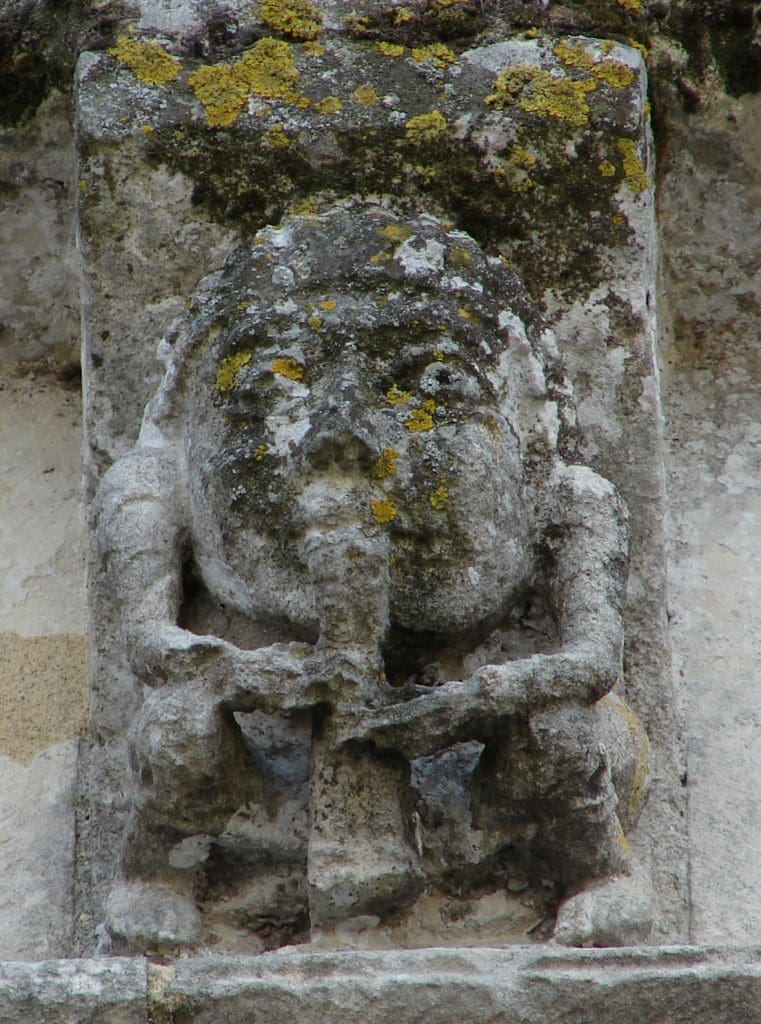
Fig. 13. A flute player and horn blower at Pérignac.

Fig. 13-14b. In situ image shows the type of company these musicians keep.
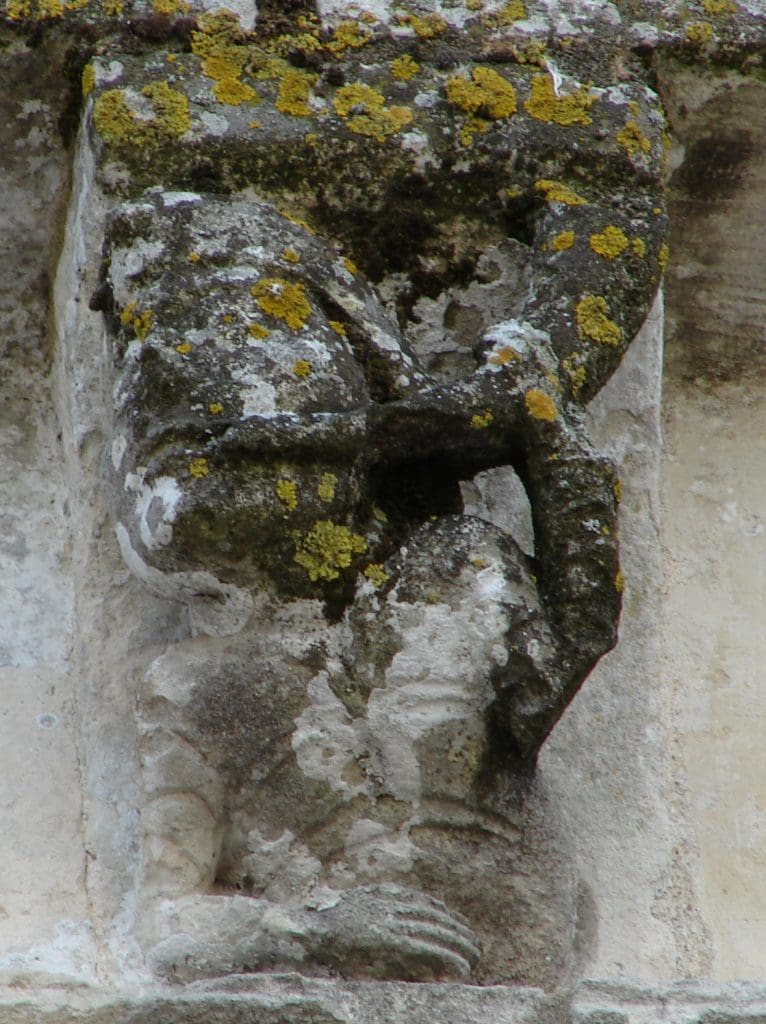
Fig. 14. A flute player and horn blower at Pérignac. In situ image shows the type of company these musicians keep.
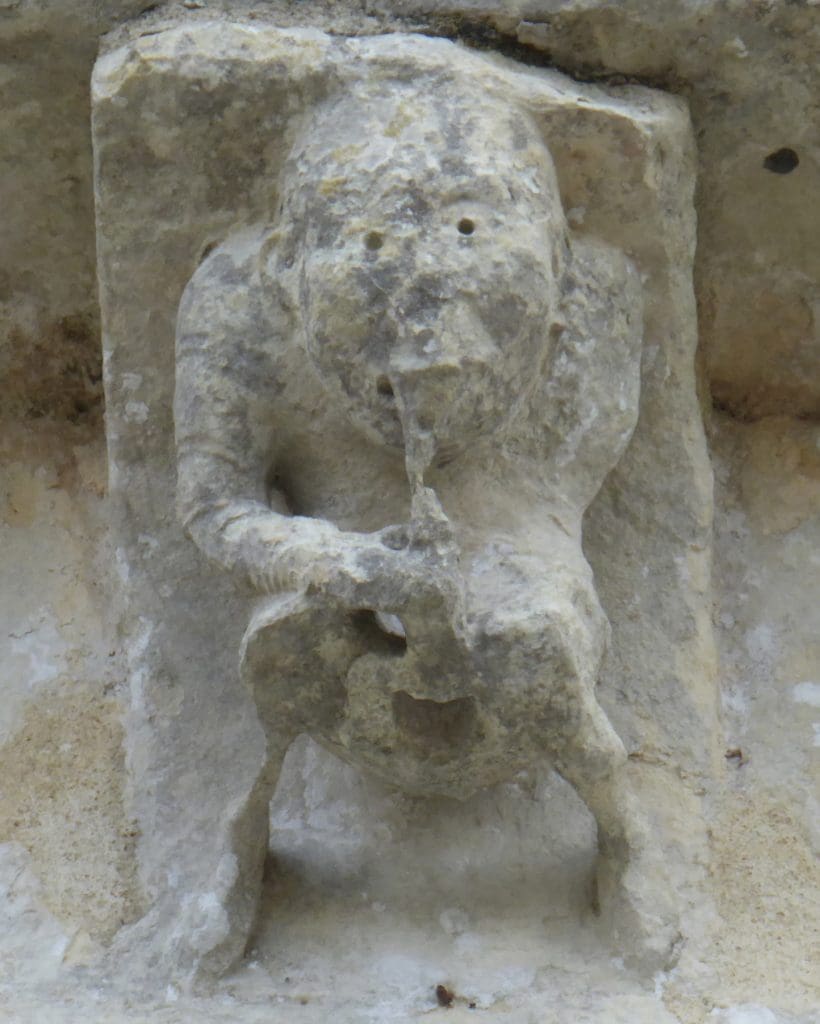
Fig. 15. A flute player at Notre-Dame, Corme Écluse, sits near a coital couple resembling the one at Pérignac. The corbel between these two is a modern reproduction, with no indication as to the original motif. (photos John Tchalenko)
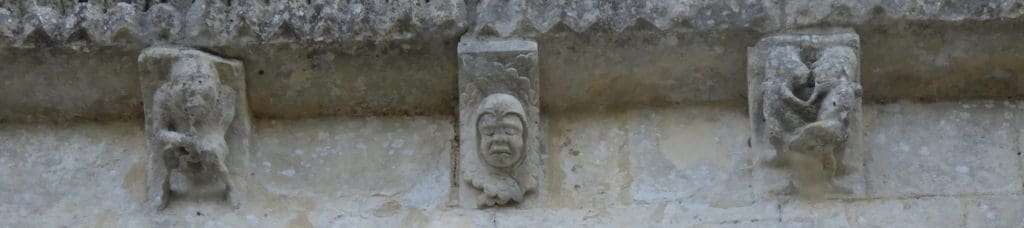
Fig. 15b. The corbel between these two is a modern reproduction, with no indication as to the original motif. (photos John Tchalenko)
The masculine masturbatory theme is relevant for the numerous horn players in Saintonge. Euphemistically, “blowing one’s horn” is predictably similar to playing one’s flute, which I shall demonstrate shortly. But the horn, like the bagpipe, also carries with it the metaphorical allusion to farting and to the anus itself[95] in popular narrative as well as medical tracts. While farting proudly wore the mantle of low comedy in the twelfth century (and still does), there was also a genuine concern about mal-aria, or bad-tempered air, the stink of which carried pollution that could kill a man.[96] The smell of carrion and decaying corpses presented serious olfactory hazards, but the fart is not so far removed since the wind escaping is transitional and represents the liminality and decomposition of the stomach’s contents.[97] Thus the horn, in the proper context, was a most unpleasant sound to behold and the mere sight of one could conjure a variety of objectionable mental and multisensory associations, and possibly even danger.
Indeed, the anus itself, with attendant smells and sounds, must be included in the imagined orchestra of the corbel table, for the corbels of Saintonge are frequented by seemingly genderless figures of anal exhibitors with their feet tucked behind their ears who commonly appear near corbel musicians or even above the front door, as we saw at St.-Quantin-de-Rançanne (Fig. 4). It is worth noting here that although liturgical dancing was frequently approved by the Church in certain situations,[98] such unpleasant corporeal alliances associated with these figures would have created a crude and unpleasant sound that certainly would have curtailed the layman’s urge to dance in the streets as a result of experiencing a Saintongeais corbel concert. The learned associations that triggered multisensory perception of corbel figures meant that the unpleasant music coming from the corbel table would have been perpetually weaponized on sight and social use of the space discouraged.
In light of the repulsive and flatulent corporeal associations of the horn, the horn blower on the southeast corner of Champagnolles’ north transept (Fig. 16) can be interpreted as essentially blowing a stinking raspberry into the air, in addition to upholding the visual standard of penile euphemism attached to blowing one’s horn. Michael Camille’s argument in favor of the use of heads on corbels as apotropaic devices,[99] while an insufficient explanation in some instances, is certainly appropriate in this scenario. One imagines the mal-aria spraying forth from the corbel’s horn, emitting aural and olfactory deterrents in all directions (except into the church itself).
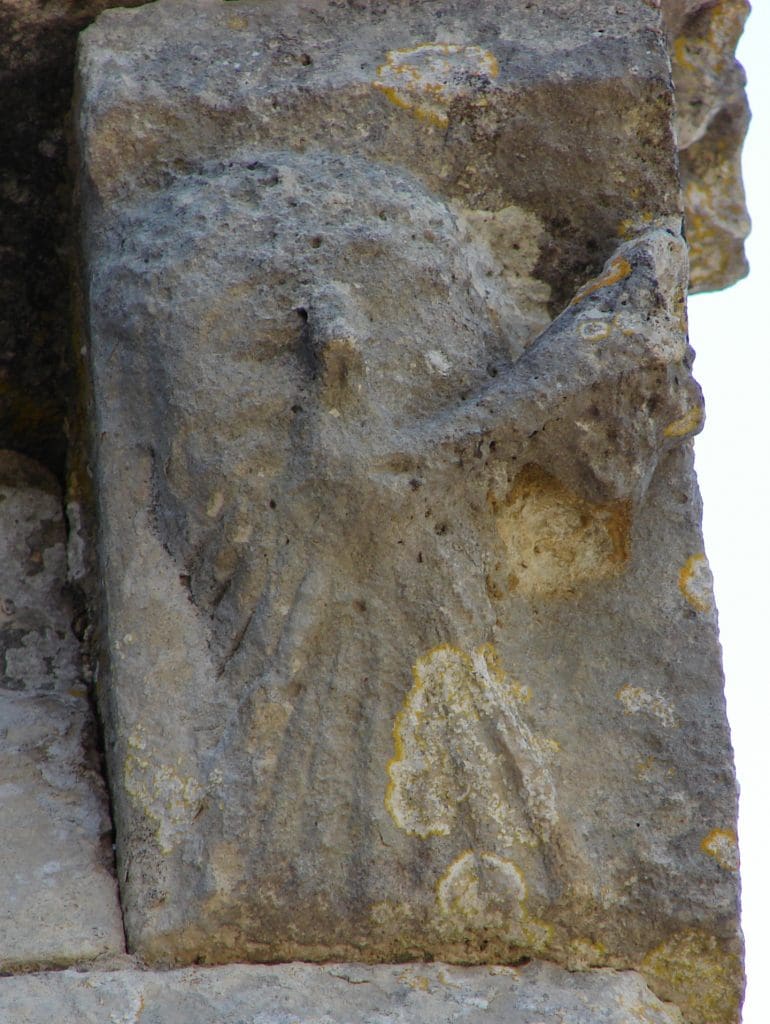
Fig. 16. This horn blower at Champagnolles blows out into the air off the corner of the north transept.
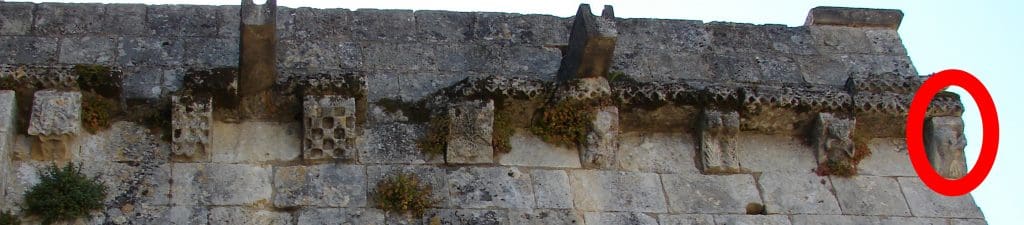
Fig. 16b.
Any phallic symbolism undermined by the horn’s flatulent function is reinforced by the figure’s long beard. The beard, as a distinctly masculine feature, denotes sexuality (or at least a potentially sexual context).[100] Elsewhere on the corbel table of Champagnolles, a leering figure strokes his beard while he watches fornicating beasts on the capital next to him (Fig. 17) and at nearby Givrezac, the apparent penis hanging beneath a barrel toter’s barrel is actually the end of his long beard (Fig. 18). In harmony with the tinge of Arabic influence permeating the literary and artistic boom in twelfth-century Aquitaine, the beard itself was an Arabic motif loaded with symbolic value denoting questionable character traits.[101]
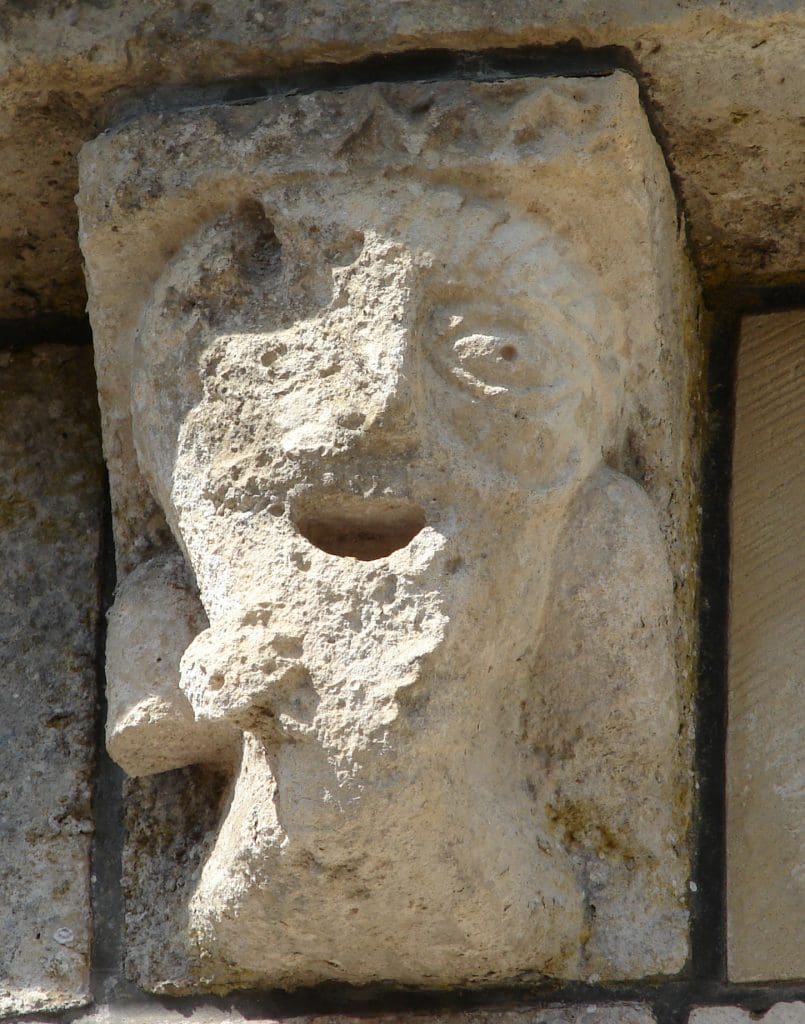
Fig. 17. Beard stroker and naughty neighbors at Champagnolles.
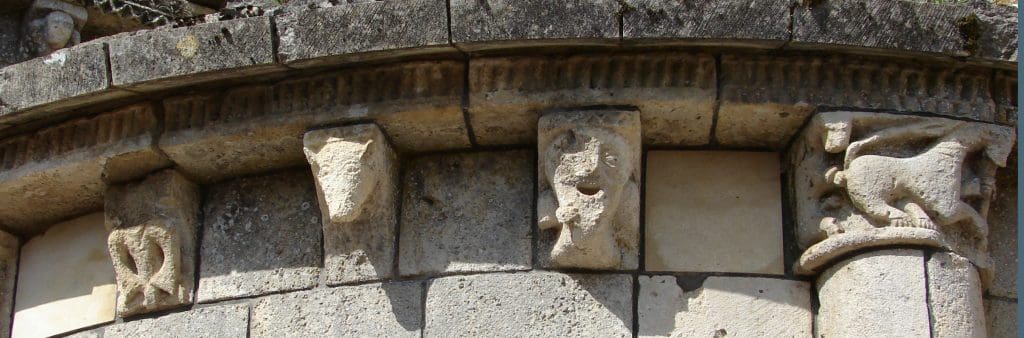
Fig. 17b.
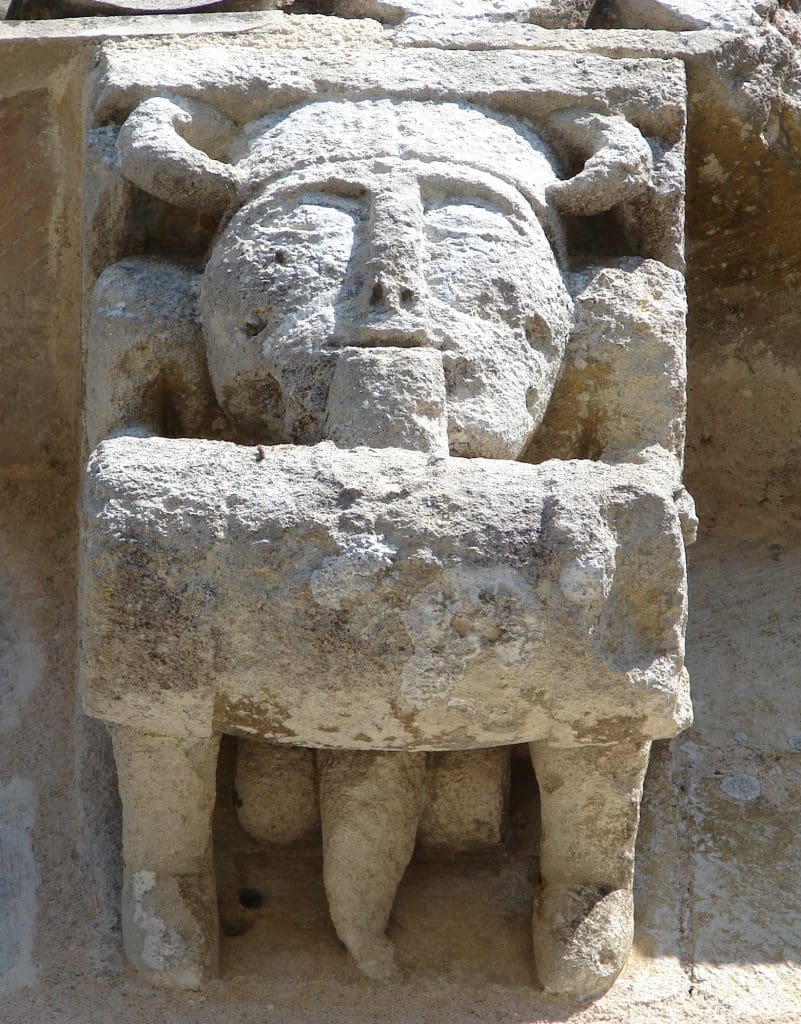
Fig. 18. Phallic beard on barrel toter, St.-Blaise, Givrezac.
Returning to the onanistic implications of horns, the horn player at Marignac (Fig. 19) may be read as more phallic than flatulent due to his context on the corbel table. This phallic inference, in the form of a man who stands awkwardly in a short, belted robe, is also an allusion to masturbation. From the ground, the beholder has a clear view under the fellow’s robe, but there are no body parts to be seen. Instead the phallus takes the form of the horn at the man’s mouth. The ingenuity of the metaphor and its placement at Marignac is aligned with Peter Damian’s view of masturbation as a sort of gateway activity to great and more heinous acts, which ultimately culminates in the act of sodomy– the ultimate sin against nature.[102] In terms of cosignification, Marignac’s horn player is situated among and linked to a plethora of sexual imagery such as sirens and eroticized beasts (Fig. 20). The presence of a pair of virile male creatures with backsides clearly exposed on a nearby corbel (Fig. 21) ventures beyond the initial caution of masturbation and suggests the potential for sodomy. Even though there is no graphic phallic depiction on the horn player corbel, the hermeneutics of the motif, its metaphor, and its cosignificant context on the corbel table strongly suggest it.
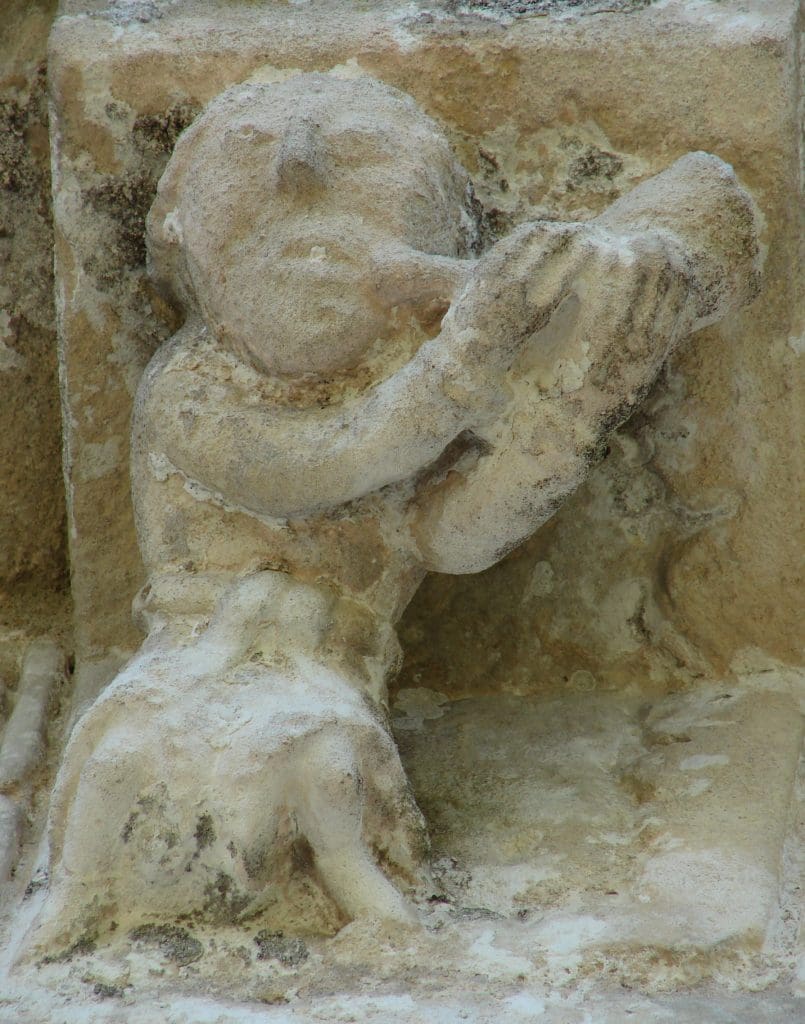
Fig. 19. Horn player at Marignac.
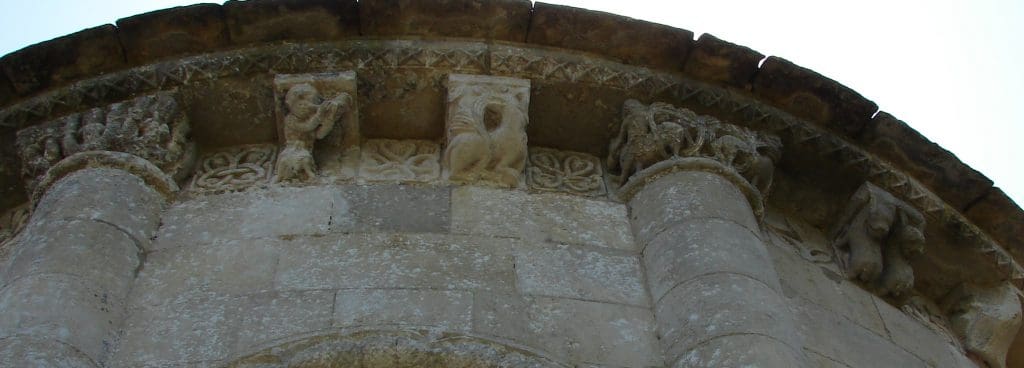
Fig. 20. Horn player in situ among capitals with double-tailed sirens and beasts. Note quatrefoil metope motifs. Marignac.
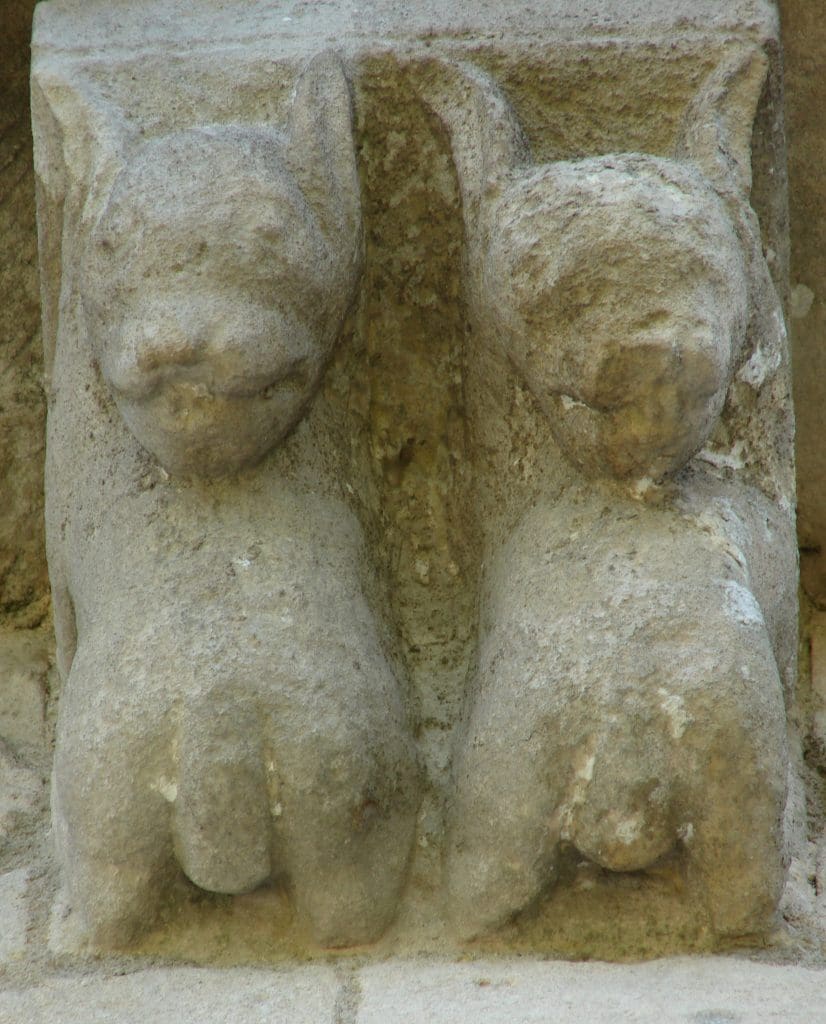
Fig. 21. Pair of very obvious male beasts. Marignac.
References to masturbation and the penis at Marignac are enhanced by two other motifs, one of which is the beast that sits next to the horn player (Fig. 22). The placement of the creature’s tail is blatantly phallic, for although the base of the tail is located exactly where it should be, the majority of the appendage rises up with a great flourish from the creature’s groin, where just a bit of it finds its way into the beast’s mouth. The tail, like trumpets and flutes, was also a favorite penile euphemism in popular narrative, as various scoundrels make constant efforts to pin a tail to the backside of their respective mistresses.[103] In the twelfth century, the tail as phallus was already endemic on the south portal of St.-Pierre in Aulnay (Fig. 23) where the animal parade on the archivolts contains at least nine examples of phallic, erect tails alongside the erect penises of surrounding creatures, thus concretizing the connection between the two appendages.[104] By the late Middle Ages, the therianthropic male with an enormous phallic tail was common in the marginalia of books of hours.[105]
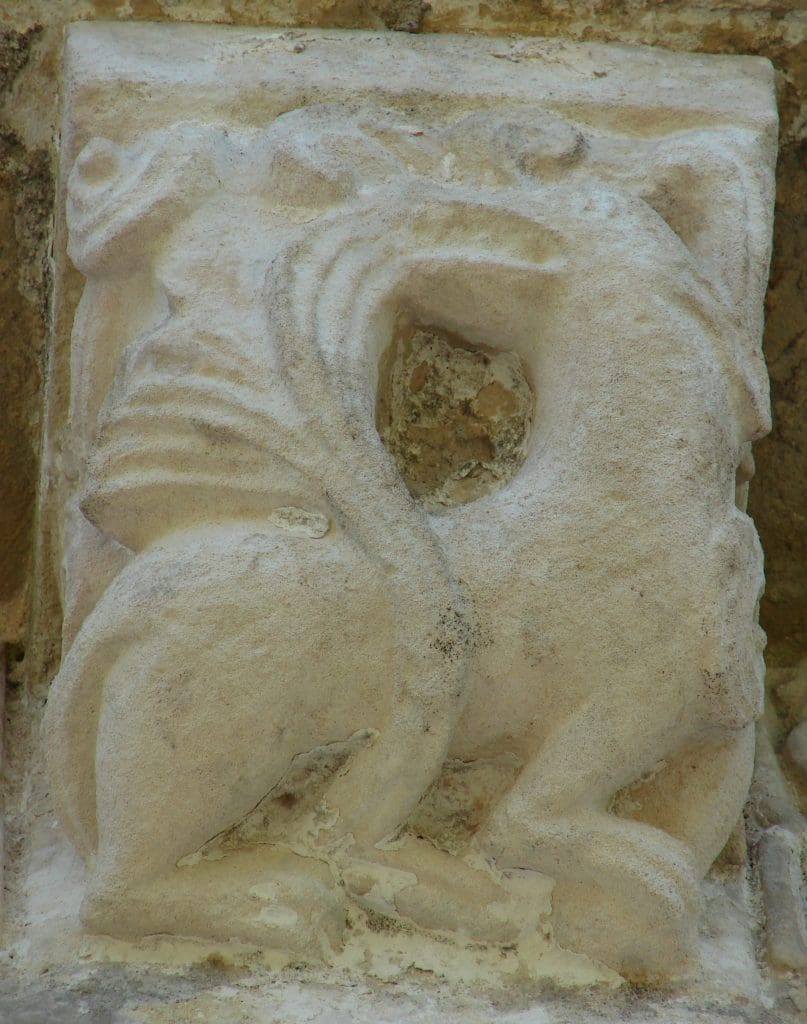
Fig. 22. Horn Player’s direct neighbor with groin-to-mouth tail. Marignac.
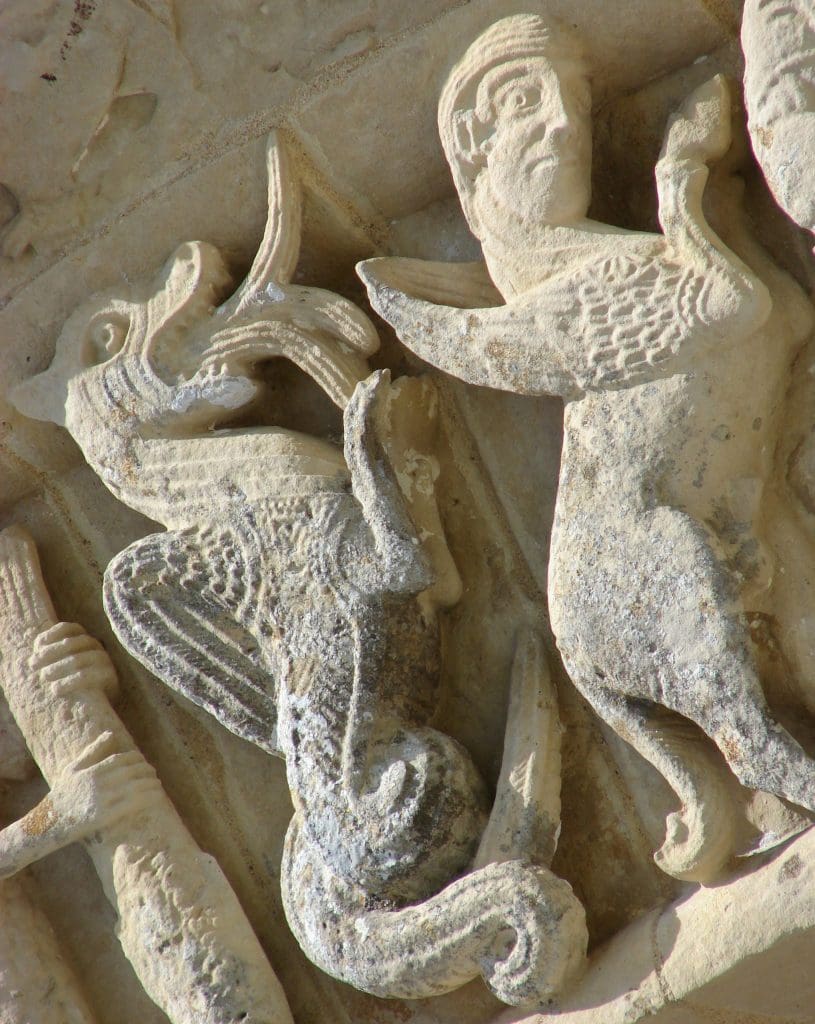
Fig. 23a. Therianthropic beasts with phallic tails at Aulnay.
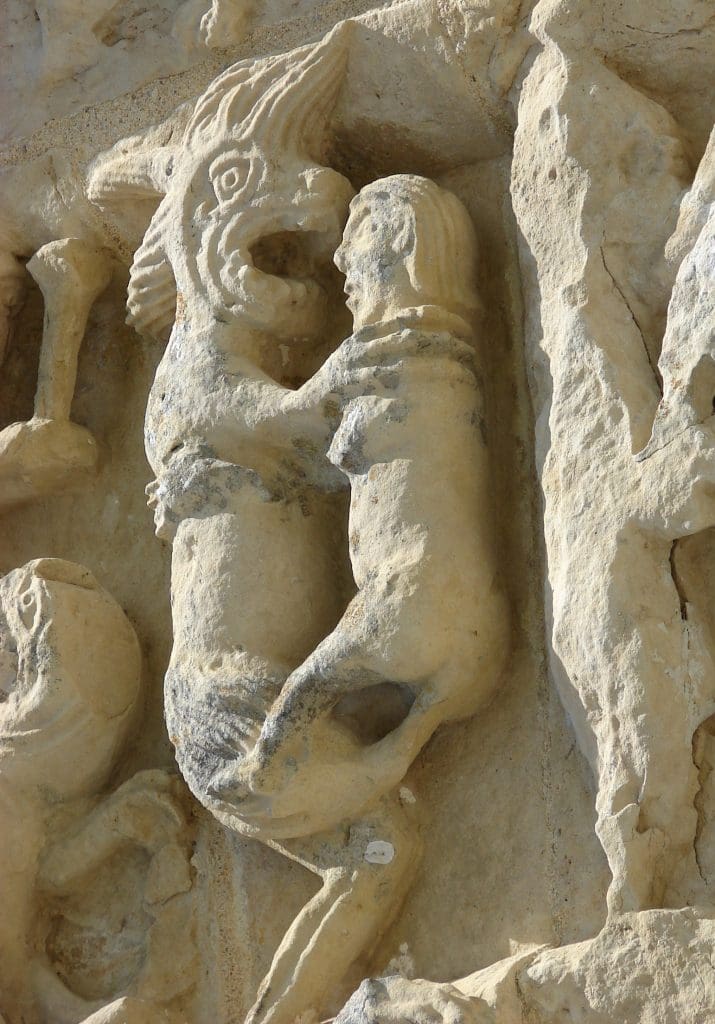
Fig. 23b. Therianthropic beasts with phallic tails at Aulnay.
The insinuation of visual metaphors relating to the penis and to masturbation is not limited to wind instruments in the profane symphony of the corbel table. Stringed instruments are also depicted as the constructed or surrogate phalluses of their players. Seen on corbel tables throughout Saintonge, the harp player squats with his instrument projecting from between his legs, which are often positioned much farther apart than they need to be to adequately support the instrument (Fig. 24). The effect is that the player cradles and strokes his instrument as it projects straight from his crotch. Similar figures populate the corbel tables of Saintonge, like these at Marignac and Corme Écluse (Figs. 25 and 26). At Poursay-Garnaud, a vielle player bows his instrument while an enormous phallus projects between his legs beneath the arc of his bow, leaving the viewer to ponder what sound that “string” makes (Fig. 27).
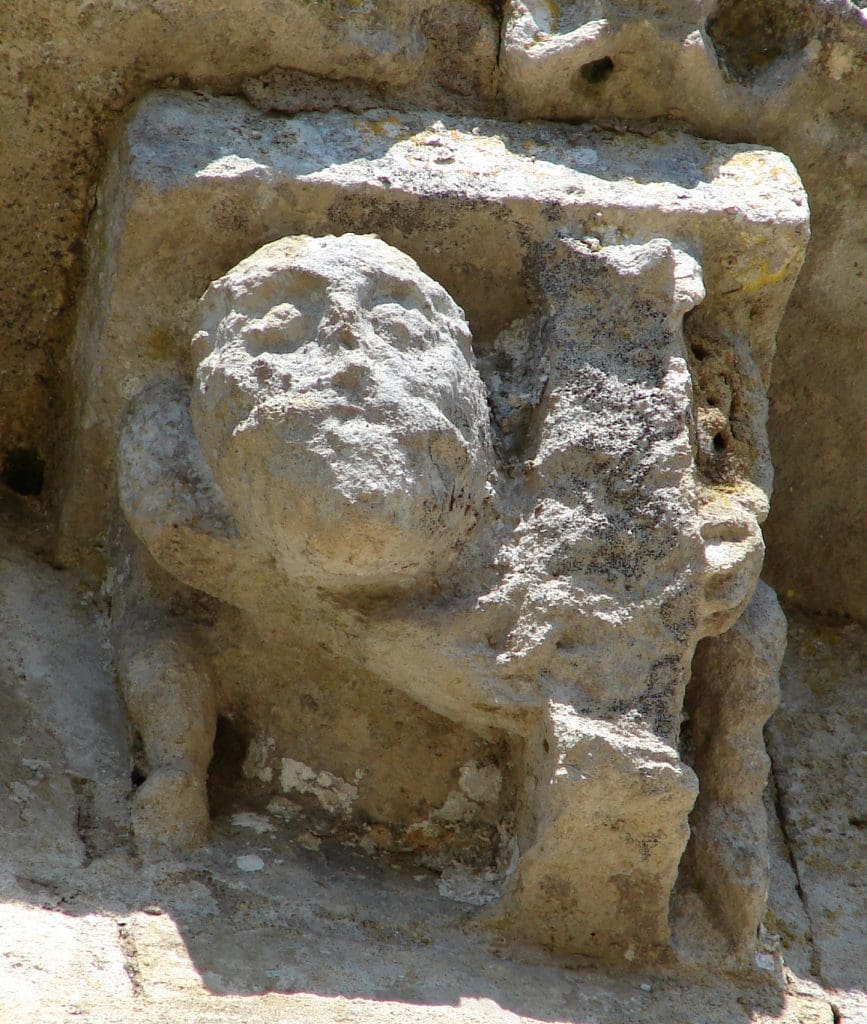
Fig. 24. Manspreading harpist at Champagnolles.
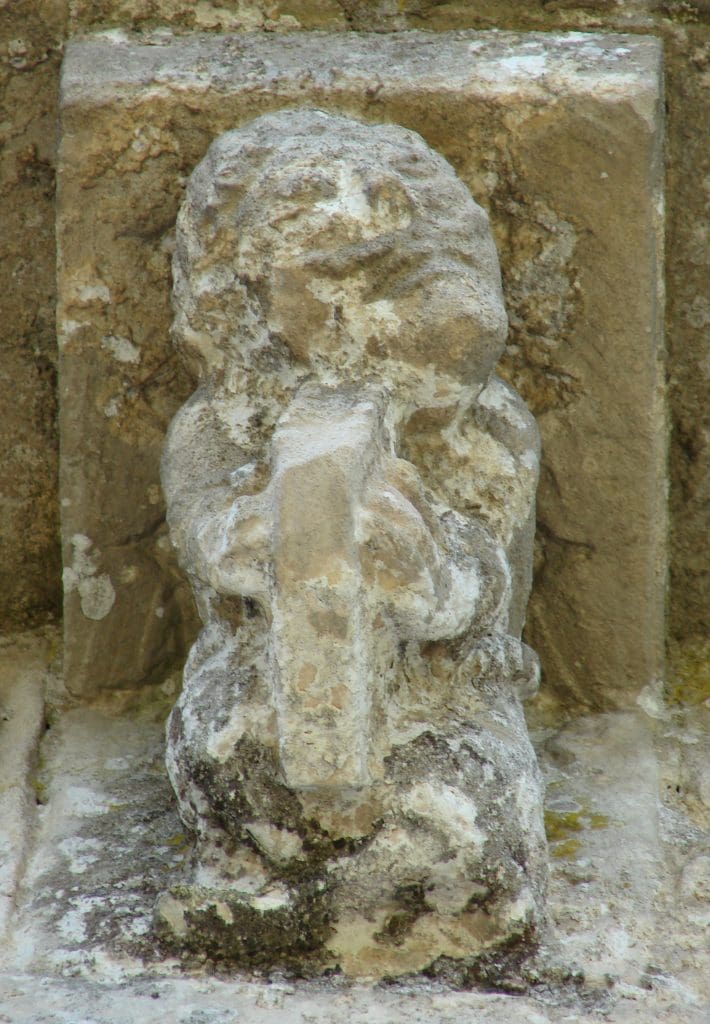
Fig. 25. Harpists at Marignac and Corme Écluse (Photo John Tchalenko).
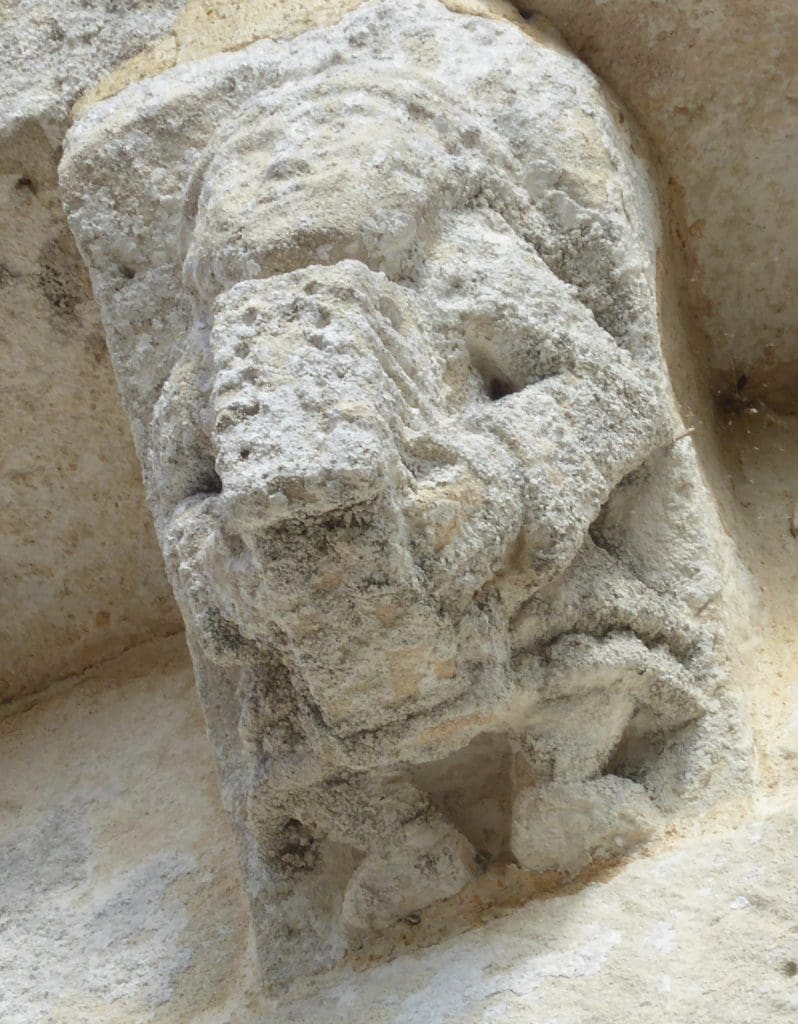
Fig. 26. Harpists at Marignac and Corme Écluse (Photo John Tchalenko).
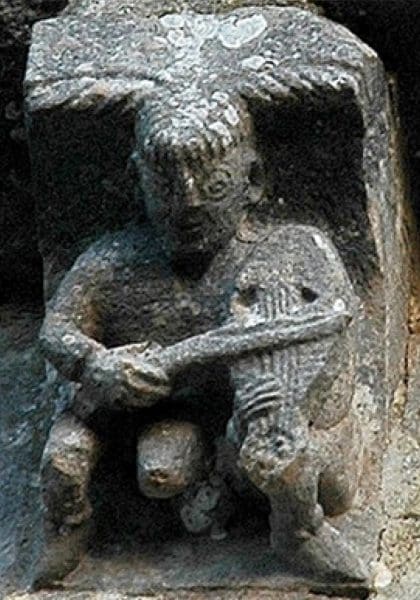
Fig. 27. Viol player at Poursay-Garnaud. (Photo John Tchalenko)
The presence of these musicians within a profane visual compositional structure would have added more aural chaos to the already loud imaginary soundtrack emanating from the corbel table with its snorting, snarling beasts and grunting coital couples accompanied by all their attendant sensory associations. The well-known jokes, euphemisms, and song structures that were beloved by twelfth-century Saintongeais villagers were manipulated by the Church, which removed their oral performances from the tavern or other secular gathering spaces and made them material in service of the Church. They were placed on the corbel table among other threats to the soul to admonish in perpetuity. In recontextualizing and weaponizing these motifs, the Church redefined elements of popular culture and created something antisocial and loathsome, a sort of “no-touch-torture” that defined how space was occupied. The sonic assault from the corbel tables curtailed loitering and moved people away from the edges, nooks, and shadows of the church’s exterior and towards a more appropriate destination, not unlike classical music blaring from a midwestern laundromat in the middle of the night.
References
| ↑1 | Lily E. Hirsch, “Weaponizing Classical Music: Crime Prevention and Symbolic Power in the Age of Repetition,” Journal of Popular Music Studies 19/4 (2007): 342-58 and her Music in American Crime Prevention and Punishment (Ann Arbor: University of Michigan Press, 2012), 13-5, 110-31. https://doi.org/10.1111/j.1533-1598.2007.00132.x. |
|---|---|
| ↑2 | Hirsch, “Weaponizing Classical Music,” 342and her Music in American Crime Prevention, 25; see also Suzanne G. Cusick, “ ‘You Are In A Place That is Out of This World…’: Music in the Detention Camps of the ‘Global War on Terror,’” Journal of the Society for American Music 2/1 (2008): 1-26, https://doi.org/10.1017/S1752196308080012, and her “Music as Torture/Music as Weapon,” Trans: Revista Transcultural de Música 17(2003): 2013. https://www.sibetrans.com/trans/articulo/152/music-as-torture-music-as |
| ↑3 | Hirsch, Music in American Crime Prevention, 22-8. |
| ↑4 | Elza Relman, “A Composer of Classical Music Blasted in the LA Metro to Force Unhoused People Out of a Station Demanded the System Stop Using His Work, Saying ‘No Form of Art Should be Used to Discourage or Limit Freedoms,” http://businessinsider.com/composer-objected-la-metro-balsting-music-deter-unhoused-people2023-4. L.A. Metro has since removed Berenguer’s composition at his request. |
| ↑5 | Disclaimer: I am a huge fan of classical music, a former viola player, and I stream classical music in my house most waking hours. Having said that, if you want to test your tolerance, you can hear the Berenguer piece here. L.A. Metro was playing this at the decibel level of a leaf blower: https://www.youtube.com/watch?v=Ob6gPTshwUE&t=1s |
| ↑6 | Although older, the most comprehensive studies about the churches of Saintonge that aid in their dating are Charles Connué, Les églises de Saintonge. 5 volumes (Saintes: P. Delavaud, 1952); René Crozet, L’art roman en Saintonge (Paris: J. Picard, 1971); and Elizabeth Lawrence Mandell, Romanesque Sculpture in Saintonge (New Haven: Yale University Press, 1940). The bishopric’s archives were burned during the Wars of Religion, and the remains, now in the archives of La Rochelle, consist of a few fragments and a ledger dating from the 16th century. There are literally no surviving records of these churches or their patronage before this ledger, as I learned when I visited the archives in 2009. The village churches in Saintonge are of different types: most are priory churches or some sort of dependency of an abbey, but there are a few parish churches. Those with monastic connections do not favor a particular affiliation. Holly Silvers, Repulsive Rhetoric: Profanity in the Visual Vernacular of Village Churches in Romanesque Saintonge, (PhD diss., Indiana University, 2010). |
| ↑7 | Given the iconography in these areas of primary sculpture, Marcello Angheben suggests that the song of the seraphs sung by the Living Creatures, “Holy, Holy, Holy, Lord God Ruler of all, who was and is and is to come” is the music of the portal. See his “Romanesque Sculpture in Aquitaine: A History of the Marginalisation of a Widely Imitated Regional Sculptural Style,” in The Regional and Transregional in Romanesque Europe, eds. John McNeill and Richard Plant (London: Routledge, 2021), 41. |
| ↑8 | See the motif distribution maps in Anthony Weir and James Jerman, Images of Lust: Sexual Carvings on Medieval Churches (London: Routledge, 1986), 126-137. |
| ↑9 | The multi-sensory experience of viewing is one of the most important considerations when determining how our medieval audience interacted with ecclesiastical sculpture. There is a vast body of work concerning medieval synaesthesia or multi-sensory responses by medieval audiences to various stimuli. Among the most comprehensive are Éric Palazzo’s L’invention chrétienne des cinq sens dans la liturgie et l’art du Moyen Âge (Paris: Éditions du Cerf, 2014) and his Cinq sens au Moyen Âge (Paris: Éditions du Cerf, 2016); Richard G. Neuhauser, ed., A Cultural History of the Senses in the Middle Ages (London: Bloomsbury Academic, 2018); Stephen G. Nichols, Andreas Kablitz, Alison Calhoun, eds., Rethinking the Medieval Senses: Heritage, Fascinations, Frames (Baltimore: The Johns Hopkins University Press, 2008); and these works incorporating other relevant eras: Heather Hunter-Crawley, and Erica O’Brien, eds., The Multi-Sensory Image from Antiquity to the Renaissance (London: Routledge, 2019); Shane Butler and Alex Purves, eds., Synaesthesia and the Ancient Senses (London: Routledge, 2013). |
| ↑10 | Charles F. Altman, “The Medieval Marquee: Church Portal Sculpture as Publicity,” Journal of Popular Culture 14/1 (1980): 37-46. https://doi.org/10.1111/j.0022-3840.1980.1401_37.x. |
| ↑11 | Henri Focillon and Émile Mâle were openly dismissive of the Aquitaine façade as lacking in substance and more or less existing for the sake of ornamentation. See Émile Mâle, L’art religieux du XIIe siècle en France. Étude sur les origines de l’iconographie du Moyen Âge (Paris: Librarie Armand Colin, 1924) and Henri Focillon Art d’Occident (Paris: Librarie Armand Colin, 1938). |
| ↑12 | See the excellent vindication of the Aquitaine façade in Marcello Angheben’s “Romanesque Sculpture in Aquitaine,” 35-45. Angheben builds upon the observations of Anat Tcherikover in her High Romanesque Sculpture in the Duchy of Aquitaine (Oxford: Oxford University Press, 2007). |
| ↑13 | Linda Seidel, Songs of Glory: The Romanesque Façades of Aquitaine (Chicago: University of Chicago Press, 1981), 19-33. |
| ↑14 | Altman, “The Medieval Marquee,” 38, and Seidel, Songs of Glory, 33. |
| ↑15 | Altman, “The Medieval Marquee,” 38-9. |
| ↑16 | Jacqueline Jung, “The Tactile and the Visionary: Notes on the Place of Sculpture in the Medieval Religious Imagination,” in Looking Beyond: Visions, Dreams, and Insights in Medieval Art and History, ed. Colum Hourihane (Princeton: Index of Christian Art, 2010), 215. |
| ↑17 | Karen Rose Matthews, “Reading Romanesque Sculpture: The Iconography and Reception of the South Portal Sculpture at Santiago de Compostela,” Gesta 39/1 (2000): 8. https://doi.org/10.2307/767148. |
| ↑18 | Leah Rutchick, “Visual Memory and Historiated Sculpture in the Moissac Cloister,” in Der Mittelalterliche Kreuzgang,ed. Peter Klein (Schnell and Steiner: Regensberg, 2004), 211; Kirk Ambrose, The Nave Sculpture of Vézelay: The Art of Monastic Viewing (Toronto: The Pontifical Institute of Mediaeval Studies, 2006), xi-xii; Barry Magrill, “Figurated Corbels on Romanesque Churches: The Interface of Diverse Social Patterns Represented on Marginal Spaces.” RACAR revue d’art canadienne, Vol.34, No.2 (2009), 44-45. |
| ↑19 | Ambrose, The Nave Sculpture of Vézelay, 17-18. |
| ↑20 | Anthony Weir and James Jerman, Images of Lust: Sexual Carvings on Medieval Churches (London: Routledge, 1986). |
| ↑21 | Nurith Kenaan-Kedar, Marginal Sculpture in Medieval France: Towards the Deciphering of an Enigmatic Pictorial Language (Hants, England: Scolar Press, 1995) and her “The Margins of Society on Marginal Romanesque Sculpture,” Gesta 31/1 (1992): 15-24. https://doi.org/10.2307/767047. |
| ↑22 | Marian Bleeke. “Sheelas, Sex, and Significance in Romanesque Sculpture: The Kilpeck Corbel Series.” Studies in Iconography, Vol. 26 (2005), 1-26. |
| ↑23 | Barry Magrill, “Figurated Corbels on Romanesque Churches,” pp. 43-54 |
| ↑24 | Malcolm Parkes, Pause and Effect: An Introduction to the History of Punctuation in the West (Aldershot, Hants: Scolar Press, 1992), 44. |
| ↑25 | Thomas E.A. Dale, Pygmalion’s Power: Romanesque Sculpture, the Senses, and Religious Experience (University Park: The Pennsylvania State University Press, 2019), 143-4. |
| ↑26 | Michael D. Costen and Catherine Oakes, Romanesque Churches of the Loire and Western France (Gloucestershire: Tempus, 2001),133-5; François Eygun, Saintonge Romane (La-Pierre-qui-Vire: Zodiaque, 1970), 133-83; Adolf Katzenellenbogen, Allegories of Virtues and Vices in Medieval Art (New York: W.W. Norton, 1964), 75-6 et passim; René Crozet, L’art roman en Saintonge (Paris: J. Picard, 1971), passim; Arthur Kingsley Porter, Romanesque Sculpture of the Pilgrimage Roads (Boston: Marshall Jones Company, 1923), 171-96. |
| ↑27 | Dale, Pygmalion’s Power, 145. |
| ↑28 | Richard William Hunt, and G.L. Bursill-Hall, eds., The History of Grammar in the Middle Ages: Collected Papers(Amsterdam: Benjamin, 1980), p. 25. |
| ↑29 | Elena Lombardi, The Syntax of Desire: Language and Love in Augustine, the Modistae, Dante (Toronto: University of Toronto Press, 2007), 212-3; Jesse M. Gellrich, The Idea of the Book in the Middle Ages: Language Theory, Mythology, and Fiction (Ithaca: Cornell University Press, 1985), 104. |
| ↑30 | Paul Saenger, Space Between Words: The Origins of Silent Reading (Stanford, CA: Stanford University Press, 1997), 32. https://doi.org/10.1515/9781503619081. |
| ↑31 | See Parkes, Pause and Effect, also Paul Saenger, Space Between Words, and his “Silent Reading: Its Impact on Late Medieval Script and Society,” Viator 13 (1982): 377-8. https://doi.org/10.1484/J.VIATOR.2.301476. |
| ↑32 | Keith Busby, “Mise en texte as Indicator or Oral Performance in Old French Verse Narrative,” in Performing Medieval Narrative, eds. Evelyn Birge Vitz, Nancy Freeman Regalado, and Marilyn Lawrence (Cambridge: D.S. Brewer, 2005), 71. https://doi.org/10.1515/9781846154201-008. |
| ↑33 | Parkes, Pause and Effect, 22, 44. |
| ↑34 | Parkes, Pause and Effect, 83. |
| ↑35 | Margaret Switten, “Versus and Troubadours Around 1100: A Comparative Study of Refrain Technique in the ‘New Song’,” Plainsong and Medieval Music 16/2 (2007): 91-2. https://doi.org/10.1017/S0961137107000678. |
| ↑36 | Cicero promoted the distance of about thirty feet for the construction of imaginary memory palaces, because that distance allowed one to take in a large section of architecture while still being able to note details. Most corbels on these village churches are easily seen along with their surroundings at thirty feet. See Marcus Tullius Cicero, Rhetorica ad herennium(book III, xix.32), trans. and ed. by Harry Caplan (Cambridge, MA: Harvard University Press, 1954), 219. |
| ↑37 | Switten, “Versus and Troubadours,” 107-8. |
| ↑38 | Brian Stock, The Implications of Literacy: Written Language and Models of Interpretation in the Eleventh and Twelfth Centuries (Princeton: Princeton University Press, 1983), 34. |
| ↑39 | R. Howard Bloch, Etymologies and Genealogies: A Literary Anthropology of the French Middle Ages (Chicago: University of Chicago Press, 1983), 34. |
| ↑40 | Augustine, De doctrina christiana, ed. and trans. R.P.H. Green (Oxford: Clarendon Press, 1995), Book II, 12.18; Book III 2.5, 3.6, 28.39, 37.55. |
| ↑41 | Thomas Aquinas, The Treatise on the Divine Nature: Summa Theologiae I, ed. and trans. Brian J. Shanley (Indianapolis: Hackett Publishing, 2006), 352. |
| ↑42 | Leah Ruthchick, “Visual Memory and Historiated Sculpture in the Moissac Cloister,” in Der mittelalterliche Kreuzgang, ed. Peter Klein (Regensberg: Schnell and Steiner, 2004), 190-211. Mary Carruthers, The Book of Memory: A Study of Memory in Medieval Culture (Cambridge: Cambridge University Press, 1992), 35-7, 39, 144, 210. |
| ↑43 | There are also similarities in the patterns of usage of certain motifs with the patterns associated with fabliaux. See the chapter on episteme and narreme in Roy J. Pearcy, Logic and Humor in the Fabliaux: An Essay in Applied Narratology(London: Boydell and Brewer, 2007), 52-76. |
| ↑44 | Michael Camille, “Seeing and Reading: Some Visual Implications of Medieval Literacy,” Art History 8 (1985): 27. For accounts of this phenomenon in England, see Michael Clanchy, From Memory to Written Record: England 1066-1307(Malden, MA: Blackwell, 1993), 206-8. |
| ↑45 | The body of scholarship on popular narrative in the Middle Ages is vast. A few key volumes that discuss early works include Peter Godman, The Archpoet and Medieval Culture (Oxford: Oxford University Press, 2014); Jan M. Ziolkowski, Fairy Tales from Before Fairy Tales: The Medieval Latin Past of Wonderful Lies (Ann Arbor: University of Michigan Press, 2010), Jan M. Ziolkowski, ed., Obscenity: Social Control and Artistic Creation in the European Middle Ages (Leiden: Brill, 1998). https://doi.org/10.1163/9789004613690; George Wolf and Roy Rosenstein, eds. and trans., The Poetry of Cercamon and Jaufré Rudel (New York: Garland Publishing, 1983); William E. Burgwinkle, trans., Razos and Troubadour Songs (New York: Garland Publishing, 1990); R. Howard Bloch, The Scandal of the Fabliaux (Chicago: University of Chicago Press, 1986). |
| ↑46 | George T. Beech, “Troubadour Contact with Muslim Spain and Knowledge of Arabic: New Evidence Concerning William IX of Aquitaine,” Romania 113 (1992-1995): 4-42. https://doi.org/10.3406/roma.1992.2180. |
| ↑47 | Beech “Troubadour Contact,” 23. |
| ↑48 | Peter Dronke, “The Rise of the Medieval Fabliau: Latin and Vernacular Evidence,” Romanische Forschungen 85/3 (1973): 276. |
| ↑49 | For examination of the Old French Tales, see Charles Muscataine, The Old French Fabliaux (New Haven: Yale University Press, 1986); Kristin L. Burr, John F. Moran, and Norris J. Lacy, eds., The Old French Fabliaux: Essays on Comedy and Context (Asheville: McFarland, 2007); Anne Elizabeth Cobby, The Old French Fabliaux: An Analytical Bibliography (Woodbridge, Suffolk: Tamesis, 2009). |
| ↑50 | Dronke, “The Rise of the Medieval Fabliau,” 276. |
| ↑51 | Illustrated in Guy Halsall, ed., Humor, History and Politics in Late Antiquity and the Early Middle Ages (New York: Cambridge University Press, 2002), especially Danuta Shanzer’s “Laughter and Humor in the Early Medieval Latin West,” 25-47; Mark Humphries’ “The Lexicon of Abuse: Drunkeness and Political Illegitimacy in the Late Roman World,” 75-88; and Guy Halsall’s “Funny Foreigners: Laughing with the Barbarians in Late Antiquity,” 89-113. https://doi.org/10.1017/CBO9780511496325.006. |
| ↑52 | Dronke, “The Rise of the Medieval Fabliau,” 277-8, esp. note 6. |
| ↑53 | Dronke, “The Rise of the Medieval Fabliau,” 277-8. See also Joseph Bédier, Les fabliaux, etudes de literature populaire et d’histoire littéraire du Moyen Âge (Paris: É. Bouillon, 1893), 91. |
| ↑54 | Marisa Galvez, Songbook: How Lyrics Became Poetry in Medieval Europe (Chicago: University of Chicago Press, 2012), 59. https://doi.org/10.7208/chicago/9780226280523.001.0001. |
| ↑55 | Emma Dillon, “Unwriting Medieval Song,” New Literary History 46:4 (2015): 599-601; see also Sarah Kay’s volume on quoting song and the use of songbooks, Parrots and Nightingales: Troubadour Quotations and the Development of European Poetry (Philadelphia: University of Pennsylvania Press, 2013). |
| ↑56 | Emma Dillon, “Unwriting Medieval Song,” 604. |
| ↑57 | Bruce Holsinger, Music, Body, and Desire in Medieval Culture: Hildegard of Bingen to Chaucer (Stanford: Stanford University Press, 2001), 152-63. https://doi.org/10.1515/9781503617148. |
| ↑58 | Holsinger, Music, Body, and Desire, 162. |
| ↑59 | Theresa Gross-Diaz, “From Lectio Divin to the Lecture Room: The Psalm Commentary of Gilbert of Poitiers,” in The Place of the Psalmsin the Intellectual Culture of the Middle Ages, ed. Nancy Van Deusen (Albany, NY: State University of New York Press, 1999), 95-7. |
| ↑60 | Katie Elizabeth Chapman, “Digital Approaches to Troubadour Song,” (PhD diss., Indiana University Bloomington, 2020), 156-179. |
| ↑61 | Holsinger, Bruce. Music, Body, and Desire, 171-2. |
| ↑62 | Carruthers, The Book of Memory, 133. |
| ↑63 | The twelfth century saw increasing use of the vernacular in preaching, and performance elements (often low-brow in nature) were frequently added to the sermon. See Giles Constable, “The Language of Preaching in the Twelfth Century,” Viator 25 (1994): 131-52. https://doi.org/10.1484/J.VIATOR.2.301211; C. Clifford Flanigan, Kathleen Ashley, and Pamela Sheingorn, “Liturgy as Social Performance: Expanding the Definitions,” in The Liturgy of the Medieval Church, eds. Thomas J. Heffernan and E. Ann Matter (Kalamazoo, MI: Western Michigan University Press, 2001), 695-714; Carol Symes, “The Appearance of Early Vernacular Plays: Forms, Functions and the Future of Medieval Theatre,” Speculum 77 (2002): 778-831. https://doi.org/10.2307/3301114; Adrian P. Tudor “Preaching, Storytelling, and the Performance of Short Pious Narratives,” in Performing Medieval Narrative, eds. Evelyn Birge Vitz, Nancy Freeman Regalado, and Marilyn Lawrence (Cambridge: D.S. Brewer, 2005), 141-53. https://doi.org/10.1515/9781846154201-013. |
| ↑64 | Carruthers, The Book of Memory, 223-4. |
| ↑65 | Carruthers, The Book of Memory, 227. |
| ↑66 | Emma Dillon, “Representing Obscene Sound,” in Medieval Obscenities, ed. Nicola McDonald (Woodbridge, Suffolk: York Medieval Press, 2006), 73. |
| ↑67 | Jean Dunbabin, France in the Making: 843-1180 (Oxford: Oxford University Press, 1985), 340-1. |
| ↑68 | William D. Paden and Frances Freeman Paden, trans., Troubadour Poems from the South of France (Woodbridge, Suffolk: D.S. Brewer, 2007), 32. |
| ↑69 | Ruth E. Harvey, “Joglars and the Professional Status of the Early Troubadours,” Medium Aevum (Sept. 22, 1993): 231. https://doi.org/10.2307/43629555. |
| ↑70 | Paul Cravayat, “Les origins du troubadour Jaufré Rudel,” Romania 71 (1950): 174-5. https://doi.org/10.3406/roma.1950.3702. Rudel’s extant body of work is published with preface and modern French translations in Yves Leclair, trans., and Roy Rosenstein, Chansons pour un amour lointain (Gardonne, France: Fédérop, 2011). |
| ↑71 | Paden Troubadour Poems, 8-11. |
| ↑72 | Beech, “Troubadour Contact,” 20-5. |
| ↑73 | Paden, Troubadour Poems, 24. |
| ↑74 | William Burgwinkle, “Troubadour Song and the Art of Juggling,” Pacific Coast Philology 26/1-2 (1991): 15-6. https://doi.org/10.2307/1316551. |
| ↑75 | Burgwinkle, “Troubadour Song,” 20. |
| ↑76 | Leslie Dunton-Downer, “Poetic Language and the Obscene,” in Obscenity: Social Control and Artistic Creation in the European Middle Ages, Jan M. Ziolkowski, ed. (Leiden: Brill, 1998), 29. https://doi.org/10.1163/9789004613690_005. |
| ↑77 | Patrick K. Ford, “The Which on the Wall: Obscenity Exposed in Early Ireland,” in Obscenity: Social Control and Artistic Creation in the European Middle Ages, ed. Jan M. Ziolkowski (Leiden: Brill, 1998), 177. |
| ↑78 | Dillon, “Representing Obscene Sound,” 61. |
| ↑79 | Bloch, The Scandal of the Fabliaux, 90, and Dillon, “Representing Obscene Sound,” 63. |
| ↑80 | Charles Muscataine, “The Fabliaux, Courtly Culture, and the (re)Invention of Vulgarity,” in Obscenity: Social Control and Artistic Creation in the European Middle Ages, ed. Jan M. Ziolkowski (Leiden: Brill, 1998), 281. https://doi.org/10.1163/9789004613690_019. |
| ↑81 | Jan M. Ziolkowski, “The Latin Grammatical and Rhetorical Tradition,” in Obscenity: Social Control and Artistic Creation in the European Middle Ages, ed. Jan M. Ziolkowski (Leiden: Brill, 1998), 33. |
| ↑82 | Caroline Walker Bynum, Fragmentation and Redemption: Essays on Gender and the Human Body in Medieval Religion(New York: Zone Books, 1991), 162-3; Mitchell Merback includes the wounds and evidence of corporeal punishment in the valorization of the naked holy body. See his The Thief, the Cross, and the Wheel: Pain and the Spectacle of Punishment in Medieval and Renaissance Europe (Chicago: University of Chicago Press, 1999), 151-7, et passim. |
| ↑83 | Dale, Pygmalion’s Power, 51-2. |
| ↑84 | Herbert L. Kessler “From Vanitas to Veritas: The Profane as the Fifth Mode of Romanesque Art.” Codex Aquilarensis 33 (2017): 27-54. |
| ↑85 | Ruth Mazo Karras, Sexuality in Medieval Europe: Doing Unto Others (New York: Routledge, 2005), 79. |
| ↑86 | Norris J. Lacy, Reading Fabliaux (Birmingham, AL: Summa, 1999), 61-2. Surpassing anti-feminist rhetoric, Norris notes that one particularly violent tale contains an “unadorned hatred of women.” |
| ↑87 | R. Howard Bloch, “ Modest Maids and Modified Nouns. Obscenity in the Fabliaux,” in Obscenity: Social Control and Artistic Creation in the European Middle Ages, ed. Jan M. Ziolkowski (Leiden: Brill, 1998), 301. The still-popular “balls” and “nuts” were also in wide usage as testicular euphemisms in the Middle Ages. |
| ↑88 | Louise O.Vasvári, “Fowl Play in My Lady’s Chamber: Textual Harassment of a Middle English Pornithological Riddle and Visual Pun,” in Obscenity: Social Control and Artistic Creation in the European Middle Ages, ed. Jan M. Ziolkowski (Leiden: Brill, 1998), 108. https://doi.org/10.1163/9789004613690_010. |
| ↑89 | Dillon, “Representing Obscene Sound,” 74. Dillon discusses the marginal musician in the manuscript tradition, but that model is appropriate for the corbel table as well in this instance. |
| ↑90 | Holsinger, Music, Body, and Desire, 178. |
| ↑91 | Dillon, “Representing Obscene Sound,” 75. |
| ↑92 | Valerie Allen, On Farting: Language and Laughter in the Middle Ages (New York: Palgrave Macmillan, 2007), 26. |
| ↑93 | Vasvári, “Fowl Play,” 124. |
| ↑94 | Although this façade has seen significant restoration, the flute player and the coupling couples are among the original corbels. |
| ↑95 | Bloch, “Modest Maids,” 299. |
| ↑96 | Allen, On Farting, 39. |
| ↑97 | Allen, On Farting, 43. |
| ↑98 | Switten, “Versus and Troubadours, 105. |
| ↑99 | Michael Camille, Image on the Edge: The Margins of Medieval Art (Cambridge, MA: Harvard University Press, 1992), 42. |
| ↑100 | James A. Schultz, “Bodies That Don’t Matter: Heterosexuality Before Heterosexuality in Gottfried’s Tristan,” in Constructing Medieval Sexuality, eds. Karma Lochrie, Peggy McCracken, and James A. Schultz (Minneapolis: University of Minnesota Press, 1997), 93. |
| ↑101 | Zehava Jacoby, “The Beard Pullers in Romanesque Art: An Islamic Motif and its Evolution in the West,” Arte Medieval2/1-2 (1987): 65-83. |
| ↑102 | Peter Damian, “Liber gomorrhianus,” MPL 145 (s.d.): 159-90. Cap. I, col. 161, Cap. XXII, col. 183. |
| ↑103 | Bloch, “Modest Maids,” 294. |
| ↑104 | Carrying by far the most profane assortment of figures on St.-Pierre, the south portal was reserved for members of the resident monastic community. The church’s west portal served pilgrims as well as local parishioners and featured the usual Saintonge Sermon in the archivolts. |
| ↑105 | Madeline Caviness, “Patron or Matron? A Capetian Bride and Vade Mecum for her Marriage Bed,” in Studying Medieval Women, ed. Nancy Partner (Cambridge, MA: Medieval Academy of America, 1993), 51. https://doi.org/10.2307/2864556. |