Risham Majeed • Ithaca College
Matthew J. Westerby • National Gallery of Art
Recommended citation: Risham Majeed and Matthew J. Westerby, “Africa in the World: materials without end. A Conversation with Risham Majeed and Matthew J. Westerby,” Different Visions: New Perspectives on Medieval Art 14 (2026). https://doi.org/10.61302/FFCT8180.
This conversation was edited from a recording made on April 21, 2026, in the exhibition Africa in the world: materials without end at the Handwerker Gallery, Ithaca College. In conversation are Risham Majeed (Associate Professor, Art, Art History, and Architecture, Ithaca College) and Matthew J. Westerby (Digital Research Officer, Center for Advanced Study in the Visual Arts, National Gallery of Art).
The exhibition brings together original objects with reproductions, 3D prints, and student-made facsimiles, to trace the movement of materials — gold, ivory, marble, silk, sardonyx — across Africa, the Mediterranean, South Asia, and Europe in the premodern world. Its accomplishments as a course and an exhibition exceeded its goals.
Some of the reproductions, animated media, and wall labels were made by students in Majeed’s Exhibition Seminar (Fall 2025), drawing attention to the ways in which reproductions of various sorts have long contributed to visual knowledge. At the same time, the opportunity to produce this material elevated the students’ role in the class from that of passive participant to that of creative agent. Finally, by placing canonical objects on display alongside less familiar ones, the show invited visitors to rethink conventional categories and designations, including those of time period, place of origin, and even religious affiliation.
The conversation highlights sectors of the exhibition from a Gandharan-Roman Buddha excavated in a port city to a Yakshi figure found in a Pompeian merchant’s villa. The Chalice of Abbot Suger as rendered in successive technologies of reproduction demonstrates how its origin as an Indian-African object has been suppressed throughout its 2000 year old existence. Throughout, Majeed and Westerby circle back to a set of questions with real stakes for how Art History can be practiced. What does it mean to call an object “African,” “Roman,” or “medieval” when its materials, makers, and meanings were never so neatly bounded? How does the Sahara function not as a barrier but as a highway? What can be revealed with reproductions that are touched, compared, and recombined freely?
RM: What is your general impression of the show?
MW: I read the catalog, so I came in with some expectations, but there’s so much more.[1] My initial impression is that you start with currency, and you see a wall of gold.
RM: You see it outside the windows.
MW: You do. So I’m immediately thinking, what does currency mean? But then I see portraits and faces, and I’m thinking about maps and transportation — about connecting cultures. Also, right away I wanted to walk to the back of the gallery, where I can see the bazaar, the covered table full of things.
You don’t get a chance to touch things in most art museums. The permission to touch real things and reproductions was exciting.
RM: One of the challenges of doing a show primarily of reproductions is how to make sure you’re not visualizing a book. In one case, we created a three-dimensional object out of a two-dimensional print and then enlarged parts to show scale.
Scale is so important because it draws you in.
MW: But there are no rulers.
RM: No rulers because we have the dimensions on each label; when an object is not to scale we highlight that. I hope you also pick up on the archaeological context. Where these things were found tells us so much about contacts and technologies of transport and materiality.
An advantage of reproduction is exhibiting things that have never and probably will never be shown together. Especially things that were recently excavated, like this Buddha, which is half Roman and half Gandharan in terms of its form (Fig. 1).
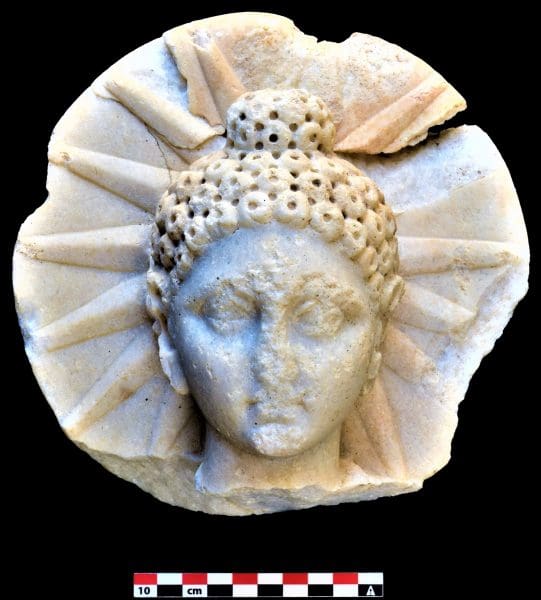
Fig 1 a. Unrecorded Artist, Buddha, Berenike or Alexandria, Egypt (excavated 2018-2022), Marble (from Paros), ca. 90-140 C.E., Berenike Archaeological Museum, Egypt.
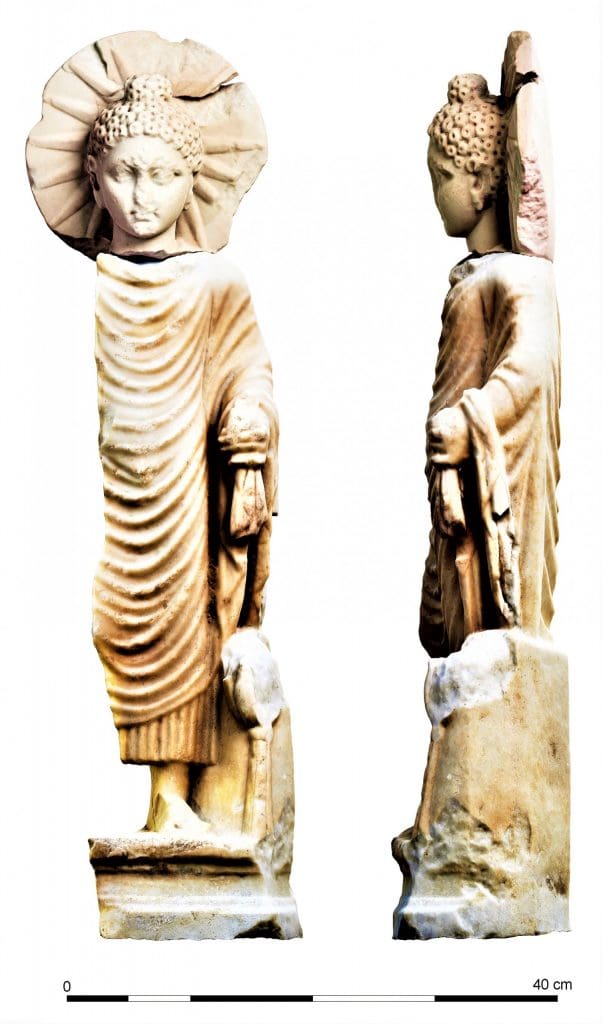
Fig 1 b. Unrecorded Artist, Buddha, Berenike or Alexandria, Egypt (excavated 2018-2022), Marble (from Paros), ca. 90-140 C.E., Berenike Archaeological Museum, Egypt.
It’s in an archaeological museum in Berenike [Egypt]. Few people know about it, but by chance, I sent an email to the archaeologist, Steven Sidebotham, asking for the dimensions.
He and his team had authored a 200-page report on the Temple of Isis in Berenike with evidence of 10 different languages and several different religions.[2] What struck me most about this Buddha is that the marble is from Paros. Sidebotham theorized that the Temple of Isis attracted highly trained sculptors from Alexandria to travel there, maybe seasonally, and to bring the materials and to carve following an oral description of deities that were new to the artists. People had settled in this port city and wanted a representation of their spiritual lives that wasn’t available in this new place.
MW: So you have different people involved in producing these works of art. Like the carver, the people who quarried the stone, the commissioner, the patron — how did they describe it? What was it supposed to be?
RM: The exciting thing we can do with reproductions is to make decisions up to the last minute. Two days before we started installing, we printed the Fayum portraits, because we had a Zoom conversation with Sidebotham, and he described this bustling city of multiple religions and foods and cultures and ethnicities, and I asked him if Fayum would be a corollary [yes]. The one thing I didn’t want to talk about in this show, which a lot of shows are dealing with, somewhat with a presentist lens, is race. Race is a later invention with a massive literature we won’t get into here.
We want to visualize the variety of types of people that may have lived in Berenike, in terms of their hair, their skin tones, their makeup, in terms of their fashion. We understand Fayum much more than Berenike, so the portraits help to enliven that for us.
MW: You can see examples of Fayum portraits in major art museums, but not next to this Buddha. Not next to this ivory Yakshi. In terms of the archaeological, you have a photo which I assume is the find context?
RM: Yes, it was in several pieces when it was discovered. You can see in the enlargement where pieces have been joined together. I was excited to see it in a show called Tree and Serpent at the Met about early Buddhism in India.[3] There was one room about connections to Rome, where they placed the Yakshi from the National Archaeology Museum of Naples (Fig. 2).
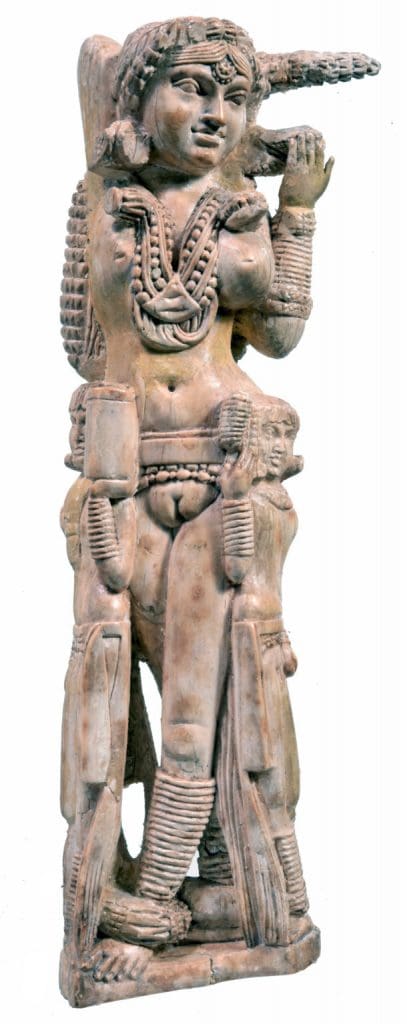
Fig 2. Unrecorded Artist. Yakshi figure (fertility spirit or perhaps a goddess), c. 1st century C.E., Indian Elephant Ivory, National Archeological Museum of Naples.
I wasn’t aware of it until that exhibition. As a medievalist, it’s not something commonly known; it was never presented in any class. Since it was discovered in Pompeii it has a firm date in the first century, and one can also understand it as an object of trade, because it was found in 1938 in a merchant’s villa.[4]
MW: One of the questions you pose — to go back for a second — is why an object is interesting.
RM: That’s the question Keith Moxey asked in “What Time is it in the History of Art?”[5] How do we generate interest in a particular object? Is it cultural context, or is it the afterlife of the object, or a combination of the two?
The Yakshi figure, which has well-known counterparts in stone in the architraves of the famous stupa at Sanchi, has an interest that exceeds its cultural context when it’s transferred to ivory and excavated in Pompeii. That fires your imagination as to what trade was like. The Indian ivory carver must have thought of his sculpture as divine-adjacent, yet the trader might have divested her of this meaning, and perhaps it was titillating to whoever purchased it.
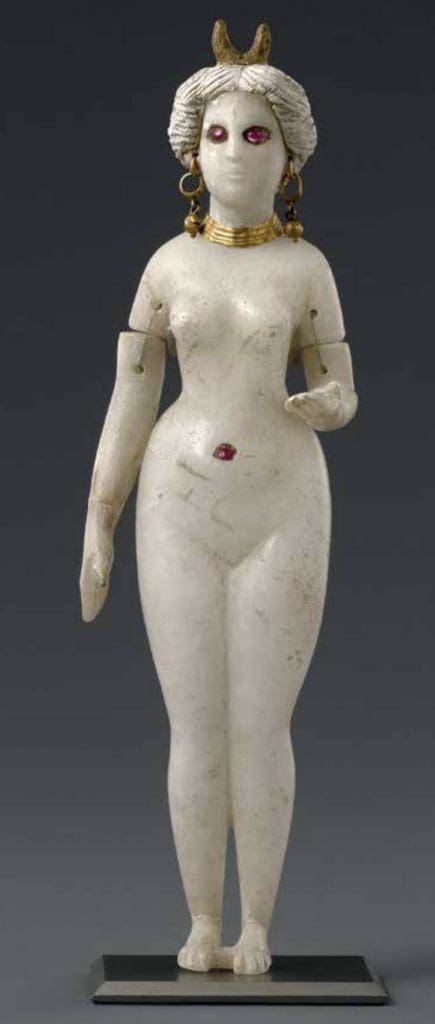
Fig 3. Unrecorded Artist, Statuette of a standing goddess, c. 1st century B.C.E-1st century C.E., alabaster, gold, stucco, bitumen, rubies, Babylon, Musée du Louvre, Paris.
There was another exhibition at the Met which displayed these tiny alabaster and marble goddesses in a startling way (Fig. 3).[6] They’re totally nude, the one in our show has rubies imported from Myanmar inlaid with bitumen into her eyes, with real jewels placed in the navel, the eyes, and a gold necklace. Keith’s idea allowed for this comparative analysis, not based on the fact that you can make a causal argument, but that a comparative approach permits us to recognize sameness in difference, which is fascinating as they were made in the same century and passed through the same lands. I think changes in materials are about “dressing” the divine, intensifying potency, and their small stature makes them personal.
MW: That idea of “knowing exactly” is so interesting to me. In this framework — out of time — you don’t have to know. Curiosity becomes more important.
RM: Right, and at that point it’s about speculation. You’re speculating, and in that speculation, it humanizes the object. Somebody owned it, somebody bought it, somebody made it, somebody touched it.
MW: Thinking of the Mediterranean, and looking over at the Catalan Atlas, it seems to illustrate mobility.
RM: Right. We’re talking about diverse people who were moving in time and place that we don’t really think about as having that range of mobility. Except for campaigns of conquest that we associate with the Roman Empire. The hybrid creations that we see here, from the Ivory Yakshi to the Berenike Buddha, are not a product of colonial machinations. Rather they evince mutual interest and desire, which is in my view, quite eloquent and moving.
I hope it motivates you to ask about what kind of difference is interesting to different time periods. For example, there’s a clear distinction in clothing in the Catalan Atlas, but Cresques probably never saw these things. For example, the camels — he only understood there was a hump and a long neck. At the same time there is a recognition that these animals are incredibly important, as it is the only way to cross the Sahara, connecting sub-Saharan Africa to the Mediterranean. Camels are the ships of the desert. So I think the analogy is being made by placing ships next to camels — there’s so many comparisons between a desert landscape and a seascape (Fig. 4).
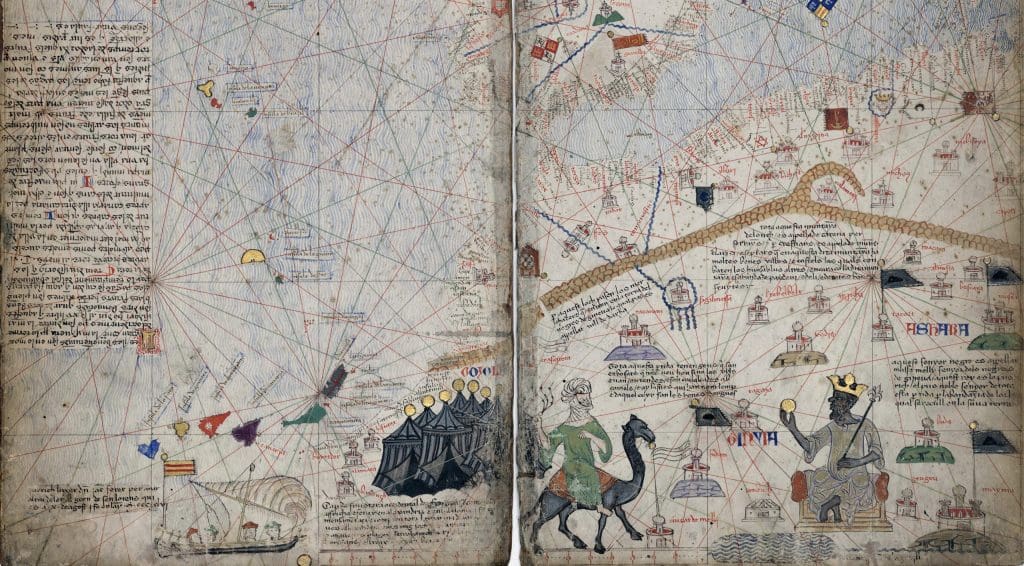
Fig 4. Abraham Cresques, Catalan Atlas (detail), Eight Vellum panels with pigment affixed to wood, Majorca, Spain, originally bound as a book for the Holy Roman Emperor Charles V, Bibliothèque Nationale de France.
One of the big points we wanted to make is the importance of nomads moving materials like gold and ivory. Mansa Musa controlled a vast quantity of very pure gold.[7] Looking at the tents in the Catalan Atlas, these are military tents that Roman soldiers would have used on temporary military campaigns. But Tuareg tents were engineered for year-long habitation. Men in Tuareg culture were veiled for practical purposes, for the desert winds. So, confused and partially known things are merged.
MW: The wall label says that tents were made and owned by women.[8] I didn’t know that. I’m also struck by how you characterize Ibn Battuta as a Tunisian globetrotter.
RM: Oh, he talks about nomad women at length, and how they’re so beautiful, and how they control the entire caravan.[9] That was hard to represent through objects, so we tried to do it later in the show with the Djenne terracotta showing a pregnant woman alongside the Tuareg dagger.
MW: I also enjoy how the labels are written, especially by students in the class. It’s not just about explaining their work, but how they write about their experience making, and what they’re familiar with and not familiar with.
RM: The students’ copies also highlight features you may not notice in the reproduction alone. For example, there is a hunk of ribs and meat on the Tang camel. You begin to think about trade and travel and goods, and practicalities. Coiled silk can be seen, which was traded for horses.[10] Food is prominently shown, which I hadn’t really thought about with this kind of funerary object of prestige (Fig. 5). Camels were used as currency as well, particularly amongst Rendille nomads in East Africa.
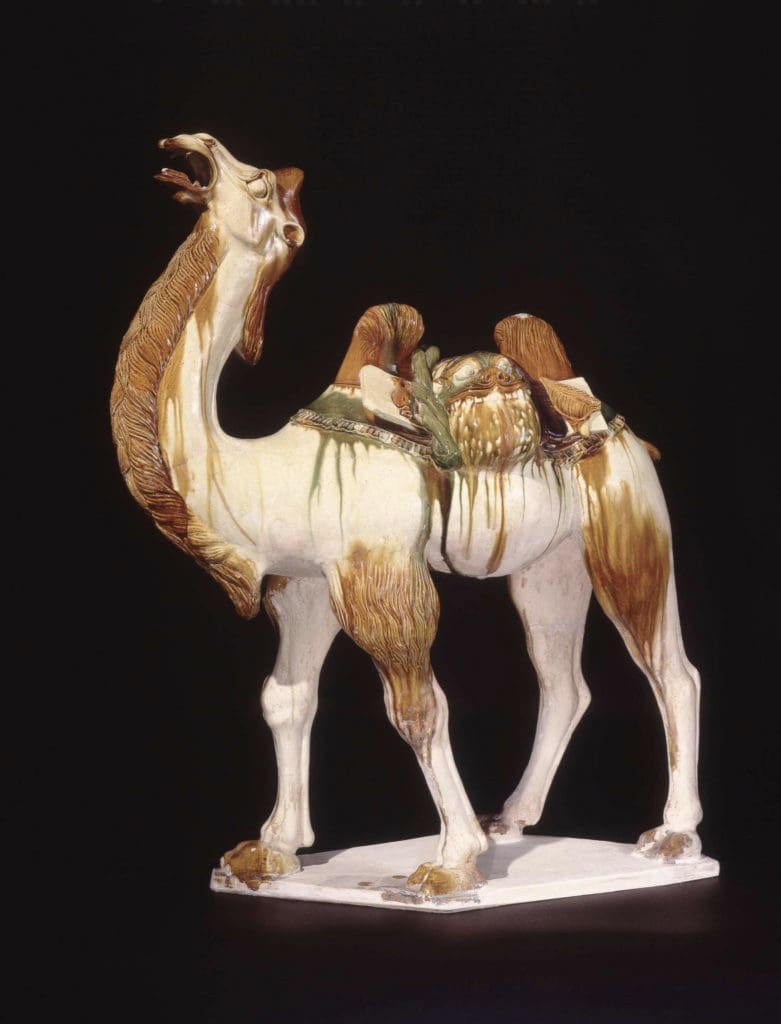
Fig 5. Unrecorded Artist, Camel, glazed earthenware, Luoyang, China, 728 C.E.
So while most of these things are copies or reproductions, we have this big plinth that we spray painted gold. I wanted to have something concrete from Africa tied into the themes of the show. These are not as old as the 8th and 9th century Igbo-Ukwu bronzes, the fabulous loans from the National Museum in Lagos that we saw in Caravans of Gold.[11] The earliest we have are from the 17th century, but they give you a sense of how much metal was traded in West Africa, and what virtuoso artistry was expended to craft currency (Figs. 6a,b).
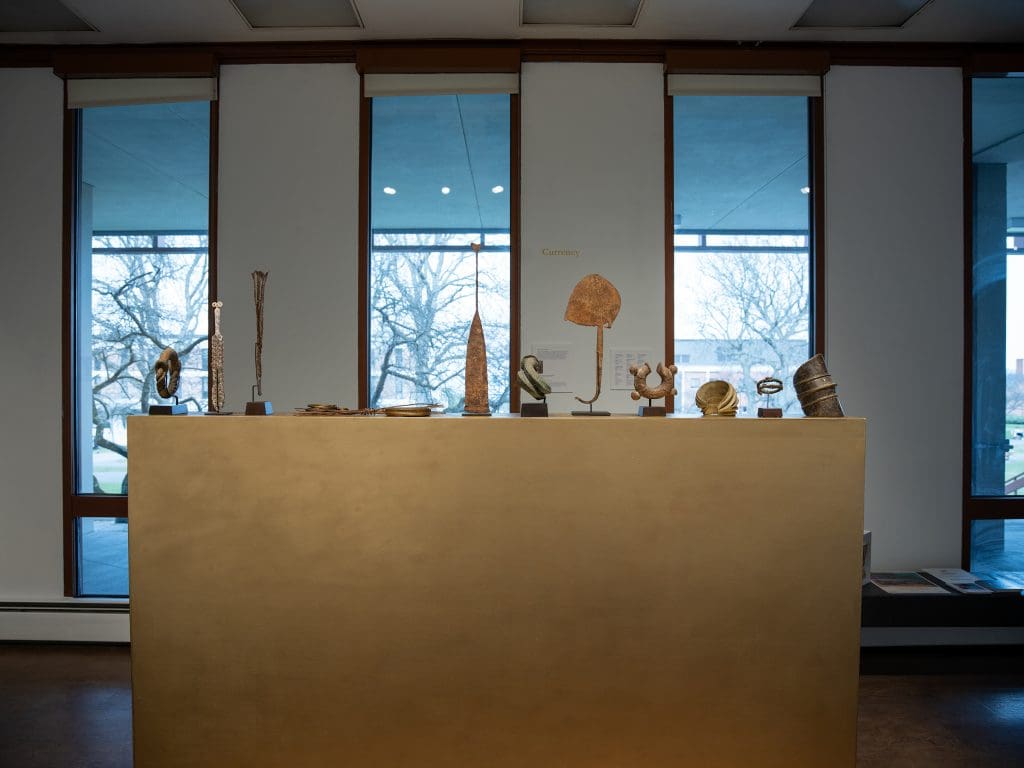
Fig 6a. Unrecorded Artists, Various West African Currencies, metal alloys, 17th-20th centuries (Collection of Amyas Naegele). Photo: Rachel Philipson.
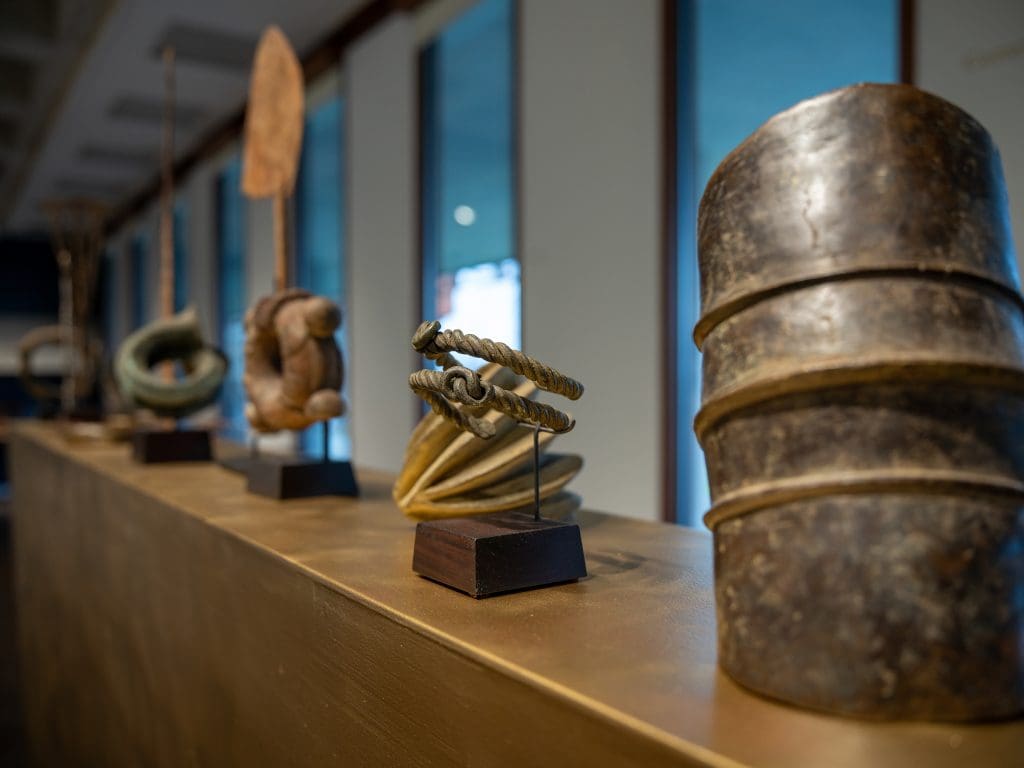
Fig 6b. Unrecorded Artist, Igbo-Ukwu double torque detail, copper alloy 17th century (Collection of Amyas Naegele). Photo: Rachel Philipson.
The bronze plaques that were looted from the kingdom of Benin show the Portuguese holding this currency. For example, what they called manillas.[12] It’s not a coincidence that there’s an efflorescence of bronze plaques as a result of contact with the Portuguese.
I wanted to bring in the later part of trade with Africa on the West Coast and Europeans, and not talk about Africa as dominated by slavery, which is a very short portion of its history. We do talk about the colonial project and slavery when we come to Benin, of course, but that was not the entry point.
MW: Are these in the catalog?
RM: They are not. They will be when we enlarge the catalog if the show travels. We wanted a vignette of metals and various periods, distinctive styles, unique cultures. Everything has a sculptural, intentional quality to it. And I wanted you to see it from every angle. No vitrines, as sculpture should be seen.
And these were worn, and used as dowry, as were camels.
MW: Speaking of metals, and going back to reproduction, something we’ve talked about is that shiny things do not do well in 3D scans. They’re glossy, and in a way shiny things resist being reproduced. There is also something called a “user-generated model,” when you upload a 3D model of a real-world object that you made yourself — like on your phone — to a shared platform. As opposed to a model created by a museum. User-generated models don’t always work, but to me they convey the experience of a place and a time. I like that result.
Looking at a very well-known object that way, like the Chalice of Abbot Suger, models can put it in a different space and time.
RM: I didn’t use the treasury engraving since we’re talking more about the sardonyx than we are about its Latin Christian liturgical afterlife.[13] What I love about these three-dimensional prints, based on your scan, was understanding how much detail you can and cannot accomplish.[14]
So we printed it with those kinds of globules, where there isn’t enough information. What do you think about it being painted?
MW: It’s interesting that you followed the watercolor renderings for the colors as opposed to a photograph. To me the issues of reflection focus on the sardonyx cup. It has a lot of color, and in my view that gets to what Suger described in the 12th century, as a combat between qualities in the stone.[15] That is what’s so captivating about the watercolors of the cup, which give it personality.
Contrary to the fact that it’s hard to create a 3D model for something that’s shiny — when you give it attention and render it with your eyes and with your hands, you’re doing something different. The 3D Gaussian splat of the Chalice is a different technology.
Animation of Suger’s Chalice, made by James Botting (Ithaca College, class of 2026) based on the Gaussian splats created by Kurt Heumiller (National Gallery of Art).
RM: That’s interesting what you just said about reflection and the material properties that Suger is so invested in. We also have Pliny’s writing on sardonyx. And I remember these images when I was at the University of Chicago, in class with Linda Seidel. She used a black and white slide of the Rosenberg photograph, and she was talking about materiality, the iridescence of colors — and you can’t see any of that. Having never seen it in person, sitting in that dark lecture hall it almost looked like mercury, as if it were moving (Fig. 7).
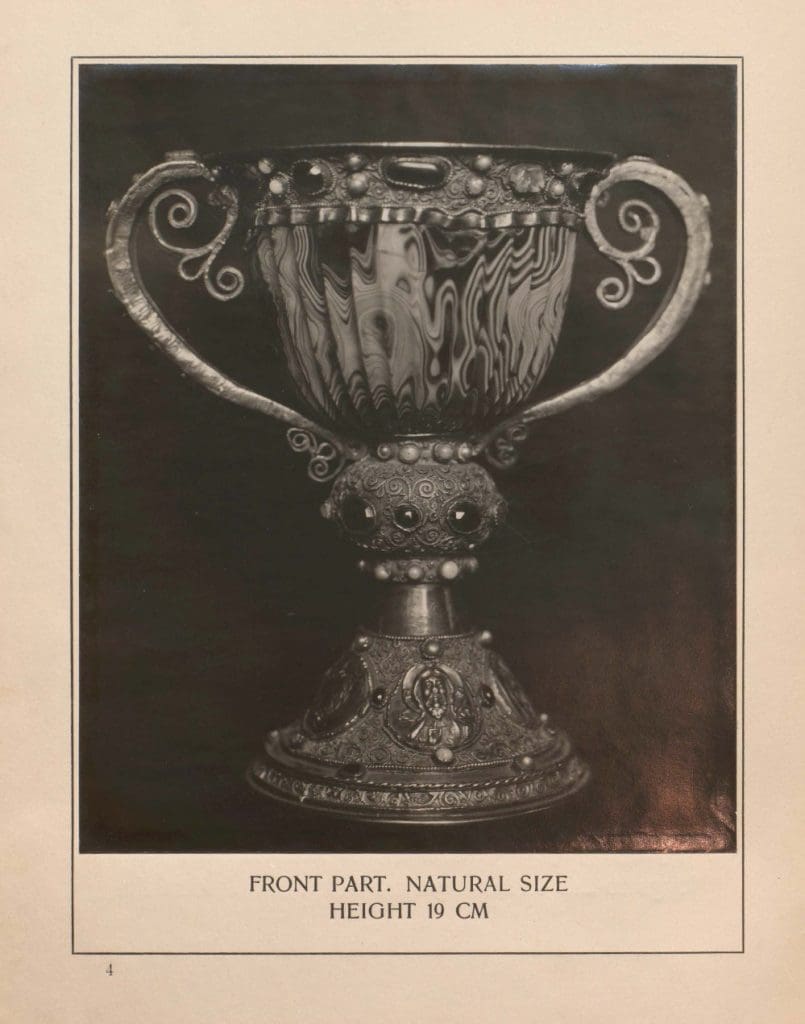
Fig 7. Photographer unknown, Chalice of the Abbot Suger, Gelatin silver print (As reproduced in Rosenberg, 1922). National Gallery of Art Library, Gift of Joseph E. Widener.
Then seeing it many years later, it immediately evoked the memory of seeing Rosenberg’s photograph and not understanding what it was.
Having an array of reproductions from various stages of the chalice’s life, draws attention to the sardonyx. There’s so much more emphasis on the bowl when you don’t have the trefoil distraction (added after the 12th century). It has integrity. And you can see the foot of the original bowl later gets covered up, so you lose the intentional framing materiality of the sardonyx after all the additions.[16]
MW: You can also see inside the cup. Photographs show that, but the animation you’ve made from the model is so effective. It makes you stop.
RM: I think it provokes a sense of wonder around this object. In my view the more times you reproduce something, the more interest it generates.
Historically, the engraving of the Chalice was the first form of reproduction. Then photography, 3D printing, and the Gaussian splats. There is a history of reproduction here, in a way.
MW: And also Suger’s description of the cup — not a reproduction, but his words about the object — compared with your classroom experience where it was narrated to you.
RM: That was one of the stranger experiences of my life, hearing about “anagogy” with this black and white image. I thought, this is genius.
MW: Something I’ve been thinking about with the sardonyx cup in the Chalice — I wonder, is it a “found object”? Perhaps that’s not the right term, but I mean how the cup has been encrusted in all these other things.
RM: It’s another question when you have something cross-cultural or cross-religious, and how one can reconcile the modifications from one context to another. Of course for Suger, Rome is the time of Christ, so the idea of Rome is like deep time. Suger preserving Roman forms is intentional and meant to evoke the sense of profound time and connection to the content of the Gospels.
And maybe that is why the object has become so overly Christianized, as coming from the time of Christ, even though the cup is earlier, and Christ wasn’t really a glint in anyone’s eye at that point. I find that amazing too, that the sense of time associated with certain places may not have reverberations of Christianity.
There is also something to dislodge in calling it “Roman Africa”.[17] As if there was nothing there before Rome. Of course, trade routes and materials and processes predate that idea.
We might also dislodge the distinction between Africa and sub-Saharan Africa, because the Sahara is not such a boundary. It’s more like a highway. There’s no way to get the gold from West Africa into France without it.
MW: Looking at the gold and beaded wire, and looking back over to the currency section of the show — what about gold and metalwork?
RM: Suger praises “barbarian” metalwork, as superior to local metalwork.[18] Could this be a reference to the specialized knowledge of Viking gold, with all its torques and twists?
MW: But the core is silver.
RM: Heavily gilded silver. And between the cup and the gilding, this is where I start to think of it as an Indian-African object, rather than a French-Christian object.
Further into this gallery, there are Iberian objects, and what would be an alternative history of the Chalice if it had been in a different context — I’m thinking here of Therese Martin’s studies of Iberian treasuries.[19]
MW: An Iberian medievalist might see the objects differently. Especially the ivory Pyxis from Al-Andalus.
RM: Right, and the reason we chose this one is, first of all, it’s African elephant ivory, and you know that because Indian elephants don’t have tusks as large as African elephants.[20] Carved in the Pyxis you see a palanquin on top of this elephant. So it depicts the elephant, the animal it’s made from. I think it shows a self-awareness of materiality. The tusks are so prominently shown on the elephant (Fig 8).
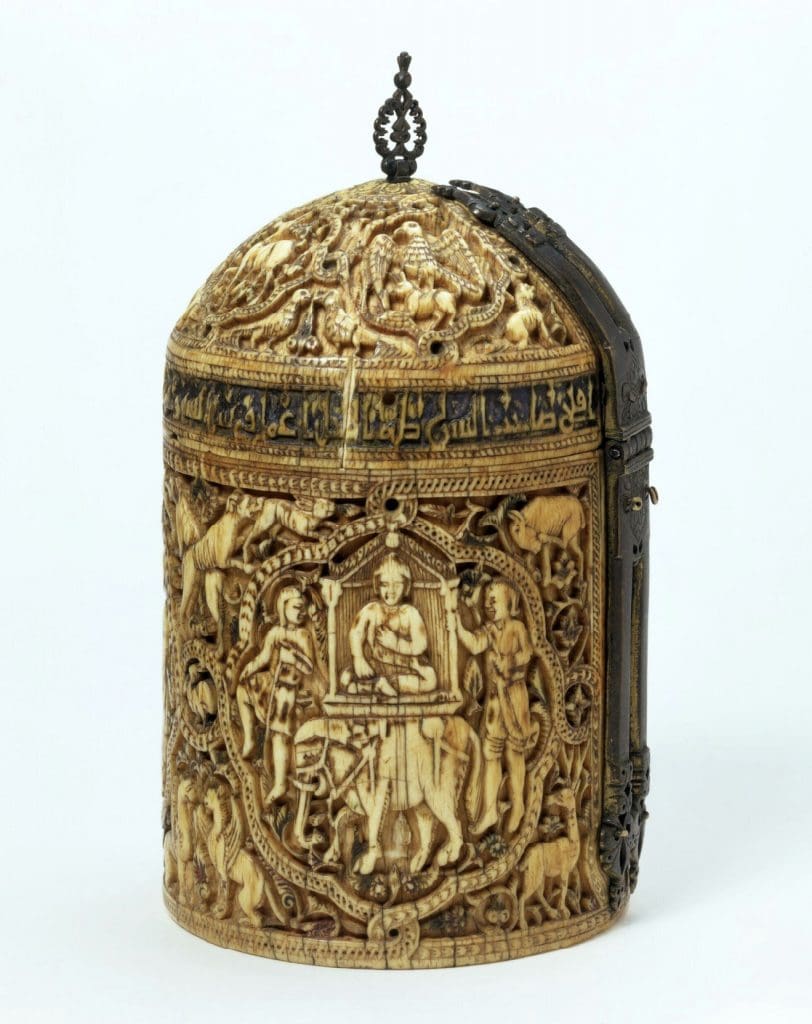
Fig 8. Unrecorded Artist, Pyxis of Ziyad ibn Aflah, African elephant ivory and metal fasteners, Córdoba, Spain, 769-70 C.E., Victoria and Albert Museum, London.
I also think it’s important for museums to start saying where the ivory comes from. Is it Africa, or is it India? Because that tells you a lot about connections and travel and knowledge, more than saying “historic ivory,” which is partially to get away from restitution issues.
MW: Speaking of makers, I see your labels say “unrecorded artist.” How did you decide on that terminology?
RM: In certain cultures, artists are not recorded but known. They’re specialists who handle valuable materials, and obviously this person knew what they were doing. There’s only one tusk, and you can’t mess it up — it’s not like you can melt it down and start again.
So I think “unrecorded” means that the artist was recognized but was not recorded in a way that we think artists function in society now. It’s a way of elevating the person who made it, because they had status in their society, but not in the same way that we think of an artist.
MW: One unrecorded artist painted this fresco at San Baudelio de Berlanga. Can you tell me about the camel?
RM: What’s astonishing about this camel from the Cloisters — which I’ve looked at for 20 years — it was always stated on the label, and in the historiography of medieval art, that camels represented the Holy Land and biblical ideas. But this is a very specific type of camel, which is a North African and Arabian camel. You can see it’s based on observation. If you’ve ever seen a camel, you know that. For example the hair, with sharp little lines, the way it goes around the perimeter of the animal (Fig. 9).
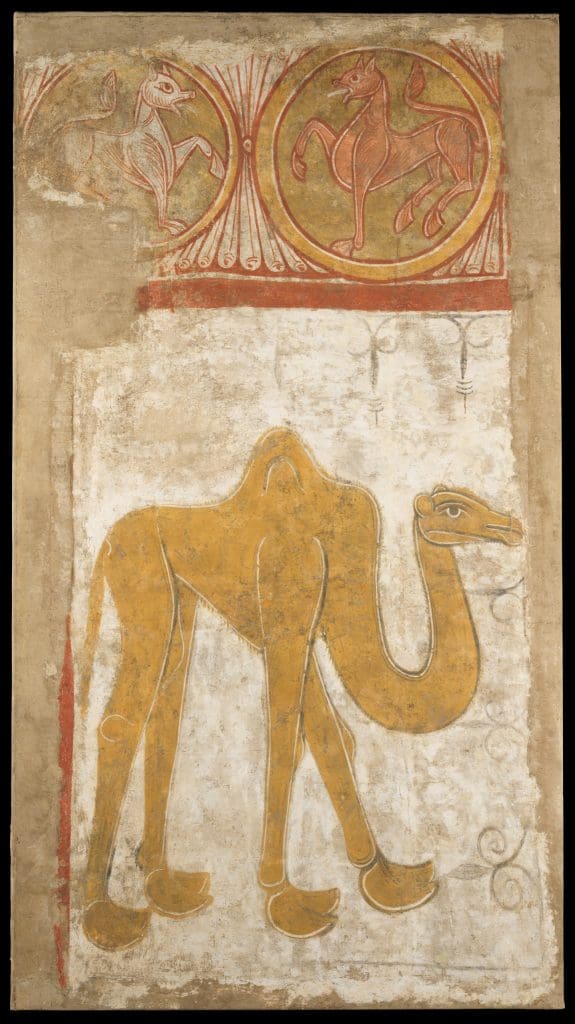
Fig 9. Unrecorded Artist (s), Camel, San Baudelio de Berlanga (Castile-Léon, Spain), fresco transferred to canvas, c. 1140s, The Met Cloisters, N.Y.
So this person knew that camels have to lock their legs as they move. They have this awkward gait to help them navigate uneven territory like sand. And this is from a time period and a place where you have converging cultures. And some histories show that camels were imported into Spain during the Umayyad rule.[21]
Another point we’re trying to make here is the imperative role of Islam in Arabia, North Africa, and then Spain. Islam takes over the Roman Empire there, and nomadic groups, especially the Tuareg — who we’ve encountered in the Catalan Atlas — have been Muslim for a long time.
Again, I think because of their instrumental role in trade, that if the entire region to the north is also Arabian in the sense that they’re coming from Arabia and are Muslim, West African kings convert to Islam in the 13th century. That conversion, while it might be guided by faith, it’s also in deliberate coexistence with indigenous faiths. Not in opposition to. Conversion to Islam by sovereigns is not only about faith, it’s more about forming a bond through a lingua franca.
MW: And maybe not coercive in the sense that other conversions could have been forced.[22]
RM: The king never forced anybody to convert to Islam, and that region was already known for trade. And the trade was intra-regional, yet it expanded beyond the Mali-Niger Delta area.
MW: This section is called Technologies of Transport. Looking at this, it is a kind of technology. Do you think of it that way?
RM: The process of memorization is a kind of technology as Francis Yates and Mary Carruthers have shown.[23] It’s an advanced mental tool. And I believe that’s what this prayer book is about, which was made for a Tuareg patron around 1900. It contains spells, incantations, various phrases in Arabic, but it is not a Quran strictly speaking; but it may have had commensurate spiritual significance for its owner.
If you imagine a Tuareg tent in the desert, it’s a vast, empty space. You as an individual are the only thing animating that space. A sharp memory can only help you navigate that alone. And to tell stories, to memorize prayers, which you have to do as a Muslim five times a day.
While there are no verses from the Quran in this book, there are incantations and spells.[24] It could be seen as a counterpoint to the Buddha figure, because it’s both Tuareg visuality and spirituality embedded with Islam. It’s neither one. It is something that was tailored to a particular person who partook in both.
MW: You said there’s different hands, and I imagine different materials.
RM: The way the Tuareg live is they herd goats, and this is goat hide. You see how thin it is? Goats are really oily.
I learned all of this a while ago. Oily, but it means that it requires an incredible patina, and so this one was made as a carrying case for the prayer book.
It’s a wallet. We have another one in that market section, but it really has this beautiful patina as a result of frequent handling and the nature of the hide itself.
Then right next to it we have a reproduction of Andrea Mantegna’s Adoration of the Magi (1495). What do you think of when you now see a very Christian image after this Islamic interlude (Fig. 10)?
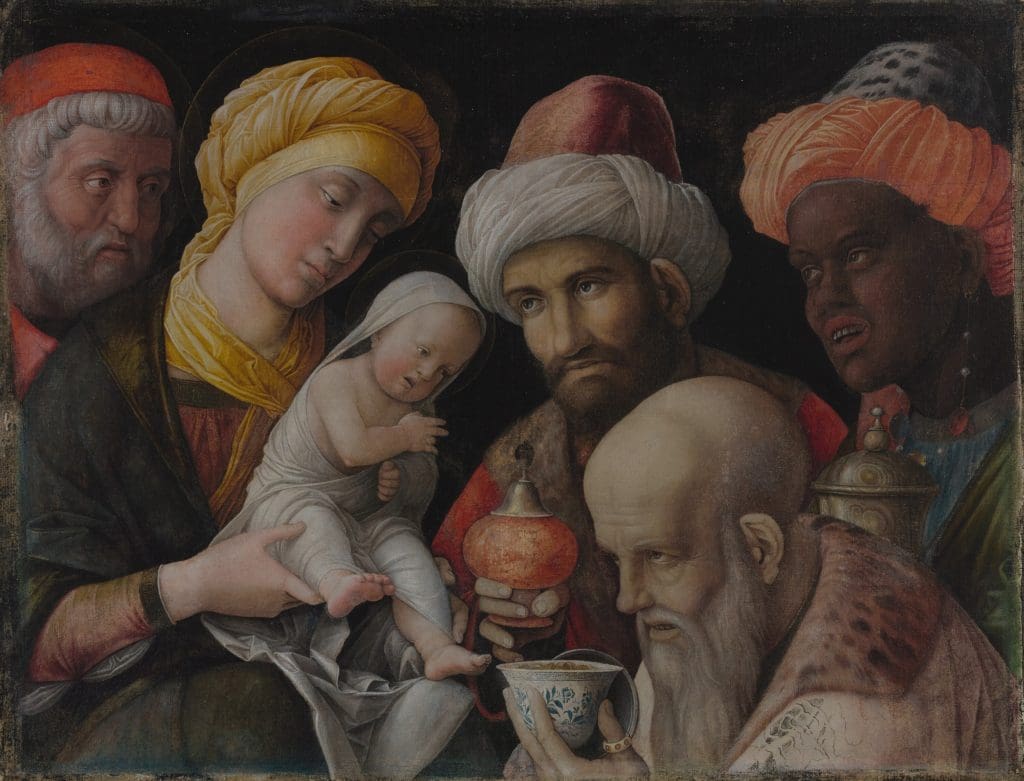
Fig 10. Andrea Mantegna, Adoration of the Magi, Distemper on linen, Mantua, Italy, c. 1495-1505, J. Paul Getty Museum, Los Angeles.
MW: I did get to read a little bit about how you described the painting in the catalog, and also acknowledging that this is a printed reproduction. I like to think about the source of a lot of those colors and colorants and the blue that Mary’s wearing. I’m also thinking about the kind of physiognomies present here: where’s the artist’s vision of an African person coming from?
RM: We have the Black King, Balthazar, looking over at her, but this Black King does not seem to me to be based on direct observation of a Black man. Physiognomy is essentialized and exaggerated though I wouldn’t call it a caricature by any means. Indeed, Mantegna’s patrons, Francesco Gonzaga and Isabella d’Este, had Black servants in their court, so it’s possible Mantegna had seen these individuals but I’m not sure he painted from observation in this case.[25]
What happens is that through Portuguese contact in Kongo and then also in Benin (last quarter of the 15th century), you have Black people emerging in Italy as sovereign emissaries for the King of Kongo, for example. They become part of the Christian church because they convert, which is smart, similar to conversion to Islam earlier in the Empire of Mali. What was so striking to me about this painting is that it’s the culmination of all of the ideas that we introduced in the exhibition.
MW: And sardonyx there!
RM: When I first saw that, I was like, that looks like sardonyx.
MW: The layering, banded, concentric.
RM: That’s what spurred this whole show. That is very unique and associated with the Black King. Then you’ve got porcelain in the center filled with gold.
I don’t know exactly what this is made out of, some other kind of gemstone. Then you’ve got either leopard or cheetah hide as a cope.
And then there is a tiraz with pseudo-Arabic script on the hemline of the Virgin, who is wearing that deep blue mantle, a color tied to lapis lazuli brought from Afghanistan. I just thought that this was the perfect culmination of all of the things that were known in the world as valuable, being given to Christ.
MW: Looking over here at a Christian painting, but thinking back to the San Baudelio camel, which could have been part of the Adoration of the Magi, in other versions, as you had said.
What also strikes me is the black background. It brings into contrast everything that we’re looking at and talking about, from the materials, the fabrics, even the ceramic. Looking over at the bazaar table in the show, I see a blue and white ceramic cup; a nice echo.
RM: I believe Mantegna was looking at Roman reliefs. They’re all very compressed and shallow. That black background, I think, creates that sense, both of intimacy, but also reminds me of sculpture.
We didn’t put that on the label, but that’s another link back to the Roman period, important for Mantegna as much as it was for Suger.
MW: As much as I mentioned the colors, thinking where they’re from, you have very clearly pointed out in the catalog how Baxandall says that money was very important in the history of art.[26] Making sure we’re talking about the money and currency, to go back to the earlier section.
RM: It is interesting to think about this picture as a distillation of luxury. You can also see these little gold coins in the porcelain, which is an amazing thing. They certainly didn’t have this quantity of gold just lying around. The other striking things are the individual pearls on the African king, another trade item coming from India, along with the sardonyx.
I have been thinking of the tiraz as an image of power rather than an appropriation in terms of announcing the triumph of Christianity over Islam. It’s a sign of worldliness, cosmopolitanism, which was prized at the time.
Muslim societies in this time period are beginning to be known as extremely wealthy. I think there’s an element of being wanted to be associated with, not necessarily the ‘other,’ but rather with the idea of money and power and privilege and place in the world. Maybe it’s a fantasy in some ways.
MW: You mentioned the pseudo-Kufic, and I’m thinking of other [earlier] Italian panels where there’s a tapestry or a carpet or something hanging in the back that might have a pseudo-Kufic or seemingly Arabic inscription like that, but it’s different here because it is functioning the way that tiraz do in their original contexts, not as background ornament.
RM: I think, well, what’s interesting about it here is as you said that it’s worn as it would have been worn, like very visible on a neckline or on the sleeve, because you see how it curves for that reason in the copy made by one of the student-curators, Meryl Palinkas.
MW: I wonder, why this particular one or this example and then reproducing it? Did you have other ones in mind, or was this the one you immediately wanted to go to (Fig. 11)?
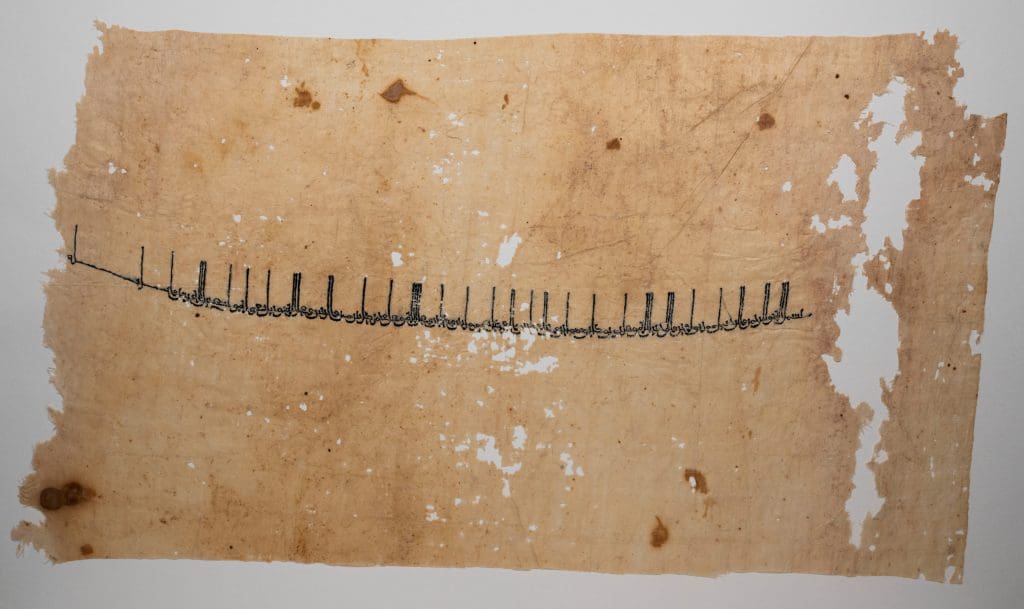
Fig 11. Unrecorded Artist, Tiraz, Plain weave linen with silk embroidery, Egypt, 10th century C.E. Metropolitan Museum of Art, New York.
RM: In some ways, there’s so many of these, and you’re like, well, you could just do any one of them, but this one had silk embroidery, which meant that it had some connection to China. It gave us this kind of entry into the Silk Road, because that was not the main topic of this class. Plus, the British Museum had just done the Silk Road show, which also debunked the idea of the Silk Road as a 19th-century fabrication.
It also seemed like this tiraz was pretty complete, and I liked the kind of very elongated, dramatic calligraphy, but it gave us these different materials.
MW: And for the copy, too, having spent time with a textiles conservator at the National Gallery, Julia Burke, to talk about silk — it just shatters when it gets really old. Having a reproduction to think about how it would have draped brings the meaning of the inscription to life. Meryl wrote about the time it took to make, and the tiny scale of each thread and stitch. It really struck me.
RM: I like this idea, this meticulous kind of repetition being a kind of spiritual act in some way that Meryl is talking about.
MW: And you can see these ascenders or descenders are individual stitches, and they’re not one long one. I almost want to count. There’s like eight, at least eight or ten here for each line.
RM: You know, actually, it may also draw your attention to that detail in the original, which one might not have considered without being able to study the copy so closely. Probably keeps its integrity better if it’s many stitches.
MW: And so now we’re in the bazaar.
RM: This is intended to be a really imaginative and creative space. Filled with historical details alongside speculation.
The striped cloth of the awning I found in an 18th century drawing of stalls around the perimeter walls of the Kaaba, and so Paul Nicholson [Handwerker gallery director] and I found a very similar pattern at Walmart and used it.
I wanted to create a sense of luxury, but also the desert, and this gold flecked sand colored cloth ($5!) was perfect. We also have trade beads that come as far away as Venice. They’re various different colors and materials. They are what you see in the Djenne terracotta, and that city was a well-established crossroads of trade by the 13th century.
MW: But it’s nice to be able to handle it.
RM: We have no casework, which is marvelous, but somebody swiped our sardonyx, so there’s a little danger.
MW: Go to the rock shop, people! They cost almost nothing. That’s the funny thing. The cost is in the polishing. Viewers must be able to understand the elasticity of value across cultures by seeing and handling materials here that otherwise are sealed in vitrines in museums.
RM: Precisely. How much something weighs, what it feels like in your hand, we have the ability to do that here. For example we’ve got West African [Asante] gold weights that are anthropomorphic. You know, that some have to do with proverbs, some have to do with trade, like fish. Some have to do with merchants in the desert and their slippers.
MW: Does this speak to the personalities of the people using them, as a kind of presence, or even absence?
RM: They speak to the entire nexus of metaphor, materials, and desire. They are foremost fabricated to measure, so the aesthetic or iconographic component also communicates a value, whether that is moral or material. For example, there is a cannon, a machete, and then a mudfish, which is very particular to West Africa. Because it can survive in water and land it relates to the dual nature of the king [Oba, Benin] who has the power to control the sea and the land.
MW: With the combination of raw and worked materials here, you can kind of see how one of these quartz crystals could have been taken down to a bead.
RM: Indeed. This crucifix made of rock crystal, is a copy of a 6th century one at the Met. I got it for $30, yet in its time it was almost a quizzical material that had a direct link to the divine in a variety of spiritual practices from reliquaries to devotional icons.
MW: It does make me think of that show at the Met, Relative Values, that indicated value by putting little images of cows on the labels, which was new and effective.[27] This was instead of gold coins or something, because the relative value of a cow was easier to transfer across time.
RM: Both the relativity of value across time and space, as well as a consistent shared heritage for cultures, religions after the collapse of Rome was a point we wanted to emphasize.
MW: That does come through. Let’s look at this Corinthian column; is it part of the college’s collection?
RM: Most colleges have plaster cast collections from decades ago. This capital is ordinarily in our architectural studio, and it was readily available because a big point that needed to be made was to decouple Roman visuality as the exclusive heritage for Christianity.
I wanted to emphasize that the classical world became a common heritage for Judaism, Islam, and Christianity. And so this Corinthian capital is meant to serve as an idea of Rome and the importance of Rome, but also how it is found in mosques and synagogues and then later Romanesque appropriations of the same floriate form. It’s a point of departure for fashioning new identities and arguments built on the foundation of Rome.
MW: Alongside the cast, you also have reproductions of the Great Mosque of Cordoba and a signed floriate capital from the palace complex of Madinat al-Zahra. Just the marble is making me think back to the Buddha, especially with this drillwork. And I don’t know if you thought to put those two in dialogue, but just the importance of marble that was brought from Paros to Alexandria and then to Berenike.
RM: Absolutely, right.
MW: I also love thinking how these plaster casts were for instruction, right? Students would sit and draw it, and that was part of fine arts education. So to have it used in this way — I want to say deployed in this way — it’s really interesting to me.
RM: Yes, it’s a surrogate that has the scale and texture of the original. In the late 19th-20th centuries, plaster casts were exported all over Europe and America. They were believed to be as good as the original: Winckelmann wrote his magnum opus, centered on the Apollo Belvedere, based on plaster casts.
MW: It makes me think of Chuck Little, and exporting the Met’s plaster cast collection to a museum in Taiwan.[28] That shows how devalued this form of reproduction has become for certain institutions but indispensable to others.
RM: There was a massive atelier in Paris that was part of the Museum of Comparative Sculpture, which Viollet-le-Duc created for the World’s Fair of 1878 at the Trocadéro Palace. Even after the fair the museum continued to produce plaster casts, especially for American museums.[29]
But the interchangeability of a cast to the original is this kind of an amazing thing, right? It divests the original of its materiality, but then reacquires it through patination. This capital should be white but it is painted to resemble stone.
MW: And thinking of that, with the chalice over there, it’s one thing to make a plaster cast of an architectural column, which is structural and decorative. For something like the chalice, which has a liturgical and sacred use, I don’t know if you thought about that as 3D printing it and painting it, if that was another comparison you’re making here.
RM: That’s a great point: the “naked” print and then the painted one. Because I have worked on plaster casts, that was something top of mind for me, but I don’t think we emphasized the parallels in the labels. These analogies can be pursued depending on how you want to approach the show: through a cultural lens, a material one, or the role of reproduction in this experience. It’s sort of nice as there is no beginning or ending to the show.
MW: One thing we haven’t talked about are the masks. They are pretty startling creatures: a lobster and a shark.
RM: There is a group of West African islands that have been trading for a very, very long time. And these creatures are available and prevalent, but transmit a relationship between Africa and the marine world, which we don’t really think about. We wanted to have something in the window that people passing by can see and come in (Fig. 12).
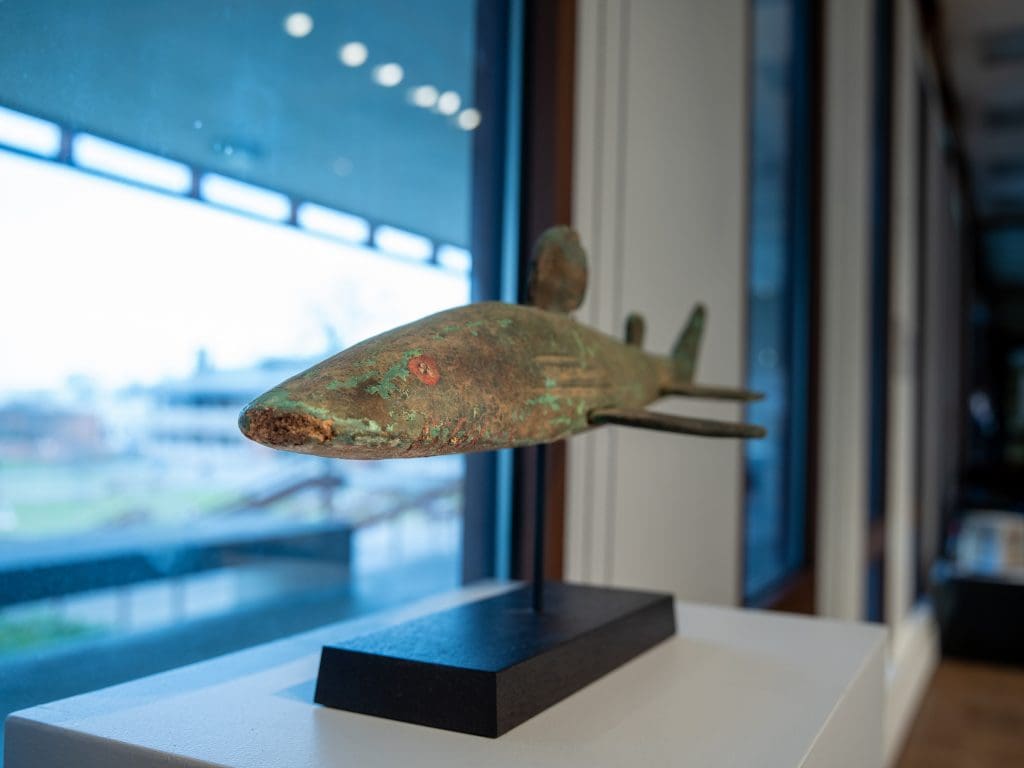
Fig 12. Unrecorded Artist, Shark (helmet) mask, wood, raffia and pigment, Bidjogo Islands, Guinea Bissao, c. 1930.
In some ways, Africa is highly visible in the show because of masquerade traditions that are much later [19th-20th centuries] than the time that we’re talking about.
In calling the show “Africa in the world,” I felt we needed to represent the material and visual culture of place, because there’s a latent critique, “well, you’re not talking about indigenous African cultures.” The message of the show is also, what does it mean to call an object “African”? Why the need to separate Islam as “foreign” when it has been a living religion and culture in Africa since the 7th century? Ethiopia is one of the first Christian realms. The monotheistic religions are part of African indigeneity. Full stop.
You don’t need to separate “African indigeneity,” as if this monolith existed entirely on its own with no contact from the rest of the world. This is an idea that is not only erroneous but keeps Africa out of time and place rather than being the central player in trade and ideas throughout history.
MW: And the label for these also mentions that the Niger Delta and islands would have been some of the first areas to trade with Europeans in the 15th century.
RM: At first glance, they don’t communicate “Africa” because they’re naturalistic and enhanced by polychromy, which is also a result of the colonial period, which transitions us to currency. I thought it was important to have this mastery of the lost wax method on prominent display. It wasn’t in the service of any of the recognizable aforementioned religions, and here we can talk about the interconnected nature of the continent, but also its pivotal role as an intermediary between India, China, and Europe for centuries.
MW: On that point, one thing I don’t see here is a map that we would think of today. We have the Catalan Atlas, the historical object. You can think of the shapes of continents, for example, and routes between them. Was that part of your discussion in design?
RM: When you have a map, even if you don’t put national boundaries on it, you mnemonically do it. And so this kind of unmoored space and time was intentional. I didn’t put the map that is the most comprehensive of the time period we’re covering, but I thought putting a traditional map would mute the narratives.
MW: Or even an orientation. You can flip the folios up and down — a non-linear sense of time and space.
RM: Being disoriented was a goal for us to get an audience to rethink some of the canonical objects of Art History. These are really famous works of “global” art. We wanted to be able to access these big ideas through important objects, not anomalies. There was no way to get the actual loans, so here we are with this mixed array.
MW: Would you do it again, in a different world, if you could put all these originals together? Would you want to?
RM: Of course! I think giving them this context has been very interesting to audiences to think about connection rather than separation.
It could only be in a temporary exhibition because of the way museums are organized and the proprietary nature of departments. For example, which department would the Berenike Buddha “belong” to? South Asia? Greece and Rome? Egypt? Could it go to the Rockefeller Wing? [Both laughing].
MW: Right. And as museums acquire works, they have to rethink how departments are organized.
RM: If we were speaking strictly as medievalists, a lot of these objects we’ve learned in classic surveys as medieval Christian objects, that have a primary devotional role, whereas ours is a completely different approach.
MW: And I feel like the first question I had was, where’s religion in this? Even as a through line, it’s a subsidiary one.
RM: For example, Arabic is a language of trade, not only the language of the Quran. It was a bit of a risk to take this approach.
And I hope nobody has swiped anything else from the bazaar, as far as I can tell.
MW: Well, there’s always Amazon.
References
| ↑1 | Africa in the World: materials without end, edited by Risham Majeed, with Emma Chank, Molly Frank, Abigail Kreig, Elena Lindeman, and Meryl Palinkas (2026). https://doi.org/10.61302/XBTG2436. |
|---|---|
| ↑2 | Steven Sidebotham, “Indians in Roman Berenike,” Jahrbuch des Deutschen Archälogischen Instituts 140 (2025): 1-126. |
| ↑3 | Tree & Serpent: Early Buddhist Art in India, 200 BCE–400 CE, July 21–November 13, 2023. https://www.metmuseum.org/exhibitions/tree-and-serpent. |
| ↑4 | John Guy, ed., Tree & Serpent: Early Buddhist Art in India, 200 BCE–400 CE (New York: Metropolitan Museum of Art, 2023), catl. 85, pp. 182-83. |
| ↑5 | Keith Moxey, “What Time is it in the History of Art?” in Time in the History of Art: Temporality, Chronology and Anachrony, eds. Dan Karlholm and Keith Moxey (New York: Routledge, 2018). https://doi.org/10.4324/9781315229409. |
| ↑6 | Blair Fowkes-Childs and Michael Seymour, eds., The World Between Empires: Art and Identity in the Ancient Middle East (New York: Metropolitan Museum of Art, 2019), see catl. 163-167, pp. 233-36. |
| ↑7 | Sarah Guérin, “Exchange of Sacrifices: West Africa in the Medieval World of Goods,” in Re-Assessing the Global Turn in Medieval Art History, ed. Christina Normore (Leeds: Arc Humanities Press, 2018), pp. 97-124. https://doi.org/10.1017/9781641892278.005. |
| ↑8 | Labelle Prussin, African Nomadic Architecture: Space, Place, Gender (Washington D.C.: Smithsonian Institution Press, 1995). See also Risham Majeed, ed., Made to Move: African Nomadic Design, Ithaca College, 2018. |
| ↑9 | Ibn Battuta wrote, “The caravan cannot travel except under their protection; and amongst them the protection of a woman is more important than that of a man. They are nomads, they do not stay in one place,” in Said Hamdun and Noël King, Ibn Battuta in Black Africa (Princeton, NJ: Markus Wiener, 2010), p. 67. |
| ↑10 | Yu-ping, Luk, “Tang China,” in Silk Roads, ed. Sue Brunning (London: British Museum Press, 2024), pp. 45-48. |
| ↑11 | Kathleen Bickford-Berzock, ed., Caravans of Gold, Fragments in Time: Art, Culture, and Exchange across Medieval Saharan Africa (Princeton: Princeton University Press, 2019). |
| ↑12 | The city of Benin was sacked by the British in 1897 and the contents of the palace were looted and brought to London where they were sold. There is extensive literature on this event, which is not of primary concern here. See Annie Coombes’s review of the most recent literature, “Museums and the Ethics of Restitution: Benin City at the Crossroads of Debate,” American Historical Review 130/3 (2025): 1218-1220. https://www.metmuseum.org/art/collection/search/316486. https://doi.org/10.1093/ahr/rhaf348. |
| ↑13 | Nicolas Guérard, engraving from Michel Félibien, Histoire de l’abbaye royale de Saint-Denis en France (Paris, 1706). |
| ↑14 | Prints were made from a 3D photogrammetric model created by Matthew Westerby from the Chalice, using Polycam on an iPhone. Our thanks to Emily Pegues and Alison Luchs, National Gallery of Art, for organizing a Study Day with the Chalice in 2023. |
| ↑15 | “The red sard of the stone stands out, in contrast to the blackness of the onyx, in striated bands of color in such a way that one seems determined to overcome the distinctive quality of the other.” Translation of Suger’s description by Richard Cusimano and Eric Whitmore, Selected Works of Abbot Suger of Saint Denis (Catholic University of America Press, 2018), https://www.jstor.org/stable/j.ctt1zkjxb9; see also Matthew J. Westerby, “Annotating Upstream: Digital Scholars, Art History, and the Interoperable Image,” Open Library of Humanities 10(2). https://doi.org/10.16995/olh.17217. |
| ↑16 | On the cup and its foot, see Dylan Smith and Therese Martin, “Reflections on the Suger Chalice: New Observations and Technical Analysis,” Facture: Conservation, Science, Art History 7, Change (2025), https://doi.org/10.66322/pksb3078. |
| ↑17 | See Mamadou Diouf, Africa in the World’s Time (New York: Seagull Books, 2025). |
| ↑18 | Gaborit-Chopin, Danielle, “Suger’s Liturgical Vessels,” in Abbot Suger and St. Denis, ed. Paula Gerson (New York: Metropolitan Museum of Art, 1986), pp. 283-94. “The Barbari ….According to Suger himself, their work was more lavish than that of native craftsmen,” p. 284. Suger wrote, “for the barbarian artist were even more lavish than ours” [quoniam barberi et profusiores nostrabtibus erant artifices], in Abbot Suger on the Abbey Church of St. Denis and Its Art Treasures: Second Edition, ed. Erwin Panofsky and Gerda Panofksy-Soergel (Princeton, NJ: Princeton University Press, 1979), pp. 60-61. |
| ↑19 | Therese Martin, ed., The Medieval Iberian Treasury in the Context of Cultural Interchange (Expanded Edition) (Leiden, The Netherlands: Brill, 2020). https://doi.org/10.1163/9789004424593. |
| ↑20 | Sarah Guérin, “Material of Might: Ivory and Representations of Power,” in Terrible Beauty: Elephant-Human-Ivory (Berlin: Humboldt Forum, 2021), pp. 36-45. |
| ↑21 | José Antonio Riquelme Cantal, et al, “Camelids in the south of the Iberian Peninsula in Roman and medieval times. Osteological evidence from the city of Cordoba (Spain),” Journal of Archaeological Science: Reports 50 (2023): 50. https://doi.org/10.1016/j.jasrep.2023.104101. |
| ↑22 | See, for example, Luke A. Fidler, “The Coercive Function of Early Medieval English Art,” Radical History Review 137 (2020): 34–53. https://doi.org/10.1215/01636545-8092762. |
| ↑23 | See Francis Yates, The Art of Memory (Chicago: University of Chicago Press, 1974) and Mary Carruthers, The Book of Memory: A Study of Memory in Medieval Culture (Cambridge: Cambridge University Press, 1990). |
| ↑24 | Our thanks to Professor Kristin Sands for this clarification (it was assumed to be a Quran but it is not). It is from the collection of Amyas Naegele. A similar manuscript is in the collection of the Minneapolis Institute of Arts: https://collections.artsmia.org/art/131783/islamic-manuscript-in-case-possibly-niger. |
| ↑25 | “Blackness was a central concern to Isabella; she wrote about the range of complexions of enslaved people in her service, requesting that her agents acquire the blackest children possible,” in Kristen Collins and Bryan Keene, eds., Balthazar: A Black African King in Medieval and Renaissance Art (Los Angeles: J. Paul Getty Museum, 2023), p. 81. |
| ↑26 | Michael Baxandall, Painting and Experience in Fifteenth-Century Italy (Oxford: Oxford University Press, 1972). |
| ↑27 | Relative Values: The Cost of Art in the Northern Renaissance, 2017–2022, curated by Elizabeth Cleland. https://www.metmuseum.org/exhibitions/relative-values-northern-renaissance (accessed May 30, 2026). |
| ↑28 | “Met donations displayed in Taipei,” Taipei Times, 12 November 2012. https://web.archive.org/web/20190831232402/https://www.taipeitimes.com/News/taiwan/archives/2012/11/21/2003548253. |
| ↑29 | See Risham Majeed, Primitive before Primitivism: Medieval and African Art in the 19th century (Ph.D. Dissertation, Columbia University, 2015) and Mari Lending, Plaster Monuments: Architecture and the Power of Reproduction (Princeton: Princeton University Press, 2017). |