Ariela Algaze • Johns Hopkins University
Kris Racaniello • CUNY
Recommended citation: Ariela Algaze and Kris Racaniello, “Introduction: What is Medieval Social Sculpture?” Different Visions: New Perspectives on Medieval Art 13 (2026). https://doi.org/10.61302/SQYQ3276.
Art history is an omnivorous field, drawing from adjacent disciplines to nourish its many methodological turns over the last century: linguistic, interpretive, performative, reflexive, global, sensorial, phenomenological, post-colonial, and so on. Rather than turning to exogenous models and methodological approaches, this special issue looks inward. Focusing on art and art practices, we use the paradigm of social sculpture, introduced by the artist and performer Joseph Beuys in the 1960s, as a historical methodology.[1] In his public lectures, Beuys—who, alongside his theoretical correspondent, Nam June Paik, was a founding figure of the Fluxus movement—provocatively claimed that “everyone is an artist” insofar as they participate in shaping or sculpting society through language, thoughts, and actions.[2]
Creating structures in society requires physical interactions between people, objects, and the environment. With the rise of artificial intelligence and infinite scroll––both of which characterize a broad move toward societal disembodiment today––creative historical acts of “being in the world” seem evermore poignant as research material and have thus captured our scholarly attention.[3] Employing this expanded definition of historical artistic creativity, which we call social sculpture, we hope to shift analysis away from limiting frameworks focused on the creation of singular art objects toward the larger set of creative events constructing the social realm. Viewed through this lens, medieval art was always interactive, requiring the participation of its audience to achieve the artworks’ desired functions and ends. Social sculpture thus frames art simultaneously as a time-based medium and a social, political tool that encompasses the entire process of living. Art, in this framework, is viewed as any intentional social contribution that has the potential to sculpt communities and identity.
Fig. 1. Centering a medieval reliquary, this video documents a contemporary procession in Conques, France that suggests how medieval social sculpture may have been experienced as a transformative process. Video of the Procession of the Majesty of Sainte Foy, taken during the 2023 fête de Sainte Foy, October 8, 2023. (Video source: Kris Racaniello).
This idea resonates with medieval people’s understanding of images and objects as vital and agentive forces. We view these objects as truly activated through their audiences’ embodied participation in civic, religious, and unofficially-sanctioned performances that shaped, transformed, and even sculpted medieval communities (Fig. 1).[4] In this volume, we foreground the generative moment of artistic creation through the eyes of historical participants—including, but not limited to, what has been traditionally considered to be an art object. Although the term social sculpture is most often associated with contemporary art, sculpture and bodies-as-sculpture have always transformed society. It is this insight that informs each of the essays included in this issue on Social Sculpture in the Middle Ages, which had its genesis in conversations with colleagues at a panel of the same title at the International Congress of Medieval Studies in Kalamazoo in 2023. For medieval art historians, reframing object-oriented histories through the prism of social sculpture allows us to begin closing the gap between object and experience.
That Beuys developed a theory of art so resonant with medieval art history is no coincidence. A keen observer of medieval art, Beuys’s artistic sensibilities were honed by years of copying artworks in the Schnütgen Museum in Cologne, a practice that indelibly left its mark on his conception of social sculpture.[5] These early experiments in figuration betray an affinity towards medieval notions of movement—an element which he defined as the “personification of Christ today” in an interview with the priest Friedhelm Mennekes.[6] In an untitled and undated sketch of a Crucifixus dolorosus (Fig. 2) (c. 1385-1400) in the Schnütgen collection (Fig. 3), for instance, the hatching in Christ’s ribcage, arms, and loincloth renders a body as it slumps from the cross, translating to the page the Gothic sculptor’s interest in the body’s torque and distribution of weight to represent Christ’s death with dynamism.
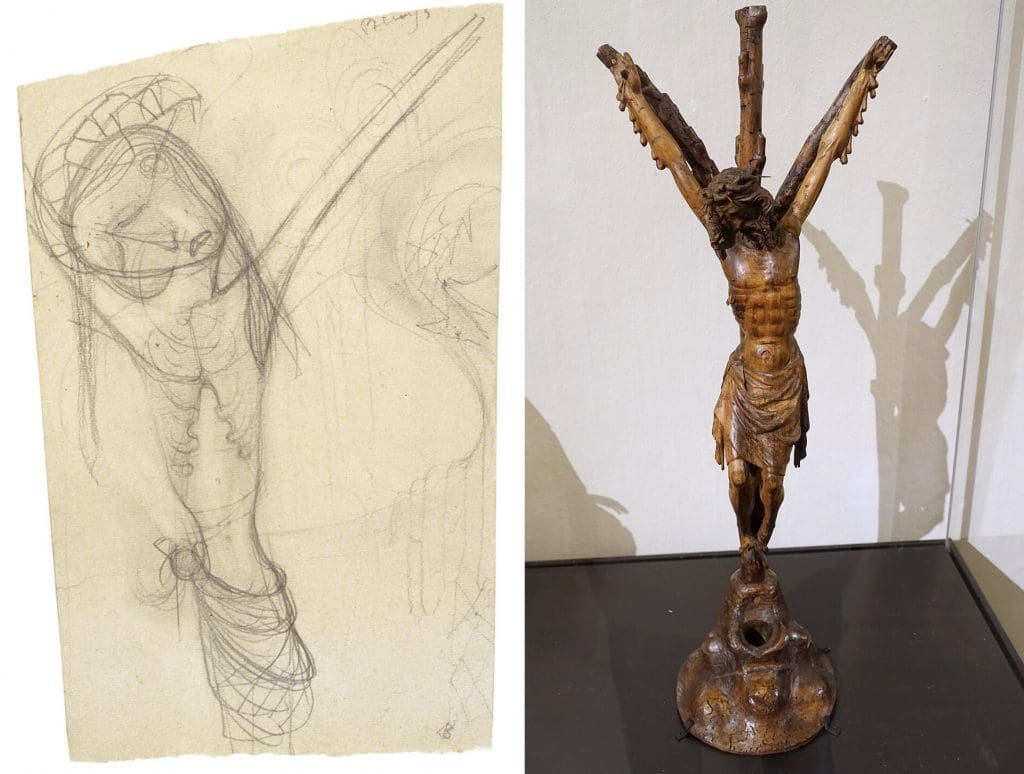
Fig. 2 (left). Joseph Beuys, Untitled, c. 1950, pencil and paper (Reprinted here with permission of the Estate of Joseph Beuys). Fig. 3 (right). Crucifixus dolorosus, c. 1385-1400, Museum Schnütgen, Inv.-Nr. A 37, Schnütgen Museum (Public domain, via Wikimedia Commons).
In the Fluxus actions for which Beuys became famous later in his career, medieval motifs likewise reappear as performative Pathosformeln. Beuys built his mythic and artistic persona by drawing on well-established strategies of relic presentation. He saved the indexical traces of his performances, and in so doing he memorialized these events materially, as seen in his relic-like Fat Chair (Fettstuhl) poster from 1984 (Fig. 4).[7] In Basel in 1971, Beuys washed the feet of seven spectators, linking the act not only to Christ’s original ablution of the disciples during the Last Supper, but also to its various reenactments across the Middle Ages, performed since the twelfth century, by the pope, by bishops, and by members of confraternities each year on Maundy Thursday. As a relic of this performance, a quotidian white bowl, scribbled in red ink with the words Für Fusswaschung—Joseph Beuys (Fig. 5), has been transformed into a museum object. In 1997, on the eleventh anniversary of his death, the Schnütgen Museum, which served such a crucial role in his artistic formation, opened an exhibition entitled Joseph Beuys und das Mittelalter, exploring the frisson between the artist’s use of relics and the medieval space of the twelfth-century church of St. Cecilia, where they were installed.[8]
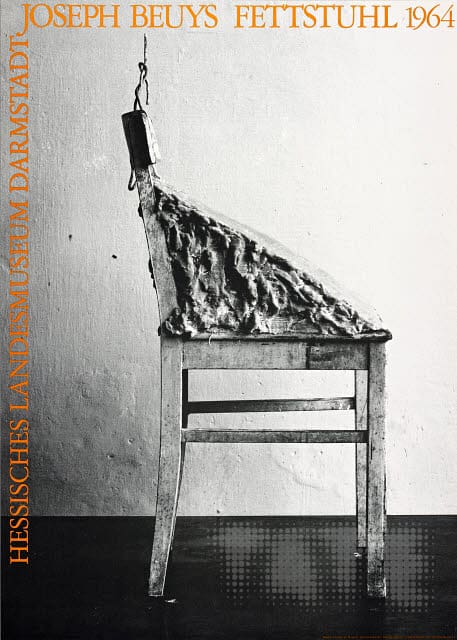
Fig. 4. Joseph Beuys, poster showing Fat Chair (Fettstuhl), 1984, print on paper, 89.7 × 64.5 cm. (© DACS, 2026, with permission).
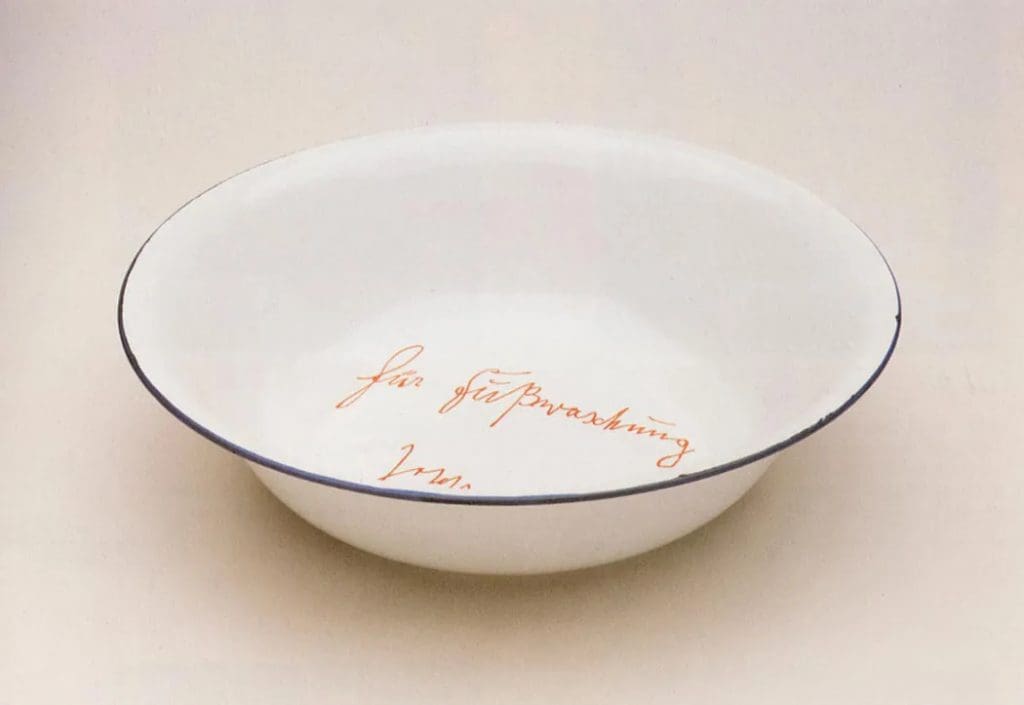
Fig. 5. Joseph Beuys, Bowl labeled “Für Fusswaschung—Joseph Beuys” 1971, enamel basin, inscribed (Reprinted here with permission of the Estate of Joseph Beuys).
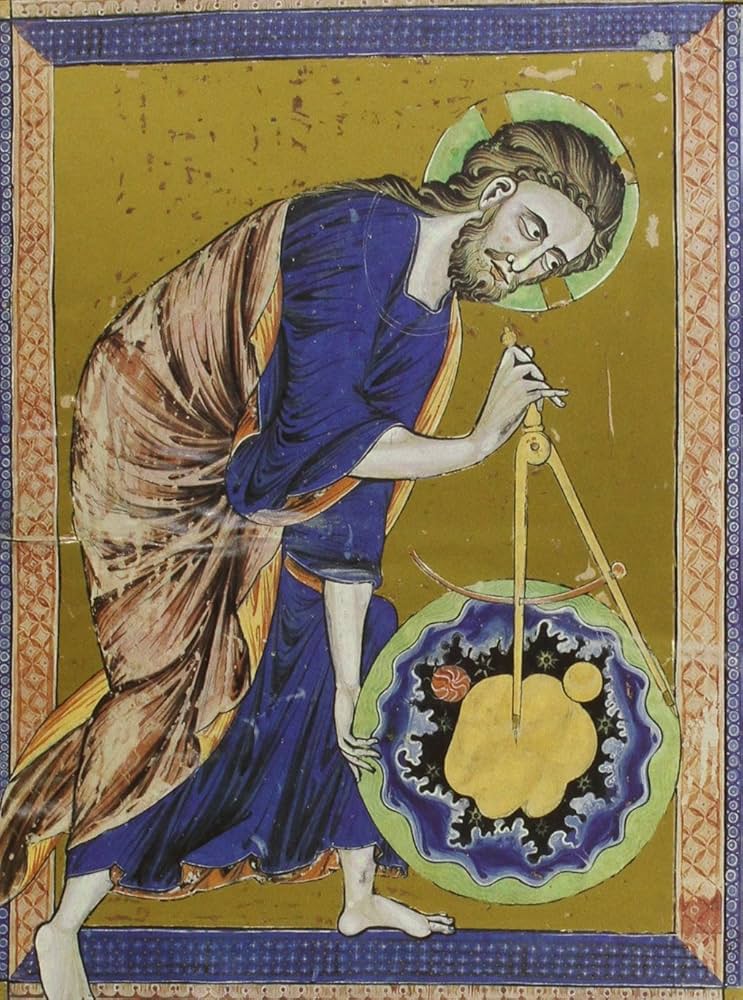
Fig. 6. Detail from the Vienna Bible Moralisée of “God as Artifex,” gold leaf and pigment on parchment, created c. 1220, Paris, (Vienna, Österreichische Nationalbibliothek, cod. 2554, fol. 1v) (Public domain, via Wikimedia Commons).
The most common term for a medieval artist was artifex, a Latin word employed to refer both to an artisan and to a creator/maker/doer/actor writ large. Other less common terms applied to medieval artists—such as opifex, genitor, fabricator, factor, and faber—similarly preserve the same plurality of meanings that artifex implies.[11] The medieval artist was an artifex in the image of God as the artifex mundi, and works of art, beginning in the Romanesque period, self-consciously and reflexively blur the lines between both senses of this word. To cite just two famous examples: in a folio from the luxuriously illustrated Vienna Bible Moralisée, the Creator uses a compass to circumscribe the edges of the Earth as a perfect circle (Fig. 6). This divine act of creation is mirrored by the illuminator’s use of a compass to forge the representation of the inchoate earth, a world made up of colored masses emerging from the compass-point, as if this moment of artistic contact created a massive centrifugal force partitioning the four Aristotelian elements.[12] Likewise, in the iconographically dense cupola in the atrium of the Basilica of San Marco where 30 scenes from the first three chapters of Genesis are depicted (Fig. 7), we find another image of the artifex mundi flanked by an angelic chorus as he molds Adam out of the clay of the Earth (Fig. 8). This scene is captioned Faciamus hominem ad imaginem et similitudinem nostram (Let us make man out of our image and likeness, Gen. 1:26). God’s “sculptor-like” creation of a body out of matter in San Marco is reminiscent of medieval images of Pygmalion (Fig. 9), the prototypical Ovidian sculptor who carves Galatea’s body from marble.[13] In these images, medieval artisans are represented as makers who create and are created in the image of God.[14]
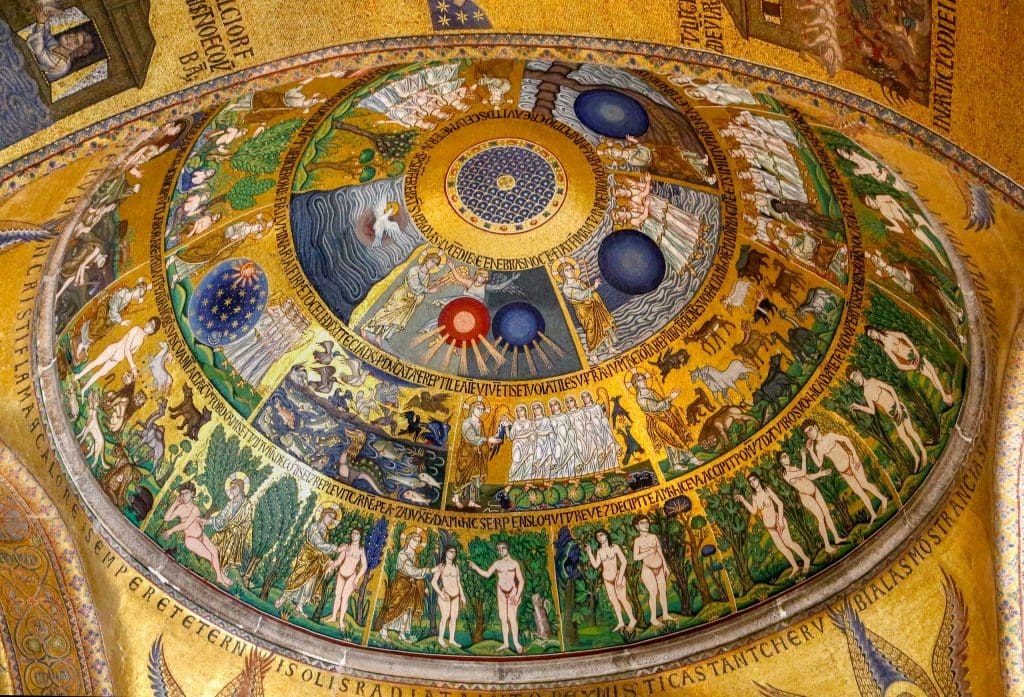
Fig. 7. Genesis cupola, 1215–1235, mosaic, narthex of the Basilica of San Marco, Venice (Public domain, via Wikimedia Commons).
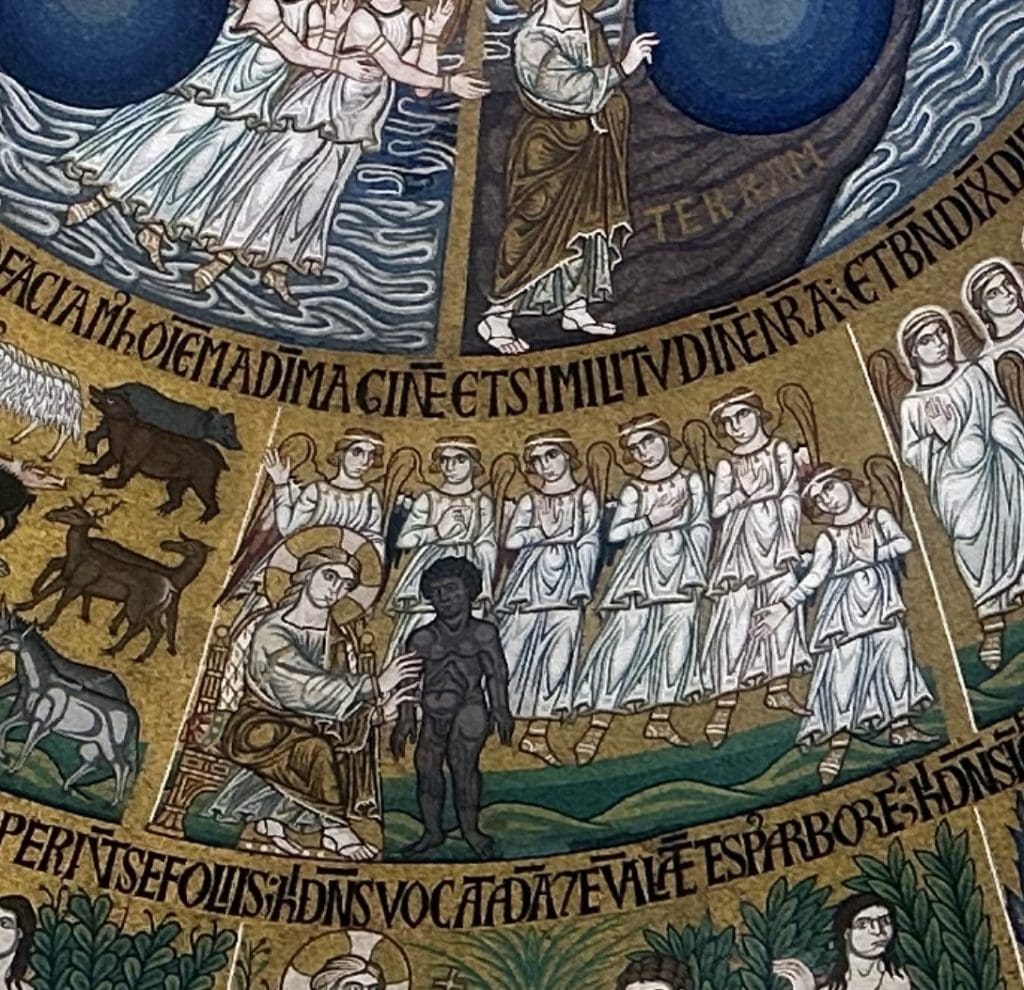
Fig. 8. Detail of Deus artifex molding Adam out of the clay of the Earth, 1215-1235, mosaic, narthex of the Basilica of San Marco, Venice (Photo source: Ariela Algaze).
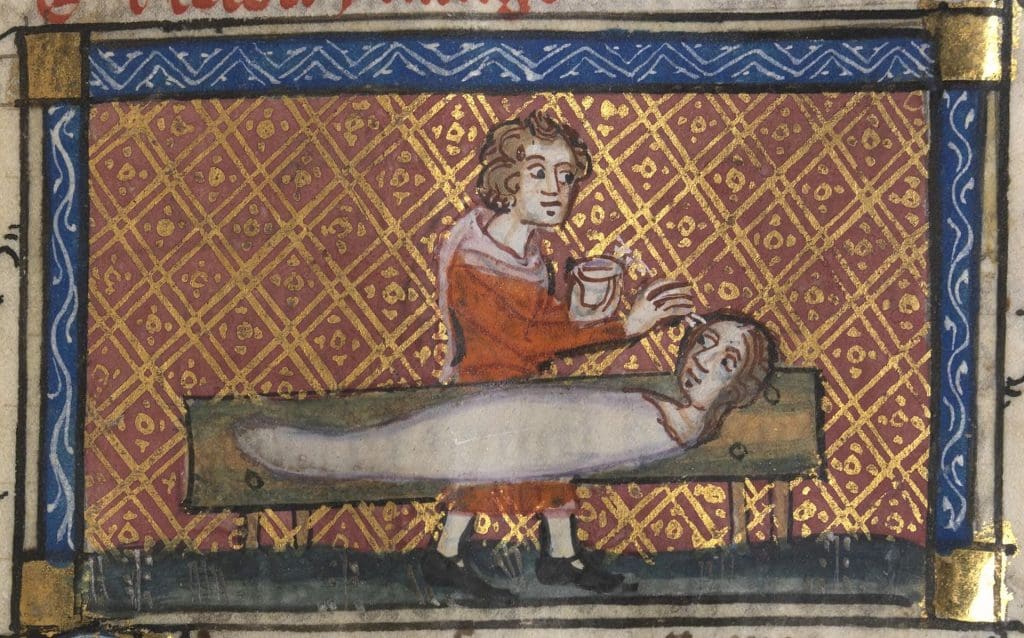
Fig. 9. “Pygmalion and Galatea” in the Roman de la Rose, pigment and gold leaf on parchment, National Library of Wales 5016D, fol. 130r. 14th century(Public domain, via Wikimedia Commons).
The artifex was at once an actor and an auctor. Indeed, there are etymological links between the Latin terms actor and auctor, both of which denote protagonists in a similar way to artifex––people who do, produce, or bring into being. Disputed but blurred in medieval texts, such as the Speculum of Vincent de Beauvais (c. 1200), the term actor was broadly applied to doers, while auctor emphasized the original authorship and visibility of the work.[15] This semantic tension can be seen in several essays in this volume, which consider works of art and the people that made and interacted with them as actors and auctors of social sculptures.
Each of these terms describes the people who did the work of bringing something into being and who often signed their creations with “me fecit” (“they/she/he made me”). Such work is already engaged in a fundamentally relational act with the material, natural, God-made world. All things were, from the Abrahamic perspective, produced, which is to say, they were made by either divine or human hands. The work of the medieval artist was not only to produce an artwork, whether for sacred or more secular use, but also to create a thing that ultimately moved people toward an anagogical understanding of God’s creation. In redefining the medieval art object not as a discrete entity, but as a productive site of creation––a thing not only made but making––and the artist as a maker of these event-objects, we can begin to understand medieval art in a manner that aligns more closely with the medieval conception of creation as action-based, iterative, and interactive.
Social Sculpture and Performance/Art Historiography
A subset of studies today can help elucidate the utility of social sculpture as an interpretive lens for contemporary medieval studies. At the intersection of qualitative and quantitative research methods is the sensory turn.[16] In medieval art history, the sensory turn has emphasized the fact that in the Middle Ages, artworks were not encountered as we might encounter them today—statically, in museums or churches open to tourism, under electric lights, through plexiglass barriers, next to “no photographs” signs. Rather, they were apprehended and understood through participation in ephemeral rituals—be they religious or secular, public or private, officially-sanctioned or illicit—that created a profound synthesis of the senses.[17] Medieval artworks were perceived in environments animated by flickering candlelight, the waxing and waning of diurnal light, the sound of chanting, and the smell of incense wafting through space.
Yet different audiences would have experienced this sensual splendor in different ways, as art historical interpretations of reader-response theory have reminded us. Karen Rose Mathews, for example, explored how the different abilities and desires of monks, canons, townspeople, and pilgrims to understand the allegorical, symbolic, and political implications of the iconography of the Puerta de las Platerías in Santiago da Compostela resulted in divergent “readings, mis-readings, and non-readings” of the space.[18] As a method of historical analysis, social sculpture invites us to consider the quotidian and the festive side-by-side, as integral aspects of the intentional social change brought about by the creation of interactive, public works, such as the monumental Romanesque portals that conveyed notions of social order through their formal and theological structures.[19]
In rethinking our approach to the production and experience of medieval art as a fundamental part of social events, we inevitably meet with methodologies and theories drawn from performance studies. This complex field has become an increasingly prominent and important source of insight for medievalists. Performance studies is conceptually split into analysis of the official versus the vernacular: ritual studies are separated from theatre studies, sacred material pitted against the secular, linear and narratively cohesive tales placed at odds with non-linear narratives.[20] Yet as Carole Symes reminds us, medieval performance is a genre much broader than liturgical performances and staged dramas that often survive in archives: “[…] performance was central to every aspect of medieval life, and […] many different kinds of texts can yield vital information about how people acted, not only in play but in reality.”[21]
On the one hand, throughout the many phases of performance and art historiography, the field has favored linear narratives and officially sanctioned acts because they generate an archival record, whereas unofficial, non-linear acts, lacking that same paper trail, have suffered near oblivion in historical studies. On the other hand, un-archived rituals and the repeated acts of subaltern or emergent social groups have primarily been treated as ethnographic—rather than artistic—material, despite their creative and generative social power.[22] As Deborah Kapchan frames it, “performance genres play an essential (and often essentializing) role in the mediation and creation of social communities, whether organized around bonds of nationalism, ethnicity, class status, or gender.”[23] To be clear, here we intend to point out a double bias in scholarship: a preference for works that have survived in the archive, and a preference for things connected to dominant groups or people. When objects are still extant parts of the archive, they tend to be subjected by art historians to visual analysis and aesthetic judgements, rather than considered for their pivotal role in events. Reimagining medieval objects as deeply embedded in and generative of the social realm can allow us to revise our approach to medieval art in order to reintegrate subaltern and unarchived objects and people. The task, then, is to reconceptualize what can be considered a source for premodern performance practices, and to critically rethink the methods, archives, and criteria we use to excavate premodern performance beyond the officially sanctioned acts that generate an archival record.
Summary of the Volume
The papers in this issue examine the ways in which premodern actions and performance practices were sculpted by—and, in turn, sculpted—medieval communities. Our authors explore questions of sculptural animation, examine the “use wear” of medieval objects and spaces, and reconstruct medieval and medievalist performances through a combination of archival and visual sources, experimental performance, and digital modeling. Describing art as an event is a methodological intervention indebted to a deep and theoretically diverse range of scholars, as sketched in this introductory essay. Such events and actions coalesced around significant objects, enacted by important historical figures. This special issue seeks to shed new light on social sculpture in the Middle Ages; however, the geographic scope of the collected papers is, admittedly, narrow and generally limited by the pervasive orientation of Medieval Studies toward Europe and the Latin West. Two final essays form a modern coda to the volume and break free of this Eurocentric focus through transoceanic studies connected to the colonial cult of saints in the Americas. It is our hope that, in the future, the methodological perspective of social sculpture will be applied within a wider framework to the pre-modern world.
The organization of the volume is purposefully anachronic. In lieu of a chronological presentation, we offer a series of deep explorations of other kinds of temporalities, dipping between the now and the then, moving away from a linear approach to time. After all, medieval Christian conceptions of time, the primary framework addressed in this special issue, operated on two planes: “‘the plane of local transient life’… and ‘the plane of those universal-historical events which are of decisive importance for the destinies of the world––the Creation, the birth, and the Passion of Christ’ ––temporal multiplicity is a structured phenomenon both general and intimate” and indeed, we contend that applying the framework of social sculpture to the analysis of medieval art allows us to access various layers of time all at once.[24] We begin, then, with time and motion, the fundamental elements of sculptural animation.
Social Sculptures: Animate Objects in the Middle Ages
The first three essays in this volume consider sculptures’ capacity to become animate agents, interacting socially with their audiences, both through the facture of sculptures with movable parts and through literary depictions of supernaturally animate sculptures. In “Sculpture in the Deceptive Mode?” Michelle Oing looks at two instances of scandal regarding sculptures with movable parts in the early sixteenth century: first, the Bern Vesperbild, a pietà manipulated to produce tears of blood that found itself at the center of a 1507 trial involving the fabrication of miracles by Dominican friars; second, the vanished Boxley Rood of Grace, a sculpture of Christ in England with an articulated neck, mouth, and eyes that was destroyed in 1536 by Protestant reformers concerned that the sculpture’s concealed mechanical parts were a form of trickery. Mapping out the networks of relations in which these sculptures participated, she argues that these works functioned as social sculptures, eliciting various actions from their viewers at divergent moments in their history, ranging from prayerful meditation to manipulation and even to their own destruction.
Dagmar Preising’s article builds on an understudied facet of Johannes Tripps’ conception of acting/active images (handelende Bildwerk): sculptures of the Virgin Mary with movable parts.[25] These include representations of the parturient Virgin (Maria gravida) with a Christ child that could be removed from her abdomen; Madonnas holding a Christ child with an articulated neck; pietàs with detachable figures of Christ; Madonnas made with hooks for pulleys to hoist them up to the Himmelhoch on Assumption Day; and mechanical automata. Preising’s work as a co-curator of the Suermondt-Ludwig’s Praymobil: Mittelalterliche Kunst in Bewegung enables her to closely examine the extant mechanisms that allowed these figures to move.[26] The imagined sociability of these sculptures—that is, their animative potential—and their integration into para- and extra-liturgical dramas allowed lay audiences to experience episodes of the life of the Virgin Mary. These animated objects, as Preising argues, become social sculptures through the fundamental involvement of their beholders.
Jordan Koel’s article, “Statue Marriage and Medieval Iconophilia,” traces the longue durée of a lesser-known literary trope, that of statue marriage. Building on the work of Thomas Dale and Michael Camille, Koel traces the changes in attitudes towards sculpted images in France and England during the twelfth and thirteenth centuries through literary depictions of betrothals to sculptures.[27] Literary depictions of animated statues of the Virgin, who comes to life to receive the ring of her devotee, Koel argues, do not just reflect a new iconophilic devotional attitude towards sculpted images, but also shape their readers’ embodied encounters and engagements with sculpture. Through the literary reframing of the trope of statue marriage, sculptures could become active forces in the lives of the people who saw and interacted with them.
The movable sculptures that Oing and Preising discuss exist in a continuum of often-contradictory medieval sources of the animation of matter, wherein medieval sculptures with mechanically movable parts exist alongside literary and theological accounts in which inert matter comes to life, which Hans Jørgensen, Henning Laugerund, and Laura Katrinne Skinnebach have described as a form of “parallel visuality.”[28] The literary sources that Koel discusses, likewise, fit into a broader genre of miracle stories, like those found in Bernard of Angers’ Liber miraculorum and Gautier of Coicy’s Miracles of Notre Dame, which reported instances of the cult sculpture of Saint Foy and icons of the Virgin Mary coming to life to aid their devotees, to smite their enemies, and to convert sinners, subjects that Beate Fricke and Peggy McCracken have previously explored.[29] The reciprocal relationship between the intense visuality of mechanically articulated props and the literary manifestations of supernaturally animated sculptures was recursive and self-amplifying. In this same era, mystics like Rupert of Deutz and Margareta Ebner recorded their visionary experiences of seeing sculptures of Christ coming to life to move and speak; as Jacqueline Jung has explored, the degree of naturalism that is possible in monumental sculpture is reflected in the embodied language these mystics use in describing their experiences of haptic encounter with the divine.[30] The essays by Oing, Preising, and Koel contribute to literature on medieval animation by interpreting animate objects as social sculptures that required the participation of the beholder for their enactment.
The “Social Organism as a Work of Art”
While the first set of essays centered on sculptural objects, the second utilizes the framework of social sculpture as a form of “action art.” Creating a social sculpture is fundamentally a relational experience. This section’s title is drawn from one of Beuys’s most striking and enigmatic phrases from his essay laying out the basic principles for his theory of social sculpture.[31] Although still deeply invested in artworks, objects, and sites, these essays emphasize the difficulties of and necessity for research that strives to understand the historical choreography and movement of bodies around objects.
Lucy Freeman Sandler analyzes how medieval images offer documentation of social sculpture through painted manuscript representations of processions with cult objects in the Bedford Hours (c. 1410–1430) and several other comparative manuscripts. Ephemeral events and processions constituted collective social actions that changed how participants and spectators saw and thought about the artwork with which they interacted and, more broadly, how they perceived society. Sandler examines a medallion depicting a Candlemas procession, arguing that it appears in the Bedford Hours, paired with an apocalyptic image of the Ark of the Covenant, because, by the fifteenth century, that feast day was associated with the miraculous ending of the plague of 541 in Constantinople. She argues that the miniature painting represents an historical ritual event as a contemporary happening, bringing Christian history into the present and reaffirming that, through devotion, the image was a conduit for miraculous powers and thus for social change.
Holly Silvers’s essay on corbel musicians as “anti-social sculpture” takes a different ephemeral medium—music and oral narrative—as her primary subject of investigation. Centered on the twelfth-century corbel tables of several Romanesque village churches in Saintonge in southwestern France, Silvers associates these sculpted musicians with fabliaux, eroticized forms of music, and other profane vocabularies. The music that the corbel sculptures appear to be playing is a far cry from the sweet sound of angelic harmonies featured in Romanesque portals; rather, it is disharmonious, profane, and vulgar, prompting the viewer to keep moving around the church. While Sandler’s essay focuses on the documentary nature of medieval images of processions, Silvers’s work shows how artwork had to be read in context to understand architectural ornamentation as prompting interactive, multi-sensory experiences that went far beyond simple acts of passive viewing.
Like Silvers, Catrin Haberfeld considers the movement of viewers around sculpture. Haberfeld’s article begins from the premise that medieval art, and especially sculpture, incited particular responses from the audience, a hypothesis they affirm by applying user experience (UX) tools to the eighth-century Ruthwell Cross. Their essay primarily focuses on medieval epigraphy to dissect the Ruthwell Cross’s user journey (namely, the steps users take to reach the end goal) through the runic verse inscribed on the cross, a variant of the Old English poem The Dream of the Rood. In addition, Haberfeld considers how the material, pigmentation, and environment would have affected the UX of the Ruthwell Cross. They argue that UX can help researchers understand how artists and masons incorporated their users’ engagement with the Cross into their designs.
Lastly, Sophie Durbin’s article considers a series of Norse interventions into the Neolithic landscapes of the Orkney islands, an archipelago north of Scotland. She employs an experimental historical method, using the framework of dance to understand how people historically navigated around these structures. This method reveals a deep medieval engagement with the Neolithic landscape. Durbin explores instances of Norse graffiti and spoliation at several sites, including the Maeshowe cairn, a nearby henge called the Ring of Brodgar, and the Orphir Round Kirk. Finally, Durbin uses her own dance experiment to activate the kinetic experience these sites engender today. As temporally layered palimpsests, these three sites function as social sculptures that are collaboratively created and recreated with every intervention: Neolithic, medieval, or modern.
Social Sculpture After the Middle Ages: Medievalisms and Beyond
Medieval forms and practices have had long afterlives, leaving behind traces and echoes of use from the early modern era to the present day. Contemporary visions of activated and socially sculpted medieval art are often colored by our experience with artworks that have been heavily restored or designed in a neomedieval style.[32] Viollet-le-Duc’s restorations of Romanesque and Gothic cathedrals in France are infamous; however, for a lesser-known, related example, we can consider the historicist restorations of the cloister of San Juan de los Reyes in Toledo, which was significantly altered during the project carried out by Arturo Mélida between 1881 and 1902.[33] Mélida’s intervention was extensive; it created an entirely new design for the top of the cloister, including a new series of gargoyles and pinnacles which still spit and pour in the rain today (Fig. 10). How we view medieval art today is shaped by these nineteenth-century imaginaries, manifested in iconic forms, such as the gargoyle, which has entered into popular consciousness through films and television. A case in point is the Disney character adaptation of Viollet-le-Duc’s gargoyle restorations, which were, in turn, prompted by Victor Hugo’s 1831 novel The Hunchback of Notre Dame. In this manner, medieval art and modern medievalisms become iterative and mutually reinforcing, a phenomenon clearly visible in the works of twentieth-century artists like Joseph Beuys, who created his own medievalist happenings like Fußwaschung, noted earlier.
Fig. 10: Two videos of the Gargoyles of the cloister of San Juan de los Reyes in the Rain, spring 2026, designed by Arturo Mélida, 1881-1902, stone (Video source: Kris Racaniello).
This is the initial premise of the first paper in this section, which echoes the reverberations of medieval social sculpture in postmedieval times. Bringing us into the 1990s, Lieke Smits begins her essay with a discussion of Cindy Sherman’s series of self-portraits and photographs that play on historical paintings. In Sherman’s Untitled #216, the artist poses as Jean Fouquet’s Madonna Surrounded by Seraphim and Cherubim, creating a tableau vivant of the right panel of the Melun Diptych (c. 1455), and, in so doing, playing on themes of motherhood and artificiality. Smits’ essay compares Sherman’s work with late medieval images of the lactatio Bernardi, arguing that they similarly affirm the heightened artificiality of Fouquet’s Madonna as a social sculpture that collectively transformed participants’ relationship with matter and spirit. Bridging several themes in this issue, Smits contends that Fouquet’s painting of the statue as a living object with milk flowing from an inanimate breast cleverly plays with the ability of objects to shift how medieval Christians interacted with the inanimate world.
Martin Lešák’s research, in turn, raises questions of devotional continuity, rupture, and social change. In 1879, more than a millennium after the relics of Saint Foy were translated from Agen to Conques in a notorious furtum sacrum (holy theft), Joseph-Christian-Ernest Bourret, the bishop of Rodez and Vabres, organized a triumphal procession to commemorate a gift he intended as a restitution to Agen: a collection of relics, contained in a nineteenth-century adaptation of the medieval coffret of Abbot Boniface of Conques. With this act, Lešák argues, Bourret created a social sculpture to heal the long-held resentment caused by the medieval furtum sacrum and, in so doing, forged new regional alliances between Conques and Agen. In viewing the creation of the medievalist reliquary and the procession as a form of participatory performance through Beuys’s materialist lens, Lešák reveals the ways in which the revival of the cult of medieval saints could serve as a way to heal old wounds, regenerate the church, and, ultimately, transform society.
The paper “Enter Idolatría” by Johanna Abel centers a festive celebration, like Martin Lešák’s work on Conques, but turns away from processions and toward the theatrical as a means of sculpting social relations. Abel examines the theater plays accompanying the Feast of Corpus Christi in the Viceroyalty of New Spain. These late-medieval to early-modern allegorical theater figures and festivities often made theological concepts physically manifest and structured social interactions in Central America. One significant character was Idolatría (Idolatry), famously invoked by the Mexican poet Sor Juana Inés de la Cruz (1648–1695), who included the character in two of her Corpus Christi plays. Abel presents the afterlife of the living images in Sor Juana’s innovative “creolizing’” baroque theater in colonial Mexico as social sculptures that created a taxonomy of medievalisms present in the plays. Sor Juana’s Idolatría had triumphal imperial associations for Novohispanic creole communities, and formed a provocative social sculpture in the Viceroyalty of New Spain.
Kris Racaniello’s concluding contribution to this volume takes the concept of social sculpture as an opportunity to examine the development of Santiago Matamoros (the Moor-killer) and its many iterations (e.g., Mata-pagãos, Mataindios) within subaltern groups. As a focus of historical social sculptures, the Matamoros figure provided a public yet coded point of community resistance against the violence of racial hierarchies developed through settler colonialism. In a series of case studies, Racaniello pursues the origin and development of the Matamoros first in medieval Iberia and then in sixteenth-century Central Africa. Uniting methodologically with Abel’s work on Idolatría, Racaniello’s research offers an afterimage of the medieval Iberian concept of the Matamoros in colonial Mesoamerica, which came to be adopted and leveraged by the Tlaxcalatec and Mexica in the shifting dynamics of power between the two groups. The paper concludes on the Gulf Coast, where, on Fat Tuesday, contemporary Black Masking Indians honor the Native Americans who helped their ancestors escape enslavement with festivities reflecting embedded notions of history and territorial origins between premodern Iberia, Africa, and the Americas. Ultimately, these expressions and subversions of the figure of the Matamoros offer an avenue to explore how medieval iconographies reverberate to this day in festivities, theatre, and ritual practices.
In Practice: Social Sculpture as Methodology
It is our hope that this special issue acts as a catalyst to reintroduce the concept of social sculpture to the fields of medieval art history and medieval studies. The utility of this framework is clear: artworks have never been disembodied nor devoid of interaction. Although we cannot recreate ephemeral moments of medieval social sculpture, we can move toward methodologies that attempt to reveal these experiences more clearly (Fig. 11). Art as social sculpture is always an object with bodies, framed by bodies, and experienced by bodies, which together make up a kaleidoscope of social relations. A sculpture can be a carved wooden figure of the Virgin and Child, but it can equally be the series of processions enacted with that cult statue that led to a redrawing of communal identities and territorial boundaries. Objects will never lose their central role in art historical studies, but recentering them within the framework of social sculpture can help art historians see the role of artworks in a new light, one that is mindful of the many gaps left by the inevitable occlusions of historical archives, as well as of the voices silenced by dominant cultural control over what is preserved within those archives.
Using social sculpture as a paradigm for medieval studies moves away from a universalizing explanation of art, as each instance of social sculpture is temporally, geographically, and receptionally specific. Social sculpture does not allow for dehistoricization, because it reminds us that each interaction is a new form of making, a new moment of intentional social change wherein the artwork is the collaboration of bodies, objects, and spaces at specific points in time. Social sculpture is therefore inherently intersectional and interdisciplinary, as temporally and geographically particular conceptions of race, confessional affiliation, class, and gender are all factors in how and who interacted with and created the social sculpture. As an analytical method aimed at understanding each work in its own particular context, social sculpture expands the definition of artistic creation in a direction more suitable to medieval societies’ conceptualization of the artifex as an artisan/auctor and a do-er/actor alike. The essays in this volume are intended to be an entry point for medievalists to consider social sculpture as a paradigm to reconsider medieval materials, objects, and documents—as well as their modern reception(s)—by reframing these extant materials as only one actor within the greater collage of moments cumulatively framing our vision of the Middle Ages.
The opportunity to publish a sweeping and rich set of thematic essays with multimedia content like those presented here would not be possible in many academic journals or platforms. For this, we are deeply grateful to the managing editors of Different Visions, Nancy Thompson and Jennifer Borland, for trusting our project and working with us to develop it to its fruition. Equally, we are indebted to our authors, whose hard work has produced a diverse set of essays. We also want to acknowledge the generous time and insightful comments of the peer-reviewers of each essay, to whom we owe a debt of gratitude.
References
| ↑1 | In 1970, Beuys set up his “Office of the Organization for Direct Democracy,” (OODD) a direct result of his participation in Fluxus in the 1960s. OODD was a space for Beuys to explore social sculpture, as a form of mass, public participation in art as apolitical and social act. Although most American art historians have ignored the integration of the political and social in Beuys’s oeuvre, recent work by scholars such as Cara Jordan and Jeff Barnum have shown the influence of the concept of social sculpture on later movements of socially engaged art. See: Cara M. Jordan, Joseph Beuys and Social Sculpture in the United States (Phd Diss., City University of New York, 2017) and Jeff Barnum, “Social Sculpture: Enabling Society to Change Itself.” Reos: Innovation in Complex Systems (2010): 1–5. |
|---|---|
| ↑2 | For his quotations see: Joseph Beuys, “I Am Searching for Field Character,” in Art into Society, Society into Art: Seven German Artists, ed. Caroline Tisdall (London: Institute of Contemporary Arts, 1974). Like Martin Heidegger, whose philosophy has come to shape several turns in medieval art historical methodologies, Beuys was a complex historical figure who cannot be disentangled from his ethno-racial inflected obsessions with occultism, which brought him into the social circles of several former Nazis. We do not here apologize for Beuys’s actions, his fabricated biography (made even more problematic because he framed his life as his art), or his more reprehensible ideologies in any way, but, instead, we hope to contextualize them. Beuys expounded aesthetically conservative and reactionary political views couched in leftist language, as noted by Benjamin Buchloh, who stated that “both [attitudes] are inscribed into a seemingly progressive and radical humanitarian program of esthetic and social evolution. The abstract universality of Beuys’ vision has its equivalent in the privatistic and deeply subjective nature of his actual work.” To counter these valid dual critiques of Beuys, we focus on the relational, rather than on the purely aesthetic in our definition of social sculpture, and do not contend that the works discussed in these papers or in this introduction can be experienced as social sculpture outside of their specific spatio-temporal moment. See, respectively, Benjamin H. D. Buchloh, “Appendix: Beuys; The Twilight of the Idol, Notes for a Preliminary Critique,” and Gene Ray, “Joseph Beuys and the After Auschwitz Sublime,” in Joseph Beuys: Mapping the Legacy, Gene Ray, ed. (New York: Distributed Art Publishers: Ringling Museum, 2001). For more on Beuys and his mythologized biography, see Hans Peter Riegel, Beuys: Die Biographie (Berlin: Aufbau Verlag, 2013). |
| ↑3 | This stress on “being in the world” paraphrases Martin Heidegger’s concept of existence, Dasein, from Being and Time (Sein und Zeit), which he published in 1927. For the English version see Martin Heidegger, Being and Time, J. Macquarie and R. Robinson, trans. (London: Camelot Press, 1962). For a recent, interpersonal intervention into Heidegger’s notions of being in the world, see Talia Mae Bettcher’s excellent summary in her chapter “Getting ‘Real’,” in Beyond Personhood: An Essay in Trans Philosophy, (Minneapolis: University of Minnesota Press, 2025), 33. |
| ↑4 | Research on object agency and animation has been explored by, among others, David Freedberg, The Power of Images: Studies in the History and Theory of Response (Chicago: University of Chicago Press, 1991); Alfred Gell, Art and Agency: An Anthropological Theory (Oxford: Oxford University Press, 1998); Bruno Latour, Reassembling the Social. An Introduction to Actor Network Theory (Oxford: Oxford University Press, 2007); Caroline Walker Bynum, Christian Materiality: An Essay on Religion in Late Medieval Europe (Princeton: Princeton University Press, 2015); Horst Bredekamp, Image Acts: A Systematic Approach to Visual Agency (Berlin: de Gruyter, 2021); Hans Henrik Lohfert Jørgensen, Laura Katrine Skinnebach, and Henning Laugerund, Animation between Magic, Miracles and Mechanics: Principles of Life in Medieval Imagery (Aarhus: Aarhus University Press, 2023). |
| ↑5 | Hiltrud Westermann-Angerhausen, Dagmar R. Täube, and Johannes Cladders, eds., Joseph Beuys und das Mittelalter, Ex. Cat., Schnütgen-Museum, Cologne (Ostfildern-Ruit: Cantz Verlag, 1997), 1-197. |
| ↑6 | Beuys (Friedhelm Mennekes and Joseph Beuys, Beuys Beuys zu Christus: Eine Position im Gespräch,zu christ book [Stuttgart: Verlag Katholisches Bibelwerk, 1990]) acknowledged using the crucifix as a figurative motif in his work up until his strong pivot to performance art in the mid-1950s, but he continued to engage with religious themes, particularly Christian ones, throughout his work and certainly continued to rely on the cross as a potent sign. The pair then published a second interview. In this interview, Beuys (Friedhelm Mennekes and Joseph Beuys, Christus denken / Thinking Christ, ([Stuttgart: Verlag Katholisches Bibelwerk, 1996], 25, 27) commented that, „Dieses Experiment erschöpft sich schon um 1954 herum. Da ist das eigentlich zu Ende … Da wird mir klar, daß über diesen abbildenden Weg mit dieser Christusfigur das Christliche selbst nicht zu erreichen ist. Jedenfalls nicht für mich“ (This experiment had already run its course by around 1954. That’s actually where it ends … That’s when it becomes clear to me that Christianity itself cannot be reached through this representational approach with this figure of Christ. At least not for me.)” See also Franz-Xaver Kaufmann, “Joseph Beuys – Homo Religiosus,” in Religion und Modernität. Sozialwissenschafliche Perspektiven (Tübingen: Mohr Siebeck, 1989:), 172–95, esp. 172. |
| ↑7 | Cynthia Hahn has notably commented on the practice of relic-making among contemporary artists in her chapter “The Reliquary Effect: Contemporary Artists and Strategies of the Relic,” in The Reliquary Effect: Enshrining the Sacred Object (London: Reaktion Books, 2017), 232–71. She writes that, of the three main artists she examines, “Joseph Beuys is the least specific in his references to relics…his ‘student’ Anselm Kiefer is more literal in his references to relic-like things that he has appropriated from a wide range of sources. A third proponent of reliquary strategies, the American artist Paul Thek calls his work ‘reliquaries’ but such a title begs the question of their rigorously manufactured contents.” Hahn defines the strategies of presentation by contemporary artists who employ the reliquary effect as consisting of: “enshrinement and assemblage; display through ceremony or ritual in performance; and hyper-awareness regarding materials, whether precious or worthless (p. 233).” |
| ↑8 | Westermann-Angerhausen, Täube, and Cladders, eds., Joseph Beuys und das Mittelalter. |
| ↑9 | See Lauren Mancia, Embodied Epistemology as Rigorous Historical Method (Cambridge: Cambridge University Press, 2025). Marla Carlson, Performing Bodies in Pain (London: Palgrave Macmillan, 2010), has similarly compared the staging of suffering in saint plays and Paschal festivals to the infliction of pain in modern body art. On critical fabulation as a means to “exceed or negotiate the constitutive limits of the archive,” see Saidiya Hartman, “Venus in Two Acts,” Small Axe: A Caribbean Journal of Criticism 12, no. 2 (2008): 1–14, esp. 11. These methodologies attempt to expand our notion of what archival materials are and how to use them productively. |
| ↑10 | On the terms used to describe medieval artists, see Beate Fricke, “Artifex and Opifex–The Medieval Artist,” in A Companion to Medieval Art: Romanesque and Gothic in Northern Europe, ed. Conrad Rudolph, 2nd edition (Hoboken: Wiley-Blackwell, 2019), 45–69. https://doi.org/10.1002/9781119077756.ch2; Herbert Kessler, “Making,” in Seeing Medieval Art, (Orchard Park: Broadview Press, 2004), 45–64; and Albert Dietl, Die Sprache der Signatur: Die mittelalterlichen Künstlerinschriften Italiens (Berlin: Deutscher Kunstverlag, 2009). |
| ↑11 | Fricke, “Artifex and Opifex,” 45–69. |
| ↑12 | On illustrations of God as a geometer in Parisian Bibles Moralisées, see Beate Fricke, Creation and Creativity in Medieval Art: Illustrating Genesis (London: Routledge, 2025), 104-16. |
| ↑13 | Herbert Kessler, Experiencing Medieval Art (Toronto: University of Toronto Press, 2019), 60. |
| ↑14 | This is not to imply a sense of hubris on the part of medieval artisans. Indeed, as Beate Fricke (“Opifex and Artifex”) notes, artists had to constantly negotiate between pride and humility, and occasionally depicted themselves in curious and irreverent ways to demonstrate their humility. |
| ↑15 | This is noted in Marie-Dominique Chenu’s now classic essay “Auctor, Actor, Autor,” Archivium Latinitatis Medii Aevi 3 (1927): 81–6, https://doi.org/10.3406/alma.1927.2044, which discusses the development of the Latin words actor (actor, author), auctor (authority, author), autor (author) and authentica (authenticity). At issue in differentiating actor from auctor is the latter’s claim to authority, specificity, and (individualistic) originality. These terms were not usually blurred on account of scribal error, but rather because of disputations in meaning. |
| ↑16 | The concept of a turn in cultural studies itself is worthy of scrutiny, but there is little space in this introduction to address it. To oversimplify an extraordinarily complex issue, these turns have resulted from the postmodern proclamation that the master narrative of emancipation and progress had ended, resulting in a set of fragmented turns. For more on this see: Doris Bachmann-Medick, Cultural Turns: New Orientations in the Study of Culture, Adam Blauhut, trans. (Berlin: De Gruyter, 2016). |
| ↑17 | To cite all of the art historical scholarship that engages with the sensory turn is an impossible task, but below we briefly discuss some of the works that have particularly inspired our approach to social sculpture. Fiona Griffiths and Kathryn Starkey (Sensory Reflections: Traces of Experience in Medieval Artifacts [Berlin: de Gruyter, 2018], 1-21) provide a useful overview of the sensory turn in medieval studies. In her work on medieval theories of optics, Suzannah Biernoff (Sight and Embodiment in the Middle Ages [Cham: Palgrave, 2002], 43), argued that the eyes were both sensory, and sensible organs that served as “an active extension of one’s soul to the object.” On the tactility and haptics of medieval sculpture, see Jacqueline Jung, Eloquent Bodies: Movement, Expression, and the Human Figure in Gothic Sculpture (New Haven: Yale University Press, 2020). On the sense of smell, see a recent volume edited by Elina Gertsman, “Scent and Sense in Medieval Material Culture,” in Convivium 12 (2025), which brings together essays on material and ritual realization of theories of olfaction in medieval Buddhist, Jewish, Christian (Latin and Byzantine), and Islamic cultures. On the sense of sound and the experience of acoustics, see Bissera Pentcheva, Hagia Sophia: Sound, Space, and Spirit in Byzantium (University Park: Pennsylvania State University Press, 2017) and Audiovision in the Middle Ages: Sainte-Foy at Conques (Palo Alto: Stanford University Press, 2023), and Kris N. Racaniello, “Conques Acoustic Analysis: Impulse Response Data & Field Observations,” in “Entangled Histories at Conques. Interdisciplinary Perspectives,” ed. Adrien Palladino, Convivium Supplementum, 2024/1, [2024]: 176-82). For some opening questions on the study of the sense of taste in the Middle Ages, see Christina Normore, A Feast for the Eyes: Art, Performance, and the Late Medieval Banquet (Chicago: University of Chicago Press, 2019). Importantly, Mary Carruthers’ work on cognition (The Book of Memory in Medieval Culture [Cambridge: Cambridge University Press, 2008]) reminds us that medieval theories of the senses did not simply include the five external senses, but also the “inner senses”: common sense, imagination, cogitation, estimation (instinct), and memory. |
| ↑18 | Karen Rose Mathews, “Reading Romanesque Sculpture: The Iconography and Reception of the South Portal Sculpture at Santiago de Compostela,” Gesta 39 (2000): 3–12. https://doi.org/10.2307/767148. |
| ↑19 | Jeffrey F. Hamburger, “The Place of Theology in Medieval Art History: Problems, Positions, Possibilities,” in The Mind’s Eye: Art and Theological Argument in the Middle Ages, ed. Jeffrey F. Hamburger and Anne-Marie Bouché (Princeton: Princeton University Press, 2006), 18. |
| ↑20 | D. Soyini Madison, Judith A. Hamera, “Performance Studies at the Intersections,” in The SAGE Handbook of Performance Studies, D. Soyini Madison, Judith A. Hamera, eds, (Thousand Oaks, CA: SAGE Publishing, 2005), xi–xxv, esp. xii. https://doi.org/10.4135/9781412976145. |
| ↑21 | Carol Symes, “The History of Medieval Theatre/Theatre of Medieval History: Dramatic Documents and the Performance of the Past,” History Compass 7 (2009): 1037. https://doi.org/10.1111/j.1478-0542.2009.00613.x. |
| ↑22 | On emergent social and cultural forms see: Raymond Williams, “Dominant, Residual, Emergent,” in Marxism and Literature, (Oxford: Oxford University Press, 1977), 121–27. Aby Warburg is perhaps the earliest (and one of the only) scholars who attempted to merge studies of ritual and art, and has recently been recognized for this role by Aleksandra Jovicevic in “Aby Warburg’s Performed Imageries in the Mnemosyne Atlas: The Unusual Birth of Performance Studies,” in Pathografies of Modernity with Aby Warburg and Beyond, ed. Daniela Padularosa (Cambridge: Cambridge Scholars Publishing, 2024), 250–67. |
| ↑23 | Deborah A. Kapchan, “Performance,” in The Journal of American Folklore, 108, no. 430, “Common Ground: Keywords for the Study of Expressive Culture,” (1995): 479-508, esp. 479. https://doi.org/10.2307/541657. |
| ↑24 | Here, we quote Carolyn Dinshaw paraphrasing Aron Gurevich. See Carolyn Dinshaw, How Soon is Now? Medieval Texts, Amateur Readers, and the Queerness of Time (Durham: Duke University Press, 2012), 42. |
| ↑25 | Johannes Tripps, Das handelnde Bildwerk in der Gotik: Forschungen zu den Bedeutungsschichten und der Funktion des Kirchengebäudes und seiner Ausstattung in der Hoch- und Spätgotik (Berlin: Gebr. Mann, 2000). |
| ↑26 | Dagmar Preising, Michael Rief, Mittelalterliche Skulpturen in Bewegung: Praymobil (Petersberg: Michael Imhof Verlag, 2026). |
| ↑27 | Thomas E.A. Dale, Pygmalion’s Power: Romanesque Sculpture, The Senses, and Religious Experience (University Park: Pennsylvania State University, 2019) and Michael Camille, The Gothic Idol: Ideology and Image-Making in Medieval Art (Cambridge: Cambridge University Press, 1989). |
| ↑28 | Jørgensen, Skinnebach, and Laugerund, Animation between Magic, Miracles and Mechanics. |
| ↑29 | Beate Fricke, Fallen Idols, Risen Saints: Sainte Foy of Conques and the Revival of Monumental Sculpture in Medieval Art (Turnhout: Brepols, 2015) and Peggy McCracken. “Miracles, Mimesis, and the Efficacy of Images,” Yale French Studies 110 (2006): 47–57. |
| ↑30 | Jacqueline E. Jung, “The Tactile and the Visionary: Notes on the Place of Sculpture in the Medieval Religious Imagination,” in Looking Beyond: Visions, Dreams and Insights in Medieval Art & History, ed. Colum Hourihane (Princeton: Princeton University Press, 2010), 203–40. |
| ↑31 | Beuys, “I Am Searching for Field Character,” 48. |
| ↑32 | William J. Diebold, “Medievalism,” Studies in Iconography 33 (2012): 247–56. Often, nationalism and medievalism go hand-in-hand. See Patrick J. Geary, Myth of Nations: The Medieval Origins of Europe, (Princeton: Princeton University Press, 2003). |
| ↑33 | Michael Camille, The Gargoyles of Notre-Dame: Medievalism and the Monsters of Modernity, (Chicago: University of Chicago Press, 2009); Daniel Ortiz Pradas, “Herederos de Juan Guas. Arquitectos de San Juan de los Reyes en los siglos XIX y XX,” Anales de Historia del Arte 22 (2012): 359–74. |