
Sculpting Race: Tracing Resistance Heritage in Black and Indigenous Subversions of the Santiago Matamoros Imaginary
Kris N. Racaniello • CUNY
Recommended citation: Kris N. Racaniello, “Sculpting Race: Tracing Resistance Heritage in Black and Indigenous Subversions of the Santiago Matamoros Imaginary,” Different Visions: New Perspectives on Medieval Art 13 (2026). https://doi.org/10.61302/UZXZ1905.
Introduction[1]
Neon plumage fills the streets each year in New Orleans on Fat Tuesday (Saint Joseph’s Day), as tribes of Black Masking Indians dress in frothily feathered robes with incredibly intricate, beaded chestplates, headdresses, and boot covers, their bodies sheathed in striking costumes like armor (Figs. 1, 2, 3).[2] In procession and in mock battle, these costumed groups of African Americans honor the Amerindians who helped their ancestors escape enslavement and survive in the Louisiana wilderness, memorializing the formation of crucial but underrecognized free societies, historically classified by the umbrella term “Maroons.”[3] The lower Mississippi Delta around New Orleans became the organizing node for these communities, drawn there by the bayous’ easy access to the trading centers of the Gulf.[4] The Black Masking Indians procession is the oldest known African American Carnival expression in the United States today. It is a lasting celebration for a community that was, and continues to be, purposefully written out of historical records.[5] Participants in Black Masking Indians become larger than life, with long feathered extensions attenuating their bodies into a conglomerate of actor-costume that forms a new, radiant being.
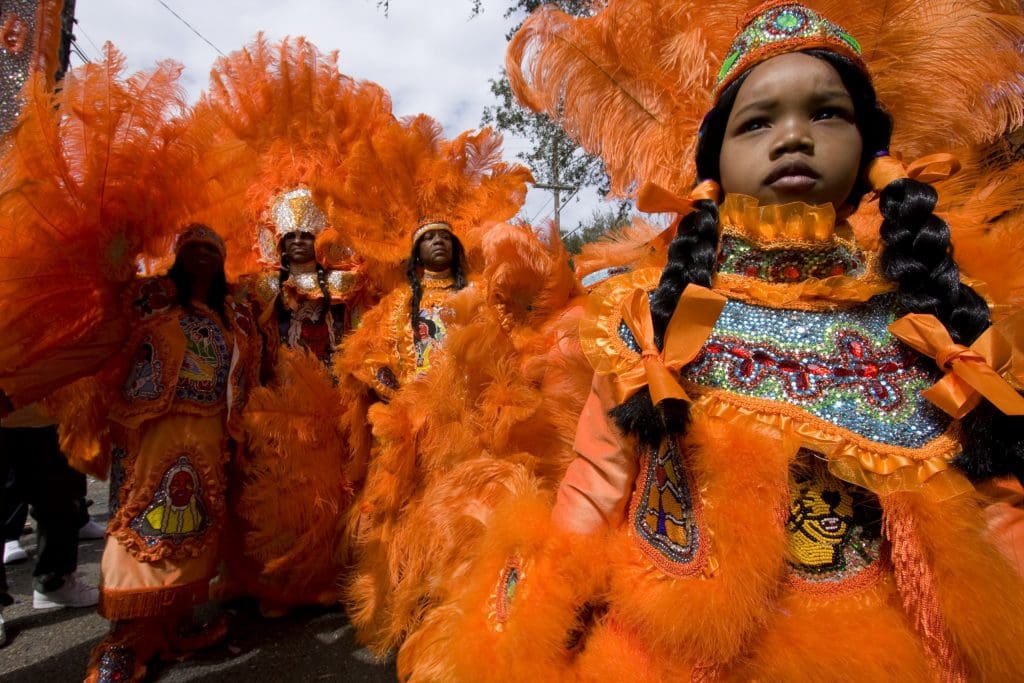
Fig. 1. Black Masking Indians, February 21, 2012, featuring three adult participants and two children in plumed and beaded costumes in neon orange. Photograph by Derek Bridges [under CC BY 2.0, with permission].
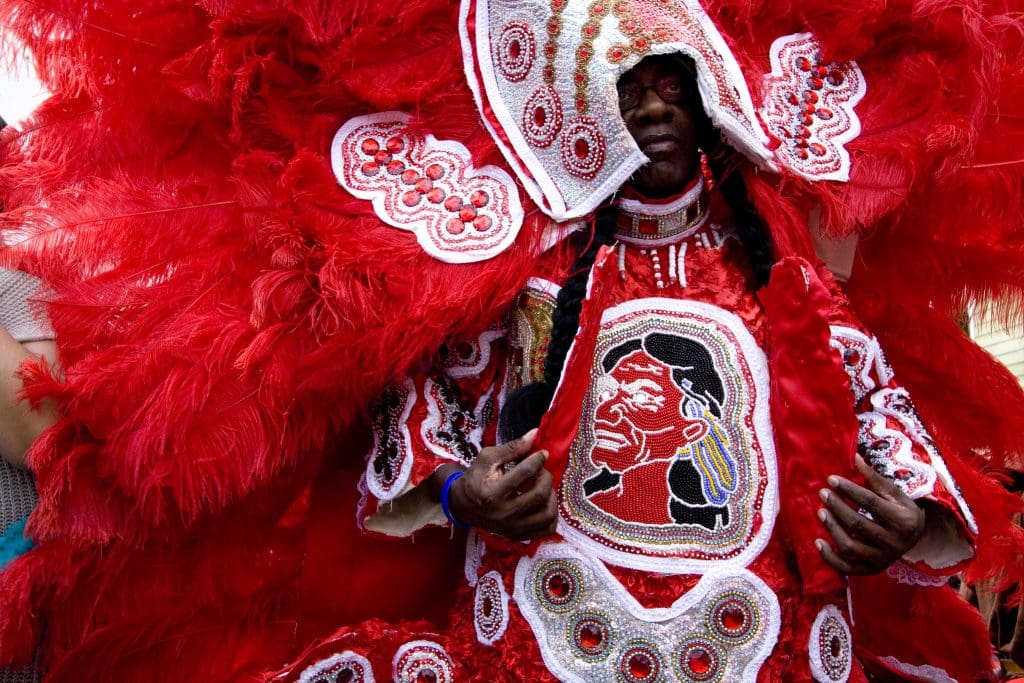
Fig. 2. Fat Tuesday on 2nd & Dryades, February 21, 2012, featuring a single participant in a plumed and beaded costume in red. Photograph by Derek Bridges [under CC BY 2.0, with permission].
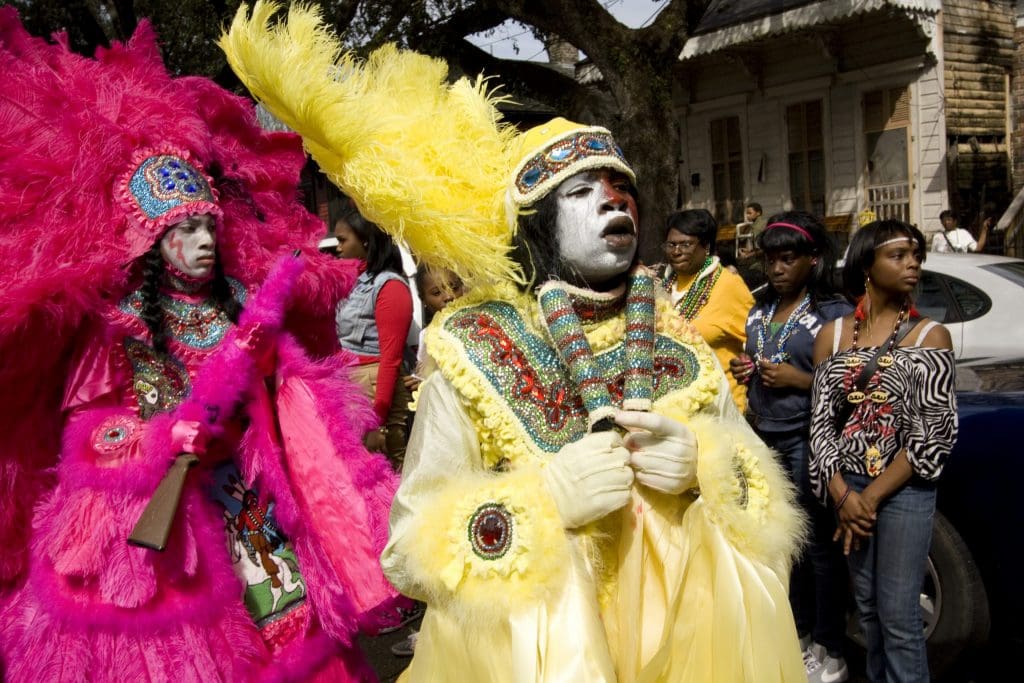
Fig. 3. Black Masking Indians in Procession, on Jackson Ave, February 21, 2012, featuring two participants with face-paint, adorned in plumed and beaded costumes, one with neon pink feathers, one with bright yellow. Photograph by Derek Bridges [under CC BY 2.0, with permission].
At first, the cultural bedrock of Black Masking Indians seems to lay far afield of the medieval Christian Santiago (Saint James the Greater), but there are many overlooked throughlines connecting their festive manifestations, in particular the Afro-Catholic festivals staged in the Americas that have shaped black Atlantic cultures.[6] I propose several uses and functions of the expanded medieval cult of saints for indigenous and diasporic communities and ultimately argue that some iterations of Santiago retain traces of a heritage of resistance to domination. Santiago acted as an interlocutor, and subverter, of colonial powers. The saint’s interpretive range created a figure through whom subaltern groups could reimagine their relations, expectations, and sovereignty within rapidly mutating power dynamics. A heritage of resilience and resistance is evident in the violent, conquering, racialized, and triumphalist version of this saint: Santiago Matamoros (the Moor-killer), a figure employed for social sculpting (à la Joseph Beuys’ soziale Plastik) by some communities of Amerindians and the Black American diaspora; a figure who originates in medieval Latin Christian crusade and Reconquista.[7] Social sculpture frames art as a political tool by expanding the definition of art to encompass the entire process of living––art is intentional social contribution and change. The paradigm of medieval social sculpture employed in this special issue identifies the “work” in the artwork as the collaboration of bodies, objects, and spaces at specific points in time. While this volume has focused on medieval social sculpture, I engage with this concept over several temporal and geographic case studies in this essay, examining not only the utility of social sculpture in medieval society, but also the reverberations of medieval social sculptures in the early colonial, modern, and even present day. In this way, using social sculpture as a framework allows medievalists to drop the often unsuitable term “medievalism” when addressing indigenous and diasporic practices that intersect with the medieval cult of saints. I reframe Santiago Matamoros not as a subject of visual iconographic study, but as an imaginary, cognitive iconography that promoted a certain rhetoric, reshaping society through various maker’s and worker’s responses to their position in relation to the Matamoros ideology, as elucidated in this issue’s Introduction as well.[8] In this way, I explore several case studies of social sculpture.
As an iconographic framework designed in the Middle Ages to create a simple visual binary social hierarchy, the Matamoros provided an accessible site for social sculpture as it was easily manipulated to negotiate for more nuanced social dynamics between colonizers, indigenous, and diasporic communities. By subtly shifting the characters of mock-violence, social actors could publicly invert and subvert newly powerful structures linked to ethnicity (or race), class, and gender, the fundamental and inseparable concepts shaping cultural memory.[9] The thematic focus of historical social sculptures provided a public yet coded point of community resistance and power against colonizing forces, especially against the violence of the racial hierarchies developed through settler colonialism. Considering medieval history alongside the colonial cult of saints can help us to better understand how the myths and imaginaries of the Middle Ages were useful and utilized by subaltern communities.[10]
The case studies pursued here begin with the development of the Matamoros in medieval Iberia and its expansion in Central Africa. Taking a transoceanic approach, our story leaps from that sea basin to others –– from the Mediterranean to the Caribbean, the Gulf of Mexico, and the nape of the Pacific –– following the role of the saint.[11] This covers the shifting dynamics of Nahua power between the Tlaxcala and Mexica in post-Hispanic Mesoamerica and resolves on the Northeastern shoreline of the Gulf Coast. It concludes by way of a return to the Black Masking Indians, exploring embedded notions of history and territorial origins across premodern Iberia, Africa, and the Americas.
Spanning a temporal and geographic breadth usually divided among distinct fields of study, this analysis is rooted in my training as a medievalist and the productive tension that arises when placing medieval art history side-by-side with contemporary performance. Medieval art historians who draw new interdisciplinary methods into the field tend to approach theatre and performance studies from a very direct perspective, often constrained by modern notions of documentary accuracy that are not available for historical performance. We typically seek out visual evidence, such as paintings depicting costumes or surviving sculptures. However, time-based media, from an era before time-based archiving, must also be recovered from more unexpected places. While largely continuing within this limited evidential framework, I aspire to broaden the scope of inquiry in this paper by suggesting future avenues for studying activated medieval art, expanding the range of sources and methodologies available to the field.
Several case studies of Santiago Matamoros now chart the evolving imaginaries of the medieval saint’s cult as a post-medieval form of social sculpture. Today, a diversity of festive rituals can be tied to this ideology, from Brazil’s Moors and Christians (Mouros e Cristãos) plays, to the aforementioned Black Masking Indians of New Orleans, to more direct continuations of Spanish colonial culture, such as the Patronal Feast of San Santiago in Lampa, Puno, Peru, where a series of religious sculptures are carried in a procession as flotillas, including this sculpture of a pallid Spanish Santiago as Matamoros (Fig. 4). Flotillas like this generate a collage of figured bodies, both living and sculpted, that act together to change the way that society functions by creating and reinforcing the interpretive frameworks of participants and street-side viewers. This is a straight forward and typical understanding of social sculpture. Rather than center such clear examples, I will instead probe the murky boundaries of historical social sculpture. Its soft defining borders consist of many kinds of documents: intimate miniature painting, the vibrations of communal dance, the harsh immobility of monumental sculpture, and the plumes of feathered costumes. Searching the shadowy corners of the archive centers the Morisco colonizers, indigenous Amerindians, and enslaved Africans who defiantly utilized the iconography of the militant Saint James over and against the Christian colonizers who, in turn, sought to systematically erase their stories of resistance from how we now tell our histories.
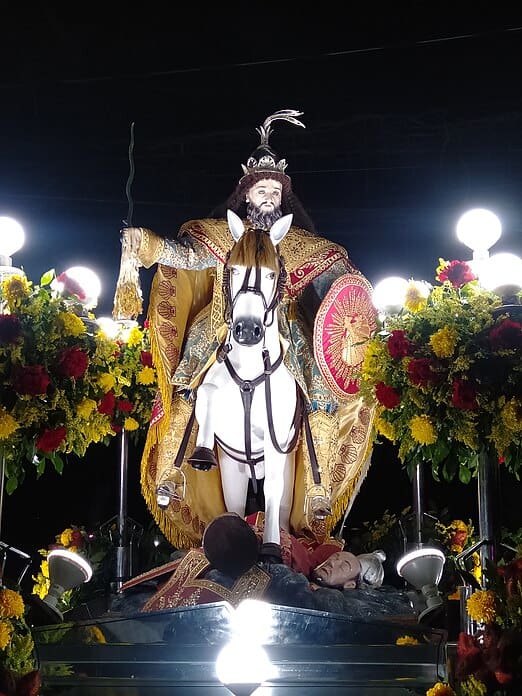
Fig. 4. Detail of the car-driven flotilla of Santiago (or San Tiago) Apostol de Quingua Salubong Festival, during the night procession on December 29, 2021 of the Santiago Apostol Church, held in Barangay Tabang, where the statue was originally housed before it was moved to Barangay Sipat (Plaridel, Philippines). Photograph by Miguel de Mayon [CC BY 4.0].
.jpg)
Making Matamoros: Reconfiguring Saint James after 1099
The cultural construction of the militant Santiago was only possible and perpetuated as a community process of hegemonic practices, not attributable to one single author, patron, or point of origin.[12] Roughly, the emergence of this new iteration of the saint can be traced to the Iberian Peninsula in the twelfth century, but this form first appears in textual rather than visual sources.[13] One source, the Historia legionense (c. 1118), writes of Santiago as a caballero, a knight on horseback. These new narratives shifted the vision of Saint James that was conveyed at his primary cult site in the Iberian Peninsula: Santiago de Compostela.
The shrine of Saint James at Santiago de Compostela was a popular sacred destination for devotees that was reimagined over the late eleventh and twelfth century as an historical Christian stronghold against the Caliphate of Córdoba and the Muslim taifas, people referred to by the Christians as the “Saracens” or the “Moors.”[14] Pope Gregory VII asserted the legal right of the papacy over the Iberian Peninsula in 1073, prompting and promoting a series of violent Christian excursions.[15] Through this rhetoric, the Roman reform catered to ambitious milites (knights) who desired new land and material enrichment, paving a path for later Christian arguments that favored colonial expansion. According to Gregory, Iberia belonged “solely to the Apostolic See” of Saint Peter, “though occupied for a long time by the pagans [now Muslims]” because it had once belonged to Rome.[16] Warrior saints, previously more popular in the Christian Roman (Byzantine) Empire, gained traction with Latin Christians. Simultaneously, new orders of militant-religious emerged, like the order of the Templars, approved at the Council of Troyes in 1128, whose earliest headquarters were in Latin Christian-occupied Jerusalem.[17] It was from within this proto-colonial, militantly expansionist context that Saint James, Santiago, accreted the “Matamoros” or “Moor-killer” iconography. The power of this creative reimagining of Santiago through the guise of a warrior saint embodied and encoded a new, expansionist and racialized Christian hierarchy that was to shape future colonial societies.
Initiating the written narratives of the militant Santiago, in the Historia legionense the saint appears to a migratory devotee, described as a “Greek” from Jerusalem.[18] The Greek devotee does not believe that Saint James could manifest in the, ostensibly, un-Christian form of a knight but, to his surprise, in the vision Santiago predicts King Fernando I’s capture of Coimbra (1064) and then mounts a horse, “whose snow-white brightness filled all the church with light.”[19] In this episode he is called bonus miles, or the “good soldier,” suggesting a new, more violent, character for the saint. The militant version of Santiago appears shortly thereafter in Compostela proper, recorded in the miracles of the Iacobus (Liber Sancti Jacobi), in a tale elaborating on the story of the unbelieving Greek from the Historia legionense.[20] The witness of the miraculous vision is named Stephen, who, at the time of the miracle, lived within the Cathedral of Santiago de Compostela. In the story,
Blessed James appeared [to Stephen], adorned in the whitest clothing bearing military arms… transformed into a soldier… James spoke in this way, “Stephen, servant of God, you who ordered me to be called not a soldier but a fisherman, I am appearing to you in this fashion, so that you no longer doubt that I am a fighter for God and his champion, that I precede the Christians in the fight against the Saracens [Muslims], and that I arise as victor for them.[21]
With these words, Santiago is established as a victorious, efficacious, Muslim-defeating military saint associated with whiteness as a visual signifier of greatness, though he is not yet called “Santiago Matamoros.”
That term, “Matamoros,” was a further elaboration for the literary fabrications, created to suit the evolving ideologies of reform, Reconquista, and crusade.[22] It was first recorded in the mid-twelfth century on a charter kept in the Cathedral archives, granted, supposedly, by King Ramiro I (r. 842-50). The charter, known as the Privilegio de los Votos, documents a votive offering by the king and was likely forged by the canon Pedro Marcio of Compostela.[23] The word “Matamoros” appears in a description of the invented mythical Battle of Clavijo which, according to the author, occurred in 834.[24] In it, King Ramiro I granted a certain quantity of grain, wine, and spoils from campaigns against the Moors to the cathedral of Compostela in gratitude for Santiago’s assistance in the Battle of Clavijo.[25] This tribute was known colloquially as the “votos de Santiago.”[26] Santiago was made into the Matamoros, a figure associated with miraculous victory in battle, through the fictional Battle of Clavijo and the associated votive tribute that implied the enduring subjugation of the “Moors.” Even more importantly, this militant version of Saint James came to embody a Christian justification for enrichment through the spoils of war due to his association with the “votos de Santiago.” From its very inception, the Matamoros was used to rationalize material and human exploitation. It became a visual shorthand for the Latin Christian belief in the rightful colonial exploitation of non-Christian lands and people and, eventually, a symbol of righteous Christian dominance, affiliated with progressive emphasis on the light complexion of Santiago and his pale, white horse.[27]
James as a peaceful pilgrim or a crusading warrior may seem to be iconographies at odds.[28] However, from the Roman reform onward (c. 1050), knights, reconceived as milites Christi, were tasked with defending dioceses or pilgrims, and the term “militare” began to indicate the reimagining of violence in an ethically justified context. This enabled the series of conflicts which we now call the “crusades.” To twelfth-century audiences, peaceable pilgrims and militaristic crusaders were part of an integrated body of pious travelers.[29] An intensifying interest in the concept of a divine social hierarchy, extended through all levels of existence, reconceptualized the spectrum of sacred violence. Santiago Matamoros was created by this shift toward permissible and even ethical violence, justified by a Christian “right-to-rule.”
This right to rule was quickly racialized and connected to geography through aesthetic cues. In formulating the trampled and impaled victim below the white saint on white horseback, an iconography attached to “Saracens” and “Moors” was employed––two terms and iconographies undergoing revision from their Late Antique attachment to geography, toward racialization in the twelfth and thirteenth centuries.[30] As Geraldine Heng has shown, the term “Saracen” used a false etymology to claim all Ishmaelites (Arab-Muslims) as liars, to support a religious-ethnic hierarchy.[31] The term “Moor” is equally slippery and complex, employed as a “catch-all term for Africans” by the twelfth century.[32] This new emphasis on race/ethnicity can be partially attributed to intensified interest in the concept of divine order following the twelfth century reimagination of Latin Christian society.
On the tympanum of Compostela Cathedral (c. 1238-66), a depiction of the Battle of Clavijo draws on the textual imagery in the Privilegio de los Votos and the Iacobus, producing the earliest extant image of the saint on horseback armed with a sword (Fig. 5).[33] A century later, the depiction of Santiago specifically as the Matamoros appears. A painting of Santiago in the 1326 Tumbo B manuscript of Santiago de Compostela Cathedral is the earliest extant example of the saint trampling his enemies, though he is still labeled “milites” (Fig. 6). Decapitated heads with Islamic headgear and bloody, dismembered hands stipple the ground below Santiago’s white steed in Tumbo B.
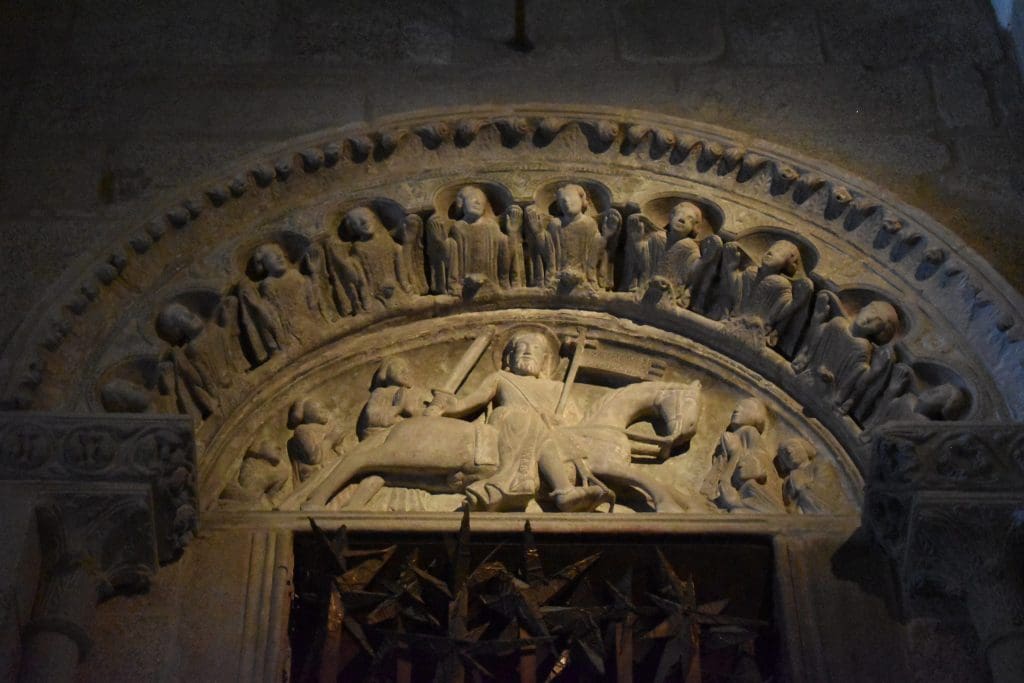
Fig. 5. Depiction of the Battle of Clavijo with Santiago as a militant knight on horseback, interior tympanum of Compostela Cathedral, stone sculpture, made c. 1238-66 [author’s photo].
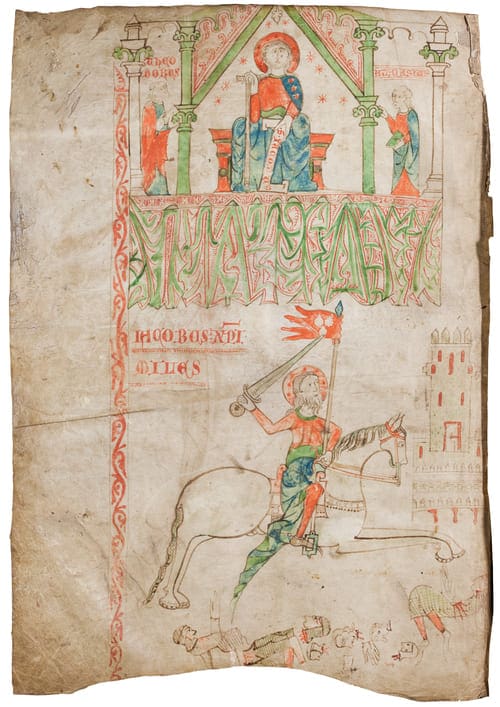
Fig. 6. First image of Santiago as a militant knight, with the figure clearly labeled “MILLES,” Tumbo B manuscript of Santiago de Compostela Cathedral (1326) Archivo Biblioteca de la Catedral de Santiago de Compostela, fol. 2v (ACS, CF, 33). © Chapter of the Cathedral of Santiago de Compostela – All rights reserved/ © Cabildo de la Catedral de Santiago de Compostela – Derechos reservados.
The iconography of Santiago Matamoros was taken up rapidly in Medieval Iberia after the thirteenth century.[34] It was integral to the bloody, racialized Christianizing of the Iberian Peninsula and of peninsular history during the expulsion periods. The image accreted new meanings and racist contexts in sixteenth century, post-contact Spain, with explicitly racialized, decapitated heads strewn on the ground below Santiago Matamoros, as seen in the central altar panel of the chapel in the Alcázar of Segovia (Fig. 7, 8). Here, the simple heads of Tumbo B have taken on physiognomically racialized features; whereas the manuscript relied solely on headgear, the panel painting utilizes new aesthetics of scientific racism, depicting the disembodied, bloodied heads as dark or sallow skinned.
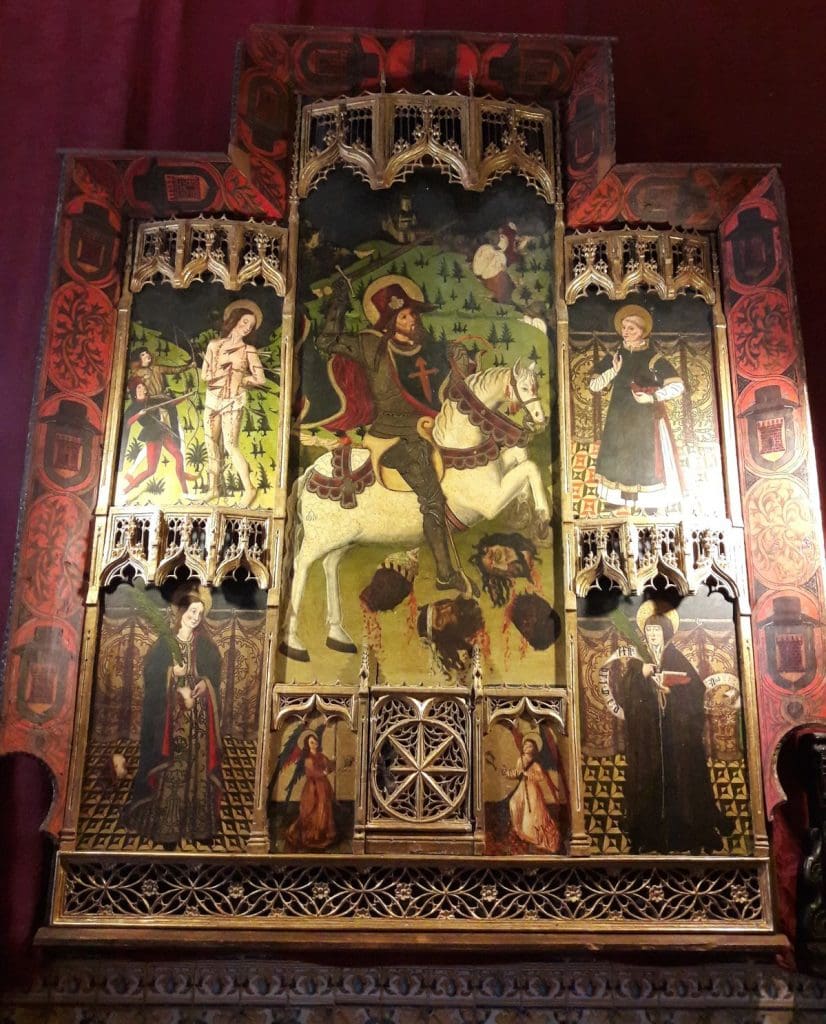
Fig. 7. Santiago Matamoros altar of the chapel in the Alcázar of Segovia, oil on wood, 15th century; Segovia, in León, Spain [downloaded from Jstor, public domain].
Fig. 8. Detail of Santiago Matamoros with severed heads, central altar panel of the chapel in the Alcázar of Segovia, oil on wood, 15th century; Segovia, in León, Spain [downloaded from Jstor, public domain].
The narrative of the Battle of Clavijo expanded on Matamoros artworks and became the subject of festive ritual actions. For example, by 1389, a mock battle between Christians and Moors, staging the Battle of Clavijo, was acted out when Queen Isabella of France made a ceremonial entry into Paris, expanding the impact of the medieval Matamoros beyond the Iberian Pyrenees.[35] Staging this battle, in effect expanding the Matamoros sculpture through real, living, acting bodies, is an exemplary case of medieval social sculpture. Public spectacles were one of the most important vehicles through which history was reimagined in the Middle Ages, yet their ephemeral nature has left these events largely overlooked in favor of more durable manifestations, like painting and stone sculpture.[36] Reaching back to this historical repertoire, we can recover a history of resistance to conversion and colonization embodied by Santiago as a site of social sculpture for a variety of communities. Making Santiago into the Matamoros cemented emerging connections between previously distinct medieval conceptions of religious, geographic, and physiognomic race and ethnicity. It created a lasting image of righteous Christian triumph over an amorphous and vilified “other,” defined in opposition to the triumphant saint as wicked, non-white, and non-Christian. Yet, when invoked by those outside the assumed righteous and dominant order, the Matamoros became a site of resistance and negotiation, challenging the power it was meant to uphold—arbitrating with the hooves of the white horse, always poised to trample those beneath it.
A Killer Santiago: Arbitrating Christianity in Kongo after 1483
As a representative of sacred violence, Santiago Matamoros accompanied early Iberian intrusions into West Central Africa. The Iberian presence in the Kingdom of Kongo––an influential polity of West Central Africa––and the introduction of Latin Christian concepts into the local social, political, and spiritual dynamics did not result in immediate conversion, nor did it result in colonization.[37] Instead a lasting, if tenuous, diplomatic and material relationship was forged between the Kongolese and Latin Christians by way of the Iberian Portuguese. It was a perceptive move, on the part of the Kongolese monarchy and aristocracy, to embrace Santiago’s militant iconographic framework as their own, manipulating the simple visual narrative of a rightful, race-based social hierarchy in their dealings with Iberians. I argue that the Matamoros became a focus of social sculpture in Kongolese society because it helped to negotiate more nuanced social dynamics between Latin Christians and Kongo communities by reformulating an iconographic ideology that was familiar and embraced by Christian militants and missionaries. More importantly, it created a festive and socially embedded argument against the abduction of Kongolese Christians for the Atlantic and Mediterranean slave trade.
The Kongolese monarch Mvemba a Nzinga (Afonso I) and his successors embraced Catholicism after a miraculous battle vision––an origin story recalling the apparition of Santiago during the invented Battle of Clavijo. Mvemba a Nzinga defeated his half-brother, a “pagan,” in the Battle of Mbanza-Kongo in 1506 and dedicated his victory to Santiago, who was said to have intervened in the battle.[38] Through this battle, he became King and took on a Christian name “Afonso I.” His veneration of Santiago connected him, not only to Clavijo, but to the Battle of Ourique in 1139, in which the “Portuguese King Afonso Henriques had allegedly defeated the Moors thanks to an intervention by Santiago. In Kongo, Santiago the [Iberian] “Moor-slayer” was thus transformed into Santiago the “pagan-slayer” (ie. the Mata-pagãos).[39]
This transformation of Santiago took place a generation after Portuguese merchant-explorers and missionary-clerics entered Kongo and greater Central West Africa via the world’s deepest river in 1483, led by Diogo Cão.[40] Indeed, Afonso I’s mythical vision occurred only after his predecessors’ conversion. However, for this study, and as Cécile Fromont rightly argues, “it is important to underline that Christianity developed in central Africa under the patronage of Portugal but at the command of the Kongo kings themselves.”[41] Kongo people converted under the guidance of their monarchy and began to produce their own Christian cult objects digesting Iberio-Kongo forms, producing a new art that reflected this budding religious identity. Kongolese artists figured their people into Christian history, as seen in this striking Crucifixion (Fig. 9) depicting four diminutive and abstract praying devotees seated on the cross arms, with a single line demarcating their brow lines, as if their eyes are closed in prayer. They are grouped around a large and expressive Christ whose ribs sag downwards, emphasizing the painful gravity of crucifixion.[42] Christ’s eyes are incised almonds, empty and swollen, suggesting his death.
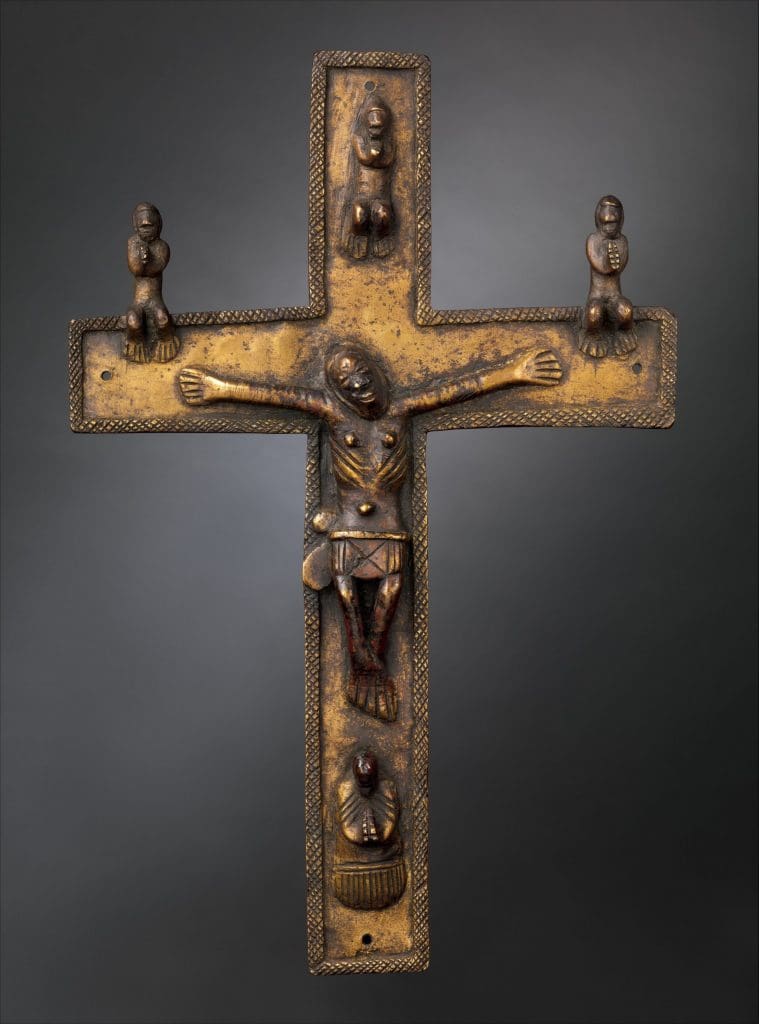
Fig. 9. Kongo Crucifix, Kongo artist, solid cast brass, H. 10 3/4 x W. 7 x D. 3/4 in. (27.3 × 17.8 × 1.9 cm), 16th-17th century; Democratic Republic of the Congo; Republic of the Congo; Angola. Metropolitan Museum of Art, no. 1999.295.7
[public domain https://www.metmuseum.org/art/collection/search/318323].
The main holiday in the Christianized Kingdom of Kongo was July 25, Saint James’s Day, and the royal city, once known as Banza, was renamed San Salvadore.[43] During Kongolese Saint James festivities, mock war dances called sangamentos were performed.[44] In his Report of the Kingdom of Congo (1591), Filippo Pigafetta described the Kongolese military dress as “a cap ornamented with ostrich’s, peacock’s, rooster’s, and other bird’s feathers.”[45] Sangamentos were iterative of the mock battles of Moors and Christians popular in Portugal, Spain, and France in the sixteenth and seventeenth centuries, like those enacted for Queen Isabella of France in 1389. Kongolese sangamento occurred in two acts, first with feathered costumes and bows, then, following an outfit change, with European-style hats, gold chains, feathers, and firearms.[46] The second costumes reflected not only Europeanization and Christianization of Kongo, but the attributes found on the coat of arms designed for Alfonso I by Portuguese artists, likely at his request (Fig. 10). It featured, “the white cross of Constantine appearing in the azure of the central African sky, the shells of Saint James ‘whom We called upon and who helped Us,’ the armored arms of the knights… and, at the bottom, represent[ations of] the destruction of two Kongo ‘idols,’” representing the Kongolese break with pagan idolatry through the breaking of black bodies.[47] Miraculous, militant visions of Santiago loomed large in the Kongo monarchy and in this festive dance honoring his pagan-smiting, idol-smashing powers. This dance does not portray the saint directly as the Mata-pagãos. Instead, Sangamento festivities utilized costumed bodies and festive objects to create a kaleidoscopic social sculpture evoking the Mata-pagãos as an imagined battle apparition in the sky, a vision blanketing the bodies of the dancer-battlers below.
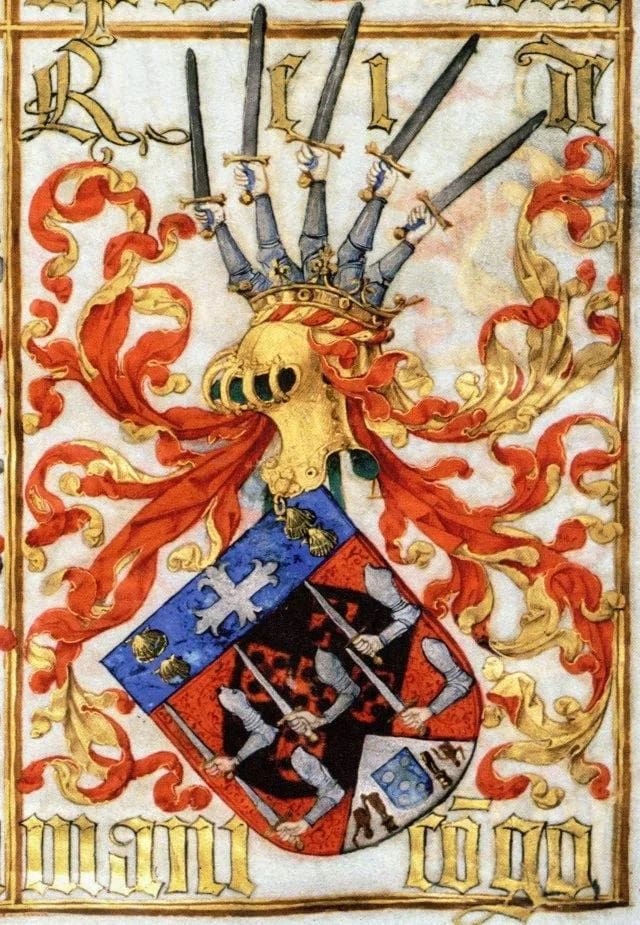
Fig. 10. Coat of Arms of Afonso I of Kongo Mvemba a Nzinga, Nzinga Mbemba or Funsu Nzinga Mvemba (c. 1456–1542 or 1543), in Livro da Nobreza e Perfeiçam das Armas, illuminated manuscript by António Godinho, written c. 1521 to 1541. Pigment and gold on parchment; 43cm x 32cm. PT/TT/CR/D/A/1/20, Direção Geral dos Arquivos-Torre do Tombo, Lisbon, MS CF-164, detail of fol. 7. Image provided by ANTT [Image free of rights for web reproduction, but must be under 314×235 pixels with complete attribution as written above].
Romanus Pontifex, issued by Pope Nicolas V in 1455, was an evangelist justification for a Portuguese/Iberian monopoly on the slave trade. The papal bull was “proposed by the king of Portugal, Alfonso V, soon after Europeans arrived at the mouth of the Senegal River and made contact with non-Muslim black Africans.”[48] António Brásio, a missionary scholar, described the document as the “Magna Carta” of the Portuguese Empire.[49] The Romanus Pontifex frames the right to the slave trade as compensation for the “costs incurred by the Portuguese in propagating the Catholic faith throughout Africa, Asia, and the Americas.”[50] The papal bull also justified enslavement because the “pagans,” abducted along the African coasts or born into enslavement, were taken to Portugal and “converted to the Catholic Faith.”[51]
Afonso I and his successors, as the kings of an independent Christian realm, endeavored to protect their freeborn population against enslavement through appeals to the kings of Portugal and the popes; their calls were met with conditional and fluctuating security for the population.[52] Cleverly employing the same legend-making tactics utilized by Iberian rulers to establish their divine right-to-rule, Afonso’s evocation of Santiago Mata-pagãos as his kingdom’s protector aided his people in appeals to the papacy and Iberian monarchies. They symbolically killed their association with pagans, severing ties to the identity used by the Romanus Pontifex as justification for their enslavement. The sangamentos changed the Kingdom of Kongo, enacting ritual protection by sculpting their society with the shape of the Matamoros. By mirroring the Iberian Matamoros with a specifically Kongolese Mata-pagãos, the monarchy of Kongo appealed to the Roman pope and tried to shelter the Kongolese people from the Romanus Pontifex, eschewing ties to a pagan past. This version of Santiago was not confined to Central Africa. As militant Christians expanded across the Atlantic, so too did the militant saint. In the Americas, as we will see below, the saint was reimagined again, as a symbol of colonial domination and religious conversion. As much as the image was used effectively by Kongolese Christians, the “spread” of this iconography through dance and costume in the Americas was anything but a positive story of social negotiation. It flowed across the waterways through the forcible abduction and displacement of the slave trade.
From Iberia to the Americas: the Mataindios as Tlaxcalan code
Iberian colonizers made themselves into saints through the image of the Matamoros; for they depicted Santiago as a glorious crusader.[53] This fresco at Santa María de Labrada, from Lugo, Spain (c. 1530-75) exemplifies the racialized use of the Matamoros in the sixteenth century at a key stop along the pilgrimage routes to Santiago de Compostela, by relying on a phenotypical contrast between the conquering saint and the dismembered and trampled people below (Fig. 11). Here, a dispassionate pale-skinned James is seated atop his white warhorse, sword raised to strike a red-eyed, black-skinned Muslim figure, while the beheaded, caricatured body of another black warrior is trampled below the horse’s legs. This is the crusader-saint envisioned as the enforcer of a divine hierarchy on earth. The Matamoros explicitly incorporated race, ethnicity, and religion into that social structure, imposed throughout colonized lands. The saint was a figurehead for the three core ideologies of European imperialism: Christian superiority, the racialized and religious other’s inferiority, and the acceptance of this as the natural order.[54] Notions of “race” are multiple and shifting across the temporalities, geographies, and individuals considered here. This study began with the development of the Matamoros in the era of Latin Christian crusade and therefore within a discourse on religious-race/ethnicity that combined the sociocultural and natural or biological.[55] While “race” increasingly came to refer to belief in phenotypical and biological race, it is fundamentally socially constructed and relational. Often, it was as tied to territory and territorial claims as it was to social groups or individual people. Santiago’s use by the early Iberians in the Americas formed part of a program of Catholic emplacement: in the cartography of Mesoamerica today, there are 27 towns called “Santiago” and 16 “Matamoroses” in Mexico alone, displacing Indigenous histories.[56] However, the Matamoros became an iconography and ideology that was embraced and transformed within indigenous visual cultures, challenging the core tenets of the Matamoros dogma.
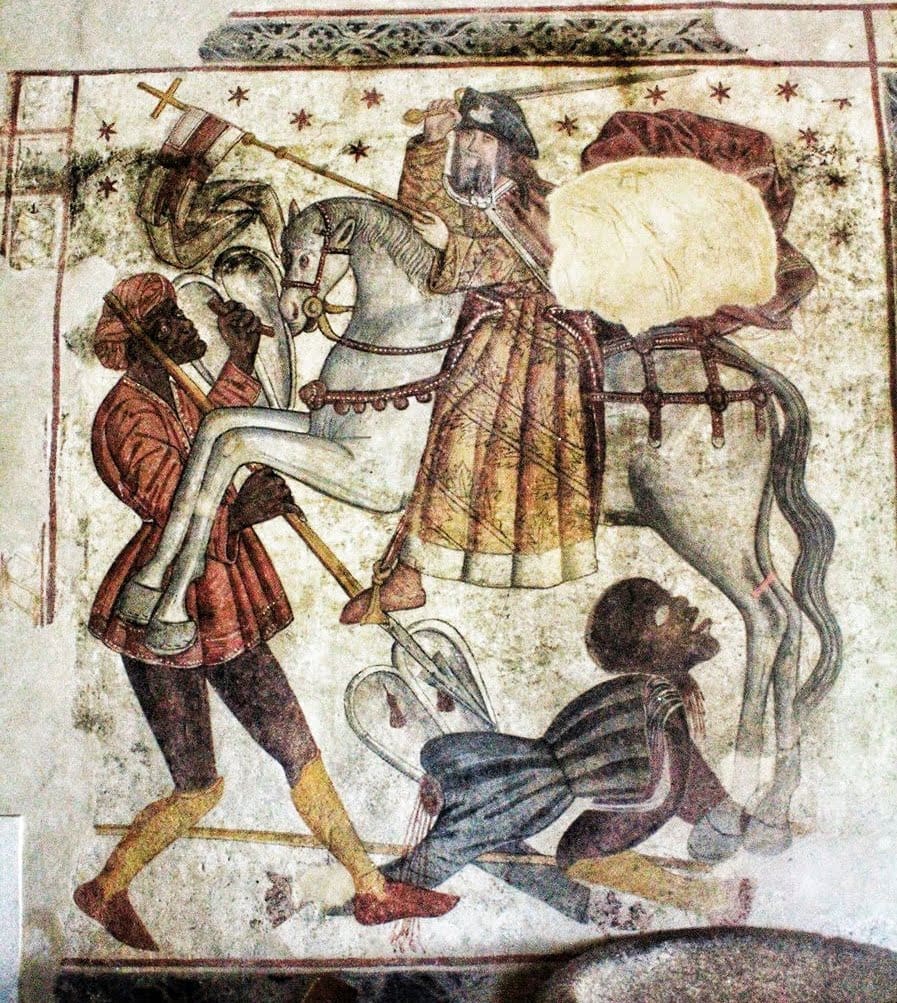
Fig. 11. Santiago Matamoros, fresco on the south wall of Santa María de Labrada, made c. 1530-75; Guitiriz, Lugo, in Galicia, Spain [author’s photo].
Iberian documentarians writing on the early colonization of the Americas alluded to Islamic places, creating an equivalency between the Muslim “Moors” and the indigenous “Indians”: Tlaxcala is compared to Granada, Tenochtitlán to Istanbul, and the court of Motecuzoma Xocoyotl (Moctezuma) to the court of the “Moors” of Granada.[57] Aside from grafting a racialized orientalism onto the indigenous peoples and lands of the Americas, this layer of narrative immediately figured a history, and thus a familiarity, upon the people Iberian colonizers encountered.[58] The Spanish in Mesoamerica documented the Matamoros in battle apparitions, projecting medieval Iberian identity into the Americas to rapidly incorporate this new land into the medieval Christian cosmogony.[59] In response, Amerindians could reverse the presumptions encoded in these moor-izing narratives, subverting them to their advantage.
Santiago Matamoros first appeared as a conqueror of indigenous peoples in a battle apparition in Tlatelolco. Bernal Díaz del Castillo wrote about the event in the 1550s, describing a battle which took place in July 1520, when a vastly outnumbered army of Spaniards, Tlaxcala, and other indigenous allies, were ambushed by the Mexica during a retreat from Tenochtitlán.[60] Calling on Santiago Matamoros, the Spanish charged, transforming the looming defeat into a victory. The Church of Santiago Matamoros Tlatelolco in modern Mexico City, composed of looted stones from the dismantled Mexica (Aztec) temple, was built as a symbol of this conquest in 1521 (Fig. 12).[61] Later, an indigenous artist, Miguel Mauricio, was commissioned to create a gilded altarpiece for this church, under the guidance of the Franciscan, Fray Juan de Torquemada, a task he completed between 1604-11.[62] Mauricio radically adapted the Matamoros to a decipherable visual code for his audience (Fig. 13). He replaced the scallop shell on Santiago’s hat with a sun-like lion motif, and the dismembered men under the hooves with indigenous warriors, not Moors. Based on the foremost of these figures––whose central, dying and dismembered body gracefully mirrors the curve of the horse’s belly and legs above––it is likely that these nearly nude warriors represent fallen Mexica enemies, an affiliation indicated by the figure’s tied hair lock.[63] A Jaguar warrior wearing a feathered helmet, stylized in the shape of a cat’s head, stands in an uncertain zone between conquered and conquerors, in the righthand background, demarcating Mauricio’s nepantla of the composition––a Nahuatl word meaning “the middle ground” or “border zone.”[64] An incredible preservation, this panel gives us insights into profoundly local conceptions of identity, playing out divisions and allegiances based in the complex microethnicities of the region.[65]
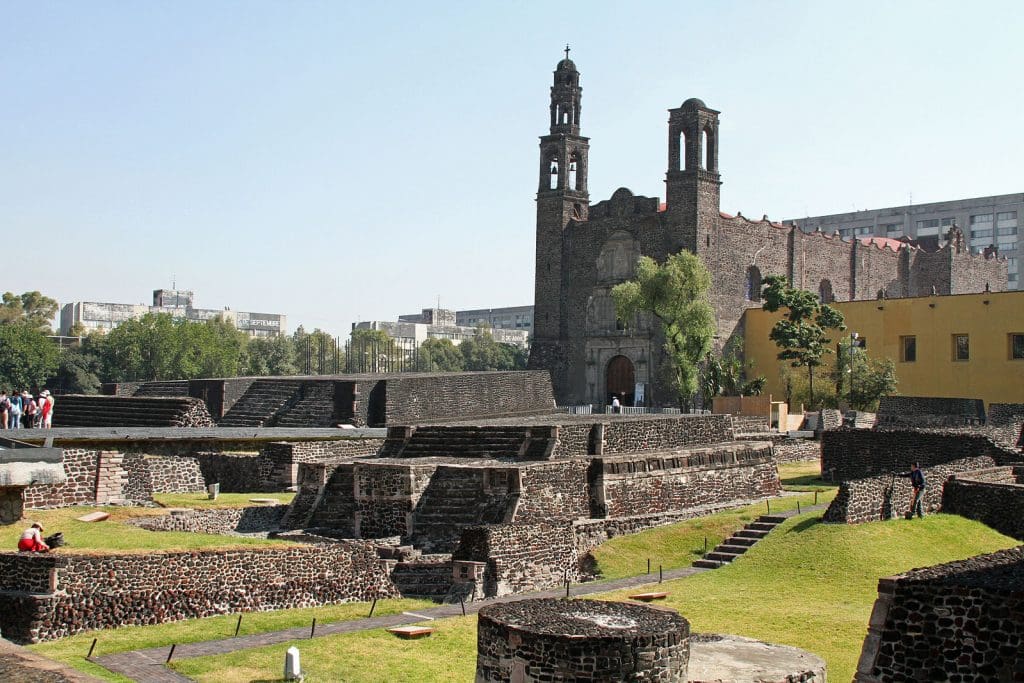
Fig. 12. The Church of Santiago Tlatelolco among Mexica ruins, church built to celebrate the conquest of the Mexica in 1521; Tlatelolco, Mexico City, Mexico. Photo by Greg Schechter [under CC BY 2.0].
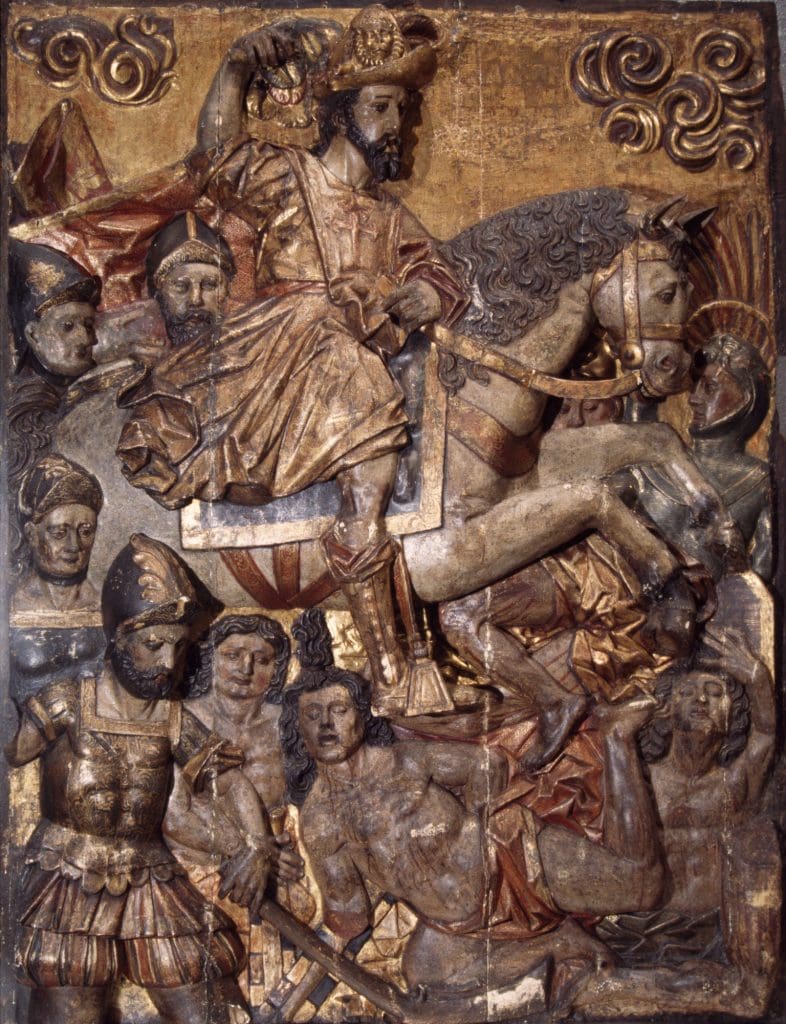
Fig. 13. Miguel Mauricio, Santiago Mataindios panel, from the altarpiece of the Church of Santiago Tlatelolco, wood, gilding, and paint, made 1604-11; Tlatelolco, Mexico City, Mexico [author’s photo].
This is, indeed, a representation of a new iteration of the militant Santiago, the Mataindios. However, this vision of the Mataindios diverges significantly from Mataindios images fabricated by Spanish colonizers. For them, Santiago was adapted to suit the aims of Spanish nation-building and imperialism.[66] Santiago, for the Spanish, was a mediator between the indigenous world and the spread of Christianity, and the Mataindios furthered this goal.[67] Apparitions of Santiago Mataindios, intervening in specific battles, were recorded in Mexico, Peru, Chile, and in the Caribbean coast region of Colombia.[68]
Miguel Mauricio’s Mataindios panel was the centerpiece of a church that doubled as a battle monument. It was a testament to the power of the Tlaxcala people, to their defeat of the Mexica and their allegiance with the Spaniards, or Caxtilteca, through the binding social ties of the Christian saint, Santiago.[69] The Tlaxcala were not only allies of the Spanish, but the main rivals of the Mexica; they were more consequential socially, artistically, and economically than the Spaniards in the years after the battle in 1520.[70] The city-state of Tlaxcala, located halfway between the Gulf Coast and Tenochtitlan, managed to maintain its autonomy and independence.[71] Thus, Tlaxcala elites and Mexica were treated very differently under Spanish rule. With this panel, Mauricio documented the shifting social dynamics of the region, and created a static, but moving monumental social sculpture. It was the central devotional image for his community, and it figured his people and their history into a newly configured society. Just as Afonso I chose to center his realm’s festive rituals around the battle apparition of Santiago, so the Church of Santiago Matamoros Tlatelolco focused community ritual practice and identity on the Mataindios through this polychrome altarpiece.
While the Mexica are bare chested, bloody, and dismembered, the Jaguar warrior at the right of the panel stands equal to the Spanish. His head is framed with a halo of plumed, feathered extensions as he turns back, looking to his comrades, seeming to wave them onward. The central Santiago once held a sword, now lost. Losing this sculptural detail, however, clarifies the connection between the Jaguar warrior and the saint: Santiago’s sword hand is framed by a small, feathered halo, equating the saint’s right hand with the indigenous warrior. Simultaneously, the radiant plumage around the Jaguar warrior’s head mirrors the rays of the radiant sun-lion’s mane. Seemingly minimal signifiers, these attributes encoded references to Tezcatlipoca through the Jaguar and, possibly, to Quetzalcoatl, through the sun-lion.[72] These publicly Christian figures were coded to evoke the Late Postclassic Aztec pantheon in the aesthetic transcript crafted for indigenous viewers.[73] For the inhabitants of Central Mesoamerica, the hierarchy of gods paralleled the political hierarchy.[74] Certainly, this mirror-world concept plays out with great effect in this panel, drawing the Matamoros and the Aztec pantheon into an historical battle, with living people echoing the gods.
Through this carving, we can see the negotiation of historical narrative between the Spanish and Amerindians. The Jaguar warrior is the right hand of Santiago as “Mata-Mexica.” He collaborates with the Spanish soldiers, but he is not on the same side of the horse. The yawning spatial gap between the horses’ hooves and the devastation of the Mexica below hovers ominously between the Jaguar and the Spaniards, rendering their allegiance distant, alien. Mauricio’s community would have witnessed the complex dynamics presented in this panel and responded to it in their daily lives with a devotional mandate. An incredibly nuanced description of the dynamics of indigenous encounter with the invading other, this panel used the figure of Santiago Mataindios as a tool to resist domination. Mauricio’s Mataindios panel’s composition, staging, and function as the centerpiece of a monument to the Mexica devastation, negotiated the creation of a more complex indigenous place within the simplistic imperialist narrative of conqueror/conquered seen in Iberian depictions of the Matamoros, like that at Lugo.
The Tlaxcala quickly produced several pictorial histories about the conquest of the Mexica.[75] Between 1581-1584, Diego Muñoz Camargo, the mestizo son of a Tlaxcala and a conquistador, oversaw the compilation of the text known as the Historia de Tlaxcala and the manuscript known as the Tlaxcala Codex. This is a now famous graphic narrative history, telling a story of triumphant Tlaxcala conquest over the Mexica, aided by the Spanish Christians. It is written in both Spanish and the native Nahuatl. The image depicting the victory at Otumba shows a rider on a white horse attacking the Mexica force (Fig. 14). Malintzin Tenepal and Cortés walk behind this figure, who is identified as Santiago.[76] Malintzin was an enslaved Nahua interpreter, advisor, and lieutenant for Cortéz, who subjected her to rape and torture.[77] Frequently, she is depicted as a leader of the Tlaxcalan army, but this role was a balancing act of unfreedoms and divergent social codes.[78] In these facing drawings, Malintzin is shown as prayerful and demure, in direct physical contact with the rear of Santiago’s white horse and, on the page opposite, with Cortéz’s steed, literally “backing” the saint and the conquistador. The consistency of Malintzin as an almost caryatid-like supporter across this manuscript made Cortéz into a direct parallel of Santiago Mataindios. A gloss is written in Spanish beneath the drawing of Santiago, Malintzin, and Cortéz at Otumba stating, “the natives affirm that, here in this place, it was ‘el señor Santiago’ who appeared in the battle on a white horse because there was no one [else like him] in the company. And today there is a lovely hermitage of Santiago [there].”
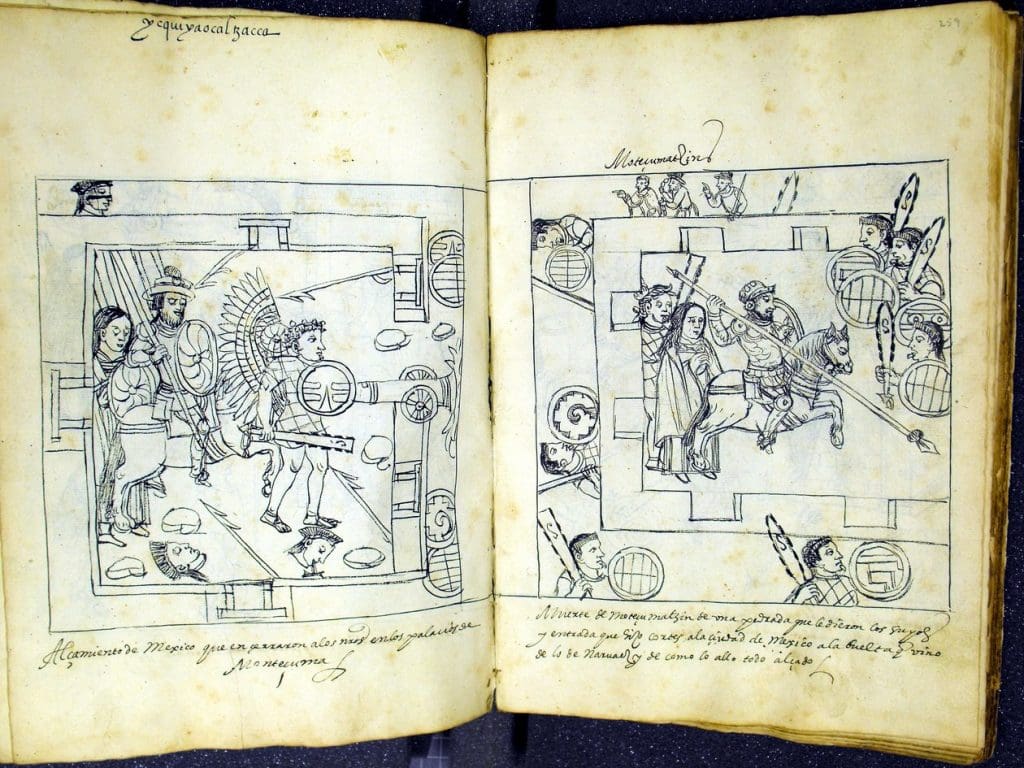
Fig. 14. Diego Muñoz Camargo, two drawings of Malintzin Tenepal and Cortés, Tlaxcala Codex, pen and ink on paper; fol. 258v-259r. MS Hunter 242 (U.3.15). Glasgow University Library, Scotland [public domain].
This Tlaxcala Codex is a derivative of, and indeed perhaps a copy of, the Lienzo de Tlaxcala, a huge cloth created around 1552 to convey an interactive narrative history; it was folded and displayed in complex ways to create narrative parallels and to highlight the relationships between different events (Fig. 15).[79] The Lienzo contains an image of Santiago Matamoros, though killing Mexica instead of Moors (Figs. 16 and 17). Thus, this may be the earliest (c. 1552) instance of Santiago in the form of the Mataindios, and it was created by Tlaxcala artists.[80] The omnivorous nature of the Tlaxcala incorporation of Spanish iconography can be attributed to their desire to promote political ties, but also to the Spaniard’s remarkable visual signifiers: their light skin, distinctive clothing, and alien material culture. In short, the Spanish were a fascinating “other” to the Tlaxcala.[81] They were new visual characters and thus became a point of aesthetic innovation and social reorientation.
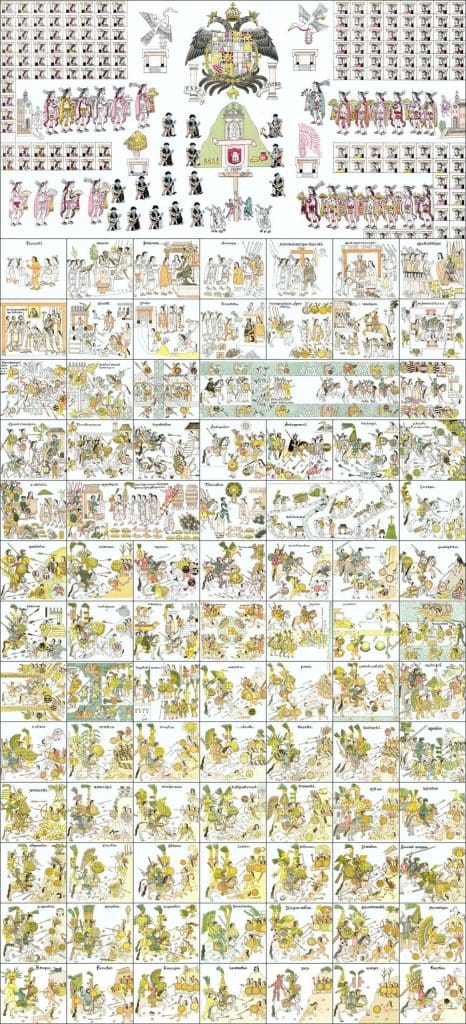
Fig. 15. Reproduction of the full Lienzo de Tlaxcala, c. 1552. The original Lienzo de Tlaxcala is lost. This recreation uses images from a lithograph facsimile printed in 1773. The recreation considered other visual documents from the sixteenth and eighteenth centuries to approximate the 1552 original [public domain].
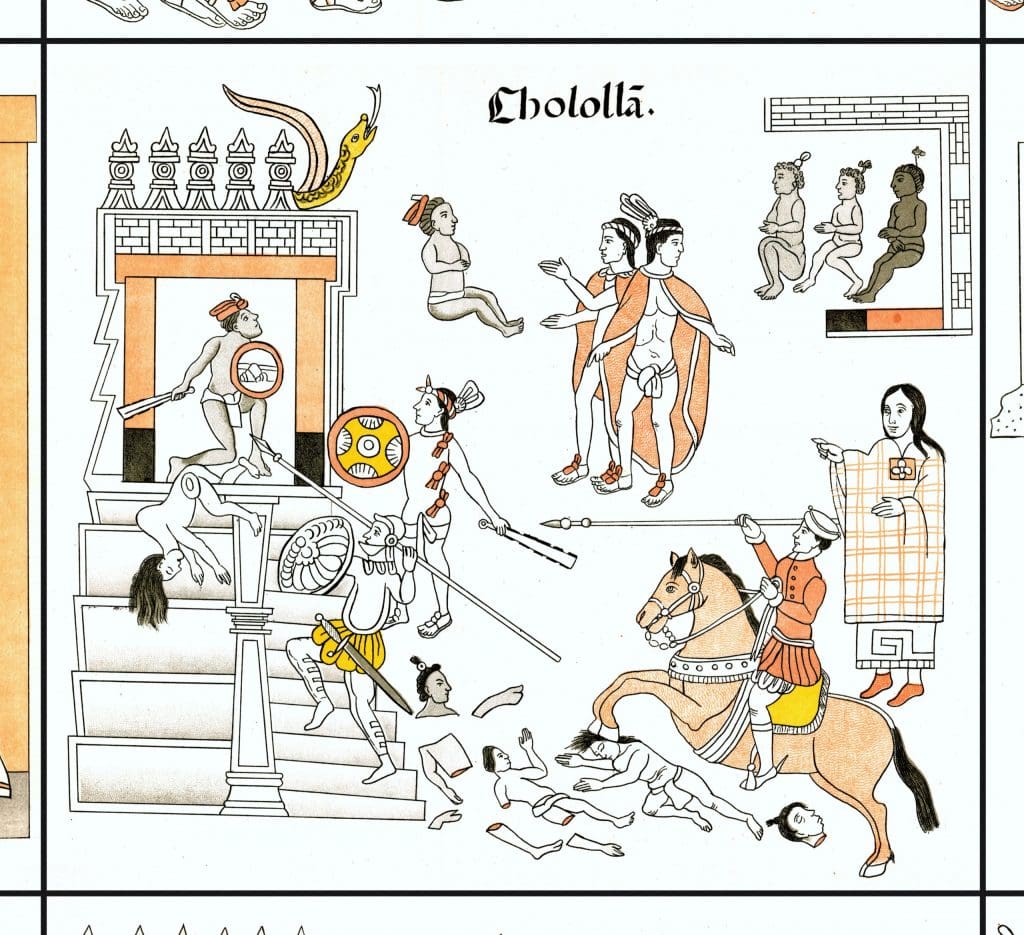
Fig. 16. Reproduction of the Lienzo de Tlaxcala, c. 1552, detail of Cell 9: Malintzin, standing to the right and wearing red shoes, directs the European-Tlaxcalan attack against the Temple of Quetzalcoatl in Cholula. With horseman in the attack against the Temple of Quetzalcoatl in Cholula [public domain].
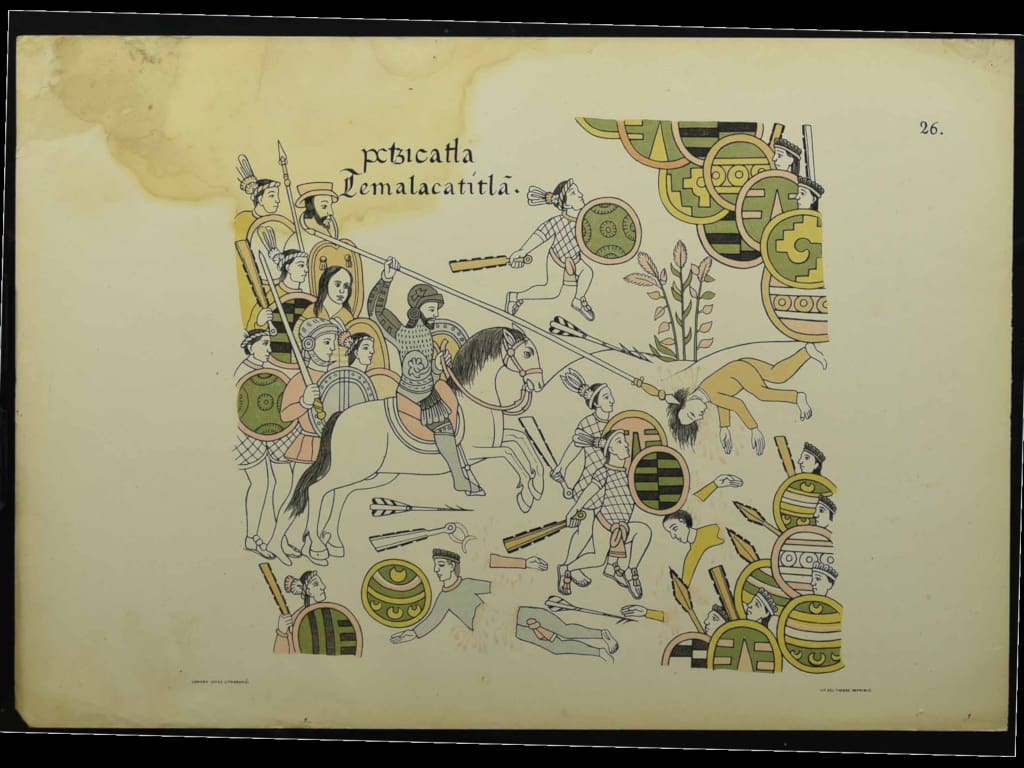
Fig. 17. Reproduction of the Lienzo de Tlaxcala, c. 1552, detail of the Battle of Otumba. Petzicatla Temalacatitlan, with Conquistador Horseman [public domain].
The militant Santiago did not become the center of all native social sculptures because it was an image that worked explicitly against certain groups, though, as argued above, it was a powerful iconography and imaginary for some subgroups in the region. This is apparent, for example, in the Codex Mendoza, made between 1541-1550, which records the conquered Mexica’s history. Mexica scribes began the text of the Codex Mendoza, but they did not want to document their peoples’ conquest, so the history, as Federico Navarrete Linares recently argued, was continued by a converted Muslim, a “Morisco,” from Granada, many of whom came to Mesoamerica after the surrender of Nasrid Granada to the Spanish Christians in 1492.[82] The Granadan Morisco scribe later wrote and drew in the devasting years from 1519-1521.[83] Thus, this text results from the dual perspectives of the indigenous Mexica and a Morisco refugee. Since the militant Santiago was not usefully coded for the native Mexica or the Muslim scribe involved in the Codex Mendoza’s production, it does not appear in this codex.
The Matamoros and Mataindios continued to be used as an image of Spanish dominance. For example, Juan Cromberger, the first book publisher in the Americas, used a distinctive ornamental title band that featured Santiago Matamoros trampling enemies, thus entering the image into broad circulation.[84] In the next century, the same ornamental band was used to illustrate Jerónimo Valera’s Commentary on Aristotle, published in Lima, Peru in 1610, simultaneously with the completion of Miguel Mauricio’s Mataindios panel (Fig. 13). Not only were churches swarming the landscape of Mesoamerica by the end of the sixteenth century, but they were filled with images of saints, including frequent paintings and sculptures of Santiago as the Matamoros or Mataindios.
Raceplay in Modern Processions & Pageants
After the mid sixteenth century, social relations continued to be renegotiated between the native peoples of the Teotihuacán Valley and the diversity of migrants in the region, including the Spanish and Seminole Floridians. It is during the late sixteenth and seventeenth century that Santiago Matamoros sculptures became integrated into public life in Mesoamerica and the Americas more broadly through their installation in new Spanish Christian spaces and through their use in processions. Ritual festivities, like Kongolese sangamentos, were and are crucial to the act of history making, but such acts are often disconnected from art history.[85] As time-based media, they fit only uncomfortably into art historical methodologies that rely on material documents––those moments of frozen digestion often called “the archive” ––over the immediacy of the active repertoire.[86] It is possible, however, to examine the procession of living bodies with and as social sculptures.
Mexica and Tlaxcala people began to stage Christian pageants, processions, and other festive ritual acts in public space following the subjugation of the Teotihuacán Valley to Iberian rule, inscribing Christian narrative, ideology, and racialized social hierarchies onto and into the landscape and community. As early as 1538 in Mexico-Tenochtitlan, the recently installed viceroy, Antonio de Mendoza (r. 1535–50) ordered festivities that included Moros y Cristianos (Moors and Christians) choreography, a mock naval battle reenacting the siege of Rhodes, and the procession of “more than fifty” blacks (likely African and Afro-descendant), adorned in “great riches of gold and precious stones and pearls and silver” and riding horses.[87] In 1539, friars in the Mexican city of Tlaxcalteca staged a mock-conquest of Jerusalem that included over 1,500 participants during Corpus Christi festivities.[88] A celebration of Santiago Matamoros was established as the principal holiday of Mexico City in 1541.[89] In 1571, authorities in Mexico-Tenochtitlan staged a mock fight between Christians and “Turks” (ie. Muslim others) involving a fleet during the feast day of Saint James, July 25th.[90]
Outsized spectacles, these mock battles echoed the grandiosity of the initial apparition of the Matamoros during the mythical Battle of Clavijo, as depicted in the thirteenth century at Santiago de Compostela (Fig. 5) but expanding it into a perpetual battle to “Christianize” the world. Without further documentation, we cannot be sure of the precise ways that the living bodies of the play-acting Christians and Turks interacted with each other and their props, but a flotilla with either a Matamoros, Mataindios, or, in the case below, a sculpture of a Turkish figure trampled by Saint James and his white horse was carried in procession during some festivities, as the painting documents (for an image of the painting, see here: https://matamorosblog6.wordpress.com/). Such a flotilla required the active support of both settlers and indigenous bodies, bearing the crushing weight of the triumphant, trampling saint in a truly Atlas-like fashion. Together, this moving collage of bodies-and-sculpture transformed indigenous societies through intermedial and transcultural dialogue, forming significant, though under-documented, instances of social sculpting that transformed individual ways of being, living, and perceiving.[91] Participants strained under the weight of the light-skinned Christian saint and his horse, physically subjugated by the representative of militant Christianity. Enacting or witnessing such a role changed participants’ views of themselves, their community, and their faith.
In the detail of the painting with the Matamoros sculpture (https://matamorosblog6.wordpress.com/), the Turkish figures––though perhaps equated in Christian European settlers’ minds with Amerindians due to the simplistic equivalency drawn between Indigenous people and Muslim others, as discussed above––take on a new relational meaning. The statue of Santiago is transformed by its use in a social sculpture. While the Turkish figures are crushed below the dappled grey horses’ hooves, their dress does not resemble the costume of the participants or any of the members of the spectators––they represent a distant other to most of the local community.[92] In the precise moment when the sculpture was elevated onto the shoulders of locals in Cuzco, the object became part of a larger collage of bodies that formed a novel iconographic intervention, generating a new rhetoric for viewers and participants in the Corpus Christi parade. While the trampled figures of Turks may have continued to represent a distant other, they also created a multiconfessional sculpture, with Muslim figures lying between the dominating figure of Saint James and the local Christian bearers of the flotilla. Simply including these statues with Turks as “counterexamples” to the heroic saint above and to the flotilla bearers below in the procession gestured not only to a hegemonic Christian domination, but negotiation for an expanded Christian community.[93] For Indigenous locals and perhaps even for Morisco or Crypto-Muslim settlers, the trampled figures gave non-Christians a place between the inaccessible saint and the community tasked with upholding the supremacy of Christianity.
Despite the potential empowerment of the Tlaxcala use of the Mataindios image in the Lienzo, the altar panel of the Church of Santiago Matamoros Tlatelolco, and other visual documents in the post-contact decades, the invention of this iteration of Saint James equally fueled the conflation of Muslim “Moors” and native Amerindians in Spain, France, and modern Europe more broadly. This led to the formulation of wide-ranging racist ideas and ideologies that had real and devastating impacts on individual lives and entire communities. Over the eighteenth and nineteenth centuries, both African and Amerindian people were subjected to de-centering processes that suggested they had no history, no place (meaning, no claim to geographic territory or space), no culture, no specific civilization, no religion, and no humanity––a racist framework that greatly deviated from race constructs that developed in the Middle Ages.[94] Among European (and European sympathizing) Christian audiences the Matamoros/Mataindios conflation created an imaginary diverse class of the rightfully subjugated, grouped together as variants of the “savage.” For example, a watercolor of the costumes in a Boeuf Gras parade––the popular butchers’ procession during Carnival––of 1857 depicts a line-up of figures dressed in Carnival costume, with a central, tawny-skinned figure wearing a feathered headdress and holding a club standing near the parade guard, a chevallier on a brown horse (Fig. 18).[95] The figure’s outfit mirrors the feathered headdress of the green devil directly opposite. Amerindians had simply become characters in the pantheon of “undesirable savages” whom one could play at during Carnival festivities.[96]
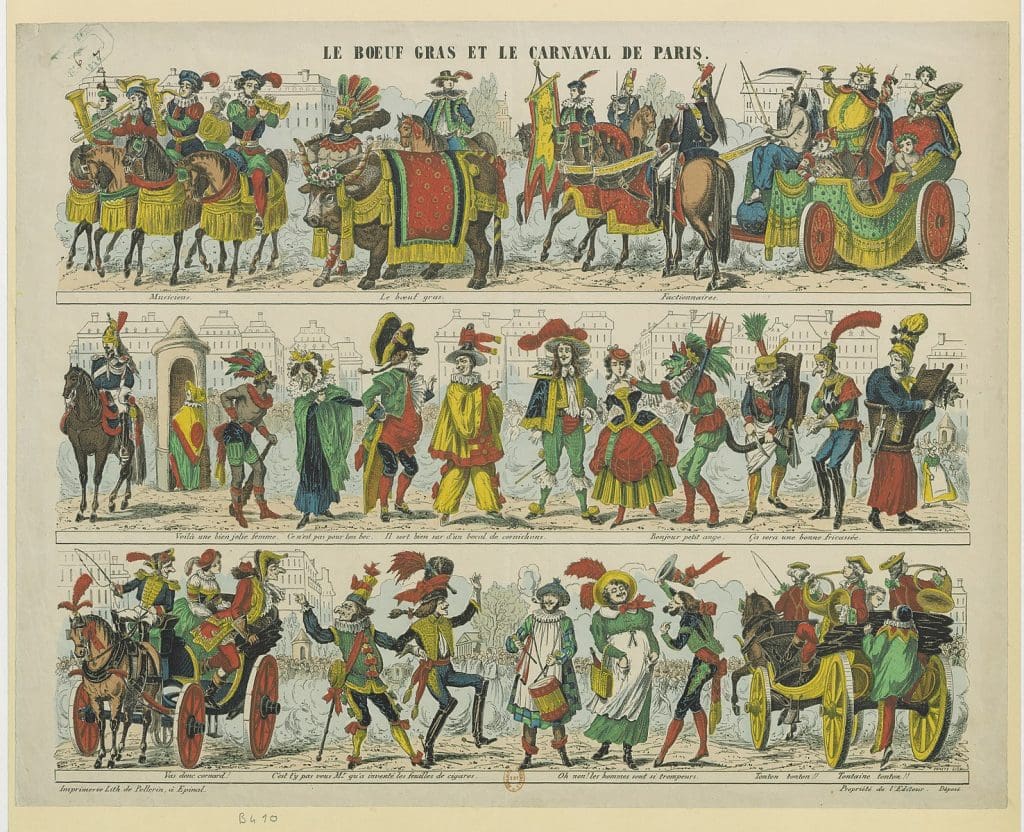
Fig. 18. Detail of a watercolor of the Parisian Boeuf Gras of 1857 with a line-up of figures dressed in Carnival costume. By Jules Chaste, Lithograph. Bibliothèque nationale de France, département Estampes et photographie, FOL-LI-59 [public domain].
From Atlantic Africa to Black Masking Indians
Returning now to the present of this figure, we will trace the Matamoros and its iterations as they cross the Gulf of Mexico, with a final case study of the religious and racialized digestion of the militant Santiago in New Orleans by Indigenous Amerindians, enslaved, and emancipated Africans. For, as Luiz Felipe de Alencastro has so neatly surmised,
scholarly studies of the colonization of the Americas generally focus on interactions among Europe, the Americas, and Native American peoples. Africans and black peoples tend to appear unconnected from the Atlantic networks, since they were already part of American colonial enclaves. Ignoring the African slave trade in the Americas and the growing predominance of African descendants in most of the New World […] reflects the old idea that the conquest of the Americas was merely an extension of the Reconquista of the Iberian Peninsula.[97]
It is with these long-marginalized communities that this analysis concludes, for the concept of the Matamoros, like the concept of Reconquista, exists to minimize, marginalize, and dehumanize the exceptionally complex and vibrant lives of those people who were the subjects of colonial violence. Even more importantly, as I have emphasized here, the Matamoros was iterative, attractive, and useful in several contexts. Historically, it was not only an image of Iberian and wider European militant religious expression, but an image and ideology deeply connected to Afro-Catholic art and festivities, many inspired from the template of the Kongo sangamento and Moors and Christians (the previously mentioned Moros y Cristianos) plays and dances.[98] African and American Matamoros expressions were intentionally designed and useful events, with an “institutional genesis for the tradition” located in Afro-Catholic histories.[99]
Considering the abbreviated history recounted above on the shifting uses of the Matamoros as social sculpture, perhaps some new perspectives will emerge concerning the Black Masking Indians as a costume-driven spectacle (Figs. 1, 2, and 3). As noted at the outset, Black Masking Indians make and remake identity and center chosen histories while marginalizing a lineage of white colonial oppressors––this festivity forms a natural conclusion to the research presented above, as it has long expressed an ideology of resistance. Rather than capitulate to white cultural assimilation, Black Indians celebrate solidarity and shared ancestral lineages between the plurality of Africa and Black and Indigenous diasporas. The following paragraphs elicit the many ways that Santiago Matamoros has been threaded through this community celebration; how that figure came to represent freedom and transformation, and ultimately how the Matamoros was subsumed by the vibrant cultural creation endemic in this festive ritual.
When the first slaving ship from Cabinda arrived in the early eighteenth century, New Orleans acquired an Afro-Catholic community, connected to the Kongolese monarchy and the imaginary of conversion linked to the battle-apparition of Santiago.[100] Organizations of enslaved Christians formed brotherhoods in Louisiana following this arrival, and these provided protection and mutual aid to the community.[101] Ruled by John Law and the Company of the Indies, the colony was primarily occupied by prisoners, military deserters, and marginalized French colonizers. The struggling settlers survived by forming alliances with powerful Amerindian groups, such as the Natchez, and by enslaving Africans and Indigenous people.[102] Despite French efforts to drive a wedge between Amerindians and Africans, a strong bond developed, strengthening ties already fostered within Black and Amerindian communities through the Christian brotherhoods. Familial links and relationships continued throughout the eighteenth century and produced a “distinctive, self-conscious group” of Black Amerindians, known as grif or griffe in Louisiana.[103] This bond was perpetuated by the fortunate people who escaped their enslavement and formed forest communities like the San Maló––named after their charismatic leader, St. Maló.[104] The Afro-Catholic and griffe-Catholic brotherhoods celebrated traditional Catholic festivities, with performances like the previously discussed sangamentos (Fig. 19).
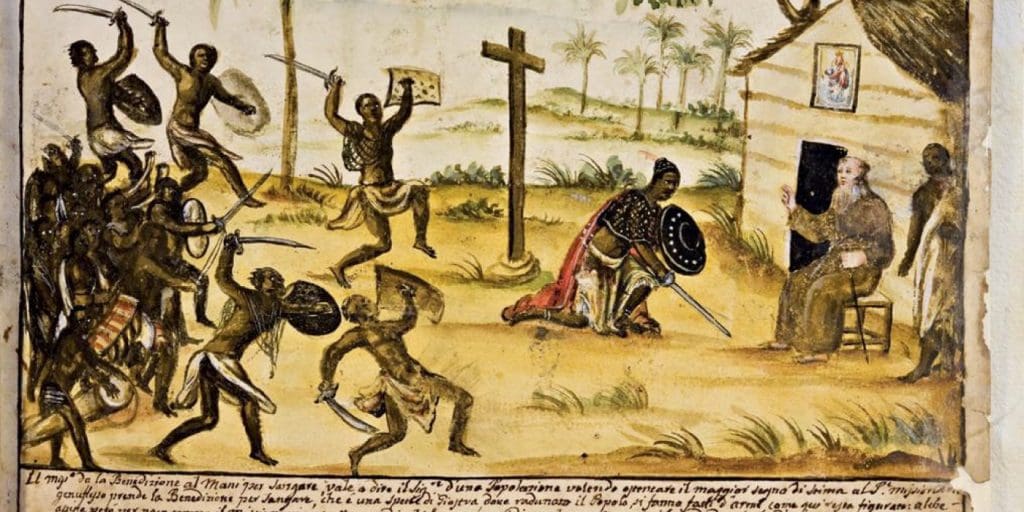
Fig. 19. “La Benedizione al Mani,” or “The Mani (King) receives the Missionary’s Blessing during a sangamento dance,” by the Capuchin friar Bernardino d’Asti, watercolor on paper (c. 1740). Citta di Torino Biblioteca civica Centrale di Torino, MS 457, fol. 18. Photo: Servizio Biblioteche della Città di Torino [public domain under CC BY 4.0 IT].
As seen in the militant, acrobatic figures crowding the lefthand side of the watercolor depicting the Mani and the Missionary (Fig. 19), the term “sangamento” derives from a local Portuguese term adapted from the Kikongo verb kusanga, meaning “to jump or to leap.”[105] The figures participating in the sangamento pictured here wear “prestige caps [the Mani’s emphasized by red feathers] and shoulder nets typical of local insignia but here seamlessly combined with coats and swords inspired by European symbols of status.”[106] The contemporary feathered headdresses of the Black Masking Indians recall the elaborate and feathered costumes of the sangamentos: both with Kongolese military dress and the European-style plumage.[107] Simultaneously, the costumes draw on a range of Amerindian and Black ritual festivities for inspiration. This confection of brightly feathered costumes employ two primary styles today: either two-dimensional beaded panel suits “with feathers depicting traditional scenes of Native American life of the midwestern Plains region (the uptown style),” or symmetrical suits in the round with “beaded panels outlined by feathers, featuring designs that resemble iconic elements of Native American or West African ritual regalia (the downtown style).”[108] A turn to incorporating historical African expressions in Black Masking Indians is attributed to Donald Harrison Sr. (1933–1998), Big Chief of the Guardians of the Flame tribe, pushing the contemporary festive regalia and rituals toward a more Afro-centric aesthetic, particularly through aural, movement, and conceptual/religious/spiritual interventions (Fig. 20).[109] Today, these costumes employ a maximalist aesthetic, expanding participant’s bodies and refashioning signifiers of racial capitalism into forms of resistance and heritage.
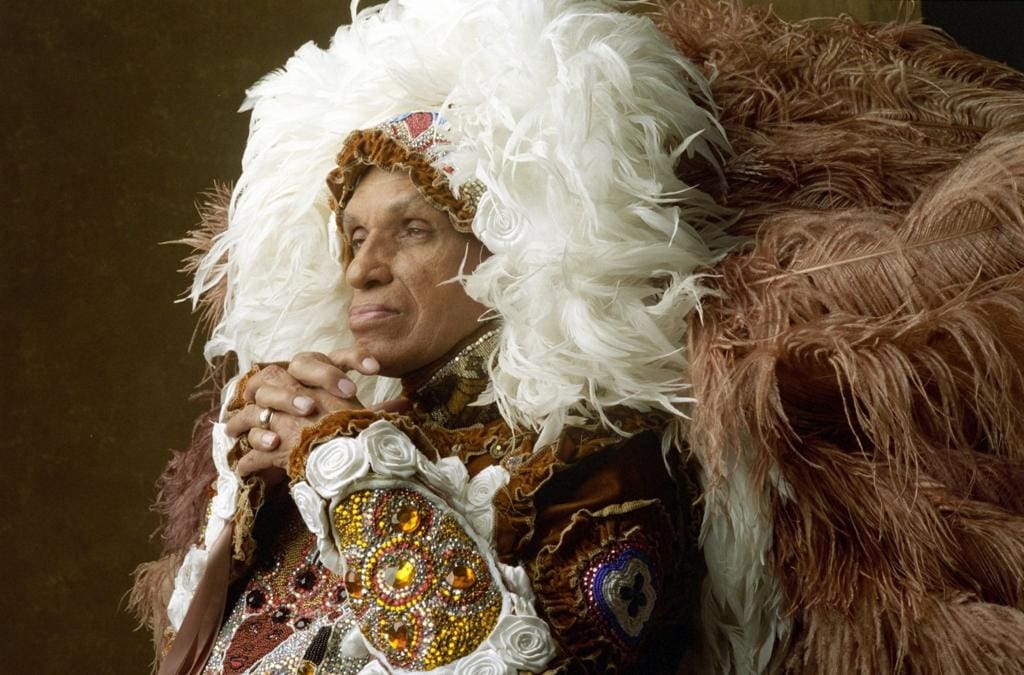
Fig. 20. Portrait of Donald Harrison Sr. Big Chief of the Guardians of the Flame tribe, in his Black Masking Indian regalia, 1995. Photograph by Kathy Anderson / The Times-Picayune.
In addition, Black Masking Indian processions directly connect to the iconography of Santiago Mataindios. In 1765, Spain assumed control of New Orleans, transforming it from La Nouvelle Orléans to Nueva Orleans.[110] More broadly, the Spanish dominated Louisiana from approximately 1762 to 1803, linking it socially and economically to Central Mesoamerica and often bringing enslaved Amerindians from the region to Nueva Orleans. The Spanish authorities noted that enslaved Africans began wearing more feathers at Carnival festivities following the cultural shifts brought by enslaved Mesoamericans. For example, on August 15, 1781, Governor Francisco Cruzat wrote that in Saint Louis “the savages, both free and slaves… dress themselves in barbarous fashion, with vermilion and many feathers which render them unrecognizable.”[111] Black groups and Amerindians, in the eyes of this Spaniard, were both subjugated “savages,” placed, in his mind, at the bottom of the divine hierarchy of humanity—a conflation enabled by the umbrella application of racialized terms, such as “Moor,” to indigenous and diasporic people. This surge in feathered outfits can be linked to iconography like that created by Miguel Mauricio in the altarpiece of the Church of Santiago Matamoros Tlatelolco (Fig. 13), drawing not only on the trampled figures below the Mataindios, but those portrayed as onlookers and allies. Black Masking Indians’ costumes combine aesthetics drawing on the European Moor-Killer, the Kongolese Pagan-Killer, and the American Indian-Killer in a perpetual ritual battle. Santiago, in all his militant forms, was expanded and transformed by the public staging of bodies-as-critical-social-sculpture by Kongolese and griffe-Americans in New Orleans. This festive ritual is inclusive of, yet separate from, European Catholic narratives of dominant racialized power. It is a continuity of medieval Kongolese ritual and pre and postconquest Mesoamerican festive costume.
Jeroen Dewulf was the first to make the connection between Santiago Mataindios and the Black Masking Indians in a paper published in 2015. Dewulf’s theory has been largely ignored, however. Reading the Black Masking Indians in relation to the Matamoros seems to contradict the preferred interpretation of interracial solidarity between indigenous peoples and enslaved Africans. Despite the joy evident in this festivity, Dewulf characterizes the Matamoros as “one of the most stereotypical, intolerant, and colonialist performances of Iberian culture.”[112] It is therefore understandably eschewed as an origin by today’s participants. Black Masking Indians certainly celebrate a heritage of community solidarity, as performance participants state today. However, this festive ritual (and the Matamoros) requires more than a singular reading.[113] Its meaning is stored in the community and solidarity that has lingered along the waterways and forest paths of the Gulf Coast.[114] It is rooted in a long history encoding a complex web of community power structures linked to the Matamoros. The militant Santiago and his trampled victims are more than a simple image of Iberian or Spanish dominance. There is an overlapping and inter-penetrating racial gaze–– “one that evidences a certain pleasurable ‘two-ness’” in the Black Masking Indians.[115] Simultaneously, the feathered costume is tied to the Kongolese military dress of the sangamentos and the feathered headgear of Mexica and Tlaxcala Jaguar warriors. Compounding complex histories of indigenous, migrant, and diasporic racial hierarchies justified through attachment to concepts of Divine Christian order, within this optical race-flipping is the flickering, coded recognition of the utility of Matamoros, Mata-pagãos, and Mataindios festivities as tools for community survival within colonial power structures. Foregoing the need for Santiago, this festivity has abolished the requisite colonizing or dominating figure in favor of community solidarity. In this way, the contemporary festivity hews closely to the Medieval Kongolese dance. Adorned in a costume of alterity and sameness, Black Masking Indians represent the complexity of indigenous-diasporic sociopolitical interactions, overwriting the simple narrative of a “Reconquista” of the Americas with a story of triumphant unity and mutuality in the face of divisive racist tactics of competition, estrangement, and segregation.
Conclusion: Sculpting Solidarity with the Matamoros
Santiago Matamoros is an imaginary that centers racialized power. The Black Masking Indians have erased the central, oppressive subject, Santiago, to create a new focus on the social bonds between those typically pushed to the margins of the saint’s narrative. More importantly, Black Masking Indians, as costumed-beings, refigure and create their community and resistance anew with every public celebration. Responding to and reclaiming a medieval iconography, the case studies of Kongolese Mata-pagãos, Tlaxcala Mataindios, and Black Masking Indians presented here all show the power of social sculpture as a tool to resist domination. Despite employing signifiers of colonial oppression, these festive expressions changed their societies by reconfiguring how community members saw themselves in relation to that signifier, namely, to Santiago. As the combined saint-on-horseback figure, the Matamoros imaginary promotes belief in a divine Christian hierarchy. Without it, as in the case of Black Masking Indians, the bonds between subaltern communities form a new focus for festive celebrations.
Attempting to trace a comprehensive resistance heritage of Matamoros imagery in festive settings is a task that lies far beyond the scope of a single article. Instead, this has been a story of the transcultural digestion of an idea, in tension between the synchronic present and the multiple imaginaries of the past encoded in festive devotional rituals, texts, and static art works.[116] I attempted to foreground the repertoire as a medium with real meaning and impact on interpreting, creating, and enriching the historical archive.[117] Perhaps a shadowy silhouette of the Matamoros as a site of resistance heritage has emerged, revealing its utility for survival and autonomy in the face of racist ideologies. While the impact of such imaginaries has important ramifications in the present, we should consider their impact beyond this present moment –– modern and contemporary performances and the uses of the Matamoros continually affect our perception of the slippery and evasive happenings of medieval history. Too often, Santiago as a militant knight has been viewed only as a “Spanish” phenomenon, despite its origins in the pre-Spanish Iberian Peninsula and its many functions in times and places beyond that limited geography. Its expansive impact and transoceanic use among a striking variety of communities throws this presumption of the Matamoros as a Spanish image into doubt. Instead, we might reconsider Santiago as a useful tool, a focal point of devotion that attracted diverse communities of Kongolese, Tlaxcalan, Incan, Spanish, French, Portuguese, and many others to manipulate and transform this image to suit their own needs and re-sculpt their societies. Echoes of the Iberian Matamoros are united by their response to the flexibility of this imaginary––by this powerful narrative of triumph and domination, created to promote a medieval cult. An infinite echo of this Matamoros lives in the bodies of those who enact and transform its ideology, spinning new tales of domination with the art of resistance.[118]
References
| ↑1 | Acknowledgements and appreciation for an article as expansive as this cannot possibly mention everyone who shaped this paper into the final text, but I include this abbreviated note to thank several essential colleagues and friends. A simplified version of this paper was first presented for the panel “Movement & Activation: Social Sculpture in the Middle Ages,” at the 58th International Congress on Medieval Studies at Western Michigan University, Kalamazoo, USA, in May 2023. I would like to thank Ariela Algaze for her continuing support for this project, Sonja Gandert for her help directing my research early in the process, and I. Thomas Howard as well as Adrien Palladino for reading subsequent drafts and providing their generous feedback. My thanks to the members of the Bibliotheca Hertziana for our many debates on approaches to (and setbacks of) global art history and especially to Lara Demori for our discussions on Peruvian/Mexican/Brazilian festivities. My sincere gratitude to the peer reviewers for their frank, honest, and engaged feedback. Most importantly, I thank Nancy Thompson and Jennifer Borland, Different Vision’s managing editors, whose advice, editing, and patience turned a once rambling paper into a cohesive article. The research for the present publication has been supported by a Rewald Travel Grant, the Samuel H. Kress Foundation, and the Bibliotheca Hertziana – Max Planck Institute for Art History (bh-p-24–28). |
|---|---|
| ↑2 | The tribes were once called “gangs,” and partially related to the Christian brotherhoods and other communities that developed among the enslaved and free Black diaspora, but this term shifted in recent decades due to the negative connotations attached to it through police and government narratives concerning crime in the United States. Additionally, I use the term Black Masking Indian, rather than “Mardi Gras Indians,” as they are commonly known, because African American people in New Orleans mask Indian at various events throughout the year, not only on Carnival. |
| ↑3 | It is equally important to note the familiar social structure of these new settlements when considered alongside West African forest societies and kingdoms. Michael P. Smith connected the tradition of Black Masking Indians to the Maroons who lived with the Seminoles in the Florida marshes–– people who escaped enslavement and formed new societies, often in harsh wilderness conditions. See his article: “Behind the Lines: The Black Mardi Gras Indians and the New Orleans Second Line,” Black Music Research Journal 14, no. 1 (1994): 43-73. https://doi.org/10.2307/779458. Nearly all popular sources describe the practice this way, including the Smithsonian, the New Yorker, various documentaries, and the tourist board of Louisiana. Invariably, these outlets also note this as an instance of uncomfortable cultural appropriation, or nearly so. This simplistic dominant narrative ignores history, as there is much more than a one directional act of cultural consumption at play. See: “Mardi Gras Indians and their traditions date back to the 1800s when Native Americans helped shield runaway slaves.” https://www.neworleans.com/things-to-do/music/history-and-traditions/mardi-gras-indians/ |
| ↑4 | For more on the etymology and origins of the Maroon community see: Jason Berry, “St. Maló in the Memory Rings,” in City of a Million Dreams: A History of New Orleans at Year 300 (Chapel Hill: University of North Carolina Press, 2018), 27-45; Gwendolyn Midlo Hall, Africans in Colonial Louisiana: The Development of Afro-Creole Culture in the Eighteenth Century (Baton Rouge: Louisiana State University Press, 1992), 1-434, esp. 212. |
| ↑5 | Oliver N. Greene, “The Aesthetic of Asé in the Black Masking Indians of New Orleans: Musical Africanisms and Orisa Manifestations in the Big Chief,” Fire!!! 6, no. 2 (2020): 73-127. |
| ↑6 | Broadly on this subject see: Cécile Fromont, ed., Afro-Catholic Festivals in the Americas: Performance, Representation, and the Making of Black Atlantic Tradition (Pennsylvania: Pennsylvania State University Press: 2019), 1-204. |
| ↑7 | Cara M. Jordan, “Joseph Beuys and Social Sculpture in the United States,” PhD dissertation, CUNY Academic Works, CUNY Graduate Center (2017), 1-395; Jeff Barnum, “Social Sculpture: Enabling Society to Change Itself,” Reos: Innovation in Complex Systems (2010): 1-5; Claire Bishop, Artificial Hells: Participatory Art and the Politics of Spectatorship (London; New York: Verso Books, 2012), 1-382, esp. 3. See also: Marc Esteve-Del-Valle and Julia Costa López, “Reconquest 2.0: the Spanish far right and the mobilization of historical memory during the 2019 elections,” in European politics and society 24, no. 4 (2023), 494-517. https://doi.org/10.1080/23745118.2022.2058754. |
| ↑8 | The dividing line between the mental, the actualized image, and the image being made in iconology is a subject of study far too vast to enter into here. Basic triads of iconological thinking were laid out by William John Thomas Mitchell and Hans Belting, each of which have been the subject of strong critique today, but which still form fundamental and valuable theoretical bases. See: W. J. T. Mitchell, Iconology: Image, Text, Ideology (Chicago: University of Chicago Press, 1986), 1-236; Hans Belting, Bild-Anthropologie: Entwürfe für eine Bildwissenschaft (Munich: Wilhelm Fink, 2001), 1-278. https://doi.org/10.30965/9783846752210; “Image, Medium, Body: A New Approach to Iconology,” Critical Inquiry 31, no. 2 (2005): 302-19. https://doi.org/10.2307/3651485. Social sculpture centers the processes between these definable points (ie. its subject is the space of being made rather than the made object). |
| ↑9 | In this assertion I draw on the framework of Diana Taylor presented in “Memory as Cultural Practice,” The Archive and the Repertoire: Performing Cultural Memory in the Americas. (Durham: Duke University Press, 2003), 86. She writes “While scholars working across fields in the humanities, social sciences, and sciences are increasingly convinced that race is socially constructed—and I take that as a given here—less work has been done on the way that cultural memory is shaped by ethnicity and gender. Here I suggest the impossibility of separating these three: cultural memory, race, and gender.” To this notion, I have added class. |
| ↑10 | I have generally opted to use the term “Black diaspora” in lieu of “African diaspora.” See: Ronald Segal, The Black Diaspora: Five Centuries of the Black Experience Outside Africa (New York: Farrar, Straus and Giroux, 1995), 1-462, esp. XIII. Racism, rather than geography, determined violent displacement and justified trafficking human beings, hence my use of the racialized term over the geographic one. |
| ↑11 | As an international publication, I use the term “Gulf of Mexico” as the historically and transnationally accepted name of this body of water. President Donald J. Trump of the United States of America issued Executive Order 14172 (“Restoring Names That Honor American Greatness”) on January 20, 2025, in an attempt to rename this global common zone. |
| ↑12 | Javier Domínguez García, Del Apóstol Matamoros a Yllapa Mataindios. Dogmas e ideologías medievales en el (des) cubrimiento de América (Estudios Históricos y Geográfico, vol. 144) (Salamanca: Universidad de Salamanca, 2008), 1-149, esp. 45-6. |
| ↑13 | Despite the previous statement, Queen Urraca is one origin point, through her commission of the Historia legionense (often misleadingly entitled the “silense”), completed around 1118 in León. Simon Barton, and Richard A. Fletcher, eds., trans., “Historia Silense,” in The World of El Cid: Chronicles of the Spanish Reconquest (Manchester: Manchester University Press, 2000): 9-63. Patrick Henriet, “Historia Silense,” in Christian-Muslim Relations: A Bibliographical History, Vol. 3 (1050-1200), David Thomas and Alex Mallett, eds., for History of Christian-Muslim Relations (Leiden: Brill, 2011), 370-374. https://doi.org/10.1163/ej.9789004195158.i-804.217; Patrick Henriet, “Historia Silense, chronique écrite par un moine de Sahagún. Nouveaux arguments,” e-Spania: Revue interdisciplinaire d’études hispaniques médiévales et modernes 14 (2012). https://doi.org/10.4000/e-spania.21655. |
| ↑14 | See note 689, Thomas F. Coffey, Linda Kay Davidson, and Maryjane Dunn, The Miracles of St. James: Translations from the Liber Sancti Jacobi (New York: Italica Press, Inc., 1996), 147; for more on the term “taifa” see: Míquel Barceló Perelló, “De Mulk al Muluk: Esperando a los al-murabitun,” in Carlos Laliena Cobera and Juan F. Utrilla, eds., De Toledo a Huesca: socialidades medievales en transición a finales del sigilo XI (1080-1100) (Zaragoza: Instituto Fernando el Catolico, 1998), 61-66. |
| ↑15 | Indeed, Pope Gregory VII hired local clergy and even some secular representatives as legates, opening up local connections to Rome. Kriston R. Rennie, “‘Uproot and Destroy, Build and Plant’: Legatine Authority under Pope Gregory VII,” Journal of Medieval History 33, no. 2 (2007): 166-180. https://doi.org/10.1016/j.jmedhist.2007.04.003; Kriston R. Rennie, “Extending Gregory VII’s ‘Friendship Network’: Social Contacts in Late Eleventh-Century France,” History 93, no. 4 (2008): 475-96. https://doi.org/10.1111/j.1468-229X.2008.00437.x. |
| ↑16 | Non latere vos credimus regnum Hispaniae ab antiquo proprii juris Sancti Petri fuisse, et adhuc (licet diu a paganis sit occupatum), lege tamen iustitiae non evacuata, nulli mortalium, sed soli apostolicae sedi, ex aequo pertinere, Pope Gregory VII, Epistola VII ad principes Hispaniae, anno 1073, PL 148, cols. 289-90; English translation based on Joseph F. O’Callaghan, Reconquest and Crusade in Medieval Spain, (Philadelphia: University of Pennsylvania Press, 2003). 1-323, esp. 27. This claim returns in 19th century colonial rhetoric. |
| ↑17 | Gianni Ferracuti, “Santiago Matamoros,” in “Guerra, intercultura, transcultura,” Umberto Rossi, ed., Studi Interculturali, no. 3 (2015): 205-211, esp. 206; Tomasz Borowski and Christopher Gerrard, “Constructing Identity in the Middle Ages: Relics, Religiosity, and the Military Orders,” Speculum 92, no. 4 (2017): 1056-1100, esp. 1056. https://doi.org/10.1086/693395. The Knights Templar are a military order of the Latin Christian Church, composed of laypeople who take religious vows, including poverty, chastity, and obedience, aligned with monastic vows, but diverging from the practices of monastics in that these knights expressly condone and commit violence. |
| ↑18 | In the Historia legionense Chapter 88-9. Barton and Fletcher, eds., trans., “Historia Silense,” 50. |
| ↑19 | Barton and Fletcher, eds., trans., “Historia Silense,” 51. |
| ↑20 | Specifically, it appears in miracle 19. Thomas F. Coffey, Linda Kay Davidson, and Maryjane Dunn, “The Twenty-Two Miracles of Saint James,” in The Sermons and Liturgy of Saint James: Book I of the Liber Sancti Jacobi (New York: Italica Press Inc., 2021), XII-XLIX, 57-96, esp. 91-93. A complicated manuscript, the original book held in Compostela’s Cathedral library archive is often known by the pseudepigraphic title Codex Calixtinus or by the title of the fifth book, the Pilgrim’s Guide to Santiago de Compostela (c. 1138-1145). There is the manuscript, the one kept in the Compostela Cathedral archives, of course, and there are several others, made later and in longer or shorter versions. For the dating see: Purkis, William J. Crusading Spirituality in the Holy Land and Iberia, c. 1095-c. 1187 (Woodbridge: Boydell & Brewer Ltd, 2008), 1-215, esp. 140-1. |
| ↑21 | Coffey, Davidson, and Dunn, “The Twenty-Two Miracles of Saint James,” 92. |
| ↑22 | Patrick Henriet, “Y a-t-il une hagiographie de la ‘Reconquête’ hispanique (XIe–XIIIe siècles)?”, in L’expansion occidentale (XIe–XVe siècles). Formes et conséquences = Actes des congrès de la Société des historiens médiévistes de l’enseignement supérieur public 33 (2002): 47–63, esp. 53–57 on Santiago Matamoros. See also Patrick Henriet, “Les saints et la frontière en Hispania au cours du moyen âge central,” in Grenzräume und Grenzüberschreitungen im Vergleich. Der Osten und der Westen des mittelalterlichen Lateineuropa, ed. K. Herbers, N. Jaspert (Berlin, 2007): 361–385. https://doi.org/10.1524/9783050048475.361. |
| ↑23 | Amancio Isla Frez, “Re-escribir la historia y construir la realeza a mediados del siglo XII. Una perspectiva desde el Privilegio de los votos de Santiago,” Anuario de Estudios Medievales 53, no. 2 (2023): 757-787, esp. 757. https://doi.org/10.3989/aem.2022.53.2.10. |
| ↑24 | Gianni Ferracuti, “Santiago Matamoros,” 208. |
| ↑25 | Richard A. Fletcher, “Epilogue: Santiago Matamoros,” in Saint James’s Catapult: The Life and Times of Diego Gelmírez of Santiago de Compostela (Oxford: Clarendon Press, 1984), 291-300, esp. 292. |
| ↑26 | Ibid, 291-293. |
| ↑27 | In general, I default to descriptions of the skin tone of the figure of Santiago (Saint James). It is important to note here that this saint is critical in the development of a concept of racialized European “whiteness.” “White” as a racial category (like all racial categories) is a social construct with no scientific basis. It is descriptive of a set of social relations and power dynamics, but not of phenotype. I generally do not employ this term as a racial category in this paper, with a few chosen exceptions where warranted as a descriptor for racialized power dynamics. |
| ↑28 | Heather Dalton, “Santiago Matamoros/Mataindios: Adopting an Old World battlefield apparition as a New World representation of triumph,” Matters of Engagement: Emotions, Identity, and Cultural Contact in the Premodern World (New York: Routledge, 2020): 96. A clear preference for Santiago Peregrino has won out in the overall visual culture of contemporary pilgrimage in Spain. See William Melczer, The Pilgrim’s Guide to Santiago de Compostela (New York: Italica Press, 1993), 1-346, esp. 67. Indeed, anyone traveling to Compostela today will notice that the violent iteration of the saint has gradually diminished, and those historical sculptures and paintings in museums have been relabeled, not as the Matamoros, but as the caballero. |
| ↑29 | Ane Bysted, “Introduction,” in The Crusade Indulgence: Spiritual Rewards and the Theology of the Crusades, C. 1095-1216 (Leiden: Brill, 2014), 3. Jonathan Riley-Smith, “The State of Mind of Crusaders to the East, 1095-1300,” in The Oxford Illustrated History of the Crusades. Jonathan Riley-Smith, ed. (Oxford: Oxford UP, 1997): 68-69. |
| ↑30 | Both terms have origins in geographic associations. “Etymologically, geographical writings gave birth to mouro as a generic label. The word derives from Latin maurus, the adjective designating someone from Mauritania, a region of North Africa (distinct from modern Mauritania).” Josiah Blackmore, “Imaging the Moor in Medieval Portugal,” Diacritics 36, no. 3/4 (2006): 28. https://doi.org/10.1353/dia.0.0004. |
| ↑31 | Geraldine Heng, “War/empire: Race Figures in the International Contest: The Islamic ‘Saracen’,” in The Invention of Race in the European Middle Ages (Cambridge: Cambridge University Press, 2018), 110-180. |
| ↑32 | Josiah Blackmore, “Imaging the Moor in Medieval Portugal,” Diacritics 36, no. 3/4 (2006): 29. |
| ↑33 | Dalton, “Santiago Matamoros/Mataindios,” 96. |
| ↑34 | Heather Dalton, “Santiago Matamoros/Mataindios: Adopting an Old World battlefield apparition as a New World representation of triumph.” In Matters of Engagement, Routledge (2020): 98. https://doi.org/10.4324/9780429488689-7. |
| ↑35 | Jeroen Dewulf, “From Moors to Indians: The Mardi Gras Indians and the Three Transformations of St. James.” Louisiana History: The Journal of the Louisiana Historical Association 56, no. 1 (2015): 13. |
| ↑36 | Jordan, “Joseph Beuys and social sculpture in the United States”; Barnum, “Social Sculpture: Enabling Society to Change Itself,” 1-5. |
| ↑37 | Cécile Fromont, “Under the sign of the cross in the Kingdom of Kongo: religious conversion and visual correlation in early modern Central Africa,” RES: Anthropology and Aesthetics 59, no. 1 (2011): 109-123, esp. 111. https://doi.org/10.1086/RESvn1ms23647785. |
| ↑38 | John K. Thornton, Afonso I Mvemba a Nzinga, King of Kongo: His Life and Correspondence (Indianapolis: Hackett Publishing, 2023), 1-255. The Kingdom of Kongo was one of the largest kingdoms in African history and the largest in sub-equatorial Africa until the Lunda Empire developed in the 1700s. The first written account of Alfonso I’s victory over his “pagan” half-brother and the miraculous battle vision was recorded in 1519 by the Spanish geographer Martín Fernández de Enciso. See: Thornton, Afonso I Mvemba a Nzinga, vi. |
| ↑39 | Jeroen Dewulf, “From Moors to Indians: The Mardi Gras Indians and the Three Transformations of St. James,” Louisiana History: The Journal of the Louisiana Historical Association 56, no. 1 (2015): 28; Cécile Fromont, “Sangamentos: Performing the Advent of Kongo Christianity,” in The Art of Conversion: Christian Visual Culture in the Kingdom of Kongo (University of North Carolina Press, 2014), 21-64, esp. 29. https://doi.org/10.5149/northcarolina/9781469618739.003.0001. |
| ↑40 | Cécile Fromont, “Dance, Image, Myth, and Conversion in the Kingdom of Kongo, 1500—1800,” African Arts 44, no. 4 (2011): 52-63, esp. 52-3. https://doi.org/10.1162/afar.2011.44.4.52. |
| ↑41 | Fromont, “Dance, Image, Myth, and Conversion in the Kingdom of Kongo,” 52. https://doi.org/10.1162/afar.2011.44.4.52. |
| ↑42 | I draw this digestive imagery from Bolívar Echeverría, who developed the term “codigophagy” (codigofagia) or “code-eating” as an alternative to the terms “mestizaje” and syncretism. Bolívar Echeverría, Las ilusiones de la modernidad. (Mexico City: Ediciones Era, [original 1987], digital 2020). |
| ↑43 | Duarte Lopez and Filippo Pigafetta, Relacao Do Reino De Congo e das Terras Circunvizinhas (Lisbon: Esta Publicacao Foi Autorizada Superiormente Por Despacho, 1949) 39; Margarite Hutchinson, ed., trans., A Report of the Kingdom of Congo and the Surrounding Countries: Drawn out of the Writings and Discourses of the Portuguese Duarte Lopez. By Filippo Pigafetta, in Rome, 1591 (1881 reprint ed., New York, 1969), 65. |
| ↑44 | Dewulf, “From Moors to Indians,” 29. |
| ↑45 | Duarte Lopez and Filippo Pigafetta, Relacao Do Reino De Congo e das Terras Circunvizinhas (Lisbon: Esta Publicacao Foi Autorizada Superiormente Por Despacho, 1949) 20-21; Margarite Hutchinson, ed., trans., A Report of the Kingdom of Congo and the Surrounding Countries: Drawn out of the Writings and Discourses of the Portuguese Duarte Lopez. By Filippo Pigafetta, in Rome, 1591 (1881 reprint ed., New York, 1969), 36. Pigafetta described the costume as such: “L’ordinanza milirare de’Mociconghi; (con questo vocabolo chiamando si li natij del reame di Cógo, come da Spagna, Spagnuolo) & di quei d’Angola è quasi la medesma; percioche combattono pedoni compartendo l essercito loro in diuersi corpi, & accómodandosi al fito della capagna, & alzádo I loro segni, l le bádiere nella maniera, che habbíamo già ricordato… L’habito militare de Signori Mociconghi è tale; in testa portanoun berettino adornato di varie piume di struzzo, di pauone, di gallo, & d’altri augelli che dimostrano l’huomo più grande & di sembianti spaucntosi.” |
| ↑46 | Fromont, “Dance, Image, Myth, and Conversion in the Kingdom of Kongo,” 54-5. |
| ↑47 | Fromont, “Dance, Image, Myth, and Conversion in the Kingdom of Kongo,” 56. |
| ↑48 | Luiz Felipe de Alencastro, “The African Slave Trade and the Construction of the Iberian Atlantic,” in The Global South Atlantic, Kerry Bystrom and Joseph R. Slaughter, eds. (New York: Fordham University Press, 2018), 33-45, esp. 34. https://doi.org/10.2307/j.ctt1xhr5wf.4; and for Alfonso I’s complete translated correspondence with the Portuguese crown see again: Thornton, Afonso I Mvemba a Nzinga, King of Kongo, 137-250. |
| ↑49 | Fr. António Brásio, “Do último cruzado ao padroado régio,” Studia (1959):125-153, esp. 147. |
| ↑50 | Felipe de Alencastro, “The African Slave Trade and the Construction of the Iberian Atlantic,” 34. https://doi.org/10.2307/j.ctt1xhr5wf.4. |
| ↑51 | Fr. António Brásio, Monumenta Missionária Africana, 2nd series, vol. 1. (Lisbon: Agência Geral do Ultramar, 1952), 277-286. |
| ↑52 | Fromont, “Sangamentos: Performing the Advent of Kongo Christianity,” 33. |
| ↑53 | On this fresco see: Francisco Singul, “Los santos militares de Santa María de Labrada (Guitiriz, Lugo), mediadores espirituales contra la muerte del alma,” Ad Limina, 10, no. 10 (2019): 91-111. https://doi.org/10.61890/adlimina/10.2019/03. |
| ↑54 | Francis J. Brooks, “Motecuzoma Xocoyotl, Hernán Cortés, and Bernal Díaz Del Castillo: The Construction of an Arrest,” The Hispanic American Historical Review 75, no. 2 (1995): 149-83, esp. 150. |
| ↑55 | Here I draw on Geraldine Heng’s formulation of medieval race-making and theory. The sociocultural and natural/biological were overlapping and combined discourses that collaborated to fabricate new notions of race at this time. Geraldine Heng, The Invention of Race in the European Middle Ages (Cambridge: Cambridge University Press, 2018), 1-493, esp. 3-5, 19, 27. |
| ↑56 | For a discussion of emplacement and displacement, and the continuous emergence of realities see: Mario Blaser, For Emplacement: Political Ontology in Two Acts (Durham: Duke University Press, 2025), 1-231, esp. 8-23. The present article is made up of several case studies as particular spatiotemporal points of encounter, re: Blaser. |
| ↑57 | Hernán G. H. Taboada, “Mentalidad de Reconquista y Primeros Conquistadores,” Revista de Historia de América, no. 135 (2004): 39-48, esp. 40. |
| ↑58 | I use the word “orientalism” here, despite the sixteenth century setting, because I believe orientalism (or at least, a kind of proto-orientalism), as defined by Said, is an apt description for the process underway here. He wrote, “Orientalism is… a distribution [sic] of geopolitical awareness into aesthetic, scholarly, economic, sociological, historical, and philological texts; it is an elaboration [sic] not only of a basic geographical distinction (the world is made up of two unequal halves, Orient and Occident) but also of a whole series of interests.” This binary, half-world thinking (recalling “hemispheric” thinking) was grafted onto the Americas in the sixteenth century, with indigenous people of the Americas placed within the European (Eurocentric) world-view of the orient-as-other, but even more specifically, of prejudice against Arab-Islamic peoples as the near-but-other; familiar people who were therefore cast as dangerous. Edward W. Said, Orientalism (New York: Vintage Books: 1979), 12. |
| ↑59 | For more on this see: Domínguez García, Del Apóstol Matamoros a Yllapa Mataindios, 82. |
| ↑60 | While the Spanish formed alliances with numerous indigenous groups, their main (and strongest) base of indigenous support came from the Tlaxcala. Bernal Díaz del Castillo was age 84 at the time this book was composed. Thomas J. Brinkerhoff, “Reexamining the Lore of the ‘Archetypal Conquistador’: Hernán Cortés and the Spanish Conquest of the Aztec Empire, 1519-1521,” The History Teacher 49, no. 2 (2016): 169-87, esp. 177-180. On Bernal Díaz Del Castillo see: Rolena Adorno, “Discourses on Colonialism: Bernal Díaz, Las Casas, and the Twentieth-Century Reader,” MLN 103, no. 2 (1988): 239-58; Manuel Durán, “Bernal Díaz Del Castillo: Crónica, Historia, Mito,” Hispania 75, no. 4 (1992): 795-804; Domínguez García, Del Apóstol Matamoros a Yllapa Mataindios, 82-84. |
| ↑61 | I use Mexica to refer specifically to the people inhabiting the imperial city-state of Mexico-Tenochtitlan, rather than the term Aztec, which is a catch-all phrase for people who spoke and still speak the Nahuatl language. Nahuatl is the Indigenous language of central Mexico. It should also be noted that by the end of the sixteenth century, Iberian-Christian saints populated Mexican and Andean churches through static artworks and in ritual festivities. |
| ↑62 | The only surviving portion of the altarpiece is the central panel, discussed here. Dalton, “Santiago Matamoros/Mataindios,” 103; Davide Domenici, “Dimenticare l’aquila calpestata. La Conquista e il passato precoloniale nel paesaggio urbano di Città del Messico,” Storicamente: Laboratorio di Storia, 13 (2017), 1-25, esp. 3-4. https://doi.org/10.12977/stor659. |
| ↑63 | This hairstyle can clearly be seen in the Florentine Codex, Book 8, ch. 21, Fol. 56v, depicting the Aztec (Mexica) emperor giving capes and adornments to his warriors. On the hairstyle see: Claudia Brittenham, “Dress and Empire in the Ancient Americas,” in Outward Appearance versus Inward Significance: Addressing Identities through Attire in the Ancient World, Aleksandra Hallmann, ed., ISAC Seminars, no. 15 (Chicago: Institute for the Study of Ancient Cultures, 2025), 27-70, esp. 41-49. |
| ↑64 | Gloria Anzaldúa and AnaLouise Keating, Interviews/Entrevistas (New York and London: Routledge, 2000), 5. |
| ↑65 | James Lockhart developed the concept of “microethnicity,” in The Nahuas After the Conquest: A Social and Cultural History of the Indians of Central Mexico, Sixteenth through Eighteenth Centuries (Stanford: Stanford University Press, 1992), 14-17, 27, 115. |
| ↑66 | Javier Domínguez García, “Santiago Mataindios: La Continuación de Un Discurso Medieval En La Nueva España,” Nueva Revista de Filología Hispánica 54, no. 1 (2006): 33-56, esp. 33-4. https://doi.org/10.24201/nrfh.v54i1.2310; Domínguez García, Del Apóstol Matamoros a Yllapa Mataindios. |
| ↑67 | Domínguez García, “Santiago Mataindios: La Continuación de Un Discurso Medieval,” 36. |
| ↑68 | Christina E. Civantos, “Orientalism and the Narration of Violence in the Mediterranean Atlantic: Gabriel García Márquez and Elias Khoury,” in The Global South Atlantic, Kerry Bystrom and Joseph R. Slaughter, eds. (New York: Fordham University Press, 2018), 165-85, esp. 175. For more on the apparitions, see Harold Hernández Lefranc, “El trayecto de Santiago Apóstol de Europa al Perú,” Investigaciones Sociales 10, no. 16 (2006): 51-92, esp. 73, Federico Navarrete, “Beheadings and Massacres: Andean and Mesoamerican Representations of the Spanish Conquest,” RES: Anthropology and Aesthetics, no. 53/54 (2008): 59-78. |
| ↑69 | “Caxtilteca” refers to the “people from Castille.” See: Matthew Restall, When Montezuma Met Cortés: The True Story of the Meeting that Changed History (New York: Ecco, 2018), 1-560, esp. 145, 174, 180. |
| ↑70 | Federico Navarrete Linares, “Las Historias Tlaxcaltecas de La Conquista y La Construcción de Una Memoria Cultural,” Iberoamericana (2001) 19, no. 71 (2019): 35-50, and Federico Navarrete Linares’ lecture, “Lienzo de Tlaxcala y Codex Mendoza: Two Examples of Codigophagy in 16th Century New Spain,” KHI Amerindian Lecture Series (16 September–16 December 2021). Department Gerhard Wolf & 4A_Laboratory: Art Histories, Archaeologies, Anthropologies, Aesthetics. Organized by Sanja Savkić Šebek (KHI in Florenz – Max-Planck-Institut & Humboldt-Universität zu Berlin) & Bat-ami Artzi (Dumbarton Oaks). This lecture took place on 30 September 2021 and is archived at: https://vimeo.com/678827301. Also see: Eleni Kefala, The Conquered: Byzantium and America on the Cusp of Modernity (Washington, DC: Extravagantes, 2020), 82. |
| ↑71 | Brinkerhoff, “Reexamining the Lore of the ‘Archetypal Conquistador’,” 177; Navarrete Linares, “Las Historias Tlaxcaltecas de La Conquista,” 35-50. |
| ↑72 | Jaguar warriors dressed as jaguars because this animal was representative of Tezcatlipoca, the Aztec god of conflict, the night sky, and natural forces. By giving Santiago the lion-sun and placing the Jaguar warrior in this composition, an equivalency or kinship between these deities may have been evident to indigenous viewers. This is especially true, as Tezcatlipoca shifted to Tepeyollotli, depicted as a jaguar leaping towards the sun. Perhaps in this composition, Santiago may have been read as the god Quetzalcoatl, Tezcatlipoca’s “incomplete twin,” who was more associated with human labor (knowledge production, etc.) than natural forces. For more on this supreme deity of the Late Postclassic Aztec pantheon see: Elizabeth Baquedano, ed., Tezcatlipoca: Trickster and Supreme Deity (Boulder: University Press of Colorado, 2014), 1-239, and especially Guilhem Olivier’s chapter “Enemy Brothers or Divine Twins?: A Comparative Approach between Tezcatlipoca and Quetzalcoatl, Two Major Deities from Ancient Mexico,” 59-82. https://doi.org/10.5876/9781607322887.c003. |
| ↑73 | Here I reference the language of the “public” and “hidden transcript” developed by James C. Scott in Domination and the Arts of Resistance: Hidden Transcripts (New Haven: Yale University Press, 1990), 1-252. Max Harris is the first to apply James Scott’s concept of “hidden” and “public transcripts” to Spanish and Latin American festive rituals. See: Max Harris, Aztecs, Moors, and Christians: festivals of reconquest in Mexico and Spain. (Austin: University of Texas Press, 2000), and Carnival and Other Christian Festivals Folk Theology and Folk Performance. 1st ed. (Austin: University of Texas Press, 2003). |
| ↑74 | Emily Umberger, “Tezcatlipoca and Huitzilopochtli: Political Dimensions of Aztec Deities,” in Tezcatlipoca: Trickster and Supreme Deity, Elizabeth Baquedano, ed. (Boulder: University Press of Colorado, 2014), 85. https://doi.org/10.5876/9781607322887.c004. |
| ↑75 | The first is now housed in the Benson Latin American Collection in Austin, Texas. Travis Barton Kranz has written the fundamental work about the writing of history in sixteenth-century Tlaxcala; see Travis Barton Kranz, “The Tlaxcalan Conquest Pictorials: The Role of Images in Influencing Colonial Policy in Sixteenth-Century Mexico,” PhD. Diss., University of California, Los Angeles (UCLA), 2001; Travis Barton Kranz, “Visual Persuasion: Sixteenth-Century Tlaxcalan Pictorials,” in The Conquest All Over Again: Nahuas and Zapotecs Thinking, Writing, and Painting Spanish Colonialism (Portland: Sussex Academic Press, 2010): 41-73. https://doi.org/10.2307/jj.18562490.7. |
| ↑76 | Known as Malinche and to the Spaniards after her baptism as doña Marina. |
| ↑77 | Elizabeth Aguilera, “Malintzin as a Visual Metaphor in the Lienzo de Tlaxcala,” Hemisphere: Visual Cultures of the Americas 7, no. 1 (2014): 9-11. She was one of 20 enslaved women given to the Spaniards in 1519 by the people of Tobasco (her family sold her into enslavement as a child) and was subjected to sexual exploitation and rape by Hérnan Cortéz as part of her enslavement, the other half of the Matamoros’ gender-based ideology. |
| ↑78 | It is frequently noted that Malintzin has been vilified in the modern view. For example, “on Independence Day of 1861, Ignacio “El Nigromante” Ramirez, politician and man of letters, reminded the celebrants that Mexicans owed their defeat to Malintzin–– Cortes’s whore.” Norma Alarcón, “Traddutora, Traditora: A Paradigmatic Figure of Chicana Feminism,” Cultural Critique, no. 13 (1989): 57–87, esp. 58. See also: Kristina Downs, “Mirrored Archetypes: The Contrasting Cultural Roles of La Malinche and Pocahontas.” Western Folklore 67, no. 4 (2008): 397-414. |
| ↑79 | Gordon Brotherston and Ana Gallegos identified this manuscript as a late sixteenth-century version of the Lienzo de Tlaxcala. Gordon Brotherston, and Ana Gallegos, “El Lienzo de Tlaxcala and el Manuscrito de Glasgow (Hunter 242),” Estudios de Cultura Náhuatl 20 (1990): 117. Although three copies of this linen roll were made, these were all lost and the Lienzo is only known through a reproduction made in 1773 by Manuel de Ylláñez, hence my decision to introduce the copy, as a later work, after the Tlaxcala Codex. The original Lienzo seems to have been painted around 1552, commissioned by Tlaxcala’s indigenous city council. The surviving council minutes for 17 June 1552 record plans to send a delegation across the Atlantic to meet with the Emperor, Charles V. |
| ↑80 | Byron Ellsworth Hamann, “Object, Image, Cleverness: the Lienzo de Tlaxcala,” Art History 36, no. 3 (2013): 521-523. https://doi.org/10.1111/1467-8365.12017. |
| ↑81 | Stephanie Wood, “Pictorial Images of Spaniards: The Other Other?,” in Transcending Conquest: Nahua Views of Spanish Colonial Mexico (2003): 23. |
| ↑82 | Federico Navarrete Linares, “Las Historias Tlaxcaltecas de La Conquista y La Construcción de Una Memoria Cultural,” Iberoamericana (2001) 19, no. 71 (2019): 35-50; Federico Navarrete Linares, “Lienzo de Tlaxcala and Codex Mendoza: Two Examples of Codigophagy in 16th Century New Spain,” KHI Amerindian Lecture Series (16 September–16 December 2021). Department Gerhard Wolf & 4A_Laboratory: Art Histories, Archaeologies, Anthropologies, Aesthetics. Organized by Sanja Savkić Šebek (KHI in Florenz – Max-Planck-Institut & Humboldt-Universität zu Berlin) & Bat-ami Artzi (Dumbarton Oaks). This lecture took place on 30 September 2021 – This lecture took place on 30 September 2021 c. 14 mins https://vimeo.com/678827301. |
| ↑83 | Ibidem. |
| ↑84 | Heather Dalton, “Santiago Matamoros/Mataindios,” 101. |
| ↑85 | Carlo Severi, “Capturing Imagination: A Cognitive Approach to Cultural Complexity,” Journal of the Royal Anthropological Institute 10, no. 4 (2004): 815-838. https://doi.org/10.1111/j.1467-9655.2004.00213.x. |
| ↑86 | Diana Taylor, The Archive and the Repertoire: Performing Cultural Memory in the Americas (Durham: Duke University Press, 2003): 22. Time-based media provides a type of archival record that bridges, or perhaps bandages, the “gap” between archive and repertoire. |
| ↑87 | These festivities took place in January of 1539. Miguel A. Valerio, “A Mexican Sangamento? The First Afro-Christian Performance in the Americas,” in Afro-Catholic Festivals in the Americas: Performance, Representation, and the Making of Black Atlantic Tradition, Cécile Fromont, ed. (Pennsylvania: Pennsylvania State University Press: 2019), 60-72. Valerio argues that this is likely “the earliest evidence of a sangamento in the diaspora and in any case provides us the background against which the American versions of the Kongo martial dance should be considered.” |
| ↑88 | Marlyse Meyer, De Carlos Magno e outras histörias: Cristàos & Mouros no Brasil, Natal, Brazil (1995): 17-60; José Rivair Macedo, “Mouros e Cristàos: A ritualizaçào da conquista no velho e no Novo Mundos,” BUCEMA (2008): 2-10. https://doi.org/10.4000/cem.8632. |
| ↑89 | Niomar de Souza Pereira, Cavalhadas no Brasil: de cortejo a cavalo a lutas de mouros e Cristäos (São Paulo: Escola de Folclore, 1983), 1-214, esp. 18-9. |
| ↑90 | Jeroen Dewulf, “From Moors to Indians: The Mardi Gras Indians and the Three Transformations of St. James.” Louisiana History: The Journal of the Louisiana Historical Association 56, no. 1 (2015): 13. |
| ↑91 | For the definition of social sculpture, again, see: Jordan, “Joseph Beuys and Social Sculpture in the United States,” 1-3, 20-23. |
| ↑92 | At least in the context of the Andean region, there was no cohesive community of Muslims at the time; the scattered Moriscos and Crypto-Muslims who settled in the region are traceable in records like the Lima Inquisition Acts (Actas de Inquisición limeñas) but they certainly did not distinguish themselves by costume. According to the popular dictionary by Sebastián de Covarrubias (1673 edition), the term “Turk” in the Viceroyalty evoked, not Ottomans or any particular real, existing person, but was a defamatory term for people who “were thieves, lived like barbarians, were very poor, and did not think they were doing anyone wrong by taking what belonged to others [Turcos, porq se davan a robar, y vivian como barvaros, y eran muy pobres, y no les parecía hazer agravio a nadie, tomando lo ageno].” See: Lucila Iglesias, “Moros en la Costa (del Pacífico). Imágenes e Ideas Sobre el Musulmán en el Virreinato del Perú,” Diálogo Andino, 45 (2014): 5-15; quoted from p. 7. As Iglesias rightly points out, Islamophobia originating in Spain was digested and recontextualized in the Peruvian context. |
| ↑93 | Iglesias, “Moros en la Costa (del Pacífico),” 9. |
| ↑94 | This is epitomized in the use of naming as erasure, with epithets like “negro” and “savage;” a form of overwriting deeply tied to methods of settler colonial emplacement which replaced indigenous monikers with place-names deriving from the Latin Christian cult of saints, like “Santiago.” See: Cedric J. Robinson, Black Marxism: The Making of a Black Radical Tradition (Chapel Hill: University of North Carolina Press, 2000), 26, 81-83. Robinson’s notion of erasure went beyond Africans to consider how the European tendency was “not to homogenize but to differentiate––to exaggerate regional, subcultural, and dialectical differences into “racial” ones… at the systemic interlocking of capitalism in the sixteenth century, the people of the Third World began to fill this expanding category of a civilization reproduced by capitalism” p. 26. Also see: Olivette Otele, African Europeans: An Untold History (London: Hurst & Co., 2020). On emplacement, naming, erasure, and settler colonialism see my chapter: “Translatio Fides in Wendat Culture: Naming Ancestral Landscapes,” in Conques Across Time: Inventions and Reinventions 9th-21st centuries, Ivan Foletti, Adrien Palladino, eds. (Brno/Rome; Viella, 2025), 328-49. |
| ↑95 | There is also a light-skinned figure of Hercules with feathered headgear in the top row behind the flower-crowned bull. However, this figure pushes the tawny-skinned figure further into the past and into allegory: they only have history in their kinship with the mythical Greco-roman past or through likeness to the atemporal devil. |
| ↑96 | Jeroen Dewulf, “From Moors to Indians: The Mardi Gras Indians and the Three Transformations of St. James.” Louisiana History: The Journal of the Louisiana Historical Association 56, no. 1 (2015): 22. |
| ↑97 | Felipe de Alencastro, “The African Slave Trade and the Construction of the Iberian Atlantic,” 33. |
| ↑98 | Several chapters from the crucial volume on Afro-Catholic Festivals in the Americas discuss Kongo sangamento and Moors and Christians as intersections with Afro-Catholic ritual including, Jeroen Dewulf, “Sangamentos on Congo Square? Kongolese Warriors, Brotherhood Kings, and Mardi Gras Indians in New Orleans,” 23-41. https://doi.org/10.1515/9780271084367-004; Kevin Dawson, “Moros e Christianos Ritualized Naval Battles: Baptizing American Waters with African Spiritual Meaning,” 42-58; Miguel A. Valerio, “A Mexican Sangamento? The First Afro-Christian Performance in the Americas,” 59-72; Dianne M. Stewart, “The Orisa House That Afro-Catholics Built: Africana Antecedents to Yoruba Religious Formation in Trinidad,” 140-162. https://doi.org/10.5325/j.ctv14gp1n5.12; in Cécile Fromont, ed., Afro-Catholic Festivals in the Americas: Performance, Representation, and the Making of Black Atlantic Tradition (Pennsylvania: Pennsylvania State University Press: 2019). |
| ↑99 | I quote from Dianne M. Stewart’s excellent analysis and critique of the ubiquitous use of the word “syncretism” in, “The Orisa House That Afro-Catholics Built: Africana Antecedents to Yoruba Religious Formation in Trinidad,” in Afro-Catholic Festivals in the Americas: Performance, Representation, and the Making of Black Atlantic Tradition, Cécile Fromont, ed. (Pennsylvania: Pennsylvania State University Press: 2019), 140-41. |
| ↑100 | Dewulf, “From Moors to Indians,” 25. The charter generation was formed by captives brought to New Orleans on 23 ships between 1719-1731 and sold into slavery. One ship, carrying 294 slaves, came from the Kongolese territory Cabinda. See: Gwendolyn Midlo Hall, Africans in Colonial Louisiana: The Development of Afro-Creole Culture in the Eighteenth Century (Baton Rouge: Louisiana State University Press, 1992), 1-434, esp. 60. |
| ↑101 | Dewulf, “From Moors to Indians,” 33. |
| ↑102 | Hall, Africans in Colonial Louisiana, 110. Jason Berry, “Bienville: Journey into the Interior,” in City of a Million Dreams: A History of New Orleans at Year 300 (Chapel Hill: University of North Carolina Press, 2018), 6-26, esp. 25. https://doi.org/10.5149/northcarolina/9781469647142.003.0001. |
| ↑103 | Hall, Africans in Colonial Louisiana, 118. |
| ↑104 | Berry, “St. Maló in the Memory Rings,” 27-45. https://doi.org/10.5149/northcarolina/9781469647142.003.0002. |
| ↑105 | Fromont, “Dance, Image, Myth, and Conversion in the Kingdom of Kongo,” 52. |
| ↑106 | Fromont, “Dance, Image, Myth, and Conversion in the Kingdom of Kongo,” 52-53. |
| ↑107 | Fromont, “Dance, Image, Myth, and Conversion in the Kingdom of Kongo,” 54-5. |
| ↑108 | Oliver N. Greene, “The Aesthetic of Asé in the Black Masking Indians of New Orleans,” 74. |
| ↑109 | Greene, “The Aesthetic of Asé in the Black Masking Indians of New Orleans,” 93. Green writes on the acoustic elements of the Black Masking Indians that “retention of African-based practices such vocal chanting and tonal variation, polyrhythmic percussion accompaniment, improvisation as a technique of signifying and composing, call-refrain form, the bamboula rhythm, and community music making” p. 114. For Donald Harrison Sr.’s biography see: Al Kennedy, Big Chief Harrison and the Mardi Gras Indian (Gretna, LA: Pelican Publishing, 2010), 1-416. |
| ↑110 | Berry, “St. Maló in the Memory Rings,” 36. |
| ↑111 | Dewulf, “From Moors to Indians,” 38. |
| ↑112 | While I generally agree with Dewulf that the Black Masking Indians are part of a hemispheric phenomenon of Afro-Iberian folk Catholicism, this festivity goes beyond the Afro-Iberian, collecting and utilizing forms, cultures, and lineages expansively from both hemispheres. Dewulf, “From Moors to Indians,” 38; “Sangamentos on Congo Square?: Kongolese Warriors, Brotherhood Kings, and Mardi Gras Indians in New Orleans,” in Afro-Catholic Festivals in the Americas: Performance, Representation, and the Making of Black Atlantic Tradition, Cécile Fromont, ed. (Pennsylvania: Penn State University Press, 2019), 23-41. https://doi.org/10.5325/j.ctv14gp1n5.6. |
| ↑113 | On performance genealogy see: Joseph Roach, “Mardi Gras Indians and Others: Genealogies of American Performance.” Theatre Journal 44, no. 4 (1992): 461-83. https://doi.org/10.2307/3208769; Dewulf, “From Moors to Indians,” 31. Recently, Oliver N. Greene argued that Black Masking Indian identity incorporates the Yoruba concept of asé (life force, or bringing-into-being ability) through the special turn to Africana aesthetics after the mid-1980s. Oliver N. Greene, “The Aesthetic of Asé in the Black Masking Indians of New Orleans,” 73-127. |
| ↑114 | Each iteration must be understood as a re-performance, accreting meaning while shedding unsuitable associations, which might, nonetheless, resurface years later in a phantom remembrance. |
| ↑115 | Ellen Christine Scott, “Race and the Struggle for Cinematic Meaning: Film Production, Censorship, and African American Reception, 1940-1960,” PhD diss. (2007): 152. |
| ↑116 | Again see: Bolívar Echeverría on the term “codigophagy” (codigofagia) or “code-eating” as an alternative to the terms “mestizaje” and syncretism. Bolívar Echeverría, Las ilusiones de la modernidad. (Mexico City: Ediciones Era, [original 1987], digital 2020). |
| ↑117 | Diana Taylor, “Memory as Cultural Practice: Mestizaje, Hybridity, Transculturation,” in The Archive and the Repertoire: Performing Cultural Memory in the Americas (Durham: Duke University Press, 2003), 79-109. https://doi.org/10.2307/j.ctv11smz1k.7. |
| ↑118 | I close with this note as an homage to James C. Scott’s work in Domination and the Arts of Resistance: Hidden Transcripts (New Haven: Yale University Press, 1990), 1-243, esp. 45-69. |